Poisoning &
Its Primary
Management
Chhabi Acharya
B. Pharmacy
HOPE Intl College
Content
• Poisoning
- Definition & Description
- Causes
- Classification
- Symptoms
- Diagnosis
• Primary Management
• References
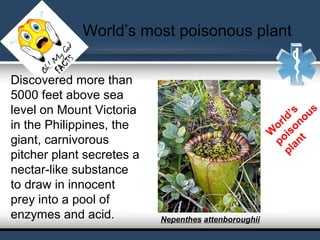
World’s most poisonous plant
Discovered more than
5000 feet above sea
level on Mount Victoria
in the Philippines, the
giant, carnivorous
pitcher plant secretes a
nectar-like substance
to draw in innocent
prey into a pool of
enzymes and acid.
W
orld’s
poisonous
plant
Nepenthes attenboroughii
Poisoning
Definition & Description
• Poisoning occurs when any substance interferes
with normal body functions after it is swallowed,
inhaled, injected, or absorbed. The branch of
medicine that deals with the detection and
treatment of poisons is known as toxicology.
• Poisonings are a common occurrence. In 80% of
the cases of poisoning, the victim is a child
under the age of five.
• Curiosity, inability to read warning labels, a
desire to imitate adults, and inadequate
supervision lead to childhood poisonings.
• The elderly are the second most likely group to
be poisoned. Mental confusion, poor eyesight,
and the use of multiple drugs are the leading
reasons why this group has a high rate of
accidental poisoning.
• A substantial number of poisonings also occur
as suicide attempts or drug overdoses.
• Poisons are common in the home and
workplace, yet there are basically two major
types.
• One group consists of products that were never
meant to be ingested or inhaled, such as
shampoo, paint thinner, pesticides, houseplant
leaves, and carbon monoxide.
• The other group contains products that can be
ingested in small quantities, but which are
harmful if taken in large amounts, such as
pharmaceuticals, medicinal herbs, or alcohol.
• Other types of poisons include the bacterial
toxins that cause food poisoning, such as
Escherichia coli; heavy metals, such as the lead
found in the paint on older houses; and the
venom found in the bites and stings of some
animals and insects.
Causes
• The effects of poisons are as varied as the
poisons themselves; however, the exact
mechanisms of only a few are understood.
• Some poisons interfere with the metabolism.
• Others destroy the liver or kidneys, such as
heavy metals and some pain relief medications,
including acetaminophen and nonsteroidal anti-
inflammatory drugs (Ibuprofen).
• A poison may severely depress the central
nervous system, leading to coma and eventual
respiratory and circulatory failure.
• Some poisons directly affect the respiratory and
circulatory system. Carbon monoxide causes
death by binding with hemoglobin that would
normally transport oxygen throughout the body.
• Cyanide interferes with respiration at the cellular
level.
• The type of poison, the amount and time
of exposure, and the age, size, and health
of the victim are all factors which
determine the severity of symptoms and
the chances for recovery.
Classification
• Mainly categorized in five broad classes :
1) Plant poisoning
2) Food & household chemicals
3) Pharmaceuticals
4) Venom poisoning
5) Other
1) Plant poisoning
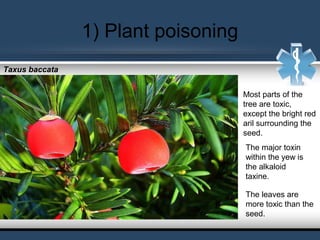
The leaves are
more toxic than the
seed.
Most parts of the
tree are toxic,
except the bright red
aril surrounding the
seed.
The major toxin
within the yew is
the alkaloid
taxine.
Taxus baccata
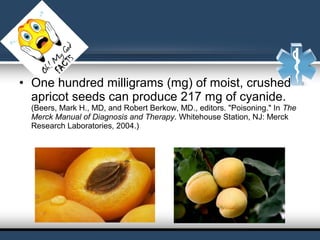
• One hundred milligrams (mg) of moist, crushed
apricot seeds can produce 217 mg of cyanide.
(Beers, Mark H., MD, and Robert Berkow, MD., editors. "Poisoning." In The
Merck Manual of Diagnosis and Therapy. Whitehouse Station, NJ: Merck
Research Laboratories, 2004.)
2) Food & Household chemicals
Food
• Food poisoning is a common, yet distressing
and sometimes life-threatening problem in the
world.
• Depending on the type of infection, people can
even die as a result of food poisoning.
• More than 250 different diseases can cause
food poisoning. Some of the most common
diseases are infections caused by bacteria, such
as Campylobacter, Salmonella & E. coli.
Household Product:
• Many products used daily in the home are
poisonous if swallowed. These products often
contain strong acids or strong bases (alkalis).
• Toxic household cleaning products include
dishwashing liquids, floor waxes and furniture
polishes, laundry detergents, spot cleaners, and
fabric softeners, toilet bowl cleaners.
• Personal care products found in the home can
also be poisonous. These include:
Deodorant
Hairspray
Hair straighteners
Nail polish and polish remover
Perfume & Shampoo
3) Pharmaceutical
• Both over-the-counter and prescription
medicines can help the body heal if taken as
directed.
• However, when taken in large quantities, or with
other drugs where there may be an adverse
interaction, they can act as poisons.
• Drug overdoses, both accidental and intentional,
are the leading cause of poisoning in adults.
• Medicinal herbs should be treated like
pharmaceuticals and taken only in designated
quantities under the supervision of a
knowledgeable person.
• Herbs that have healing qualities when taken in
small doses can be toxic in larger doses, or may
interact with prescription medications in
unpredictable ways.
• More than 4000 mg of acetaminophen a day
causes poisoning.
• Taking more than 150mg/kg of aspirin can have
serious and even deadly results if untreated
• Barbituate overdose occurs when someone
accidentally or intentionally takes more than the
normal or recommended amount of this
medication. This is life threatening.
• Large overdose of morphine can cause
breathing to stop and death if the person does
not get medical attention or an antidote right
away.
4) Venom Poisoning
• Venom is the general term referring to any
variety of toxins used by certain types of animals
that inject it into their victims by the means of a
bite, sting or other sharp body feature.
• Different venomous animal and insects may
inject venom in human during their attack. Such
venom as toxic chemical agent shows the
poisonous effect.
5) Other causes of poisonings
• People can be poisoned by fumes they inhale.
Carbon monoxide is the most common form of
inhaled poison.
• Other toxic substances that can be inhaled
include farm and garden insecticides and
herbicides, gasoline fumes, insect repellent,
paint thinner fumes and many other chemical
agent.
Symptoms
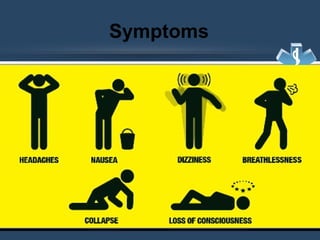
• Aspirin poisoning symptoms: Upset stomach
and stomach pain, Nausea & Vomiting. Chronic
overdose may include Tiredness, Slight fever,
Confusion ,Collapse, Rapid heart beat.
• Barbiturate intoxication and overdose include:
Altered level of consciousness, Difficulty in
thinking, sleepiness or coma, Faulty judgment,
In coordination, Shallow breathing, Slowness of
speech
• Morphine poisoning symptoms: Gastrointestinal
system constipation, Nausea, Vomiting, Low
blood pressure, Weak pulse, Difficulty breathing.
Diagnosis
• Initially, poisoning is suspected if the victim
shows changes in behavior and signs or
symptoms previously described. Hallucination or
other psychiatric symptoms may indicate
poisoning by a hallucinogenic plant.
• Evidence of an empty container or information
from the victim are helpful in determining exactly
what substance has caused the poisoning.
• The vomit may be tested to determine the exact
composition of the poison.
Primary Management of
Poisoning
Primary Management
• Seek immediate medical help.
• Try and identify the poison if possible .
• Check for signs like burns around mouth,
breathing difficulty or vomiting.
• Induce vomiting if poison swallowed.
• In case of convulsions, protect the person from
self injury.
• If the vomit falls on the skin, wash it thoroughly
• Position the victim on the left till medical help
arrives.
1) For inhalation poisoning
• Seek immediate emergency help.
• Get help before you attempt to rescue others.
• Hold a wet cloth to cover your nose and mouth
• Open all the doors and windows.
 
• Take deep breaths before you begin the rescue.
• Avoid lighting a match. 
• Check the patient's breathing.
• Do a CPR, if necessary. 
• If the patient vomits, take steps to prevent.
Charcoal/ Ipecac
• Primary  detoxication  by  ipecac-induced  emesis 
or  gastric  lavage  (cleansing  or  rinsing)  is 
incomplete.
• In mild to moderate  poisoning administration of 
activated  charcoal  alone  without  gastric 
emptying  is  often  more  effective,  because  it 
binds toxins promptly.
• In-vitro and in-vivo studies of many substances 
have  shown  good  adsorption  to  activated 
charcoal  (e.g.  digitalis,  beta-blocking  agents, 
phenobarbitone, carbamazepine, theophylline).
2) Venom Poisoning:
• Lie down immediately after the bite.
• Call an ambulance.
• Don’t move, particularly the bitten part.
• In the first second after the bite it is possible to 
press out the poison. Do it if possible.
• Clean  the  wound  with  antiseptic  solution  and 
bandage the wound (not tightly). 
• Drink a lot of fluid, it will dilute the poison.
• If possible catch the snake or at least remember 
the look of animal or insect.
Research based…
• Syrup  of  ipecac  should  no  longer  be  used 
routinely  as  a  poison  treatment  intervention  in 
the home.
• Current  research  does  not  support  the  routine 
administration of activated charcoal in the home 
as  efficacy  and  safety  have  not  been 
demonstrated.
References
1) FARLEX, http://medical-dictionary.thefreedictionary.com/Poisoning
2) St John Ambulance, http://www.sja.org.uk/sja/first-aid-
advice/poisoning/drug-poisoning.aspx
3) Pediatrics, 
http://pediatrics.aappublications.org/content/112/5/1182.full
4) US National Library Of Medicine, 
http://www.ncbi.nlm.nih.gov/pubmed/8145456
5) MD INDIA,
http://www.medindia.net/patients/Firstaid_Poisoning.htm
Poisoning & Its Primary Management

Poisoning & Its Primary Management

  • 1.
    Poisoning & Its Primary Management ChhabiAcharya B. Pharmacy HOPE Intl College
  • 2.
    Content • Poisoning - Definition& Description - Causes - Classification - Symptoms - Diagnosis • Primary Management • References
  • 3.
    World’s most poisonousplant Discovered more than 5000 feet above sea level on Mount Victoria in the Philippines, the giant, carnivorous pitcher plant secretes a nectar-like substance to draw in innocent prey into a pool of enzymes and acid. W orld’s poisonous plant Nepenthes attenboroughii
  • 4.
  • 5.
    Definition & Description •Poisoning occurs when any substance interferes with normal body functions after it is swallowed, inhaled, injected, or absorbed. The branch of medicine that deals with the detection and treatment of poisons is known as toxicology. • Poisonings are a common occurrence. In 80% of the cases of poisoning, the victim is a child under the age of five.
  • 6.
    • Curiosity, inabilityto read warning labels, a desire to imitate adults, and inadequate supervision lead to childhood poisonings. • The elderly are the second most likely group to be poisoned. Mental confusion, poor eyesight, and the use of multiple drugs are the leading reasons why this group has a high rate of accidental poisoning.
  • 7.
    • A substantialnumber of poisonings also occur as suicide attempts or drug overdoses. • Poisons are common in the home and workplace, yet there are basically two major types. • One group consists of products that were never meant to be ingested or inhaled, such as shampoo, paint thinner, pesticides, houseplant leaves, and carbon monoxide.
  • 8.
    • The othergroup contains products that can be ingested in small quantities, but which are harmful if taken in large amounts, such as pharmaceuticals, medicinal herbs, or alcohol. • Other types of poisons include the bacterial toxins that cause food poisoning, such as Escherichia coli; heavy metals, such as the lead found in the paint on older houses; and the venom found in the bites and stings of some animals and insects.
  • 9.
    Causes • The effectsof poisons are as varied as the poisons themselves; however, the exact mechanisms of only a few are understood. • Some poisons interfere with the metabolism. • Others destroy the liver or kidneys, such as heavy metals and some pain relief medications, including acetaminophen and nonsteroidal anti- inflammatory drugs (Ibuprofen).
  • 10.
    • A poisonmay severely depress the central nervous system, leading to coma and eventual respiratory and circulatory failure. • Some poisons directly affect the respiratory and circulatory system. Carbon monoxide causes death by binding with hemoglobin that would normally transport oxygen throughout the body. • Cyanide interferes with respiration at the cellular level.
  • 11.
    • The typeof poison, the amount and time of exposure, and the age, size, and health of the victim are all factors which determine the severity of symptoms and the chances for recovery.
  • 12.
    Classification • Mainly categorizedin five broad classes : 1) Plant poisoning 2) Food & household chemicals 3) Pharmaceuticals 4) Venom poisoning 5) Other
  • 13.
    1) Plant poisoning Theleaves are more toxic than the seed. Most parts of the tree are toxic, except the bright red aril surrounding the seed. The major toxin within the yew is the alkaloid taxine. Taxus baccata
  • 14.
    • One hundredmilligrams (mg) of moist, crushed apricot seeds can produce 217 mg of cyanide. (Beers, Mark H., MD, and Robert Berkow, MD., editors. "Poisoning." In The Merck Manual of Diagnosis and Therapy. Whitehouse Station, NJ: Merck Research Laboratories, 2004.)
  • 15.
    2) Food &Household chemicals Food • Food poisoning is a common, yet distressing and sometimes life-threatening problem in the world. • Depending on the type of infection, people can even die as a result of food poisoning. • More than 250 different diseases can cause food poisoning. Some of the most common diseases are infections caused by bacteria, such as Campylobacter, Salmonella & E. coli.
  • 16.
    Household Product: • Manyproducts used daily in the home are poisonous if swallowed. These products often contain strong acids or strong bases (alkalis). • Toxic household cleaning products include dishwashing liquids, floor waxes and furniture polishes, laundry detergents, spot cleaners, and fabric softeners, toilet bowl cleaners.
  • 17.
    • Personal careproducts found in the home can also be poisonous. These include: Deodorant Hairspray Hair straighteners Nail polish and polish remover Perfume & Shampoo
  • 18.
    3) Pharmaceutical • Bothover-the-counter and prescription medicines can help the body heal if taken as directed. • However, when taken in large quantities, or with other drugs where there may be an adverse interaction, they can act as poisons. • Drug overdoses, both accidental and intentional, are the leading cause of poisoning in adults.
  • 19.
    • Medicinal herbsshould be treated like pharmaceuticals and taken only in designated quantities under the supervision of a knowledgeable person. • Herbs that have healing qualities when taken in small doses can be toxic in larger doses, or may interact with prescription medications in unpredictable ways.
  • 20.
    • More than4000 mg of acetaminophen a day causes poisoning. • Taking more than 150mg/kg of aspirin can have serious and even deadly results if untreated • Barbituate overdose occurs when someone accidentally or intentionally takes more than the normal or recommended amount of this medication. This is life threatening.
  • 21.
    • Large overdoseof morphine can cause breathing to stop and death if the person does not get medical attention or an antidote right away.
  • 22.
    4) Venom Poisoning •Venom is the general term referring to any variety of toxins used by certain types of animals that inject it into their victims by the means of a bite, sting or other sharp body feature. • Different venomous animal and insects may inject venom in human during their attack. Such venom as toxic chemical agent shows the poisonous effect.
  • 23.
    5) Other causesof poisonings • People can be poisoned by fumes they inhale. Carbon monoxide is the most common form of inhaled poison. • Other toxic substances that can be inhaled include farm and garden insecticides and herbicides, gasoline fumes, insect repellent, paint thinner fumes and many other chemical agent.


  • 24.
  • 25.
    • Aspirin poisoningsymptoms: Upset stomach and stomach pain, Nausea & Vomiting. Chronic overdose may include Tiredness, Slight fever, Confusion ,Collapse, Rapid heart beat. • Barbiturate intoxication and overdose include: Altered level of consciousness, Difficulty in thinking, sleepiness or coma, Faulty judgment, In coordination, Shallow breathing, Slowness of speech
  • 26.
    • Morphine poisoningsymptoms: Gastrointestinal system constipation, Nausea, Vomiting, Low blood pressure, Weak pulse, Difficulty breathing.
  • 27.
    Diagnosis • Initially, poisoningis suspected if the victim shows changes in behavior and signs or symptoms previously described. Hallucination or other psychiatric symptoms may indicate poisoning by a hallucinogenic plant. • Evidence of an empty container or information from the victim are helpful in determining exactly what substance has caused the poisoning. • The vomit may be tested to determine the exact composition of the poison.
  • 28.
  • 29.
    Primary Management • Seekimmediate medical help. • Try and identify the poison if possible . • Check for signs like burns around mouth, breathing difficulty or vomiting. • Induce vomiting if poison swallowed. • In case of convulsions, protect the person from self injury.
  • 30.
    • If thevomit falls on the skin, wash it thoroughly • Position the victim on the left till medical help arrives. 1) For inhalation poisoning • Seek immediate emergency help. • Get help before you attempt to rescue others. • Hold a wet cloth to cover your nose and mouth • Open all the doors and windows.
  • 31.
      • Take deep breaths before you begin the rescue. • Avoid lighting a match.  •Check the patient's breathing. • Do a CPR, if necessary.  • If the patient vomits, take steps to prevent.
  • 32.
    Charcoal/ Ipecac • Primary detoxication  by  ipecac-induced  emesis  or  gastric  lavage  (cleansing  or  rinsing)  is  incomplete. • In mild to moderate  poisoning administration of  activated  charcoal  alone  without  gastric  emptying  is  often  more  effective,  because  it  binds toxins promptly.
  • 33.
    • In-vitro and in-vivo studies of many substances  have  shown good  adsorption  to  activated  charcoal  (e.g.  digitalis,  beta-blocking  agents,  phenobarbitone, carbamazepine, theophylline). 2) Venom Poisoning: • Lie down immediately after the bite. • Call an ambulance. • Don’t move, particularly the bitten part.
  • 34.
    • In the first second after the bite it is possible to  press out the poison. Do it if possible. • Clean the  wound  with  antiseptic  solution  and  bandage the wound (not tightly).  • Drink a lot of fluid, it will dilute the poison. • If possible catch the snake or at least remember  the look of animal or insect.
  • 35.
    Research based… • Syrup  of ipecac  should  no  longer  be  used  routinely  as  a  poison  treatment  intervention  in  the home. • Current  research  does  not  support  the  routine  administration of activated charcoal in the home  as  efficacy  and  safety  have  not  been  demonstrated.
  • 36.
    References 1) FARLEX, http://medical-dictionary.thefreedictionary.com/Poisoning 2) St John Ambulance, http://www.sja.org.uk/sja/first-aid- advice/poisoning/drug-poisoning.aspx 3)Pediatrics,  http://pediatrics.aappublications.org/content/112/5/1182.full 4) US National Library Of Medicine,  http://www.ncbi.nlm.nih.gov/pubmed/8145456 5) MD INDIA, http://www.medindia.net/patients/Firstaid_Poisoning.htm