Submitted by:
Godwin Scaria
Hemandh M Thilakan
Muhammad Salih
Manufacturing processes
 Batch process -A process that is not in continuous
or mass production; operations are carried out with
discrete quantities of material or a limited number
of items
 Continuous process -Industrial process that
continuously receives raw materials and processes
them through to completed units
Batch Process
 A process in which the materials or work are stationary
at one physical location while being treated is termed as
batch process.
 Most often of thermal type where system is brought
upto temperature and pressure and controlled for a
period of time.
 If process rate is slow , a two position (on-off) controller
is used
If process rate is large ,it is necessary to employ
proportional control
Batch Production
Batch process (Contd)
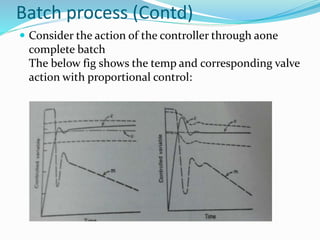
 Consider the action of the controller through aone
complete batch
The below fig shows the temp and corresponding valve
action with proportional control:
Analysis of the above graph
 As temperature rises, process begins and valve opens and as
temperature lowers valve closes
 In most process, a gradually decreasing valve setting is
required in order to balance energy . It is called offset
 As long as proportional sensitivity is high offset will also be
small
 Offset is reduced by integral response
 Large initial overshoot is due to action of integral response
PREVENTION OF OVERSHOOT
 First, many electric controllers with integral response
incorporate a “rate of approachsetter”. This devices
limits the integral action until the first approach to the set
point has been made
 Second, a controller which incorpates a proportional
derivative unit followed by a proportional integral unit
also may be adjusted to prevent overshoot.
Purpose of Batch Process
To produce one or more products at
 A given composition
 Max amount
 Best economy(employing least materials, time and
energy)
Disadvantage of Batch process
•Frequent start up and shutdown of equipment –
DOWNTIME!!
•Cleaning time between batches
•May be batch to batch variability
•Not good for bulk chemical production
Advantage of Batch Process
 Good for small amounts of speciality
chemicals
 Make a range of products using same
equipment
 Can schedule maintenance & inspections to
equipment in between batches
 Good for developing new products
 Easier to scale up from lab scale
 Generally cheaper set up costs
 Employees understand the process well
Continuous Process Control
 A process in which the materials or work flows more
or less continuously through a plant apparatus while
being treated is termed a continuous process.
Continuous process control
 Storage vessel control
 Surge vessel control
Storage vessel control
 Here the supply of materials is almost sometimes not
constant and a flow control is necessary. The resultings
flow of materials is nearly constant in spite of large
changes of head in the tank
Surge vessel control
In the above case for the vessel without control of outflow
If there is control,
Combining the above two eqn, we get
&
&
•The time const T may be selected by adjusting the proportional
sensitivity of the controller so as to spread out the inflow change
over a period of about four time constants.
Continuous process control (Contd)
 Possess a number of degrees of freedom given by the
numbers of variables and defining relations for the system
Purpose of the process is to produce one or more products at
a) Given composition
b) A given or maximum flow rate
c) Best economy (employing least materials, energy,
personnel time, and equipment)
Advantages of Continuous
Processing
Good for large volumes (bulk
chemicals)
Fewer start up and shutdowns –
UPTIME!!
Potentially greater yields
Potentially easier to maintain quality or
spot out of specification product
sooner
Valve Positioner
 The friction in the packing and guiding surfaces of a
control valve to exhibit hysteresis in which stem position is
plotted against valve top pressure.
 To reduce the deleterious effect of hysteresis and to speed
up the response of the valve one can attach to the control
valve a positioner which act as a high gain proportional
controller that receives a set point signal from the primary
controller and a measurement from the valve stm position.
The valve positioner can be of two types:
 Direct acting type
 Feedback type
Direct Acting Type
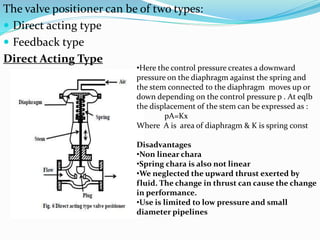
•Here the control pressure creates a downward
pressure on the diaphragm against the spring and
the stem connected to the diaphragm moves up or
down depending on the control pressure p . At eqlb
the displacement of the stem can be expressed as :
pA=Kx
Where A is area of diaphragm & K is spring const
Disadvantages
•Non linear chara
•Spring chara is also not linear
•We neglected the upward thrust exerted by
fluid. The change in thrust can cause the change
in performance.
•Use is limited to low pressure and small
diameter pipelines
Feedback Type Valve Positioner
•It has a pilot cyinder , the piston of this pilot
cylinder opens and closes the air supply and vent
ports to the main cylinder whose piston is
connected to the stem of the control valve
•There is a mechanical link connected to the stem
that adjusts the fixed end of the spring connected
to the diaphragm
•This link provides the feedback to the positioner
•As control pressure increases,the diaphragm
moves down, this causes the lower chamber of the
main cylinder to be connected to 20 psi line and
the upper chamber to the vent line.
•Compressed air enters the bottom of the main
cylinder and the piston moves up, the feedback
line compresses the spring further and this causes
the diaphragm to move back to its original
position
•The relationship between the control pressure
and movement of the stem in this case is more or
less linear
 Nowadays many electro mechanical valve positioner
have been developed rather than pneumatic valve
positioner.
Thank you……

Process control

  • 1.
    Submitted by: Godwin Scaria HemandhM Thilakan Muhammad Salih
  • 2.
    Manufacturing processes  Batchprocess -A process that is not in continuous or mass production; operations are carried out with discrete quantities of material or a limited number of items  Continuous process -Industrial process that continuously receives raw materials and processes them through to completed units
  • 3.
    Batch Process  Aprocess in which the materials or work are stationary at one physical location while being treated is termed as batch process.  Most often of thermal type where system is brought upto temperature and pressure and controlled for a period of time.  If process rate is slow , a two position (on-off) controller is used If process rate is large ,it is necessary to employ proportional control
  • 4.
  • 5.
    Batch process (Contd) Consider the action of the controller through aone complete batch The below fig shows the temp and corresponding valve action with proportional control:
  • 6.
    Analysis of theabove graph  As temperature rises, process begins and valve opens and as temperature lowers valve closes  In most process, a gradually decreasing valve setting is required in order to balance energy . It is called offset  As long as proportional sensitivity is high offset will also be small  Offset is reduced by integral response  Large initial overshoot is due to action of integral response
  • 7.
    PREVENTION OF OVERSHOOT First, many electric controllers with integral response incorporate a “rate of approachsetter”. This devices limits the integral action until the first approach to the set point has been made  Second, a controller which incorpates a proportional derivative unit followed by a proportional integral unit also may be adjusted to prevent overshoot.
  • 8.
    Purpose of BatchProcess To produce one or more products at  A given composition  Max amount  Best economy(employing least materials, time and energy) Disadvantage of Batch process •Frequent start up and shutdown of equipment – DOWNTIME!! •Cleaning time between batches •May be batch to batch variability •Not good for bulk chemical production
  • 9.
    Advantage of BatchProcess  Good for small amounts of speciality chemicals  Make a range of products using same equipment  Can schedule maintenance & inspections to equipment in between batches  Good for developing new products  Easier to scale up from lab scale  Generally cheaper set up costs  Employees understand the process well
  • 10.
    Continuous Process Control A process in which the materials or work flows more or less continuously through a plant apparatus while being treated is termed a continuous process.
  • 11.
    Continuous process control Storage vessel control  Surge vessel control Storage vessel control  Here the supply of materials is almost sometimes not constant and a flow control is necessary. The resultings flow of materials is nearly constant in spite of large changes of head in the tank
  • 12.
    Surge vessel control Inthe above case for the vessel without control of outflow If there is control, Combining the above two eqn, we get & & •The time const T may be selected by adjusting the proportional sensitivity of the controller so as to spread out the inflow change over a period of about four time constants.
  • 13.
    Continuous process control(Contd)  Possess a number of degrees of freedom given by the numbers of variables and defining relations for the system Purpose of the process is to produce one or more products at a) Given composition b) A given or maximum flow rate c) Best economy (employing least materials, energy, personnel time, and equipment)
  • 14.
    Advantages of Continuous Processing Goodfor large volumes (bulk chemicals) Fewer start up and shutdowns – UPTIME!! Potentially greater yields Potentially easier to maintain quality or spot out of specification product sooner
  • 15.
    Valve Positioner  Thefriction in the packing and guiding surfaces of a control valve to exhibit hysteresis in which stem position is plotted against valve top pressure.  To reduce the deleterious effect of hysteresis and to speed up the response of the valve one can attach to the control valve a positioner which act as a high gain proportional controller that receives a set point signal from the primary controller and a measurement from the valve stm position.
  • 16.
    The valve positionercan be of two types:  Direct acting type  Feedback type Direct Acting Type •Here the control pressure creates a downward pressure on the diaphragm against the spring and the stem connected to the diaphragm moves up or down depending on the control pressure p . At eqlb the displacement of the stem can be expressed as : pA=Kx Where A is area of diaphragm & K is spring const Disadvantages •Non linear chara •Spring chara is also not linear •We neglected the upward thrust exerted by fluid. The change in thrust can cause the change in performance. •Use is limited to low pressure and small diameter pipelines
  • 17.
    Feedback Type ValvePositioner •It has a pilot cyinder , the piston of this pilot cylinder opens and closes the air supply and vent ports to the main cylinder whose piston is connected to the stem of the control valve •There is a mechanical link connected to the stem that adjusts the fixed end of the spring connected to the diaphragm •This link provides the feedback to the positioner •As control pressure increases,the diaphragm moves down, this causes the lower chamber of the main cylinder to be connected to 20 psi line and the upper chamber to the vent line. •Compressed air enters the bottom of the main cylinder and the piston moves up, the feedback line compresses the spring further and this causes the diaphragm to move back to its original position •The relationship between the control pressure and movement of the stem in this case is more or less linear
  • 18.
     Nowadays manyelectro mechanical valve positioner have been developed rather than pneumatic valve positioner.
  • 19.