Implantable Drug Delivery
System
PAWAN TIKTE
Introduction
 Lafarge introduced the implantable system concept for
sustained release drug administration in 1861.
 It was first introduced to produce steroid hormones -
containing solid implants for long-term delivery.
 Implants are very small pellets composed of drug
without excipients.
Definition.....
 Implants are small sterile solid masses consisting of a
highly purified drug made by compression or moulding.
 Implants are DDS which provides CDDS over period of
time at site of implantation.
 Implants are intended for implantation in the body’s
subcutaneous or intramuscular tissue by a minor surgical
incision or injected through a large bore needle.
Ideal Properties of an - IDDS
 Environmentally stable.
 Bio compatible.
 Easy to manufacture and sterilize.
 Enable rate controlled drug release.
 Relatively inexpensive.
 A good mechanical strength.
 Free from surgical procedure.
Advantages
 Controlled drug delivery for a longer period.
 Decrease frequency of dose.
 Avoid first pass metabolism.
 Minimize drug side effects.
 Improve drug stability and bioavailability.
Disadvantages
 Small surgery needed for large implantation and painful .
 Therapy cannot be discontinued easily.
 Bio compatabillity issue.
 Reaction between host and implants.
 Implants infection, inflammatory reactions.
 Device failure and implants dislocation.
 The osmotic pumps can be implanted
subcutaneously or intraperitoneally depending on
the size of animal.
 For targeted drug delivery system , a catheter can
be attached to the osmotic pump to gain access to
the tissues of interest.
 Subcutaneous implantation is technically the easiest
and least intrusive procedure.
Concepts of implants & osmotic pumps
 The implantable osmotic pump employ
osmotic gradient inside the lumen called the
salt sleeve and the tissue condition in which
the pump is implanted.
 A high osmalarity of the salt sleeve make
water flow into the pump through a
semipermeable film which encases the
external surfaces of the pump
Principle
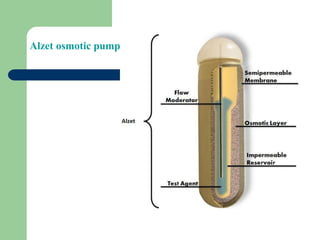
Alzet osmotic pump
 In cross section, the implantable osmotic release
pump are composed of ..
1. A drug core (reserviour)
2. The diffusion agent
3. The tissue layer ( rate controller)
4. A flow moderator is inserted into the body of the
diffusion pump.
Apparatus and equipment
Main components of or implantable osmotic release pump
include :
 drug compound ( water soluble / insoluble)
 Osmogens or osmotic agents ( ionic compound / inorganic salt
 A stable semipermeable membrane.
 Plasticizers.
 Flux regulators.
 Pore forming agent
 Coating solvents.
 Ex : alzet osmotic pump
Implantable drug delivery system