POLYMERS
Presented by:
Miss. Kamble Akanksha M.
Roll No: 03 [DDS]
First Year M-Pharmacy
Dept. of Pharmaceutics
S.M.B.T.C.O.P, Igatpuri.
SEMINAR PRESENTATION
Contents
• Introduction
• Ideal Properties
• Classification
• Applications
• References
Introduction
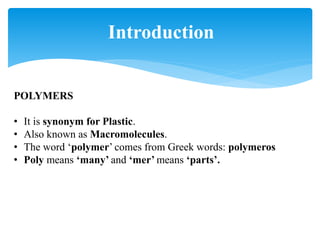
POLYMERS
• It is synonym for Plastic.
• Also known as Macromolecules.
• The word ‘polymer’ comes from Greek words: polymeros
• Poly means ‘many’ and ‘mer’ means ‘parts’.
• These are very large molecules consisting of many repeating units
called monomers [small molecules] and are formed by a process
called polymerization.
• In other words, polymers are very large molecules made when 100’s
of monomers join together to form long chains.
Ideal Characteristics
It should be inert.
It should be non-toxic.
It should be compatible with environment.
It should be easy to fabricate and inexpensive.
It should be biodegradable and biocompatible.
It should provide good drug polymer linkage.
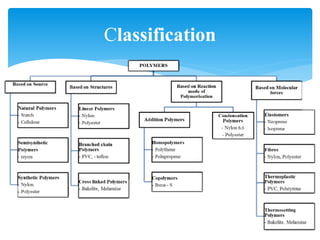
Classification
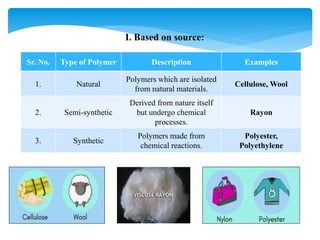
I. Based on source:
Sr. No. Type of Polymer Description Examples
1. Natural
Polymers which are isolated
from natural materials.
Cellulose, Wool
2. Semi-synthetic
Derived from nature itself
but undergo chemical
processes.
Rayon
3. Synthetic
Polymers made from
chemical reactions.
Polyester,
Polyethylene
Sr. No. Type of Polymer Description Examples
1. Linear
Monomers linked linearly to
each other
PE, PVC
2. Branched-chain
Monomers linked like a
branches
Low-density
polyethylene [LDPE]
3. Cross-linked
Monomers are connected to
each other.
Bakelite
II. Based on structure:
III. Based on mode of Polymerization:
Sr. No. Type of Polymer Description Examples
1. Homo-Polymer
It is made-up single type of
monomer. Identical bonding
linkages to each monomer
unit.
Polypropene,
Polyethene
2. Co-polymer
When two or more different
monomers together
[different repeating units]
Buna-S
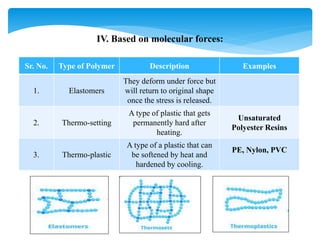
IV. Based on molecular forces:
Sr. No. Type of Polymer Description Examples
1. Elastomers
They deform under force but
will return to original shape
once the stress is released.
2. Thermo-setting
A type of plastic that gets
permanently hard after
heating.
Unsaturated
Polyester Resins
3. Thermo-plastic
A type of a plastic that can
be softened by heat and
hardened by cooling.
PE, Nylon, PVC
Applications
Applications
Medicine
Consumer
science
Industry
Sports
1. Medicine:
Many biomaterials especially heart valve replacements and blood vessels are
made-up of polymers like Teflon, Dacron
2. Consumer Science:
Plastic consumers of all shapes and sizes are light weight and economically
less expensive than more traditional containers.
3. Industry:
Automobile parts, pipes, tanks, packing material, adhesives are all polymer
application used in the industrial market.
4. Sports:
Playground equipment, golf clubs, swimming pools and protective helmets
are produced from polymers.
Applications
References
1. Robinson J R and Lee V .H, Controlled drug delivery –fundamentals and
applications, Marcel Dekker
2. Jain N k, Controlled and Novel Drug Delivery; CBS Publication
THANK-YOU

Polymers, Ideal properties, Classification/Types, Applications

  • 1.
    POLYMERS Presented by: Miss. KambleAkanksha M. Roll No: 03 [DDS] First Year M-Pharmacy Dept. of Pharmaceutics S.M.B.T.C.O.P, Igatpuri. SEMINAR PRESENTATION
  • 2.
    Contents • Introduction • IdealProperties • Classification • Applications • References
  • 3.
    Introduction POLYMERS • It issynonym for Plastic. • Also known as Macromolecules. • The word ‘polymer’ comes from Greek words: polymeros • Poly means ‘many’ and ‘mer’ means ‘parts’.
  • 4.
    • These arevery large molecules consisting of many repeating units called monomers [small molecules] and are formed by a process called polymerization. • In other words, polymers are very large molecules made when 100’s of monomers join together to form long chains.
  • 5.
    Ideal Characteristics It shouldbe inert. It should be non-toxic. It should be compatible with environment. It should be easy to fabricate and inexpensive. It should be biodegradable and biocompatible. It should provide good drug polymer linkage.
  • 6.
  • 7.
    I. Based onsource: Sr. No. Type of Polymer Description Examples 1. Natural Polymers which are isolated from natural materials. Cellulose, Wool 2. Semi-synthetic Derived from nature itself but undergo chemical processes. Rayon 3. Synthetic Polymers made from chemical reactions. Polyester, Polyethylene
  • 8.
    Sr. No. Typeof Polymer Description Examples 1. Linear Monomers linked linearly to each other PE, PVC 2. Branched-chain Monomers linked like a branches Low-density polyethylene [LDPE] 3. Cross-linked Monomers are connected to each other. Bakelite II. Based on structure:
  • 9.
    III. Based onmode of Polymerization: Sr. No. Type of Polymer Description Examples 1. Homo-Polymer It is made-up single type of monomer. Identical bonding linkages to each monomer unit. Polypropene, Polyethene 2. Co-polymer When two or more different monomers together [different repeating units] Buna-S
  • 10.
    IV. Based onmolecular forces: Sr. No. Type of Polymer Description Examples 1. Elastomers They deform under force but will return to original shape once the stress is released. 2. Thermo-setting A type of plastic that gets permanently hard after heating. Unsaturated Polyester Resins 3. Thermo-plastic A type of a plastic that can be softened by heat and hardened by cooling. PE, Nylon, PVC
  • 11.
  • 12.
    1. Medicine: Many biomaterialsespecially heart valve replacements and blood vessels are made-up of polymers like Teflon, Dacron 2. Consumer Science: Plastic consumers of all shapes and sizes are light weight and economically less expensive than more traditional containers. 3. Industry: Automobile parts, pipes, tanks, packing material, adhesives are all polymer application used in the industrial market. 4. Sports: Playground equipment, golf clubs, swimming pools and protective helmets are produced from polymers. Applications
  • 13.
    References 1. Robinson JR and Lee V .H, Controlled drug delivery –fundamentals and applications, Marcel Dekker 2. Jain N k, Controlled and Novel Drug Delivery; CBS Publication
  • 14.