Go to View > Header & Footer to edit July 4, 2011   |  slide  RSCs – Stimulating and supporting innovation in learning Using Learners Own Devices Gordon Millner – Technical Advisor, RSC-EM www.rsc-em.ac.uk
July 4, 2011   |  slide  Can everyone  switch off their  mobile phone  please On silent/vibrate will not be sufficient, I want it switched off Can you all put your laptops and iPads etc away please and get out pen and paper No texting or tweeting or taking notes electronically is allowed
"By now almost everyone owns one and uses one, often more than one.  Not only do they own them and use them but they also invest considerable time, effort and resource choosing them, buying them, customising them and exploiting them …. July 4, 2011   |  slide
“ These devices express  part or much of their owners'  values, affiliations, identity and individuality through their choice and through their use  July 4, 2011   |  slide
“ They are  both pervasive and ubiquitous,  both conspicuous and unobtrusive,  both noteworthy and taken-for-granted  in the lives of most people …  July 4, 2011   |  slide
“ This explains in part why mobile learning is not just e-learning on mobile devices;  it also hints that we might leverage learners' own devices and in doing so take education into new modes, spaces and places."  (Prof. John Traxler, Univ. of Wolverhampton, 2011) July 4, 2011   |  slide
Let’s look at some  FACTS July 4, 2011   |  slide
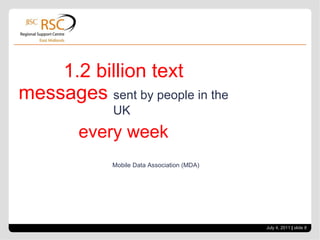
1.2 billion text messages  sent by people in the UK  every week Mobile Data Association (MDA)  July 4, 2011   |  slide
95 per cent  of UK households have access to mobile devices Mobile Data Association (MDA)  July 4, 2011   |  slide
there are now  more mobile devices  in use in the UK  than there are people . Mobile Data Association (MDA)  July 4, 2011   |  slide
What’s missing?
“ Technology   is playing an increasingly  important role   in people’s lives July 4, 2011   |  slide
“ Staying in touch  with friends and family by  email   and arranging your life by  SMS   is fast becoming  the norm  July 4, 2011   |  slide
And then there’s the  uploading of messages, posts and photos to  facebook and twitter videos to  youtube July 4, 2011   |  slide
“ Similarly it must therefore be that  technology   is playing an increasingly  important role in a learner’s life July 4, 2011   |  slide
What about  netbooks,  notebooks and  tablets? Which do you think are going up or going down in sales? July 4, 2011   |  slide
UK  Netbook sales  strong in 2009 but going  DOWN 22% in Oct 2010  and by  DOWN 40% in Nov 2010  compared to same month in previous year Christmas 2010 was the end  of the netbook PC phenomenon July 4, 2011   |  slide
Mainstream portable  sales  UP 32% in Oct 2010  and  24% in Nov 2010  compared to the same months a year before July 4, 2011   |  slide
Tablet  sales  UP 424% in Nov 2010 Compared to same month in 2009 Remember though: there weren’t many tablets about in 2009 Apple’s iPad – 60% of all tablet sales,  the 3G version accounting for 80% of the share  STATS: channelweb.co.uk July 4, 2011   |  slide
So lets give our students a device to use then Giving or loaning devices for the purpose of a learning activity may not always be a solution. In a recent project XDAs were given to learners for the purposes of the project, but were rejected as being too large and complex and because the learners already owned (and preferred to use) other devices.  Quotes from the case study include: “ They found the XDA too large and complex for everyday convenience, yet too small to manage a full range of files.“ “ Our students do not seem interested in carrying an extra devic e.” July 4, 2011   |  slide
Do you have examples in your organisation of learners own devices being used? July 4, 2011   |  slide
Does your organisation have barriers that prevent students using their own devices?   July 4, 2011   |  slide
So what now? REAL scenarios: Management want to reduce their capital spend on equipment and suggests to not update PCs this year in some classrooms, even remove them altogether and let students use their own devices instead.  This will also reduce the need for as many ICT technical support staff and so save money Students and staff want to learn and work the “Martini Way” across the campus/organisation with their own device(s) A student is caught viewing rude material on their laptop computer.  They are using their own USB 3G dongle and so are not connected to your network Students are using their mobile phones on a field trip “ Johnny” cannot afford to have his own mobile device and so cannot participate in lessons Mary’s brother is always missing his learning support session July 4, 2011   |  slide
What issues are raised? Will all students want to bring in their own device for fear of theft, bullying, getting broken What about digital exclusion? Some students can’t afford their own personal devices  Devices are personal and will usually contain a great deal of personal data and information. Could this personal data be compromised during everyday use in a formal education context?  Is it ethical or desirable to ask students who have purchased their personal devices, to use them for purposes they may not have expected them to be used for?  What about wear and tear, or accidental damage of the devices during learning?  Who would pay for replacement or repair, or insure the devices during these kind of activities.  Supporting the range of devices, is more technical staffing needed Security of network July 4, 2011   |  slide
What issues are raised? Legitimate use of device whether using network connection or own connection Needing appropriate actions in place in case of breach of “responsible use policy” Expense of managed wireless network and continual virus checks/updates of devices Separate areas of network may need setting up and what type of access are you allowing to devices. Everything including workarea…  or internet and email only?? Do students have their own work area, perhaps cloud-based? JANET acceptable use Are there more opportunities for learning spaces? What about charging facilities for batteries?  Who’s responsibility? What about printing?  Do they need to print? July 4, 2011   |  slide
What are the benefits? It fits in with the learner’s way of life “ Martini” learning and improved “ownership” of their learning 24/7 access Learners take photographs, record sounds and videos on trips or in the classroom.  Geotagging is now a possibility Flexibility and choice seem to be key, and link in with the idea of enabling and encouraging creativity.  Better communication … assignment submissions, deadlines and announcements, SMS notifications of closures/timetable changes, keeping potential students “warm” before they start.  Use SMS positively and supportively as well as for chasing. Allow learners to subscribe to SMS, giving them choice which is empowering Learners taking notes in class, photos of board, copy/paste into assignments. Learners can carry around electronic versions of their handouts, PPTs, etc all the time, also becomes searchable compared to paper.  Also made available in different formats, eg. Audio/video/text, thus they can be more inclusive July 4, 2011   |  slide
Any Q’s Gordon Millner – Technical Advisor, RSC-EM E:  [email_address] T: 01509 618120 July 4, 2011   |  slide
Further Resources This presentation was part of the  RSC East Midlands e-fair 2011 “Becoming an agile learning provider” for more information and to see all the resources go to: http://moodle.rsc-em.ac.uk/course/view.php?id=227 July 4, 2011   |  slide

Using learners’ own devices

  • 1.
    Go to View> Header & Footer to edit July 4, 2011 | slide RSCs – Stimulating and supporting innovation in learning Using Learners Own Devices Gordon Millner – Technical Advisor, RSC-EM www.rsc-em.ac.uk
  • 2.
    July 4, 2011 | slide Can everyone switch off their mobile phone please On silent/vibrate will not be sufficient, I want it switched off Can you all put your laptops and iPads etc away please and get out pen and paper No texting or tweeting or taking notes electronically is allowed
  • 3.
    "By now almosteveryone owns one and uses one, often more than one. Not only do they own them and use them but they also invest considerable time, effort and resource choosing them, buying them, customising them and exploiting them …. July 4, 2011 | slide
  • 4.
    “ These devicesexpress part or much of their owners' values, affiliations, identity and individuality through their choice and through their use July 4, 2011 | slide
  • 5.
    “ They are both pervasive and ubiquitous, both conspicuous and unobtrusive, both noteworthy and taken-for-granted in the lives of most people … July 4, 2011 | slide
  • 6.
    “ This explainsin part why mobile learning is not just e-learning on mobile devices; it also hints that we might leverage learners' own devices and in doing so take education into new modes, spaces and places." (Prof. John Traxler, Univ. of Wolverhampton, 2011) July 4, 2011 | slide
  • 7.
    Let’s look atsome FACTS July 4, 2011 | slide
  • 8.
    1.2 billion textmessages sent by people in the UK every week Mobile Data Association (MDA) July 4, 2011 | slide
  • 9.
    95 per cent of UK households have access to mobile devices Mobile Data Association (MDA) July 4, 2011 | slide
  • 10.
    there are now more mobile devices in use in the UK than there are people . Mobile Data Association (MDA) July 4, 2011 | slide
  • 11.
  • 12.
    “ Technology is playing an increasingly important role in people’s lives July 4, 2011 | slide
  • 13.
    “ Staying intouch with friends and family by email and arranging your life by SMS is fast becoming the norm July 4, 2011 | slide
  • 14.
    And then there’sthe uploading of messages, posts and photos to facebook and twitter videos to youtube July 4, 2011 | slide
  • 15.
    “ Similarly itmust therefore be that technology is playing an increasingly important role in a learner’s life July 4, 2011 | slide
  • 16.
    What about netbooks, notebooks and tablets? Which do you think are going up or going down in sales? July 4, 2011 | slide
  • 17.
    UK Netbooksales strong in 2009 but going DOWN 22% in Oct 2010 and by DOWN 40% in Nov 2010 compared to same month in previous year Christmas 2010 was the end of the netbook PC phenomenon July 4, 2011 | slide
  • 18.
    Mainstream portable sales UP 32% in Oct 2010 and 24% in Nov 2010 compared to the same months a year before July 4, 2011 | slide
  • 19.
    Tablet sales UP 424% in Nov 2010 Compared to same month in 2009 Remember though: there weren’t many tablets about in 2009 Apple’s iPad – 60% of all tablet sales, the 3G version accounting for 80% of the share STATS: channelweb.co.uk July 4, 2011 | slide
  • 20.
    So lets giveour students a device to use then Giving or loaning devices for the purpose of a learning activity may not always be a solution. In a recent project XDAs were given to learners for the purposes of the project, but were rejected as being too large and complex and because the learners already owned (and preferred to use) other devices. Quotes from the case study include: “ They found the XDA too large and complex for everyday convenience, yet too small to manage a full range of files.“ “ Our students do not seem interested in carrying an extra devic e.” July 4, 2011 | slide
  • 21.
    Do you haveexamples in your organisation of learners own devices being used? July 4, 2011 | slide
  • 22.
    Does your organisationhave barriers that prevent students using their own devices?   July 4, 2011 | slide
  • 23.
    So what now?REAL scenarios: Management want to reduce their capital spend on equipment and suggests to not update PCs this year in some classrooms, even remove them altogether and let students use their own devices instead. This will also reduce the need for as many ICT technical support staff and so save money Students and staff want to learn and work the “Martini Way” across the campus/organisation with their own device(s) A student is caught viewing rude material on their laptop computer. They are using their own USB 3G dongle and so are not connected to your network Students are using their mobile phones on a field trip “ Johnny” cannot afford to have his own mobile device and so cannot participate in lessons Mary’s brother is always missing his learning support session July 4, 2011 | slide
  • 24.
    What issues areraised? Will all students want to bring in their own device for fear of theft, bullying, getting broken What about digital exclusion? Some students can’t afford their own personal devices Devices are personal and will usually contain a great deal of personal data and information. Could this personal data be compromised during everyday use in a formal education context? Is it ethical or desirable to ask students who have purchased their personal devices, to use them for purposes they may not have expected them to be used for? What about wear and tear, or accidental damage of the devices during learning? Who would pay for replacement or repair, or insure the devices during these kind of activities. Supporting the range of devices, is more technical staffing needed Security of network July 4, 2011 | slide
  • 25.
    What issues areraised? Legitimate use of device whether using network connection or own connection Needing appropriate actions in place in case of breach of “responsible use policy” Expense of managed wireless network and continual virus checks/updates of devices Separate areas of network may need setting up and what type of access are you allowing to devices. Everything including workarea… or internet and email only?? Do students have their own work area, perhaps cloud-based? JANET acceptable use Are there more opportunities for learning spaces? What about charging facilities for batteries? Who’s responsibility? What about printing? Do they need to print? July 4, 2011 | slide
  • 26.
    What are thebenefits? It fits in with the learner’s way of life “ Martini” learning and improved “ownership” of their learning 24/7 access Learners take photographs, record sounds and videos on trips or in the classroom. Geotagging is now a possibility Flexibility and choice seem to be key, and link in with the idea of enabling and encouraging creativity. Better communication … assignment submissions, deadlines and announcements, SMS notifications of closures/timetable changes, keeping potential students “warm” before they start. Use SMS positively and supportively as well as for chasing. Allow learners to subscribe to SMS, giving them choice which is empowering Learners taking notes in class, photos of board, copy/paste into assignments. Learners can carry around electronic versions of their handouts, PPTs, etc all the time, also becomes searchable compared to paper. Also made available in different formats, eg. Audio/video/text, thus they can be more inclusive July 4, 2011 | slide
  • 27.
    Any Q’s GordonMillner – Technical Advisor, RSC-EM E: [email_address] T: 01509 618120 July 4, 2011 | slide
  • 28.
    Further Resources Thispresentation was part of the RSC East Midlands e-fair 2011 “Becoming an agile learning provider” for more information and to see all the resources go to: http://moodle.rsc-em.ac.uk/course/view.php?id=227 July 4, 2011 | slide