




Mobile Learning
& New Trends
José Bidarra | Universidade Aberta | Portugal
The classroom today…
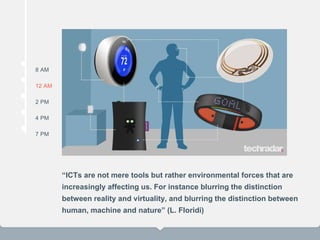
• 8 AM
• 12 AM
• 2 PM
• 4 PM
• 7 PM
“ICTs are not mere tools but rather environmental forces that are
increasingly affecting us. For instance blurring the distinction
between reality and virtuality, and blurring the distinction between
human, machine and nature” (L. Floridi)
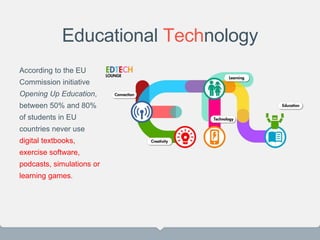
Educational Technology
According to the EU
Commission initiative
Opening Up Education,
between 50% and 80%
of students in EU
countries never use
digital textbooks,
exercise software,
podcasts, simulations or
learning games.
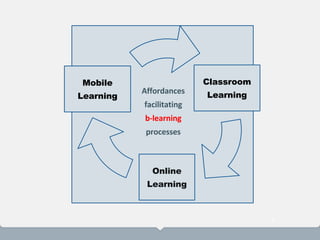
Classroom
Learning
Online
Learning
Mobile
Learning
4
Affordances
facilitating
b-learning
processes
5
Mobile Learning prospects
Learning Anytime, Anywhere…
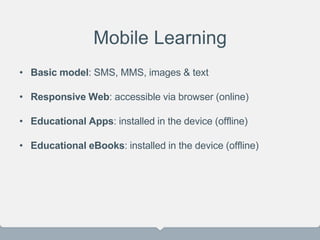
Mobile Learning
• Basic model: SMS, MMS, images & text
• Responsive Web: accessible via browser (online)
• Educational Apps: installed in the device (offline)
• Educational eBooks: installed in the device (offline)
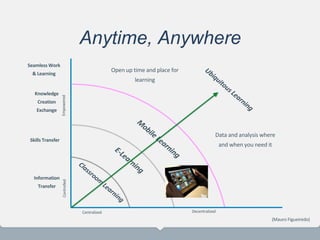
Anytime, Anywhere
Information
Transfer
DecentralizedCentralized
Skills Transfer
EmpoweredControlled
Knowledge
Creation
Exchange
Seamless Work
& Learning
Open up time and place for
learning
Data and analysis where
and when you need it
(Mauro Figueiredo)
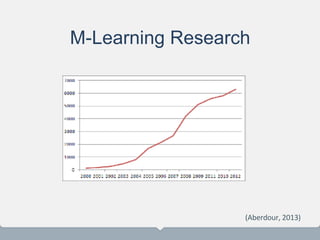
M-Learning Research
(Aberdour, 2013)
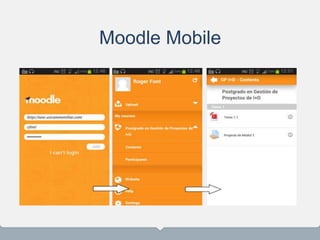
Moodle Mobile
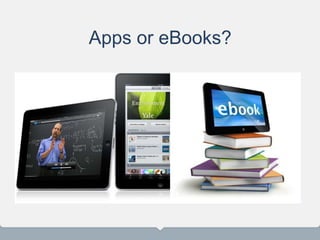
Apps or eBooks?
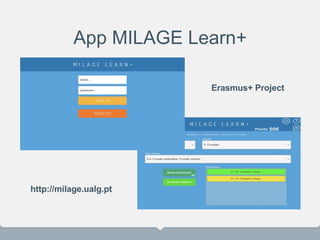
App MILAGE Learn+
http://milage.ualg.pt
Erasmus+ Project
Responsive Web vs. Native Apps
One of the first decisions product designers have to make is whether they are
going to just make a web product “friendly” for mobile screens or invest in
developing a mobile application.
Responsive Web:
• Requires an Internet Connection;
• Poor Performance (Browser Limitations);
• Lack of Natural Navigation;
• Lack of Push Notifications;
• Lack of Other Functionality (QR codes, voice recognition, AR, …).
Responsive Web vs. Native Apps
Native Apps:
• Internet Connection Not Always Necessary;
• Better Performance;
• Increased Functionality;
• Enhanced Security for Users;
• Brand Awareness and Accessibility;
• High investment in time and money.
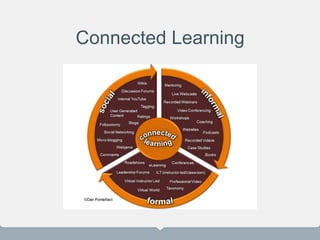
Connected Learning
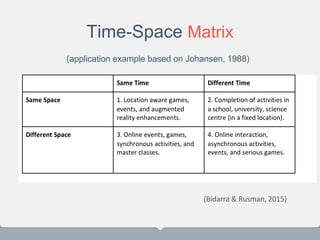
Time-Space Matrix
(Bidarra & Rusman, 2015)
16
(application example based on Johansen, 1988)
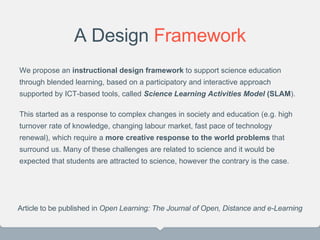
A Design Framework
We propose an instructional design framework to support science education
through blended learning, based on a participatory and interactive approach
supported by ICT-based tools, called Science Learning Activities Model (SLAM).
This started as a response to complex changes in society and education (e.g. high
turnover rate of knowledge, changing labour market, fast pace of technology
renewal), which require a more creative response to the world problems that
surround us. Many of these challenges are related to science and it would be
expected that students are attracted to science, however the contrary is the case.
Article to be published in Open Learning: The Journal of Open, Distance and e-Learning
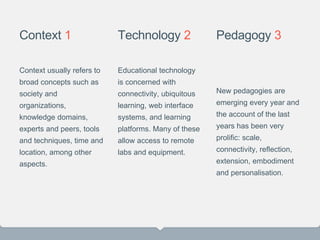
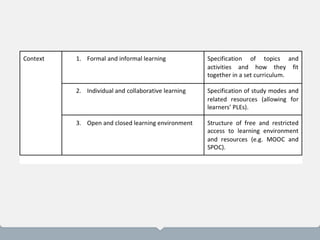
Context 1 Technology 2 Pedagogy 3
Context usually refers to
broad concepts such as
society and
organizations,
knowledge domains,
experts and peers, tools
and techniques, time and
location, among other
aspects.
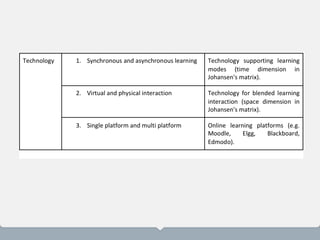
Educational technology
is concerned with
connectivity, ubiquitous
learning, web interface
systems, and learning
platforms. Many of these
allow access to remote
labs and equipment.
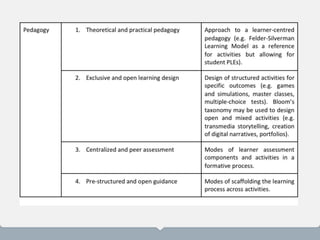
New pedagogies are
emerging every year and
the account of the last
years has been very
prolific: scale,
connectivity, reflection,
extension, embodiment
and personalisation.
Digital Storytelling
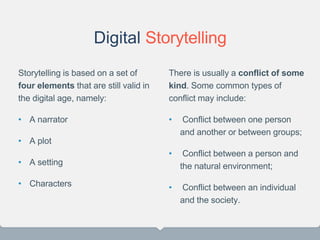
Storytelling is based on a set of
four elements that are still valid in
the digital age, namely:
• A narrator
• A plot
• A setting
• Characters
There is usually a conflict of some
kind. Some common types of
conflict may include:
• Conflict between one person
and another or between groups;
• Conflict between a person and
the natural environment;
• Conflict between an individual
and the society.
22
Content Gamification
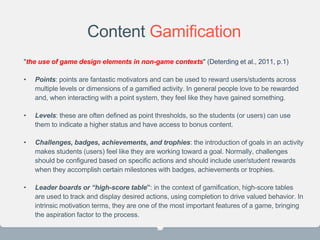
"the use of game design elements in non-game contexts" (Deterding et al., 2011, p.1)
• Points: points are fantastic motivators and can be used to reward users/students across
multiple levels or dimensions of a gamified activity. In general people love to be rewarded
and, when interacting with a point system, they feel like they have gained something.
• Levels: these are often defined as point thresholds, so the students (or users) can use
them to indicate a higher status and have access to bonus content.
• Challenges, badges, achievements, and trophies: the introduction of goals in an activity
makes students (users) feel like they are working toward a goal. Normally, challenges
should be configured based on specific actions and should include user/student rewards
when they accomplish certain milestones with badges, achievements or trophies.
• Leader boards or “high-score table”: in the context of gamification, high-score tables
are used to track and display desired actions, using completion to drive valued behavior. In
intrinsic motivation terms, they are one of the most important features of a game, bringing
the aspiration factor to the process.
23
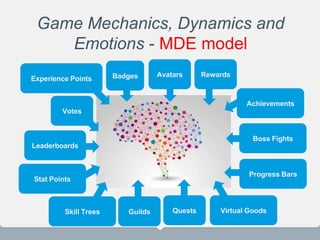
Game Mechanics, Dynamics and
Emotions - MDE model
Badges Avatars
Votes
Leaderboards
Achievements
Boss Fights
Virtual GoodsGuilds Quests
Rewards
Progress Bars
Skill Trees
Experience Points
Stat Points
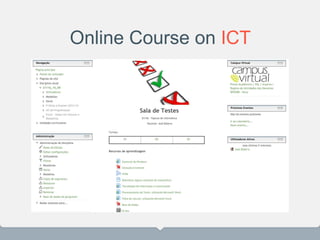
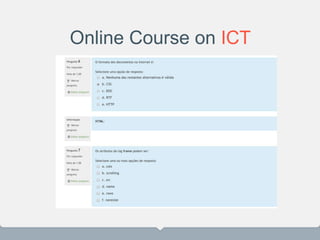
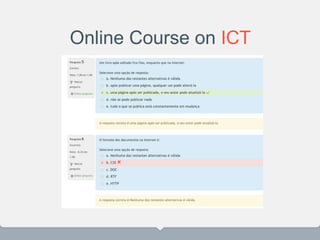
Online Course on ICT
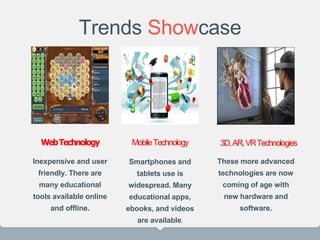
WebTechnology 3D,AR,VRTechnologiesMobileTechnology
Smartphones and
tablets use is
widespread. Many
educational apps,
ebooks, and videos
are available.
These more advanced
technologies are now
coming of age with
new hardware and
software.
Inexpensive and user
friendly. There are
many educational
tools available online
and offline.
Trends Showcase
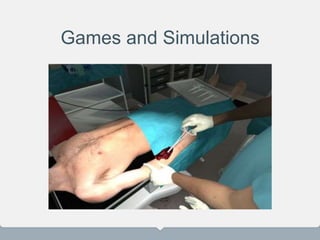
Games and Simulations
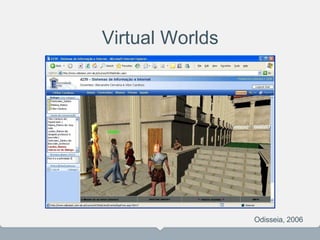
Virtual Worlds
Odisseia, 2006
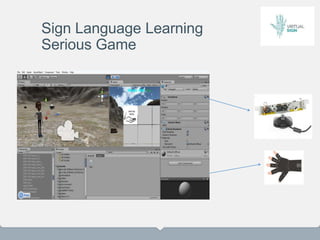
Sign Language Learning
Serious Game
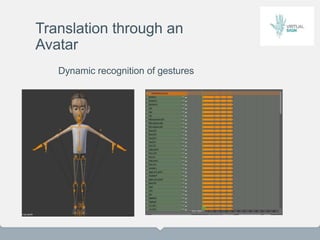
Translation through an
Avatar
Dynamic recognition of gestures
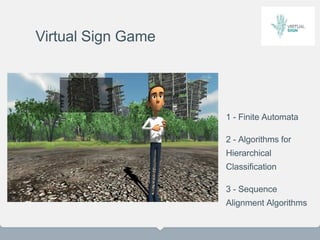
Virtual Sign Game
1 - Finite Automata
2 - Algorithms for
Hierarchical
Classification
3 - Sequence
Alignment Algorithms
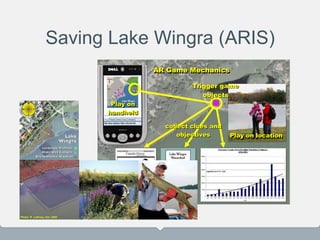
Saving Lake Wingra (ARIS)
AR Game Mechanics
Play on locationPlay on location
Play on
handheld
Play on
handheld
collect clues and
objectives
collect clues and
objectives
Trigger game
objects
Trigger game
objects
For a $3.5M 2005-2008 STAR Schools
grant with Harvard and MIT, my doctoral
research group made location-based
games using MITʼs Outdoor Augmented
Reality platform. It was prety cool stuff.
Saving Lake Wingra (ARIS)
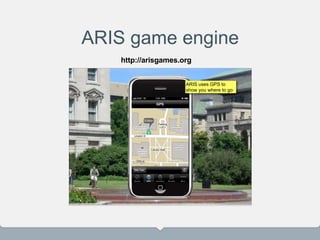
ARIS game engine
20
ARIS uses GPS to
show you where to go
http://arisgames.org
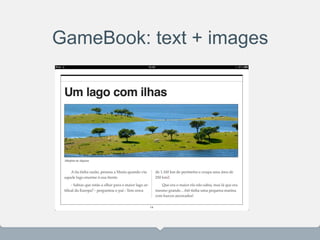
GameBook: text + images
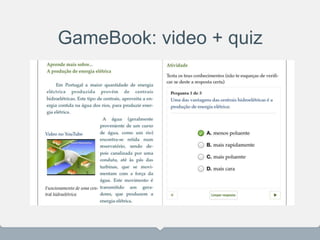
GameBook: video + quiz
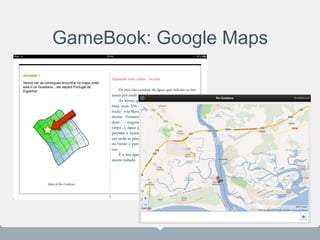
GameBook: Google Maps
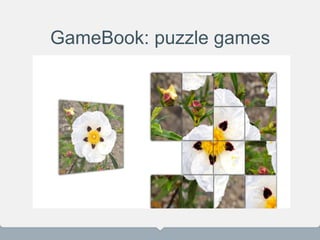
GameBook: puzzle games
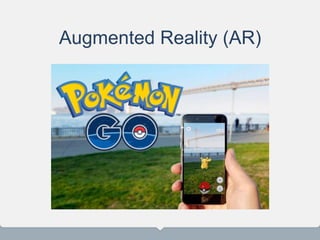
Augmented Reality (AR)
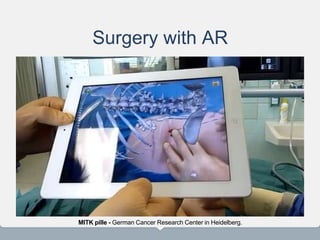
Surgery with AR
MITK pille - German Cancer Research Center in Heidelberg.
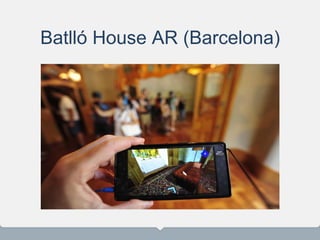
Batlló House AR (Barcelona)
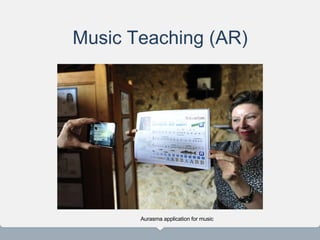
Music Teaching (AR)
Aurasma application for music
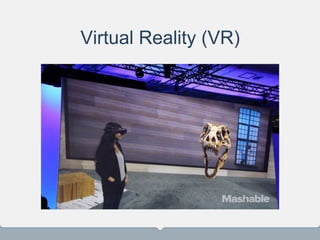
Google Glass
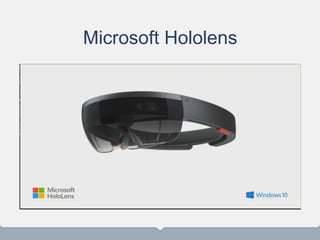
Microsoft Hololens
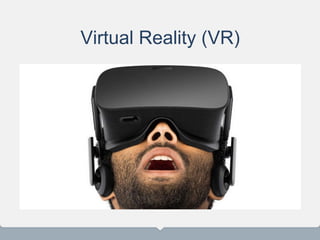
Virtual Reality (VR)
Virtual Reality (VR) (accessible
Google Cardboard)
Support the emergence of learners that are:
• always connected,
• in constant interaction,
• accessing vast information,
• making fast decisions,
• integrating different media.
What future?
THANK YOU!
JOSÉ BIDARRA
JOSE.BIDARRA@UAB.PT
CIAC – UALG – UAB
2017

Mobile Learning & New Trends

  • 1.
    Mobile Learning & NewTrends José Bidarra | Universidade Aberta | Portugal
  • 2.
  • 3.
    • 8 AM •12 AM • 2 PM • 4 PM • 7 PM “ICTs are not mere tools but rather environmental forces that are increasingly affecting us. For instance blurring the distinction between reality and virtuality, and blurring the distinction between human, machine and nature” (L. Floridi)
  • 4.
    Educational Technology According tothe EU Commission initiative Opening Up Education, between 50% and 80% of students in EU countries never use digital textbooks, exercise software, podcasts, simulations or learning games.
  • 5.
  • 6.
  • 7.
    Mobile Learning • Basicmodel: SMS, MMS, images & text • Responsive Web: accessible via browser (online) • Educational Apps: installed in the device (offline) • Educational eBooks: installed in the device (offline)
  • 8.
    Anytime, Anywhere Information Transfer DecentralizedCentralized Skills Transfer EmpoweredControlled Knowledge Creation Exchange SeamlessWork & Learning Open up time and place for learning Data and analysis where and when you need it (Mauro Figueiredo)
  • 9.
  • 10.
  • 11.
  • 12.
  • 13.
    Responsive Web vs.Native Apps One of the first decisions product designers have to make is whether they are going to just make a web product “friendly” for mobile screens or invest in developing a mobile application. Responsive Web: • Requires an Internet Connection; • Poor Performance (Browser Limitations); • Lack of Natural Navigation; • Lack of Push Notifications; • Lack of Other Functionality (QR codes, voice recognition, AR, …).
  • 14.
    Responsive Web vs.Native Apps Native Apps: • Internet Connection Not Always Necessary; • Better Performance; • Increased Functionality; • Enhanced Security for Users; • Brand Awareness and Accessibility; • High investment in time and money.
  • 15.
  • 16.
    Time-Space Matrix (Bidarra &Rusman, 2015) 16 (application example based on Johansen, 1988)
  • 17.
    A Design Framework Wepropose an instructional design framework to support science education through blended learning, based on a participatory and interactive approach supported by ICT-based tools, called Science Learning Activities Model (SLAM). This started as a response to complex changes in society and education (e.g. high turnover rate of knowledge, changing labour market, fast pace of technology renewal), which require a more creative response to the world problems that surround us. Many of these challenges are related to science and it would be expected that students are attracted to science, however the contrary is the case. Article to be published in Open Learning: The Journal of Open, Distance and e-Learning
  • 18.
    Context 1 Technology2 Pedagogy 3 Context usually refers to broad concepts such as society and organizations, knowledge domains, experts and peers, tools and techniques, time and location, among other aspects. Educational technology is concerned with connectivity, ubiquitous learning, web interface systems, and learning platforms. Many of these allow access to remote labs and equipment. New pedagogies are emerging every year and the account of the last years has been very prolific: scale, connectivity, reflection, extension, embodiment and personalisation.
  • 22.
    Digital Storytelling Storytelling isbased on a set of four elements that are still valid in the digital age, namely: • A narrator • A plot • A setting • Characters There is usually a conflict of some kind. Some common types of conflict may include: • Conflict between one person and another or between groups; • Conflict between a person and the natural environment; • Conflict between an individual and the society. 22
  • 23.
    Content Gamification "the useof game design elements in non-game contexts" (Deterding et al., 2011, p.1) • Points: points are fantastic motivators and can be used to reward users/students across multiple levels or dimensions of a gamified activity. In general people love to be rewarded and, when interacting with a point system, they feel like they have gained something. • Levels: these are often defined as point thresholds, so the students (or users) can use them to indicate a higher status and have access to bonus content. • Challenges, badges, achievements, and trophies: the introduction of goals in an activity makes students (users) feel like they are working toward a goal. Normally, challenges should be configured based on specific actions and should include user/student rewards when they accomplish certain milestones with badges, achievements or trophies. • Leader boards or “high-score table”: in the context of gamification, high-score tables are used to track and display desired actions, using completion to drive valued behavior. In intrinsic motivation terms, they are one of the most important features of a game, bringing the aspiration factor to the process. 23
  • 24.
    Game Mechanics, Dynamicsand Emotions - MDE model Badges Avatars Votes Leaderboards Achievements Boss Fights Virtual GoodsGuilds Quests Rewards Progress Bars Skill Trees Experience Points Stat Points
  • 25.
  • 26.
  • 27.
  • 28.
    WebTechnology 3D,AR,VRTechnologiesMobileTechnology Smartphones and tabletsuse is widespread. Many educational apps, ebooks, and videos are available. These more advanced technologies are now coming of age with new hardware and software. Inexpensive and user friendly. There are many educational tools available online and offline. Trends Showcase
  • 29.
  • 30.
  • 31.
  • 32.
  • 33.
    Virtual Sign Game 1- Finite Automata 2 - Algorithms for Hierarchical Classification 3 - Sequence Alignment Algorithms
  • 34.
    Saving Lake Wingra(ARIS) AR Game Mechanics Play on locationPlay on location Play on handheld Play on handheld collect clues and objectives collect clues and objectives Trigger game objects Trigger game objects For a $3.5M 2005-2008 STAR Schools grant with Harvard and MIT, my doctoral research group made location-based games using MITʼs Outdoor Augmented Reality platform. It was prety cool stuff.
  • 35.
  • 36.
    ARIS game engine 20 ARISuses GPS to show you where to go http://arisgames.org
  • 37.
  • 38.
  • 39.
  • 40.
  • 41.
  • 42.
    Surgery with AR MITKpille - German Cancer Research Center in Heidelberg.
  • 43.
    Batlló House AR(Barcelona)
  • 44.
    Music Teaching (AR) Aurasmaapplication for music
  • 45.
  • 46.
  • 47.
  • 48.
  • 49.
    Virtual Reality (VR)(accessible Google Cardboard)
  • 50.
    Support the emergenceof learners that are: • always connected, • in constant interaction, • accessing vast information, • making fast decisions, • integrating different media. What future?
  • 51.

Editor's Notes

  • #9 This chart shows the correlation between learner-control and levels of teaching (from information transfer to skills to knowledge creation to real work and learning).
  • #32 In order to progress in the game the players are encoraged to perform Gestures matching to certin words or frases. These gestures are recorded in real time using the Kinect and a pair of 5 DT Gloves. After being saved, the gesture is analysed, and the player performence is evaluated.
  • #33 2nd phase: In order to translate the words into gestures we move to a dynamic recognition of the Gestures. In this phase there are some challenges we faced such as: _ The Sequential combination of movements and hands configurations, that we have to control. _ The Significant variations, in the performance of the gesture, and the speed of the hands and body position; _ And the difficulty of perceiving, or understand where, each word begins and where it ends.
  • #34 In PSL There are 54 (fifty four) possible hands configurations (states); A word is defined by a transition from an initial state to a final state; Each state transition has an associated movement; _ Words classification : we have 3 classifiers, that we have used: 1- Finite Automata 2- Algorithms for Hierarchical Classification 3- Sequence Alignment Algorithms