Mobile learning: Hype or evidenced impact for higher educationapplications?Mohamed Ally, Ph.D.Director and ProfessorCentre for Distance EducationAthabasca UniversityCanadamohameda@athabascau.caEducation 2011-2021 SummitGlobal challenges and perspectives of blended and distance learning Sydney, AustraliaFebruary 2011
Presentation OutlineWhat is happening in mobile learning?Why higher education needs to get involved in mobile learning?Examples of use of mobile technology in higher educationCampus-based education Delivery ModelThe learner in mobile learningFuture of mobile technology in educationConclusion
International Association of Mobile LearningExecutive CommitteePresident - Agnes Kukulska-Hulme, The Open University, UKVice-President - Jill Attewell, Learning and Skills Network, UKSecretary - Jocelyn Wishart, University of Bristol, UKTreasurer - Tom Brown, Midrand Graduate Institute, South AfricaMember - Mohamed Ally, Athabasca University, CanadaMember - Vanessa Camilleri, University of Malta, MaltaMember - Brendan Tangney, Trinity College Dublin, IrelandMember - John Traxler, University of Wolverhampton, UK
International Association of Mobile LearningFounding DirectorsMohamed Ally - Athabasca University, Canada Jill Attewell - Learning and Skills Network, UK Tom Brown - Midrand Graduate Institute, South Africa Giorgio daBormida - EIGI ConsultingCaryl Oliver - caryloliver.com, Australia Mike Sharples - University of Nottingham, UK John Traxler - University of Wolverhampton, UK Herman van derMerwe - North West University, South Africa
Regional and Countries Mobile Learning AssociationsLatin AmericaMalaysiaArabian Gulf
Setting Standards for Mobile LearningWorking on a ISO standards committee to set standards for mobile learning for learners on the move (nomadic learners)International committee (Canada, South Korea, Germany) that reports to a larger committee
Mobile Learning JournalsInternational Journal of Interactive Mobile TechnologiesInternational Journal of Mobile and Blended LearningInternational Journal of Mobile Learning and Organisation
Journals that Published Mobile Learning PapersAmerican Journal of Distance EducationDistance EducationIRRODL (International Review of Research in Open and Distance Learning)Journal of Distance EducationBritish Journal of Educational TechnologyEducational Technology, Research and DevelopmentEducational Technology & Society
Mobile Learning ConferencesFive mobile learning conferences are being held in 2011 Many conferences,  including IEEE and ACM conferences, have mobile learning streams
The World Bank
UN Millennium Development GoalsGoal 1: Eradicate Extreme Hunger and PovertyGoal 2: Achieve Universal Primary EducationGoal 3: Promote Gender Equality and Empower WomenGoal 4: Reduce Child MortalityGoal 5: Improve Maternal HealthGoal 6: Combat HIV/AIDS, Malaria and other diseasesGoal 7: Ensure Environmental SustainabilityGoal 8: Develop a Global Partnership for Development
Connect the Indigenous Peoples with Mobile Technology
Mobile technology in different sectors
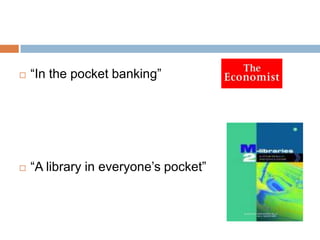
“In the pocket banking”“A library in everyone’s pocket”
“A doctor in everyone’s pocket”Are we ready for “Education in the pocket”
Are Faculty Ready for Mobile Learning?Corbeil et al. (2007) conducted a study where they asked students and faculty whether they are ready for mobile learning. Of the 107 students who responded, all students owned a smart phone or cell phone and 94 percent of the students said that they are ready for mobile learning; however, only 60 percent of faculty said that they are ready for mobile learning.Learners are ready to use mobile technology for learning but the question is “Are educators ready for mobile learning”.
Some people are predicting that mobile technology has no role in educationThey will be proven wrong We know of famous predictions in the past that were wrong. Examples include: The ‘telephone’ has too many shortcomings to be seriously considered as a means of communication. The device is inherently of no value to us. The cinema is little more than a fad. It’s canned drama. What audiences really want to see is flesh and blood on the stage.
Some educators, professionals and experts are resisting the use of mobile learning (some resisted the use of the internet in education but students and educators cannot do without the internet today)
Some experts are predicting that mobile devices are not suitable for learningWe know of other predictions that were wrong, for examplethere will be a need for only 5 computers in the worldwhy would anyone want a computer in the home etc.
There is no turning back - mobile learning can make a major contribution to education and society
Campus-based Education System
Is the physical campus system set up for learning?The campus-based higher education system is a complex system. The question is why is it so complex when learning should be learner-centered and it is the learner who is doing the learning?
Problems on Campus-Based InstitutionIf you think of a typical campus-based higher education institution today, common problems include: high dropout rate, high absenteeism, vandalism, conflict between students, conflict between faculty and students, old infrastructure, closure because of extreme weather conditions and break out of contagious diseases, students and staff safety, campus security, students or staff suing the university because of injury, etc.
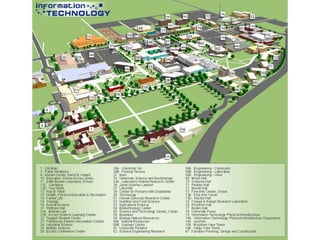
Campus-based institutions need the infrastructure to prevent and solve these problems. For example, health services, security guards, building maintenance, etc.
Operating Costs: Campus-based vs Distance Education InstitutionsThe campus-based university spent 34 percent of the budget on operating costs while the distance education university spent only 15 percent on operation. For a campus based university with total expenses of one billion dollars, 340 million is spent on operation. The operating cost for the campus based university is more than double the operating cost for the distance education universityThe infrastructure for campus-based institutions is buildings while the infrastructure for distance education is information technology.
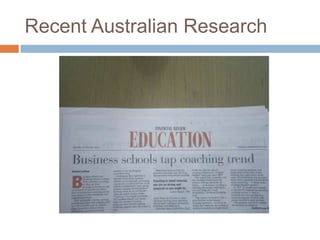
Recent Australian Research
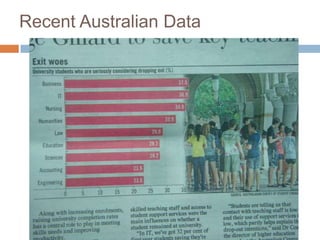
Recent Australian Data
Australian StudyResearchers surveyed 150 students who dropped out from 4 Australian Universities.Reasons for dropping out include:Teaching staffCourse contentLife issuesPaid work commitments
Mobile Learning around the World
Mobile technology in education around the worldMany mobile learning projects in Europe. For example, HandLeR, MOBILearn, Caerus, Mobile Learning Organiser, Myartspace, etc.At Athabasca University there are developments and research on the use of mobile technology in course delivery, language training, workplace learning, and reading by older adults.The first international conference on mobile learning was held in the United Kingdom in 2002.
ChinaThe Network Education College, which is an online college in China, implemented online learning where students can access learning materials from anywhere and at anytime using a variety of technology, including mobile devices.Because of the flexibility in access of learning materials, enrolment grew from 200 to 17,000 in seven years.
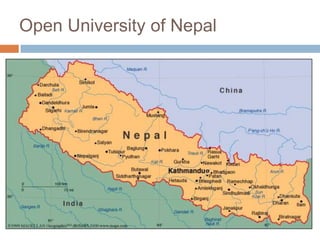
Open University of Nepal
Latin AmericaThere are approximately between 50 and 60 millions underserved indigenous people in Latin America who have limited or no access to formal education.Many of these people are nomads where they travel from one location to the next to make a living.An research project was conducted to develop a mobile learning model to use mobile technologies to reach these underserved indigenous people.Results showed that the students were able to use the devices to learn and the parents used the devices occasionally to improve their vocabulary.
United StatesEducational institutions are giving students mobile devices as standard resources required to complete an education. Abilene Christian University gave iPods or iPhones to freshman students.University of Texas at San Antonio and gave free iPod Touches to teachers who attended a technology training workshop.
Other CountriesGovernments of countries are giving people wireless mobile devices or portable devices for learning.
Example of Projects at Athabasca UniversityCourse Delivery Using Mobile Devices
Mobile Course DeliveryStudy was directed to over 500 students in 3 different computer science courses (all are completely online and distance delivery)Students were asked to complete a unit of study using a mobile device then complete a surveyMany students completed one or more units but only a sub-set of the students completed the survey to determine their experience with the mobile devices
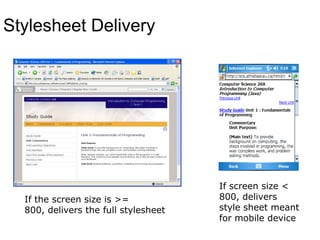
Delivering to Specific DevicesDevice detection had been problematic because new devices and mobile OSs and browsers were constantly coming on stream.Created problems for the device detection scheme used to determine the mobile device:String user_agent = request.getHeader("user-agent");Changed to JavaScript to determine screen real estate:if (screen.width >= 800) {  document.write('<style type=\"text/css\">…..
Stylesheet DeliveryIf screen size < 800, delivers style sheet meant for mobile deviceIf the screen size is >= 800, delivers the full stylesheet
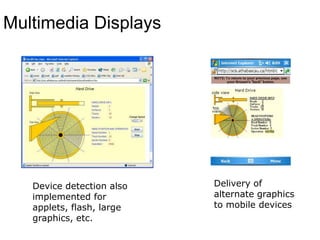
Multimedia DisplaysDelivery of alternate graphics to mobile devicesDevice detection also implemented for applets, flash, large graphics, etc.
ResultsNo difficulties encountered in access using mobile devices.A variety of devices used by students:   iPaq, PalmOne Treo and Tungsten,  Blackberry, Dell Axim, Pantech 3200, Motorola Razor, Samsung, UT Starcom,   Toshiba Pocket PC e330, and even a PSP (Portable Sony Playstation). A complete range of connection plans including WiFi, phone plans, and desktop synchronization.
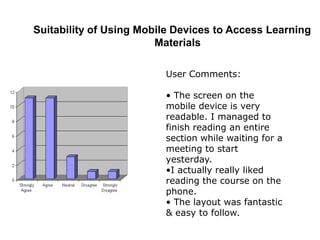
Suitability of Using Mobile Devices to Access Learning MaterialsUser Comments: The screen on the mobile device is very readable. I managed to finish reading an entire section while waiting for a meeting to start yesterday.
I actually really liked reading the course on the phone.
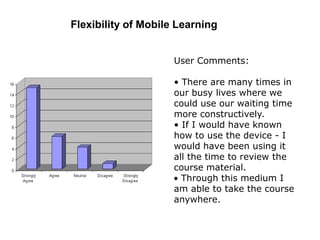
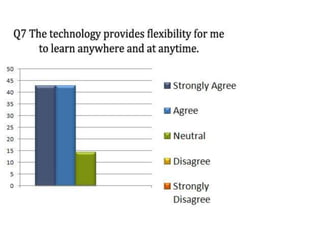
 The layout was fantastic & easy to follow. Flexibility of Mobile LearningUser Comments: There are many times in our busy lives where we could use our waiting time more constructively.
 If I would have known how to use the device - I would have been using it all the time to review the course material.
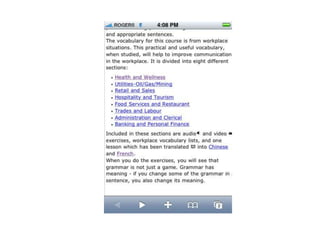
 Through this medium I am able to take the course anywhere.Language Training
Benefits of Mobile Learning to Learners
New Generations of StudentsOnline presenceNow generationVirtual generationSocial networkingGamesDigital expertsAdapt to technology quicklyTechnology is second nature
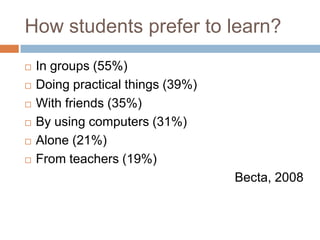
How students prefer to learn?In groups (55%)Doing practical things (39%)With friends (35%)By using computers (31%)Alone (21%)From teachers (19%)Becta, 2008
Use of Mobile Technology in EducationUses of mobile technologies in education include: administration of learning, monitoring students’ progress, providing learner support, interactive activities to promote higher level learning, delivery of learning materials, use of context specific activities, workplace learning, just-in-time learning, and reaching the disabled.Gaskill and Mills (2009)
Learnable Moment
Mobile learning benefits learners since they can use mobile devices to learn in their own learning community where situated learning, authentic learning, context aware learning, augmented reality mobile learning, and personalized learning are encouraged (Traxler, 2010).Learning will move more and more outside of the classroom and into the learner’s environments, both real and virtual, thus becoming more situated, personal, collaborative and lifelong (Naismith et al., 2006).
Mobile Learning to Develop 21st Century SkillsUse of mobile technology by learners will help the learners develop 21st century skills required by learners when they join the workforce.
21st Century Skills AreaCommunicationProject ManagementContinuous ImprovementProblem SolvingInformation and Communication TechnologyTeam WorkPersonal Well-beingLeadershipGlobalizationResearchCritical Thinking
Mobile Technology
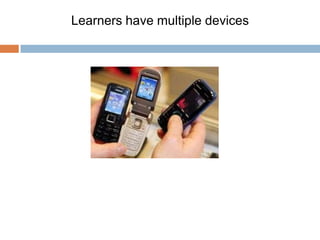
Learners have multiple devices
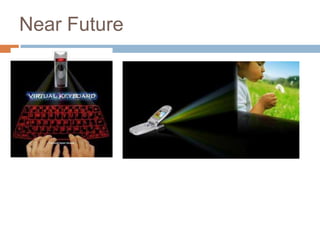
Near Future
FutureIn the future, mobile devices will look completely difference from what they are today.According to a recent Futurelab report, by 2020, digital technology will be embedded and distributed in most objects.Personal artefacts such as keys, clothes, shoes, notebook, and newspaper will have devices embedded within them which can communicate with each other.We will not be taking any devices with us, they will exist everywhere.
Everything will be connected to everything through network. There will no longer be any such thing as ‘the internet’, ‘telephone’, ‘TV’ and so forth; instead there is blanket wireless connectivity to the network which allows access to all communications channels even in remote areas.
Input to and feedback from digital technologies will become much more ‘natural’ by 2020, and we feel as though we are interacting with things and with people, not machines, screens and keyboards.
Conclusion
Is the use of mobile technology ‘hype’?
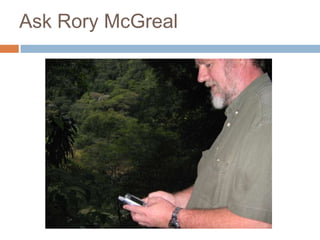
Ask Rory McGreal
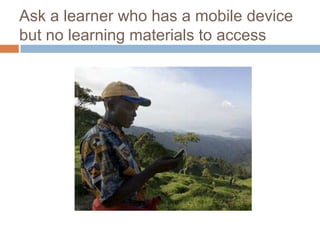
Ask a learner who has a mobile device but no learning materials to access
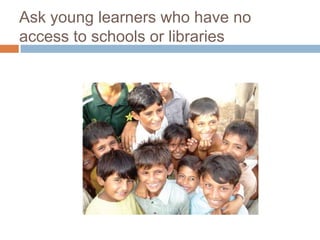
Ask young learners who have no access to schools or libraries
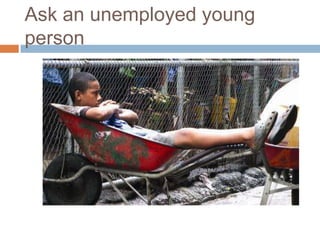
Ask an unemployed young person
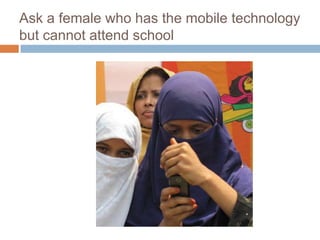
Ask a female who has the mobile technology but cannot attend school
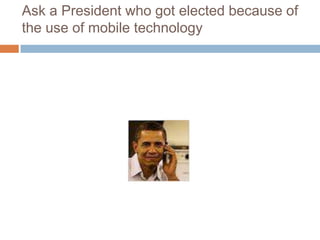
Ask a President who got elected because of the use of mobile technology
Young people are using mobile technology for revolutions because of lack of jobs, no human rights, suppression, high prices for basic needs (education, food), etc.Would it take a revolution by young learners to transform education to meet their needs?
With Mobile Learning “Education for All” is possible
Social JusticeThe concept of social justice expresses an ideal in which all members of society are treated fairly and have access to their fair share of society’s goods.

Mobile learning: Hype or evidenced impact for higher education applications?

  • 1.
    Mobile learning: Hypeor evidenced impact for higher educationapplications?Mohamed Ally, Ph.D.Director and ProfessorCentre for Distance EducationAthabasca UniversityCanadamohameda@athabascau.caEducation 2011-2021 SummitGlobal challenges and perspectives of blended and distance learning Sydney, AustraliaFebruary 2011
  • 5.
    Presentation OutlineWhat ishappening in mobile learning?Why higher education needs to get involved in mobile learning?Examples of use of mobile technology in higher educationCampus-based education Delivery ModelThe learner in mobile learningFuture of mobile technology in educationConclusion
  • 6.
    International Association ofMobile LearningExecutive CommitteePresident - Agnes Kukulska-Hulme, The Open University, UKVice-President - Jill Attewell, Learning and Skills Network, UKSecretary - Jocelyn Wishart, University of Bristol, UKTreasurer - Tom Brown, Midrand Graduate Institute, South AfricaMember - Mohamed Ally, Athabasca University, CanadaMember - Vanessa Camilleri, University of Malta, MaltaMember - Brendan Tangney, Trinity College Dublin, IrelandMember - John Traxler, University of Wolverhampton, UK
  • 7.
    International Association ofMobile LearningFounding DirectorsMohamed Ally - Athabasca University, Canada Jill Attewell - Learning and Skills Network, UK Tom Brown - Midrand Graduate Institute, South Africa Giorgio daBormida - EIGI ConsultingCaryl Oliver - caryloliver.com, Australia Mike Sharples - University of Nottingham, UK John Traxler - University of Wolverhampton, UK Herman van derMerwe - North West University, South Africa
  • 8.
    Regional and CountriesMobile Learning AssociationsLatin AmericaMalaysiaArabian Gulf
  • 9.
    Setting Standards forMobile LearningWorking on a ISO standards committee to set standards for mobile learning for learners on the move (nomadic learners)International committee (Canada, South Korea, Germany) that reports to a larger committee
  • 10.
    Mobile Learning JournalsInternationalJournal of Interactive Mobile TechnologiesInternational Journal of Mobile and Blended LearningInternational Journal of Mobile Learning and Organisation
  • 11.
    Journals that PublishedMobile Learning PapersAmerican Journal of Distance EducationDistance EducationIRRODL (International Review of Research in Open and Distance Learning)Journal of Distance EducationBritish Journal of Educational TechnologyEducational Technology, Research and DevelopmentEducational Technology & Society
  • 12.
    Mobile Learning ConferencesFivemobile learning conferences are being held in 2011 Many conferences, including IEEE and ACM conferences, have mobile learning streams
  • 13.
  • 14.
    UN Millennium DevelopmentGoalsGoal 1: Eradicate Extreme Hunger and PovertyGoal 2: Achieve Universal Primary EducationGoal 3: Promote Gender Equality and Empower WomenGoal 4: Reduce Child MortalityGoal 5: Improve Maternal HealthGoal 6: Combat HIV/AIDS, Malaria and other diseasesGoal 7: Ensure Environmental SustainabilityGoal 8: Develop a Global Partnership for Development
  • 15.
    Connect the IndigenousPeoples with Mobile Technology
  • 17.
    Mobile technology indifferent sectors
  • 18.
    “In the pocketbanking”“A library in everyone’s pocket”
  • 19.
    “A doctor ineveryone’s pocket”Are we ready for “Education in the pocket”
  • 20.
    Are Faculty Readyfor Mobile Learning?Corbeil et al. (2007) conducted a study where they asked students and faculty whether they are ready for mobile learning. Of the 107 students who responded, all students owned a smart phone or cell phone and 94 percent of the students said that they are ready for mobile learning; however, only 60 percent of faculty said that they are ready for mobile learning.Learners are ready to use mobile technology for learning but the question is “Are educators ready for mobile learning”.
  • 21.
    Some people arepredicting that mobile technology has no role in educationThey will be proven wrong We know of famous predictions in the past that were wrong. Examples include: The ‘telephone’ has too many shortcomings to be seriously considered as a means of communication. The device is inherently of no value to us. The cinema is little more than a fad. It’s canned drama. What audiences really want to see is flesh and blood on the stage.
  • 22.
    Some educators, professionalsand experts are resisting the use of mobile learning (some resisted the use of the internet in education but students and educators cannot do without the internet today)
  • 23.
    Some experts arepredicting that mobile devices are not suitable for learningWe know of other predictions that were wrong, for examplethere will be a need for only 5 computers in the worldwhy would anyone want a computer in the home etc.
  • 24.
    There is noturning back - mobile learning can make a major contribution to education and society
  • 25.
  • 26.
    Is the physicalcampus system set up for learning?The campus-based higher education system is a complex system. The question is why is it so complex when learning should be learner-centered and it is the learner who is doing the learning?
  • 27.
    Problems on Campus-BasedInstitutionIf you think of a typical campus-based higher education institution today, common problems include: high dropout rate, high absenteeism, vandalism, conflict between students, conflict between faculty and students, old infrastructure, closure because of extreme weather conditions and break out of contagious diseases, students and staff safety, campus security, students or staff suing the university because of injury, etc.
  • 28.
    Campus-based institutions needthe infrastructure to prevent and solve these problems. For example, health services, security guards, building maintenance, etc.
  • 31.
    Operating Costs: Campus-basedvs Distance Education InstitutionsThe campus-based university spent 34 percent of the budget on operating costs while the distance education university spent only 15 percent on operation. For a campus based university with total expenses of one billion dollars, 340 million is spent on operation. The operating cost for the campus based university is more than double the operating cost for the distance education universityThe infrastructure for campus-based institutions is buildings while the infrastructure for distance education is information technology.
  • 32.
  • 33.
  • 34.
    Australian StudyResearchers surveyed150 students who dropped out from 4 Australian Universities.Reasons for dropping out include:Teaching staffCourse contentLife issuesPaid work commitments
  • 35.
  • 36.
    Mobile technology ineducation around the worldMany mobile learning projects in Europe. For example, HandLeR, MOBILearn, Caerus, Mobile Learning Organiser, Myartspace, etc.At Athabasca University there are developments and research on the use of mobile technology in course delivery, language training, workplace learning, and reading by older adults.The first international conference on mobile learning was held in the United Kingdom in 2002.
  • 37.
    ChinaThe Network EducationCollege, which is an online college in China, implemented online learning where students can access learning materials from anywhere and at anytime using a variety of technology, including mobile devices.Because of the flexibility in access of learning materials, enrolment grew from 200 to 17,000 in seven years.
  • 38.
  • 39.
    Latin AmericaThere areapproximately between 50 and 60 millions underserved indigenous people in Latin America who have limited or no access to formal education.Many of these people are nomads where they travel from one location to the next to make a living.An research project was conducted to develop a mobile learning model to use mobile technologies to reach these underserved indigenous people.Results showed that the students were able to use the devices to learn and the parents used the devices occasionally to improve their vocabulary.
  • 40.
    United StatesEducational institutionsare giving students mobile devices as standard resources required to complete an education. Abilene Christian University gave iPods or iPhones to freshman students.University of Texas at San Antonio and gave free iPod Touches to teachers who attended a technology training workshop.
  • 41.
    Other CountriesGovernments ofcountries are giving people wireless mobile devices or portable devices for learning.
  • 42.
    Example of Projectsat Athabasca UniversityCourse Delivery Using Mobile Devices
  • 43.
    Mobile Course DeliveryStudywas directed to over 500 students in 3 different computer science courses (all are completely online and distance delivery)Students were asked to complete a unit of study using a mobile device then complete a surveyMany students completed one or more units but only a sub-set of the students completed the survey to determine their experience with the mobile devices
  • 44.
    Delivering to SpecificDevicesDevice detection had been problematic because new devices and mobile OSs and browsers were constantly coming on stream.Created problems for the device detection scheme used to determine the mobile device:String user_agent = request.getHeader("user-agent");Changed to JavaScript to determine screen real estate:if (screen.width >= 800) { document.write('<style type=\"text/css\">…..
  • 45.
    Stylesheet DeliveryIf screensize < 800, delivers style sheet meant for mobile deviceIf the screen size is >= 800, delivers the full stylesheet
  • 46.
    Multimedia DisplaysDelivery ofalternate graphics to mobile devicesDevice detection also implemented for applets, flash, large graphics, etc.
  • 47.
    ResultsNo difficulties encounteredin access using mobile devices.A variety of devices used by students: iPaq, PalmOne Treo and Tungsten, Blackberry, Dell Axim, Pantech 3200, Motorola Razor, Samsung, UT Starcom, Toshiba Pocket PC e330, and even a PSP (Portable Sony Playstation). A complete range of connection plans including WiFi, phone plans, and desktop synchronization.
  • 48.
    Suitability of UsingMobile Devices to Access Learning MaterialsUser Comments: The screen on the mobile device is very readable. I managed to finish reading an entire section while waiting for a meeting to start yesterday.
  • 49.
    I actually reallyliked reading the course on the phone.
  • 50.
    The layoutwas fantastic & easy to follow. Flexibility of Mobile LearningUser Comments: There are many times in our busy lives where we could use our waiting time more constructively.
  • 51.
    If Iwould have known how to use the device - I would have been using it all the time to review the course material.
  • 52.
    Through thismedium I am able to take the course anywhere.Language Training
  • 56.
    Benefits of MobileLearning to Learners
  • 57.
    New Generations ofStudentsOnline presenceNow generationVirtual generationSocial networkingGamesDigital expertsAdapt to technology quicklyTechnology is second nature
  • 58.
    How students preferto learn?In groups (55%)Doing practical things (39%)With friends (35%)By using computers (31%)Alone (21%)From teachers (19%)Becta, 2008
  • 59.
    Use of MobileTechnology in EducationUses of mobile technologies in education include: administration of learning, monitoring students’ progress, providing learner support, interactive activities to promote higher level learning, delivery of learning materials, use of context specific activities, workplace learning, just-in-time learning, and reaching the disabled.Gaskill and Mills (2009)
  • 60.
  • 61.
    Mobile learning benefitslearners since they can use mobile devices to learn in their own learning community where situated learning, authentic learning, context aware learning, augmented reality mobile learning, and personalized learning are encouraged (Traxler, 2010).Learning will move more and more outside of the classroom and into the learner’s environments, both real and virtual, thus becoming more situated, personal, collaborative and lifelong (Naismith et al., 2006).
  • 62.
    Mobile Learning toDevelop 21st Century SkillsUse of mobile technology by learners will help the learners develop 21st century skills required by learners when they join the workforce.
  • 63.
    21st Century SkillsAreaCommunicationProject ManagementContinuous ImprovementProblem SolvingInformation and Communication TechnologyTeam WorkPersonal Well-beingLeadershipGlobalizationResearchCritical Thinking
  • 64.
  • 65.
  • 67.
  • 68.
    FutureIn the future,mobile devices will look completely difference from what they are today.According to a recent Futurelab report, by 2020, digital technology will be embedded and distributed in most objects.Personal artefacts such as keys, clothes, shoes, notebook, and newspaper will have devices embedded within them which can communicate with each other.We will not be taking any devices with us, they will exist everywhere.
  • 69.
    Everything will beconnected to everything through network. There will no longer be any such thing as ‘the internet’, ‘telephone’, ‘TV’ and so forth; instead there is blanket wireless connectivity to the network which allows access to all communications channels even in remote areas.
  • 70.
    Input to andfeedback from digital technologies will become much more ‘natural’ by 2020, and we feel as though we are interacting with things and with people, not machines, screens and keyboards.
  • 71.
  • 72.
    Is the useof mobile technology ‘hype’?
  • 73.
  • 74.
    Ask a learnerwho has a mobile device but no learning materials to access
  • 75.
    Ask young learnerswho have no access to schools or libraries
  • 76.
    Ask an unemployedyoung person
  • 77.
    Ask a femalewho has the mobile technology but cannot attend school
  • 78.
    Ask a Presidentwho got elected because of the use of mobile technology
  • 79.
    Young people areusing mobile technology for revolutions because of lack of jobs, no human rights, suppression, high prices for basic needs (education, food), etc.Would it take a revolution by young learners to transform education to meet their needs?
  • 80.
    With Mobile Learning“Education for All” is possible
  • 81.
    Social JusticeThe conceptof social justice expresses an ideal in which all members of society are treated fairly and have access to their fair share of society’s goods.
  • 82.
    Research NeededHow todesign for the unknownHow to design for learners on the moveMost effective interfaces for mobile and virtual devicesHow to design information rich content for mobile deliveryWhat are the characteristics of mobile technology for different culturesInteractivity on mobile devicesIntelligent learning materialsLearner-generated content for mobile learningOER for mobile delivery
  • 83.
    Thank youDr. MohamedAllyDirector and ProfessorAthabasca UniversityCanadamohameda@athabascau.ca