Using Computer Game Design to Foster Successful Learners  Dr Judy Robertson Heriot-Watt University Cathrin Howells Creative Contexts
Overview In the Adventure Author project, we have been working with young people as they make their own computer games. In this talk we will discuss why game making is a rich task for learning and how it fits in with the Curriculum for Excellence in Scotland. We will look at the “successful learner” strand in particular We will give illustrative examples from a recently completed field study in a primary school
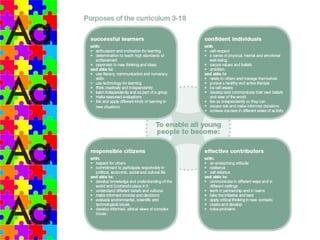
Curriculum for Excellence in Scotland Confident individuals Responsible citizens Effective contributors Successful learners Think independently and creatively Have enthusiasm and motivation for learning Learn independently and as part of a group Make reasoned evaluations
Field studies We have conducted various community education field studies with the Neverwinter Nights game authoring toolkit This year we decided to look at a more formal learning environment: 8 week field study in a state funded primary school in Dundee 30x 9-10 year old children, one class teacher, one ICT specialist teacher, 3 researchers Each pupil had 40 minutes to work on game per session We’re now working on improving the game making software.
NWN demo
Learning activities Demo software skills (e.g. conversation editing) to whole group Discuss model games (by adults or other learners) in group Give children goal for session (e.g. to have finished an interactive conversation)  OR Give children time for exploratory play – try out what is possible in toolset and game  Plenary sessions for sharing what was learned, exchanging tips Peer play testing Teaching visitors how to play
Enthusiasm and motivation for learning “ It was the best thing I've done.” (Alex Rider) “ I really, really enjoyed it . . . Thank you for letting me make my own game.” (John) Something novel: “ It was an opportunity – not everyone gets to do this.” (Jack) Best thing: “ The challenge of making the game – hard things.” (James Bond)
Determination to reach high standards of achievement New computing skills Demands of the NWN toolset  Area transitions! New thinking skills Orchestration of game ideas Understanding the player's perspective  Working with constraints of time and hardware and creative flexibility
Learning independently “My favourite bit was when I played my game and see what went wrong.” (Rene) “He . . . insisted I show him what he was doing wrong rather than doing it for him.” (Researcher’s notes) CJ was able to generalise how to make portals after being shown one example by a researcher. Brush fire effect . . .
Learning in groups whole class discussions beginning and ending each workshop informal opportunities for paired and small group interactions  collaboration informal peer-tutoring structured peer-testing sessions  occasional needs-related groups
Linking and applying learning implicit use of inference supporting the player editing and improving writing explicit “ Well, I wrote a story and now I’m transforming it and making it better.” (Nadia) “ It’s a better way of learning like, better sort of language work, cos its more fun and it helps you with computing as well… it helps you with your conversation… you think about it a lot more to make your game better”  (Predator) cross-curricular opportunities
Reasoned evaluation identifying and rectifying errors  decisions about changes to games implications of sequences of decisions effective game design evaluation of software
Creative thinking: evolution of ideas The toolset caused game ideas to change because: It was not possible or was too difficult to accomplish original idea The author discovered a new feature of the software and thus new possibilities Some children deliberately relied on game ideas emerging from toolset (rather than planning up front)
Creative thinking: evolution of ideas (2) Ideas also changed because the author: Realised plans were too complex and scaled back Grew in skill and gained confidence to tackle more complex ideas Forgot original ideas! Realised the game was incoherent Wanted to accommodate peer feedback Had to prioritise because of time constraints
Implications What would it take to spread this success more widely?  Teacher training: In technology skills In constructivist learning approaches In diagnosing successful learner component skills Game capable hardware in schools (in this case graphics cards) A curriculum which truly values cross curricular flexibility
Conclusions Game making creates a rich environment for learning. Its complexity is an asset.  It can foster the development of  successful learning  skills, including creativity Incorporating learning of this style in classrooms will be challenging… …  but the benefits could be great within the Curriculum for Excellence framework.
Any questions? Thank you! [email_address] [email_address]   http://www.macs.hw.ac.uk/AdventureAuthor/
 

Using Computer Game Design For Learning

  • 1.
    Using Computer GameDesign to Foster Successful Learners Dr Judy Robertson Heriot-Watt University Cathrin Howells Creative Contexts
  • 2.
    Overview In theAdventure Author project, we have been working with young people as they make their own computer games. In this talk we will discuss why game making is a rich task for learning and how it fits in with the Curriculum for Excellence in Scotland. We will look at the “successful learner” strand in particular We will give illustrative examples from a recently completed field study in a primary school
  • 3.
    Curriculum for Excellencein Scotland Confident individuals Responsible citizens Effective contributors Successful learners Think independently and creatively Have enthusiasm and motivation for learning Learn independently and as part of a group Make reasoned evaluations
  • 4.
    Field studies Wehave conducted various community education field studies with the Neverwinter Nights game authoring toolkit This year we decided to look at a more formal learning environment: 8 week field study in a state funded primary school in Dundee 30x 9-10 year old children, one class teacher, one ICT specialist teacher, 3 researchers Each pupil had 40 minutes to work on game per session We’re now working on improving the game making software.
  • 5.
  • 6.
    Learning activities Demosoftware skills (e.g. conversation editing) to whole group Discuss model games (by adults or other learners) in group Give children goal for session (e.g. to have finished an interactive conversation) OR Give children time for exploratory play – try out what is possible in toolset and game Plenary sessions for sharing what was learned, exchanging tips Peer play testing Teaching visitors how to play
  • 7.
    Enthusiasm and motivationfor learning “ It was the best thing I've done.” (Alex Rider) “ I really, really enjoyed it . . . Thank you for letting me make my own game.” (John) Something novel: “ It was an opportunity – not everyone gets to do this.” (Jack) Best thing: “ The challenge of making the game – hard things.” (James Bond)
  • 8.
    Determination to reachhigh standards of achievement New computing skills Demands of the NWN toolset Area transitions! New thinking skills Orchestration of game ideas Understanding the player's perspective Working with constraints of time and hardware and creative flexibility
  • 9.
    Learning independently “Myfavourite bit was when I played my game and see what went wrong.” (Rene) “He . . . insisted I show him what he was doing wrong rather than doing it for him.” (Researcher’s notes) CJ was able to generalise how to make portals after being shown one example by a researcher. Brush fire effect . . .
  • 10.
    Learning in groupswhole class discussions beginning and ending each workshop informal opportunities for paired and small group interactions collaboration informal peer-tutoring structured peer-testing sessions occasional needs-related groups
  • 11.
    Linking and applyinglearning implicit use of inference supporting the player editing and improving writing explicit “ Well, I wrote a story and now I’m transforming it and making it better.” (Nadia) “ It’s a better way of learning like, better sort of language work, cos its more fun and it helps you with computing as well… it helps you with your conversation… you think about it a lot more to make your game better” (Predator) cross-curricular opportunities
  • 12.
    Reasoned evaluation identifyingand rectifying errors decisions about changes to games implications of sequences of decisions effective game design evaluation of software
  • 13.
    Creative thinking: evolutionof ideas The toolset caused game ideas to change because: It was not possible or was too difficult to accomplish original idea The author discovered a new feature of the software and thus new possibilities Some children deliberately relied on game ideas emerging from toolset (rather than planning up front)
  • 14.
    Creative thinking: evolutionof ideas (2) Ideas also changed because the author: Realised plans were too complex and scaled back Grew in skill and gained confidence to tackle more complex ideas Forgot original ideas! Realised the game was incoherent Wanted to accommodate peer feedback Had to prioritise because of time constraints
  • 15.
    Implications What wouldit take to spread this success more widely? Teacher training: In technology skills In constructivist learning approaches In diagnosing successful learner component skills Game capable hardware in schools (in this case graphics cards) A curriculum which truly values cross curricular flexibility
  • 16.
    Conclusions Game makingcreates a rich environment for learning. Its complexity is an asset. It can foster the development of successful learning skills, including creativity Incorporating learning of this style in classrooms will be challenging… … but the benefits could be great within the Curriculum for Excellence framework.
  • 17.
    Any questions? Thankyou! [email_address] [email_address] http://www.macs.hw.ac.uk/AdventureAuthor/
  • 18.