
Ensuring Progression
Getting Started
Purpose of the workshop:
 to explore how progression is embedded
within the curriculum framework
 share practical suggestions on how to get
started within a school/authority
 begin to consider implications for planning
and recognising progress
Definition in website glossary:
“ Progression means increasing the breadth and the depth
of learning at each level as well as providing greater
challenge for pupils as they move to the next levels.
The experiences and outcomes offer opportunities to
consolidate and extend learning in individual areas in order
to meet the varied needs of children and young people,
recognising that children and young people will progress at
different rates.
...the curriculum framework sets out broad expectations for
progression.....”
How can I see progression within the
framework?
Principles of curriculum design (BtC 3)
Principles and practice section
Progression across the levels
Progression within a level
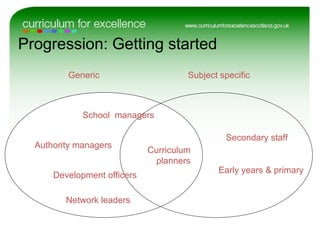
 Progression: Getting started     
Curriculum 
planners
Secondary staff
Early years & primary
Generic Subject specific
School  managers
Authority managers
Network leaders
Development officers
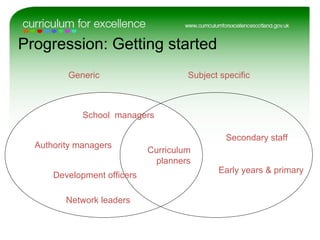
 Progression: Getting started     
Curriculum 
planners
Secondary staff
Early years & primary
Generic Subject specific
School  managers
Authority managers
Network leaders
Development officers

Ensuring Progression: getting started

Editor's Notes

  • #2 Emphasis is on getting started, and use this as determining your starting point as each will be at different stages.
  • #3 Introduce that often progression and assessment are used interchangeably so for clarification there is a definition on the website(see next slide)
  • #4 TOO SMALL TO BE SEEN BUT say that it can be accessed on the website by typing in progression. Key points Breadth and depth of learning at each level and across the levels. Learners progress at different rates The framework sets out BROAD EXPECTATIONS: Because the new framework gives an outline of progression this doesn’t mean a dropping of standards, so there is perhaps a question on how to achieve consistent application of standards. Also to ensure depth and not racing through the levels.
  • #5 I ask myself this when I have downloaded the p&p and experiences and outcomes because I need to see where it is and I need to think about what it is so that I can plan. I also want to identify what I am doing already that sits well within the framework to know that I am not starting from scratch.
  • #6 So when you are doing the tasks, it is worth thinking about the range of people who could use them in a variety of ways. Everyone is a curriculum planner so bear in mind that the aim of the tasks is serve the purpose of giving insight into possible ways of getting started. Individual tasks could be extended and amended according to your target group: so it may be as a department, a primary staff group, ASG’s, authority L&T networks/subject networks etc. So the time allocations will not be sufficient for you to work through in great detail...that is not within the scope of one hour.