





EXEMPLIFICATION: What does it mean?
WHY?  To support teachers in their planning and to ensure that the Es and Os are translated into very good teaching, learning and achievement for ALL learners To deepen teachers’ understanding of what young people are expected to learn To identify innovative contexts for learning To see effective learning and teaching in action Exemplification
Planning for Exemplification WHAT? 3 High Level Organisers : Clarifying the learning Contexts for learning Pedagogy Exemplification categorised by priority
Planning for Exemplification HOW? Partnership Working Sharing resources identified by HMIe  / LAs / LTS / SCILT Audit of existing resources Targeted Commissioning Quality Assurance
WHICH FORMAT ? Exemplification Case Studies  Learners’ work    Audio / Podcasts  MindMaps Video clips  Text to put on websites  Web links  Interactive resources  PDF materials / Downloadable software  PowerPoint
Learning a new language encourages children and young people to broaden their horizons as they explore the language and its associated culture. Through my learning of a new language: I gain a deeper understanding of my first language and appreciate the richness and interconnected nature of languages. I enhance my understanding and enjoyment of other cultures and of my own and gain insights into other ways of thinking and other views of the world. I develop skills that I can use and enjoy in work and leisure throughout my life. Introductory statements for learning new  languages
Clarifying the learning: Modern languages Elaboration/ reassurance of expected standards (links to SCQF Level 4 /  CEFR ) Exemplification to aid understanding of standards /  expectations  of performance Exemplification to aid understanding of progression within  2 nd  level
Contexts for learning: Modern languages Exemplification on planning  relevant  contexts Exemplification on planning across outcomes / levels Exemplification on planning across  curricular  areas
Pedagogy : Modern languages Exemplification on effective approaches to learning and teaching ( e.g. active / critical skills ) Online development of presentations from Good Practice Conference
 
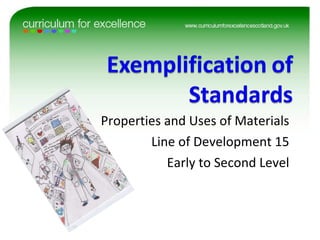
Properties and Uses of Materials Line of Development 15 Early to Second Level
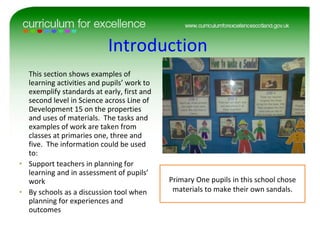
Introduction  This section shows examples of learning activities and pupils’ work to exemplify standards at early, first and second level in Science across Line of Development 15 on the properties and uses of materials.  The tasks and examples of work are taken from classes at primaries one, three and five.  The information could be used to: Support teachers in planning for learning and in assessment of pupils’ work By schools as a discussion tool when planning for experiences and outcomes  Primary One pupils in this school chose materials to make their own sandals.
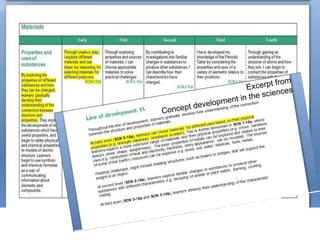
Excerpt from Concept development in the sciences
Primary One – Early Level Background The primary one teacher in this podcast describes a task which was part of the class project on Clothes.  The children had woodkin dolls and a selection of materials.  They were questioned about suitable clothing for different weather and activities as they played. The children were asked to consider which materials to dress the dolls in for rain, going out to play in the cold etc.  In active play tasks in Primary’s 1 and 2 the children regularly select materials suitable to their task and are able to describe these using simple language like, soft, hard and shiny.  Transcript of interview with Carolyn V2.docx The children in primary one designed tie –die t-shirts with accessories  and had a fashion show for parents.
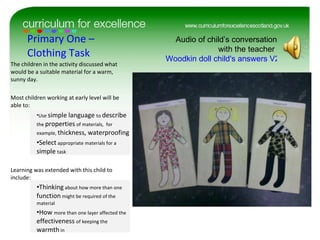
Primary One – Clothing Task The children in the activity discussed what would be a suitable material for a warm, sunny day. Most children working at early level will be able to: Use  simple language  to  describe  the  properties  of materials,  for example,  thickness, waterproofing Select  appropriate materials for a  simple  task Learning was extended with this child to include: Thinking  about how more than one  function  might be required of the material How  more than one layer affected the  effectiveness  of keeping the  warmth  in Audio of child’s conversation with the teacher  Woodkin doll child's answers V2.docx
TIMESCALES QUALITY ASSURANCE PROCESS INNOVATION CHALLENGES?
How might Sharing the Standard exemplification be used within a learning environment? How might sharing the standard exemplification look in your curricular area? How might GLOW be used to support the exemplification process? You might wish to consider the potential of GLOW GROUPS / GLOW MEET / GLOW CHAT. Questions for Reflection and Discussion

CfE Improving Learning - workshop 4 - Modern Languages

  • 1.
  • 2.
    WHY? Tosupport teachers in their planning and to ensure that the Es and Os are translated into very good teaching, learning and achievement for ALL learners To deepen teachers’ understanding of what young people are expected to learn To identify innovative contexts for learning To see effective learning and teaching in action Exemplification
  • 3.
    Planning for ExemplificationWHAT? 3 High Level Organisers : Clarifying the learning Contexts for learning Pedagogy Exemplification categorised by priority
  • 4.
    Planning for ExemplificationHOW? Partnership Working Sharing resources identified by HMIe / LAs / LTS / SCILT Audit of existing resources Targeted Commissioning Quality Assurance
  • 5.
    WHICH FORMAT ?Exemplification Case Studies Learners’ work Audio / Podcasts MindMaps Video clips Text to put on websites Web links Interactive resources PDF materials / Downloadable software PowerPoint
  • 6.
    Learning a newlanguage encourages children and young people to broaden their horizons as they explore the language and its associated culture. Through my learning of a new language: I gain a deeper understanding of my first language and appreciate the richness and interconnected nature of languages. I enhance my understanding and enjoyment of other cultures and of my own and gain insights into other ways of thinking and other views of the world. I develop skills that I can use and enjoy in work and leisure throughout my life. Introductory statements for learning new languages
  • 7.
    Clarifying the learning:Modern languages Elaboration/ reassurance of expected standards (links to SCQF Level 4 / CEFR ) Exemplification to aid understanding of standards / expectations of performance Exemplification to aid understanding of progression within 2 nd level
  • 8.
    Contexts for learning:Modern languages Exemplification on planning relevant contexts Exemplification on planning across outcomes / levels Exemplification on planning across curricular areas
  • 9.
    Pedagogy : Modernlanguages Exemplification on effective approaches to learning and teaching ( e.g. active / critical skills ) Online development of presentations from Good Practice Conference
  • 10.
  • 11.
    Properties and Usesof Materials Line of Development 15 Early to Second Level
  • 12.
    Introduction Thissection shows examples of learning activities and pupils’ work to exemplify standards at early, first and second level in Science across Line of Development 15 on the properties and uses of materials. The tasks and examples of work are taken from classes at primaries one, three and five. The information could be used to: Support teachers in planning for learning and in assessment of pupils’ work By schools as a discussion tool when planning for experiences and outcomes Primary One pupils in this school chose materials to make their own sandals.
  • 13.
    Excerpt from Conceptdevelopment in the sciences
  • 14.
    Primary One –Early Level Background The primary one teacher in this podcast describes a task which was part of the class project on Clothes. The children had woodkin dolls and a selection of materials. They were questioned about suitable clothing for different weather and activities as they played. The children were asked to consider which materials to dress the dolls in for rain, going out to play in the cold etc. In active play tasks in Primary’s 1 and 2 the children regularly select materials suitable to their task and are able to describe these using simple language like, soft, hard and shiny. Transcript of interview with Carolyn V2.docx The children in primary one designed tie –die t-shirts with accessories and had a fashion show for parents.
  • 15.
    Primary One –Clothing Task The children in the activity discussed what would be a suitable material for a warm, sunny day. Most children working at early level will be able to: Use simple language to describe the properties of materials, for example, thickness, waterproofing Select appropriate materials for a simple task Learning was extended with this child to include: Thinking about how more than one function might be required of the material How more than one layer affected the effectiveness of keeping the warmth in Audio of child’s conversation with the teacher Woodkin doll child's answers V2.docx
  • 16.
    TIMESCALES QUALITY ASSURANCEPROCESS INNOVATION CHALLENGES?
  • 17.
    How might Sharingthe Standard exemplification be used within a learning environment? How might sharing the standard exemplification look in your curricular area? How might GLOW be used to support the exemplification process? You might wish to consider the potential of GLOW GROUPS / GLOW MEET / GLOW CHAT. Questions for Reflection and Discussion

Editor's Notes

  • #2 People often get the meaning of this mixed up with the adjective “exemplary” or adverb ”exemplarily” : worth following as an example : Many people think of perfection / excellence EXEMPLIFICATION : is the NOUN which comes from the verb “exemplify”: DICTIONARY DEFINITION- to be an example of something/ to show an example of something or show it by means of an example. Exemplification is SUPPORT for STAFF
  • #3 WHY DO WE NEED EXEMPLIFICATION ? In short, 5-14 was a very prescriptive framework. CfE allows staff more freedom to use their creativity to design teaching and learning contexts that best suit the needs of their pupils. To support staff in the challenges that CfE presents, they have requested exemplification to support its implementation across the 3-15 age range.
  • #4 Clarifying the learning (i.e. indicating expectations of learning, teaching and assessment and aiding understanding of standards and progression both within and between levels) Contexts for learning (i.e. a possible theme which could be used for planning learning and teaching of one or more of the experiences and outcomes) Pedagogy (i.e. the opportunities for new approaches to learning, teaching and assessment enabled by the experiences and outcomes) The position supported by the government is to limit both the quantity and type of exemplification so that CfE is not seen to be offering templates nor prescription that would inhibit the creativity and flexibility of local authorities, schools and teachers.
  • #6 The position supported by the government is to limit both the quantity and type of exemplification so that CfE is not seen to be offering templates nor prescription that would inhibit the creativity and flexibility of local authorities, schools and teachers.
  • #7 In Modern languages we have also tried to link our exemplification to these 3 Introductory statements which are KEY to all ML planning / teaching and learning Interconnected nature of languages / language learning (L1 / L2) MAKE LINKS CULTURAL AWARENESS : Global Citizenship COMMUNICATIVE COMPETENCE : Explaining the bigger picture: WHY/ BENEFITS/ADVANTAGES in learning a language. Using MLs in real and relevant situations
  • #8 CLARIFYING THE LEARNING : SHARING THE STANDARD WHAT? PowerPoint Presentation / Support notes: Common European Framework of Reference (CEFR) PowerPoint Presentation / Support notes: Languages Ladder   WHY? - To deepen teachers’ understanding of what young people are expected to learn by raising awareness of other languages frameworks (in this case CEFR and languages Ladder) which seek to describe learning experiences and outcomes at beginner level and then to track progression in each of the language skills. - To support teachers in their planning and to ensure that the Es and Os are translated into very good teaching, learning and achievement for ALL learners by promoting discussion of the relevance of these important European developments to the CfE Experiences and Outcomes for Modern Languages. These PowerPoint Presentations should be used in conjunction with the Appendices from the CfE Modern Languages 3-15 Framework as part of ongoing support to clarify the level of performance expected of the learner at each level in each language skill. NEXT STEPS SEPTEMBER ’09: Further elaboration of the level of performance expected in each skill at each level by relating the outcomes in the CfE Modern Languages Framework to other documentation at a similar level which currently exists within Scotland (e.g. SCQF level 4, within England (Languages Ladder) and within Europe (CEFR)) MARCH ’10 : Examples of pupil performance in specific skills at specific levels  
  • #9 PURPOSE : To identify innovative contexts for learning WHAT? : TRANSITION Case Study / Film Clip / Web-link to Journey to Excellence: Partnership working – Primary/Secondary in Modern Languages in Edinburgh City: St. Thomas of Aquins HS WHY? - To identify innovative contexts for learning: One approach as to how a high school in Edinburgh and its associated primary schools collaborate to ensure a smooth and coherent transition from P7 to S1 - To see effective learning and teaching in action: using collaborative planning and peer mentoring as a means of ensuring an effective transition from primary to secondary WHAT? Case Study / Film Clip / Web-link to Journey to Excellence: Partnership working in Modern Languages in North Lanarkshire Council (St. Margaret’s HS) WHY? - To identify innovative contexts for learning: Partnership working with a school in Majorca as a context for developing the CfE capacities and for making learning more relevant. - To see effective learning and teaching in action: using ICT and collaborative learning as a means of engaging pupils actively in their learning   PARTNERSHIP WORKING WHAT? Case Study – Western Isles Sir E Scott School – Working together to develop cultural awareness and multilingualism WHY? - To identify innovative contexts for learning: A Comenius bilateral project with school in Brittany - To see effective learning and teaching in action : Using an interdisciplinary approach involving a variety of curricular areas and the local community  
  • #10 Effective learning and teaching in action Online development of presentations from Good Practice Conference: Practitioner Voice / Film Clips
  • #15 Could the voice recording be linked to the photographs
  • #16 Audio of child discussing his selections
  • #18 A term that defines the criteria for success at a particular level. 'Sharing the standard' happens at moderation meetings, when teachers within and across schools/departments ensure they assess pupils' work in the same way.