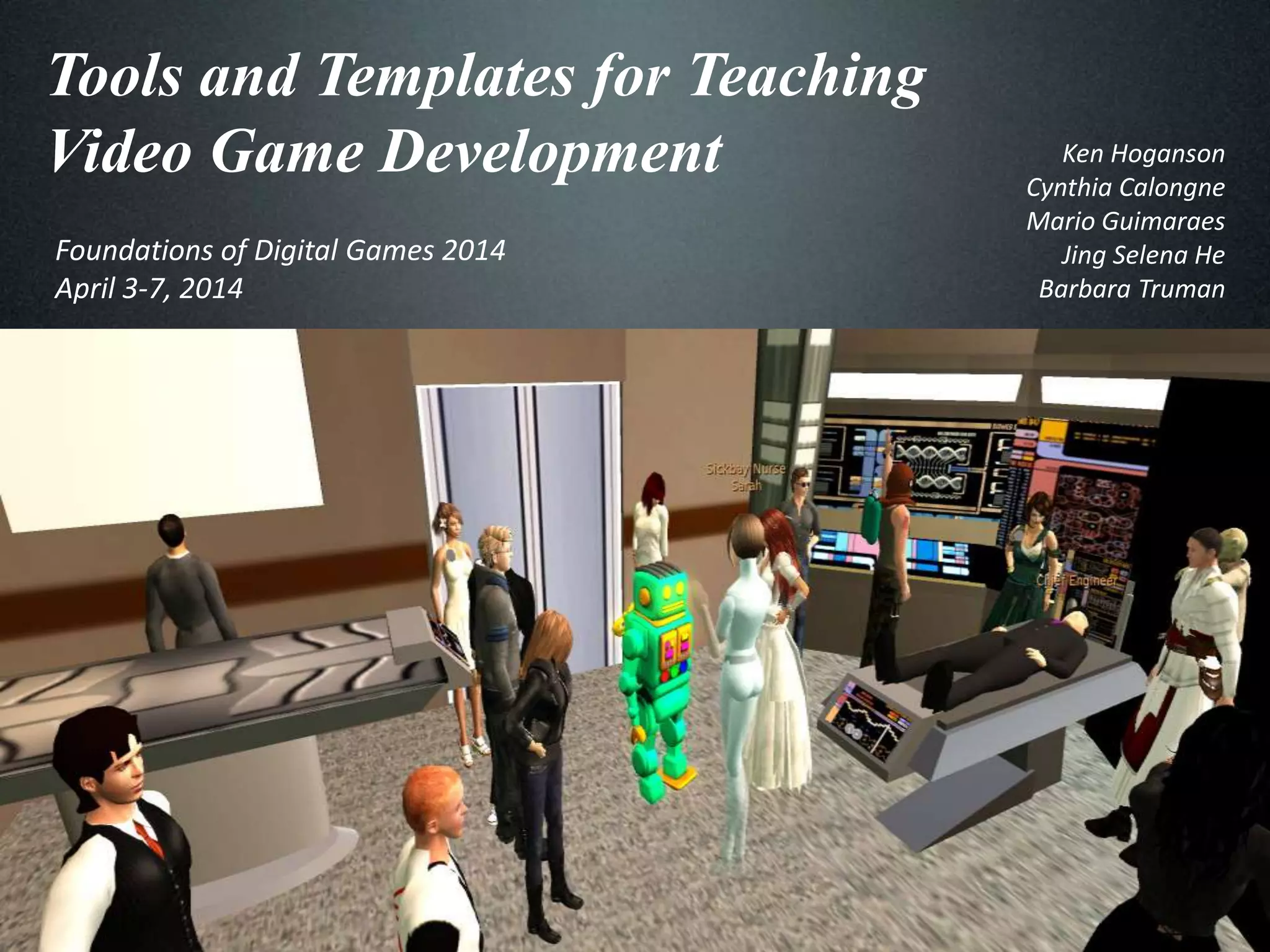
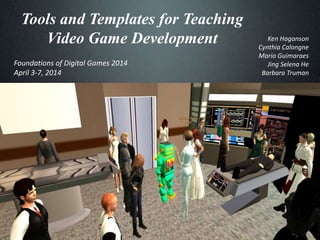
Tools and Templates for Teaching
Video Game Development
Foundations of Digital Games 2014
April 3-7, 2014
Ken Hoganson
Cynthia Calongne
Mario Guimaraes
Jing Selena He
Barbara Truman
Speakers and Games
• Ken Hoganson - Digital Gaming & Innovative Computing Conf
– Game Design Camp, Courses: AI & Game Design, Game Theory & Design
– http://science.kennesaw.edu/~khoganso/
• Jing Selena He - Madden, Littlest Pet Shop I & II (NDS, Wii)
– Electronic Arts, Course: Game Design and Development
– http://cs.kennesaw.edu/she/
• Mario Guimaraes – Game Maker, Unity 3D, HTML5
– Teaching Computer Game Development
– http://www.zu.ac.ae/main/en/colleges/colleges/college_information_technology/bio/mario_bio.aspx
• Barbara Truman – GAMESMOOC, Game and simulation design
– http://barbaratruman.com/ and http://www.slideshare.net/barbaratruman
• Cynthia Calongne – GAMESMOOC, Game and simulation design
– Courses: Advanced Game Design; Games, Gamification and Serious Games
– http://www.slideshare.net/lyrlobo/presentations
Panel Questions
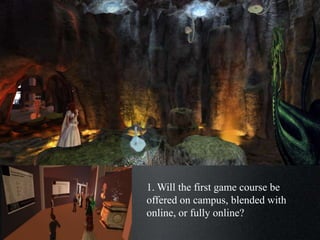
1. Will the first game course be offered on campus, blended with
online, or fully online?
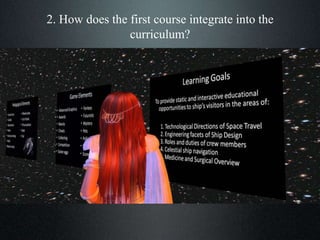
2. How does the first course integrate into the curriculum?
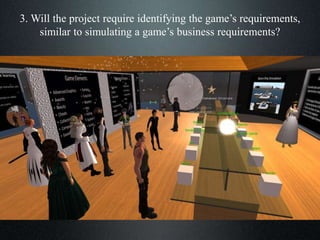
3. Will the project require identifying the game’s requirements,
similar to simulating a game’s business requirements?
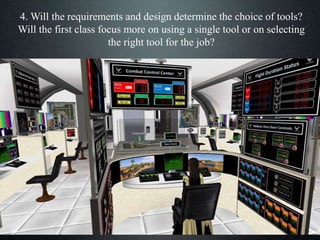
4. Will the requirements and design determine the choice of
tools? Will the first class focus more on using a single tool or
on selecting the right tool for the job?
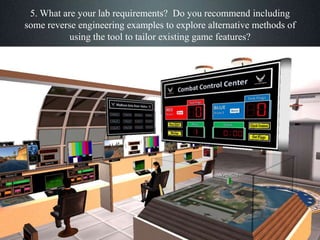
5. What are your lab requirements? Do you recommend
including some reverse engineering examples to explore
alternative methods of using the tool to tailor existing game
features?
Panel Questions II
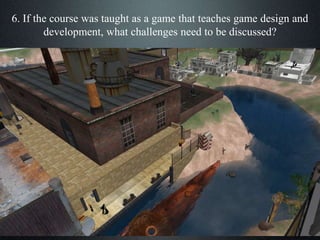
6. If the course was taught as a game that teaches game design
and development, what challenges need to be discussed?
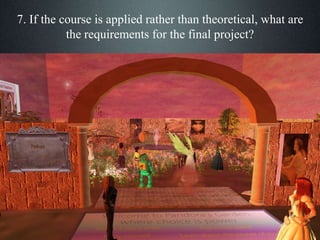
7. If the course is applied rather than theoretical, what are the
requirements for the final project?
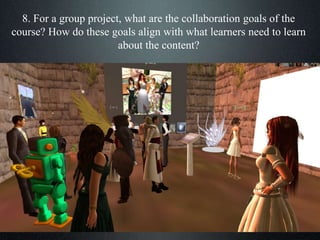
8. For a group project, what are the collaboration goals of the
course? How do these goals align with what learners need to
learn about the content?
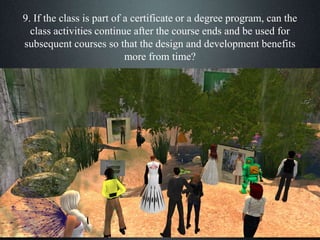
9. If the class is part of a certificate or a degree program, can the
class activities continue after the course ends and be used for
subsequent courses so that the design and development
benefits more from time?
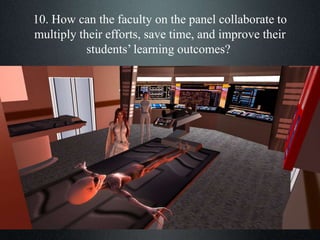
10. How can the faculty on the panel collaborate to multiply their
efforts, save time, and improve their students’ learning
outcomes?
1. Will the first game course be
offered on campus, blended with
online, or fully online?
2. How does the first course integrate into the
curriculum?
3. Will the project require identifying the game’s requirements,
similar to simulating a game’s business requirements?
4. Will the requirements and design determine the choice of tools?
Will the first class focus more on using a single tool or on selecting
the right tool for the job?
5. What are your lab requirements? Do you recommend including
some reverse engineering examples to explore alternative methods of
using the tool to tailor existing game features?
6. If the course was taught as a game that teaches game design and
development, what challenges need to be discussed?
7. If the course is applied rather than theoretical, what are
the requirements for the final project?
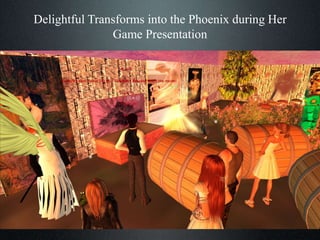
Delightful Transforms into the Phoenix during Her
Game Presentation
8. For a group project, what are the collaboration goals of the
course? How do these goals align with what learners need to learn
about the content?
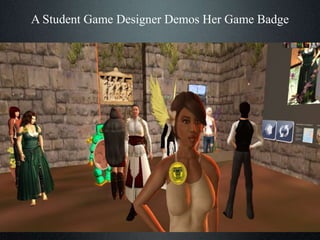
A Student Game Designer Demos Her Game Badge
9. If the class is part of a certificate or a degree program, can the
class activities continue after the course ends and be used for
subsequent courses so that the design and development benefits
more from time?
10. How can the faculty on the panel collaborate to
multiply their efforts, save time, and improve their
students’ learning outcomes?
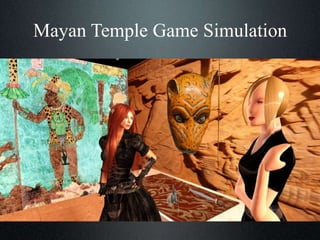
Mayan Temple Game Simulation
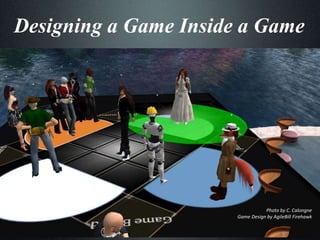
Designing a Game Inside a Game
Photo by C. Calongne
Game Design by AgileBill Firehawk
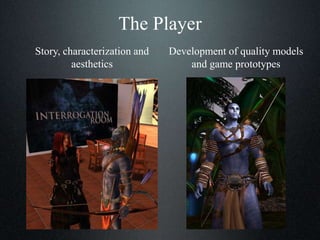
The Player
Story, characterization and
aesthetics
Development of quality models
and game prototypes
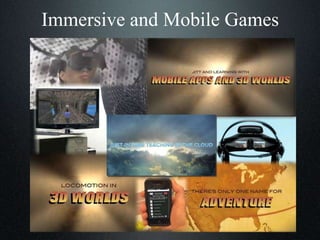
Immersive and Mobile Games
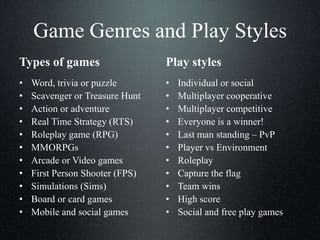
Game Genres and Play Styles
Types of games
• Word, trivia or puzzle
• Scavenger or Treasure Hunt
• Action or adventure
• Real Time Strategy (RTS)
• Roleplay game (RPG)
• MMORPGs
• Arcade or Video games
• First Person Shooter (FPS)
• Simulations (Sims)
• Board or card games
• Mobile and social games
Play styles
• Individual or social
• Multiplayer cooperative
• Multiplayer competitive
• Everyone is a winner!
• Last man standing – PvP
• Player vs Environment
• Roleplay
• Capture the flag
• Team wins
• High score
• Social and free play games
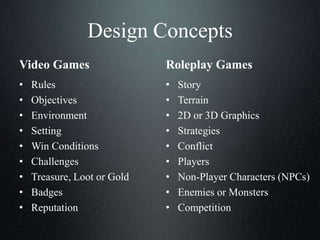
Design Concepts
Video Games
• Rules
• Objectives
• Environment
• Setting
• Win Conditions
• Challenges
• Treasure, Loot or Gold
• Badges
• Reputation
Roleplay Games
• Story
• Terrain
• 2D or 3D Graphics
• Strategies
• Conflict
• Players
• Non-Player Characters (NPCs)
• Enemies or Monsters
• Competition
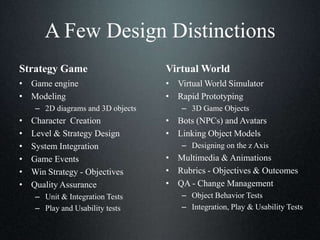
A Few Design Distinctions
Strategy Game
• Game engine
• Modeling
– 2D diagrams and 3D objects
• Character Creation
• Level & Strategy Design
• System Integration
• Game Events
• Win Strategy - Objectives
• Quality Assurance
– Unit & Integration Tests
– Play and Usability tests
Virtual World
• Virtual World Simulator
• Rapid Prototyping
– 3D Game Objects
• Bots (NPCs) and Avatars
• Linking Object Models
– Designing on the z Axis
• Multimedia & Animations
• Rubrics - Objectives & Outcomes
• QA - Change Management
– Object Behavior Tests
– Integration, Play & Usability Tests
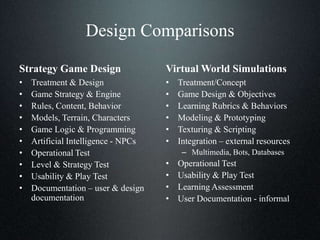
Design Comparisons
Strategy Game Design
• Treatment & Design
• Game Strategy & Engine
• Rules, Content, Behavior
• Models, Terrain, Characters
• Game Logic & Programming
• Artificial Intelligence - NPCs
• Operational Test
• Level & Strategy Test
• Usability & Play Test
• Documentation – user & design
documentation
Virtual World Simulations
• Treatment/Concept
• Game Design & Objectives
• Learning Rubrics & Behaviors
• Modeling & Prototyping
• Texturing & Scripting
• Integration – external resources
– Multimedia, Bots, Databases
• Operational Test
• Usability & Play Test
• Learning Assessment
• User Documentation - informal
Badges and Gamification
• Transforming a course into a game
– Points and grades become gold and rewards
– Reputation, titles and badges
– Incentivizes learning
– Minimizes game development
– Uses a similar assessment strategy
– If competitive, requires anonymity, seeding the population
with NPCs
Benefits of Games
Games can stimulate
• Problem solving
• Critical thinking
• Digital literacy
• Strategy & tactics
• Motor skill development
• Collaboration
• Leadership & courage
• Socialization
Game-based learning
• Vision & creativity
• Sustainability
• Immersion
• Learning retention
• Heutagogy
• Knowledge networks
• Socio-technical skills
• Entrepreneurship
Game Papers by Our Speakers
• Guimaraes, M. & Murray, M. (2008). An exploratory overview of teaching
computer game development. Retrieved from
http://digitalcommons.kennesaw.edu/facpubs/1375/
• Hoganson, K. (2010). Teaching Programming Concepts with GameMaker.
Retrieved from http://digitalcommons.kennesaw.edu/facpubs/2245/
• Wang, T., Guo, L., Li, G., Li, J., Wang, R., Ren, M., & He, J.S. (2012).
Implementing the Jacobi Algorithm for Solving Eigenvalues of Symmetric
Matrices with CUDA, NAS 2012, XiaMen, China, June 28-30, 2012.
• Calongne, C., Stricker, A., Truman, B., Murray, J., Lavieri Jr., E., Martini,
D. (2014). Slippery Rocks and ALGAE: A Multiplayer Educational
Roleplaying Game and a Model for Adaptive Learning Game Design. 19th
Annual TCC Worldwide Online Conference Proceedings, April 22, 2014.
A Few Game Creation Resources
Torque3D - open source http://www.garagegames.com/products/torque-3d
Unity3D Game Engine – Multiplatform http://unity3d.com/
GameMaker Studio by YoYo Games
http://www.yoyogames.com/gamemaker/
SL Game Kit – no programming https://marketplace.secondlife.com/stores/16732?id=16732
Games in Education - Game Creation Tools
http://gamesined.wikispaces.com/Game+Creation+Tools
Class Tools.net: Create Interactive flash games for education
http://www.classtools.net/
Create & Play PurposeGames http://www.purposegames.com/
Artificial Intelligence Resources:
Pandorabots – Chatbot Creation http://www.pandorabots.com/botmaster/en/home
Games and Research
Wright, W. (2010). Games as Tools for Science and Society. GameTech.
Slides: http://www.slideshare.net/guesta79ddf9/orando2010-5
Video: http://www.youtube.com/watch?v=fulyfB0c_CQ
McGonigal (2010). Reality is Broken. http://janemcgonigal.com/
McCrea, B. (2012). WoWing Language Arts. The Journal, Sept. 2012.
http://online.qmags.com/TJL0912/default.aspx?pg=24&mode=1#pg24&mode1
Boyle, A. (2011). Gamers solve molecular puzzle that baffled scientists
http://cosmiclog.nbcnews.com/_news/2011/09/18/7802623-gamers-solve-molecular-
puzzle-that-baffled-scientists?lite
Steinkuehler, C. 2010. MMOs, Learning & The New Pop Cosmopolitan
http://archive.nmc.org/2010-nml-symposium/steinkuehler-keynote
NMC Horizon Report http://www.nmc.org/horizon-project/horizon-reports
Re-Mission 2: Fight cancer and WIN! Games for cancer based on
scientific research http://www.re-mission2.org/
Game Videos
Jane McGonigal (2010). : Gaming can make a better world. Ted Talks.
http://www.ted.com/talks/jane_mcgonigal_gaming_can_make_a_better_world.html
CNN. (2010). Gaming to save the world. Jane McGonigal on Evoke.
http://www.cnn.com/video/?/video/tech/2010/03/09/am.game.solves.problem
s.cnn#/video/tech/2010/03/09/am.game.solves.problems.cnn
Schell, J. (2010). When games invade real life.
http://www.ted.com/talks/jesse_schell_when_games_invade_real_life.html
Novak, Kae. (2012). Massively Minecraft’s Open House Tour. Abacus from
GAMESMOOC narrating. http://www.youtube.com/watch?v=aZez0EZKL6U
Five-Minute Film Festival: Game-Based Learning
http://www.edutopia.org/blog/film-festival-video-game-based-learning
Edu Games and Game Design Labs
3D Game Lab http://3dgamelab.com/
Massively Minecraft – Jokaydia Minecraft Servers http://massivelyminecraft.org/
Quest Atlantis ARX http://www.questatlantis.org/
WoW in School http://wowinschool.pbworks.com/w/page/5268731/FrontPage
Games Based Learning MOOC http://gamesmooc.shivtr.com/
Virtual Harmony, Mars Geothermal Game http://harmonyestate.dyndns-ip.com/?q=node/11
Mars Expedition Strategy Challenge Trailer
https://www.facebook.com/photo.php?v=1399395902637&set=vb.124529564864&type=3&permPage=1
Mars Expedition Strategy Challenge Video:
https://www.facebook.com/photo.php?v=1404251944035&set=vb.124529564864&type=3&permPage=1
Presentations on Designing Games
Fliesen, D. and Calongne, C. (2012). Virtual guides: a hybrid approach to immersive
learning. http://www.slideshare.net/lyrlobo/game-tech-virtual-guides-fliesen-
calongne
Stricker, A. and Calongne, C. (2011). Games and simulation design: from a hostage
rescue game to geothermal energy on Mars in Virtual Harmony
http://www.slideshare.net/lyrlobo/gordon-research-conference-2011
Calongne, C. (2011). Designing simulations and games: design tips and tricks
http://www.slideshare.net/lyrlobo/designing-simulations-and-gamesdesign-tips-and-
tricks
Calongne, C. (2010). Mars Expedition GameTech 2010
http://www.slideshare.net/lyrlobo/mars-expedition-game-tech-2010
Calongne C. and Stricker, A. (2009). Evaluating a Game Simulation Kit in Second Life.
http://www.slideshare.net/lyrlobo/evaluating-a-game-simulation-kit-in-second-life
Calongne, C. (2009). Designing Games & Learning Activities in Second Life
http://www.slideshare.net/lyrlobo/designing-games-and-learning-activities-in-
second-life
Calongne, C. (2012). Highlights from 33 Classes with Lyr Lobo in an Animoto Video
http://ctusoftware.blogspot.com/2012/08/highlights-from-33-classes-with-lyr.html
Tools and Templates for Teaching
Video Game Development Ken Hoganson
Cynthia Calongne
Mario Guimaraes
Jing Selena He
Barbara Truman
Foundations of Digital Games 2014
April 3-7, 2014

Teaching video game development panel FDG2014

  • 1.
    Tools and Templatesfor Teaching Video Game Development Foundations of Digital Games 2014 April 3-7, 2014 Ken Hoganson Cynthia Calongne Mario Guimaraes Jing Selena He Barbara Truman
  • 2.
    Speakers and Games •Ken Hoganson - Digital Gaming & Innovative Computing Conf – Game Design Camp, Courses: AI & Game Design, Game Theory & Design – http://science.kennesaw.edu/~khoganso/ • Jing Selena He - Madden, Littlest Pet Shop I & II (NDS, Wii) – Electronic Arts, Course: Game Design and Development – http://cs.kennesaw.edu/she/ • Mario Guimaraes – Game Maker, Unity 3D, HTML5 – Teaching Computer Game Development – http://www.zu.ac.ae/main/en/colleges/colleges/college_information_technology/bio/mario_bio.aspx • Barbara Truman – GAMESMOOC, Game and simulation design – http://barbaratruman.com/ and http://www.slideshare.net/barbaratruman • Cynthia Calongne – GAMESMOOC, Game and simulation design – Courses: Advanced Game Design; Games, Gamification and Serious Games – http://www.slideshare.net/lyrlobo/presentations
  • 3.
    Panel Questions 1. Willthe first game course be offered on campus, blended with online, or fully online? 2. How does the first course integrate into the curriculum? 3. Will the project require identifying the game’s requirements, similar to simulating a game’s business requirements? 4. Will the requirements and design determine the choice of tools? Will the first class focus more on using a single tool or on selecting the right tool for the job? 5. What are your lab requirements? Do you recommend including some reverse engineering examples to explore alternative methods of using the tool to tailor existing game features?
  • 4.
    Panel Questions II 6.If the course was taught as a game that teaches game design and development, what challenges need to be discussed? 7. If the course is applied rather than theoretical, what are the requirements for the final project? 8. For a group project, what are the collaboration goals of the course? How do these goals align with what learners need to learn about the content? 9. If the class is part of a certificate or a degree program, can the class activities continue after the course ends and be used for subsequent courses so that the design and development benefits more from time? 10. How can the faculty on the panel collaborate to multiply their efforts, save time, and improve their students’ learning outcomes?
  • 5.
    1. Will thefirst game course be offered on campus, blended with online, or fully online?
  • 6.
    2. How doesthe first course integrate into the curriculum?
  • 7.
    3. Will theproject require identifying the game’s requirements, similar to simulating a game’s business requirements?
  • 8.
    4. Will therequirements and design determine the choice of tools? Will the first class focus more on using a single tool or on selecting the right tool for the job?
  • 9.
    5. What areyour lab requirements? Do you recommend including some reverse engineering examples to explore alternative methods of using the tool to tailor existing game features?
  • 10.
    6. If thecourse was taught as a game that teaches game design and development, what challenges need to be discussed?
  • 11.
    7. If thecourse is applied rather than theoretical, what are the requirements for the final project?
  • 12.
    Delightful Transforms intothe Phoenix during Her Game Presentation
  • 13.
    8. For agroup project, what are the collaboration goals of the course? How do these goals align with what learners need to learn about the content?
  • 14.
    A Student GameDesigner Demos Her Game Badge
  • 15.
    9. If theclass is part of a certificate or a degree program, can the class activities continue after the course ends and be used for subsequent courses so that the design and development benefits more from time?
  • 16.
    10. How canthe faculty on the panel collaborate to multiply their efforts, save time, and improve their students’ learning outcomes?
  • 17.
  • 19.
    Designing a GameInside a Game Photo by C. Calongne Game Design by AgileBill Firehawk
  • 20.
    The Player Story, characterizationand aesthetics Development of quality models and game prototypes
  • 21.
  • 25.
    Game Genres andPlay Styles Types of games • Word, trivia or puzzle • Scavenger or Treasure Hunt • Action or adventure • Real Time Strategy (RTS) • Roleplay game (RPG) • MMORPGs • Arcade or Video games • First Person Shooter (FPS) • Simulations (Sims) • Board or card games • Mobile and social games Play styles • Individual or social • Multiplayer cooperative • Multiplayer competitive • Everyone is a winner! • Last man standing – PvP • Player vs Environment • Roleplay • Capture the flag • Team wins • High score • Social and free play games
  • 26.
    Design Concepts Video Games •Rules • Objectives • Environment • Setting • Win Conditions • Challenges • Treasure, Loot or Gold • Badges • Reputation Roleplay Games • Story • Terrain • 2D or 3D Graphics • Strategies • Conflict • Players • Non-Player Characters (NPCs) • Enemies or Monsters • Competition
  • 27.
    A Few DesignDistinctions Strategy Game • Game engine • Modeling – 2D diagrams and 3D objects • Character Creation • Level & Strategy Design • System Integration • Game Events • Win Strategy - Objectives • Quality Assurance – Unit & Integration Tests – Play and Usability tests Virtual World • Virtual World Simulator • Rapid Prototyping – 3D Game Objects • Bots (NPCs) and Avatars • Linking Object Models – Designing on the z Axis • Multimedia & Animations • Rubrics - Objectives & Outcomes • QA - Change Management – Object Behavior Tests – Integration, Play & Usability Tests
  • 28.
    Design Comparisons Strategy GameDesign • Treatment & Design • Game Strategy & Engine • Rules, Content, Behavior • Models, Terrain, Characters • Game Logic & Programming • Artificial Intelligence - NPCs • Operational Test • Level & Strategy Test • Usability & Play Test • Documentation – user & design documentation Virtual World Simulations • Treatment/Concept • Game Design & Objectives • Learning Rubrics & Behaviors • Modeling & Prototyping • Texturing & Scripting • Integration – external resources – Multimedia, Bots, Databases • Operational Test • Usability & Play Test • Learning Assessment • User Documentation - informal
  • 29.
    Badges and Gamification •Transforming a course into a game – Points and grades become gold and rewards – Reputation, titles and badges – Incentivizes learning – Minimizes game development – Uses a similar assessment strategy – If competitive, requires anonymity, seeding the population with NPCs
  • 30.
    Benefits of Games Gamescan stimulate • Problem solving • Critical thinking • Digital literacy • Strategy & tactics • Motor skill development • Collaboration • Leadership & courage • Socialization Game-based learning • Vision & creativity • Sustainability • Immersion • Learning retention • Heutagogy • Knowledge networks • Socio-technical skills • Entrepreneurship
  • 31.
    Game Papers byOur Speakers • Guimaraes, M. & Murray, M. (2008). An exploratory overview of teaching computer game development. Retrieved from http://digitalcommons.kennesaw.edu/facpubs/1375/ • Hoganson, K. (2010). Teaching Programming Concepts with GameMaker. Retrieved from http://digitalcommons.kennesaw.edu/facpubs/2245/ • Wang, T., Guo, L., Li, G., Li, J., Wang, R., Ren, M., & He, J.S. (2012). Implementing the Jacobi Algorithm for Solving Eigenvalues of Symmetric Matrices with CUDA, NAS 2012, XiaMen, China, June 28-30, 2012. • Calongne, C., Stricker, A., Truman, B., Murray, J., Lavieri Jr., E., Martini, D. (2014). Slippery Rocks and ALGAE: A Multiplayer Educational Roleplaying Game and a Model for Adaptive Learning Game Design. 19th Annual TCC Worldwide Online Conference Proceedings, April 22, 2014.
  • 32.
    A Few GameCreation Resources Torque3D - open source http://www.garagegames.com/products/torque-3d Unity3D Game Engine – Multiplatform http://unity3d.com/ GameMaker Studio by YoYo Games http://www.yoyogames.com/gamemaker/ SL Game Kit – no programming https://marketplace.secondlife.com/stores/16732?id=16732 Games in Education - Game Creation Tools http://gamesined.wikispaces.com/Game+Creation+Tools Class Tools.net: Create Interactive flash games for education http://www.classtools.net/ Create & Play PurposeGames http://www.purposegames.com/ Artificial Intelligence Resources: Pandorabots – Chatbot Creation http://www.pandorabots.com/botmaster/en/home
  • 33.
    Games and Research Wright,W. (2010). Games as Tools for Science and Society. GameTech. Slides: http://www.slideshare.net/guesta79ddf9/orando2010-5 Video: http://www.youtube.com/watch?v=fulyfB0c_CQ McGonigal (2010). Reality is Broken. http://janemcgonigal.com/ McCrea, B. (2012). WoWing Language Arts. The Journal, Sept. 2012. http://online.qmags.com/TJL0912/default.aspx?pg=24&mode=1#pg24&mode1 Boyle, A. (2011). Gamers solve molecular puzzle that baffled scientists http://cosmiclog.nbcnews.com/_news/2011/09/18/7802623-gamers-solve-molecular- puzzle-that-baffled-scientists?lite Steinkuehler, C. 2010. MMOs, Learning & The New Pop Cosmopolitan http://archive.nmc.org/2010-nml-symposium/steinkuehler-keynote NMC Horizon Report http://www.nmc.org/horizon-project/horizon-reports Re-Mission 2: Fight cancer and WIN! Games for cancer based on scientific research http://www.re-mission2.org/
  • 34.
    Game Videos Jane McGonigal(2010). : Gaming can make a better world. Ted Talks. http://www.ted.com/talks/jane_mcgonigal_gaming_can_make_a_better_world.html CNN. (2010). Gaming to save the world. Jane McGonigal on Evoke. http://www.cnn.com/video/?/video/tech/2010/03/09/am.game.solves.problem s.cnn#/video/tech/2010/03/09/am.game.solves.problems.cnn Schell, J. (2010). When games invade real life. http://www.ted.com/talks/jesse_schell_when_games_invade_real_life.html Novak, Kae. (2012). Massively Minecraft’s Open House Tour. Abacus from GAMESMOOC narrating. http://www.youtube.com/watch?v=aZez0EZKL6U Five-Minute Film Festival: Game-Based Learning http://www.edutopia.org/blog/film-festival-video-game-based-learning
  • 35.
    Edu Games andGame Design Labs 3D Game Lab http://3dgamelab.com/ Massively Minecraft – Jokaydia Minecraft Servers http://massivelyminecraft.org/ Quest Atlantis ARX http://www.questatlantis.org/ WoW in School http://wowinschool.pbworks.com/w/page/5268731/FrontPage Games Based Learning MOOC http://gamesmooc.shivtr.com/ Virtual Harmony, Mars Geothermal Game http://harmonyestate.dyndns-ip.com/?q=node/11 Mars Expedition Strategy Challenge Trailer https://www.facebook.com/photo.php?v=1399395902637&set=vb.124529564864&type=3&permPage=1 Mars Expedition Strategy Challenge Video: https://www.facebook.com/photo.php?v=1404251944035&set=vb.124529564864&type=3&permPage=1
  • 36.
    Presentations on DesigningGames Fliesen, D. and Calongne, C. (2012). Virtual guides: a hybrid approach to immersive learning. http://www.slideshare.net/lyrlobo/game-tech-virtual-guides-fliesen- calongne Stricker, A. and Calongne, C. (2011). Games and simulation design: from a hostage rescue game to geothermal energy on Mars in Virtual Harmony http://www.slideshare.net/lyrlobo/gordon-research-conference-2011 Calongne, C. (2011). Designing simulations and games: design tips and tricks http://www.slideshare.net/lyrlobo/designing-simulations-and-gamesdesign-tips-and- tricks Calongne, C. (2010). Mars Expedition GameTech 2010 http://www.slideshare.net/lyrlobo/mars-expedition-game-tech-2010 Calongne C. and Stricker, A. (2009). Evaluating a Game Simulation Kit in Second Life. http://www.slideshare.net/lyrlobo/evaluating-a-game-simulation-kit-in-second-life Calongne, C. (2009). Designing Games & Learning Activities in Second Life http://www.slideshare.net/lyrlobo/designing-games-and-learning-activities-in- second-life Calongne, C. (2012). Highlights from 33 Classes with Lyr Lobo in an Animoto Video http://ctusoftware.blogspot.com/2012/08/highlights-from-33-classes-with-lyr.html
  • 37.
    Tools and Templatesfor Teaching Video Game Development Ken Hoganson Cynthia Calongne Mario Guimaraes Jing Selena He Barbara Truman Foundations of Digital Games 2014 April 3-7, 2014