User Experiences of Game Idea Generation Games Annakaisa Kultima, Johannes Niemelä, Janne Paavilainen & Hannamari Saarenpää
Who? What? Where? University of Tampere , Finland Laboratory of Hypermedia,  Game Research Lab GameSpace project  (1.8.2006 – 30.9.2008) Study of design and evaluation methods for casual multiplayer mobile games Frans Mäyrä, Janne Paavilainen, Annakaisa Kultima, Johannes Niemelä, Jussi Kuittinen & Hannamari Saarenpää Finnish Innovation and Technology Funding Agency Industry partners: Nokia, Veikkaus (Finnish National Lottery), TeliaSonera, Sumea/Digital Chocolate, Sulake Annakaisa Kultima @ Meaningful Play 2008, October 9-11, Michigan State University
In this presentation... Idea generation Purposeful creation of new ideas Developing idea generation tools for creative work Creativity techniques, brainstorming techniques,  idea generation  techniques Complimentary for natural ideation processes Domain specific  idea generation Game ideas Supporting the specific features of games or even  certain types of games Game-based idea generation Annakaisa Kultima @ Meaningful Play 2008, October 9-11, Michigan State University
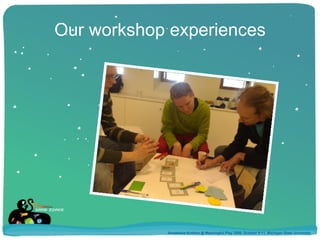
Our workshop experiences Annakaisa Kultima @ Meaningful Play 2008, October 9-11, Michigan State University
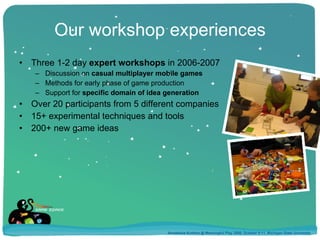
Our workshop experiences Three 1-2 day  expert workshops  in 2006-2007 Discussion on  casual multiplayer mobile games Methods for early phase of game production Support for  specific domain of idea generation Over 20 participants from 5 different companies 15+ experimental techniques and tools 200+ new game ideas Annakaisa Kultima @ Meaningful Play 2008, October 9-11, Michigan State University
Some example ideas… Bluetooth Planets Each player acts as alien king with one homeworld. Players’ task is to colonize other planets. Other planets are scanned via bluetooth and each bluetooth beacon represents a planet with different attributes. Player sends a reconnaissance spybot to study the planet. The spybots can be designed with various features depending on what kind of information the player needs to know. Players can also invade other players’ planets. Shave my Baby! Find your baby, oh no, she has a beard, quick race to the barbershop to shave my baby! Attend to the multiplayer race pushing your pram through the streets to get to the barbershop first, since he can only shave one baby per day. (Hairy baby shaves are bad for business.) Obstacles: the criminal wants to steal the baby (why? Don’t ask). Co-operate with others to gain collective advantage, bribe or negotiate to get secret knowledge (shortcuts to route). One Winner – lots of losers. Annakaisa Kultima @ Meaningful Play 2008, October 9-11, Michigan State University
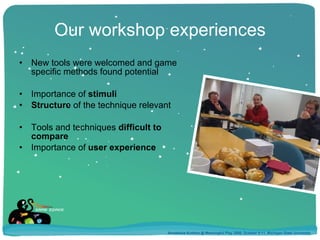
Our workshop experiences New tools were welcomed and game specific methods found potential Importance of  stimuli Structure  of the technique relevant Tools and techniques  difficult to compare Importance of  user experience Annakaisa Kultima @ Meaningful Play 2008, October 9-11, Michigan State University
How and what to study? Ideas Comparing techniques and tools based on the ideas produced What exactly they are supporting? User experiences Real idea needs: how to support them? Realities of the use:  what kind of tools suite to the context? Annakaisa Kultima @ Meaningful Play 2008, October 9-11, Michigan State University
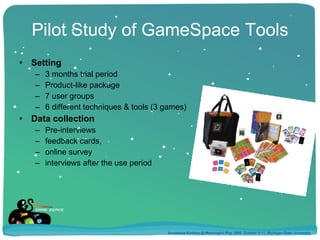
Pilot Study of GameSpace Tools Setting 3 months trial period Product-like package 7 user groups  6 different techniques & tools (3 games) Data collection Pre-interviews feedback cards, online survey interviews after the use period Annakaisa Kultima @ Meaningful Play 2008, October 9-11, Michigan State University
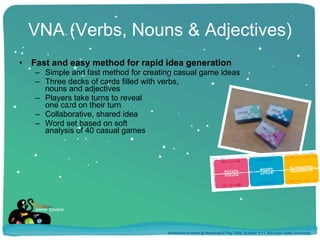
VNA (Verbs, Nouns & Adjectives) Fast and easy method for rapid idea generation Simple and fast method for creating casual game ideas Three decks of cards filled with verbs, nouns and adjectives Players take turns to reveal one card on their turn Collaborative, shared idea Word set based on soft  analysis of 40 casual games Annakaisa Kultima @ Meaningful Play 2008, October 9-11, Michigan State University
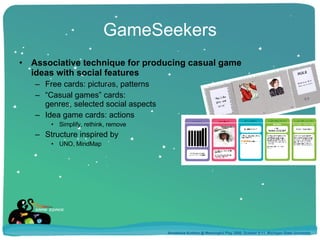
GameSeekers Associative technique for producing casual game ideas with social features Free cards: pictures, patterns “ Casual games” cards:  genres, selected social aspects Idea game cards: actions Simplify, rethink, remove Structure inspired by  UNO, MindMap Annakaisa Kultima @ Meaningful Play 2008, October 9-11, Michigan State University
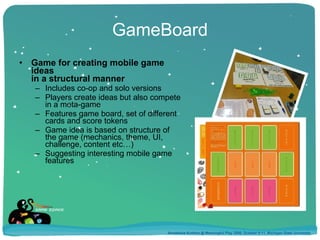
GameBoard Game for creating mobile game ideas  in a structural manner Includes co-op and solo versions Players create ideas but also compete in a meta-game Features game board, set of different cards and score tokens Game idea is based on structure of the game (mechanics, theme, UI, challenge, content etc…) Suggesting interesting mobile game features Annakaisa Kultima @ Meaningful Play 2008, October 9-11, Michigan State University
Other tools MorF Computer aided Morphological Forced  Connections for Game Ideas  USB-key to run the program and archive the ideas  PieceBox Game related toys as an inspiration  and mediation for game ideas Mecano Using everyday objects as an inspiration  for game mechanics innovation Annakaisa Kultima @ Meaningful Play 2008, October 9-11, Michigan State University
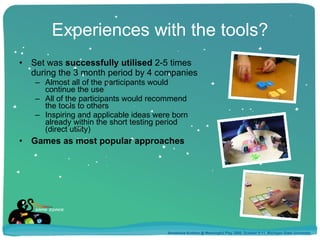
Experiences with the tools? Set was  successfully utilised  2-5 times  during the 3 month period by 4 companies Almost all of the participants would  continue the use All of the participants would recommend  the tools to others Inspiring and applicable ideas were born  already within the short testing period  (direct utility) Games as most popular approaches Annakaisa Kultima @ Meaningful Play 2008, October 9-11, Michigan State University
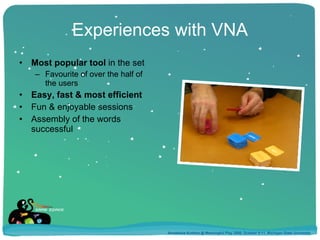
Experiences with VNA Most popular tool  in the set Favourite of over the half of the users Easy, fast & most efficient Fun & enjoyable sessions  Assembly of the words successful Annakaisa Kultima @ Meaningful Play 2008, October 9-11, Michigan State University
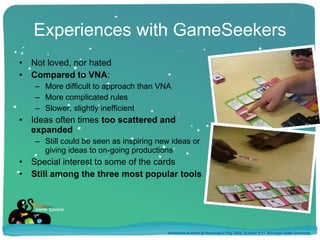
Experiences with GameSeekers Not loved, nor hated Compared to VNA : More difficult to approach than VNA More complicated rules Slower, slightly inefficient Ideas often times  too scattered and expanded Still could be seen as inspiring new ideas or giving ideas to on-going productions Special interest to some of the cards Still among the three most popular tools Annakaisa Kultima @ Meaningful Play 2008, October 9-11, Michigan State University
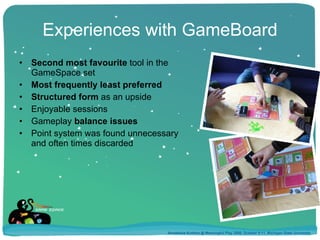
Experiences with GameBoard Second most favourite  tool in the GameSpace set Most frequently least preferred Structured form  as an upside Enjoyable sessions Gameplay  balance issues Point system was found unnecessary  and often times discarded Annakaisa Kultima @ Meaningful Play 2008, October 9-11, Michigan State University
Conclusions Despite the critique,  overall experiences were positive Sessions were fun, inspiring and  useful Games were most popular idea generation tools VNA most popular (easy, fast & efficient) Annakaisa Kultima @ Meaningful Play 2008, October 9-11, Michigan State University
Discussion General remarks Relatively short testing period Small sample, certain types of game companies Game designers love games Problems with GameSeekers & GameBoard can be solved Reversed engineering Various tools and games should be designed Different approaches instead of one perfect approach Annakaisa Kultima @ Meaningful Play 2008, October 9-11, Michigan State University
Games for Creativity Playful atmosphere Games provide better metaphor for creativity Structure & stimuli Rules keeps you focused & force equality between participators Game world provides stimuli to start with & surprise to challenge yourself with Creativity techniques, idea generation techniques Thinking tools, forcing out of the box, creative problem solving Design games Idea mediation and communication participatory design (collaborative design) Serious games Games for production Annakaisa Kultima @ Meaningful Play 2008, October 9-11, Michigan State University
What kind of a game? Thoughts based on our experiences Collaborative Support for free association Provided stimuli for easy flowing process Structure for supporting certain idea needs and focusing the session Forced combinations for surprising ideas No special need for point system or other external rewards, ideas themselves are enough rewarding Annakaisa Kultima @ Meaningful Play 2008, October 9-11, Michigan State University
Future work Broadening the perspective: Various stages of the iterative process of game design Game ideas evolve and inspire new ideas all through the process Generating, refining, organizing, managing  and evaluating  game ideas Especially: Special needs of game ideas for  idea management systems Game idea  documentation and description language Restriction based idea generation vs. blue sky ideas E.g.  ideas for existing IP Development of  different  idea generation games Annakaisa Kultima @ Meaningful Play 2008, October 9-11, Michigan State University
Thank You! Contact: [email_address] Read more and follow the progress: http://gameslices.wordpress.com

User Experiences of Game Idea Generation Games

  • 1.
    User Experiences ofGame Idea Generation Games Annakaisa Kultima, Johannes Niemelä, Janne Paavilainen & Hannamari Saarenpää
  • 2.
    Who? What? Where?University of Tampere , Finland Laboratory of Hypermedia, Game Research Lab GameSpace project (1.8.2006 – 30.9.2008) Study of design and evaluation methods for casual multiplayer mobile games Frans Mäyrä, Janne Paavilainen, Annakaisa Kultima, Johannes Niemelä, Jussi Kuittinen & Hannamari Saarenpää Finnish Innovation and Technology Funding Agency Industry partners: Nokia, Veikkaus (Finnish National Lottery), TeliaSonera, Sumea/Digital Chocolate, Sulake Annakaisa Kultima @ Meaningful Play 2008, October 9-11, Michigan State University
  • 3.
    In this presentation...Idea generation Purposeful creation of new ideas Developing idea generation tools for creative work Creativity techniques, brainstorming techniques, idea generation techniques Complimentary for natural ideation processes Domain specific idea generation Game ideas Supporting the specific features of games or even certain types of games Game-based idea generation Annakaisa Kultima @ Meaningful Play 2008, October 9-11, Michigan State University
  • 4.
    Our workshop experiencesAnnakaisa Kultima @ Meaningful Play 2008, October 9-11, Michigan State University
  • 5.
    Our workshop experiencesThree 1-2 day expert workshops in 2006-2007 Discussion on casual multiplayer mobile games Methods for early phase of game production Support for specific domain of idea generation Over 20 participants from 5 different companies 15+ experimental techniques and tools 200+ new game ideas Annakaisa Kultima @ Meaningful Play 2008, October 9-11, Michigan State University
  • 6.
    Some example ideas…Bluetooth Planets Each player acts as alien king with one homeworld. Players’ task is to colonize other planets. Other planets are scanned via bluetooth and each bluetooth beacon represents a planet with different attributes. Player sends a reconnaissance spybot to study the planet. The spybots can be designed with various features depending on what kind of information the player needs to know. Players can also invade other players’ planets. Shave my Baby! Find your baby, oh no, she has a beard, quick race to the barbershop to shave my baby! Attend to the multiplayer race pushing your pram through the streets to get to the barbershop first, since he can only shave one baby per day. (Hairy baby shaves are bad for business.) Obstacles: the criminal wants to steal the baby (why? Don’t ask). Co-operate with others to gain collective advantage, bribe or negotiate to get secret knowledge (shortcuts to route). One Winner – lots of losers. Annakaisa Kultima @ Meaningful Play 2008, October 9-11, Michigan State University
  • 7.
    Our workshop experiencesNew tools were welcomed and game specific methods found potential Importance of stimuli Structure of the technique relevant Tools and techniques difficult to compare Importance of user experience Annakaisa Kultima @ Meaningful Play 2008, October 9-11, Michigan State University
  • 8.
    How and whatto study? Ideas Comparing techniques and tools based on the ideas produced What exactly they are supporting? User experiences Real idea needs: how to support them? Realities of the use: what kind of tools suite to the context? Annakaisa Kultima @ Meaningful Play 2008, October 9-11, Michigan State University
  • 9.
    Pilot Study ofGameSpace Tools Setting 3 months trial period Product-like package 7 user groups 6 different techniques & tools (3 games) Data collection Pre-interviews feedback cards, online survey interviews after the use period Annakaisa Kultima @ Meaningful Play 2008, October 9-11, Michigan State University
  • 10.
    VNA (Verbs, Nouns& Adjectives) Fast and easy method for rapid idea generation Simple and fast method for creating casual game ideas Three decks of cards filled with verbs, nouns and adjectives Players take turns to reveal one card on their turn Collaborative, shared idea Word set based on soft analysis of 40 casual games Annakaisa Kultima @ Meaningful Play 2008, October 9-11, Michigan State University
  • 11.
    GameSeekers Associative techniquefor producing casual game ideas with social features Free cards: pictures, patterns “ Casual games” cards: genres, selected social aspects Idea game cards: actions Simplify, rethink, remove Structure inspired by UNO, MindMap Annakaisa Kultima @ Meaningful Play 2008, October 9-11, Michigan State University
  • 12.
    GameBoard Game forcreating mobile game ideas in a structural manner Includes co-op and solo versions Players create ideas but also compete in a meta-game Features game board, set of different cards and score tokens Game idea is based on structure of the game (mechanics, theme, UI, challenge, content etc…) Suggesting interesting mobile game features Annakaisa Kultima @ Meaningful Play 2008, October 9-11, Michigan State University
  • 13.
    Other tools MorFComputer aided Morphological Forced Connections for Game Ideas USB-key to run the program and archive the ideas PieceBox Game related toys as an inspiration and mediation for game ideas Mecano Using everyday objects as an inspiration for game mechanics innovation Annakaisa Kultima @ Meaningful Play 2008, October 9-11, Michigan State University
  • 14.
    Experiences with thetools? Set was successfully utilised 2-5 times during the 3 month period by 4 companies Almost all of the participants would continue the use All of the participants would recommend the tools to others Inspiring and applicable ideas were born already within the short testing period (direct utility) Games as most popular approaches Annakaisa Kultima @ Meaningful Play 2008, October 9-11, Michigan State University
  • 15.
    Experiences with VNAMost popular tool in the set Favourite of over the half of the users Easy, fast & most efficient Fun & enjoyable sessions Assembly of the words successful Annakaisa Kultima @ Meaningful Play 2008, October 9-11, Michigan State University
  • 16.
    Experiences with GameSeekersNot loved, nor hated Compared to VNA : More difficult to approach than VNA More complicated rules Slower, slightly inefficient Ideas often times too scattered and expanded Still could be seen as inspiring new ideas or giving ideas to on-going productions Special interest to some of the cards Still among the three most popular tools Annakaisa Kultima @ Meaningful Play 2008, October 9-11, Michigan State University
  • 17.
    Experiences with GameBoardSecond most favourite tool in the GameSpace set Most frequently least preferred Structured form as an upside Enjoyable sessions Gameplay balance issues Point system was found unnecessary and often times discarded Annakaisa Kultima @ Meaningful Play 2008, October 9-11, Michigan State University
  • 18.
    Conclusions Despite thecritique, overall experiences were positive Sessions were fun, inspiring and useful Games were most popular idea generation tools VNA most popular (easy, fast & efficient) Annakaisa Kultima @ Meaningful Play 2008, October 9-11, Michigan State University
  • 19.
    Discussion General remarksRelatively short testing period Small sample, certain types of game companies Game designers love games Problems with GameSeekers & GameBoard can be solved Reversed engineering Various tools and games should be designed Different approaches instead of one perfect approach Annakaisa Kultima @ Meaningful Play 2008, October 9-11, Michigan State University
  • 20.
    Games for CreativityPlayful atmosphere Games provide better metaphor for creativity Structure & stimuli Rules keeps you focused & force equality between participators Game world provides stimuli to start with & surprise to challenge yourself with Creativity techniques, idea generation techniques Thinking tools, forcing out of the box, creative problem solving Design games Idea mediation and communication participatory design (collaborative design) Serious games Games for production Annakaisa Kultima @ Meaningful Play 2008, October 9-11, Michigan State University
  • 21.
    What kind ofa game? Thoughts based on our experiences Collaborative Support for free association Provided stimuli for easy flowing process Structure for supporting certain idea needs and focusing the session Forced combinations for surprising ideas No special need for point system or other external rewards, ideas themselves are enough rewarding Annakaisa Kultima @ Meaningful Play 2008, October 9-11, Michigan State University
  • 22.
    Future work Broadeningthe perspective: Various stages of the iterative process of game design Game ideas evolve and inspire new ideas all through the process Generating, refining, organizing, managing and evaluating game ideas Especially: Special needs of game ideas for idea management systems Game idea documentation and description language Restriction based idea generation vs. blue sky ideas E.g. ideas for existing IP Development of different idea generation games Annakaisa Kultima @ Meaningful Play 2008, October 9-11, Michigan State University
  • 23.
    Thank You! Contact:[email_address] Read more and follow the progress: http://gameslices.wordpress.com