US TRANSDUCERS (2)
Dr. Kamal Sayed MSc US UAA
Function/frequency/bandwidth/focusing/arrays/
soundbeams/Output/ OK
•
A. Function
•
–A transducer is a device that can convert one form of energy
into another.
•
–Piezoelectric USs convert electrical energy into ultrasonic
energy, and vice versa.
•
Piezoelectric means pressure electricity
.
•
–The piezoelectric effect of a transducer is destroyed if heated
above its Curie temperature.
•
US TXR materials include lead-zirconate-titanate (PZT) ,
plastic polyvinylidene difluoride (PVDF), and the
new monocrystalline transducers.
US TXR materials include lead-zirconate-titanate (PZT) ,
plastic polyvinylidene difluoride (PVDF), and the
new monocrystalline transducers
PZT = P ; for Lead {Lead is a chemical element with the symbol
[Pb] (from the Latin plumbum) and atomic number 82.)
Z ; for Zirconate
T ; for titanate
High-frequency voltage oscillations are produced by the scanner’s
•
front end and sent to the US TXRr over coaxial cables.
•
–Transducer crystals do not conduct electricity, but each side is
coated with a thin layer of silver that acts as an electrode.
•
–The electrical energy causes the crystal to momentarily change
shape (i.e., expand and contract).
•
–The nonconducting crystal changes shape in response to
a voltage placed on its electrodes.
•
–This change in shape of the crystal increases and decreases the
pressure in front of the transducer, thus producing ultrasound
waves (transmitter).
•
•
–When the crystal is subjected to pressure changes by the
returning ultrasound echoes, the pressure changes are
converted back into electrical energy signals.
•
–Voltage signals from returning echoes are transferred from
the receiver to a computer, which are then used to create
ultrasound images.
•
–Transducers may be operated in either pulsed or continuous-
wave mode.
•
–Virtually all of medical ultrasound makes use of pulsed
transducers.
•
B. Frequency
•
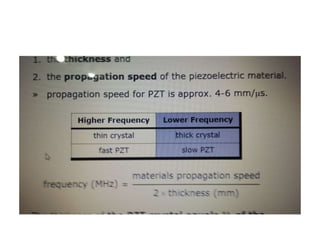
–The thickness of a PZT determines the
resonant frequency of the transducer.
•
–Transducer crystals are normally manufactured so that
their thickness (t) is equal to one-half of the wavelength (λ)
(i.e., t = λ/2).
•
–Changing the thickness of the crystal changes the frequency
but not the ultrasound amplitude or velocity.
•
The matching layer thickness is one-fourth the wavelength
of sound in that material and is referred to as quarter-wave
matching.
•
–A thickness to 1 mm and a velocity of sound of 4,000 m/s
has a resonant frequency f = v/λ = v/(2 × t), or 2 MHz.
•
–High-frequency transducers are thin, and low-
frequency transducers are thick.
•
–Transducers also emit ultrasound energy at frequencies
other than the resonant frequency but at a lower intensity.
•
–Clinical scanners can drive their transducers at several
different transmit frequencies.
•
Bandwidth and Quality Factor (Q-F)
•
Bandwidth :
•
It is uncommon for a TXR to emit a sound beam with
•
only a single pure frequency. Rather, the pulse is more
like a sound ‘click’ and contains a range of frequencies
•
below and above the main frequency.
•
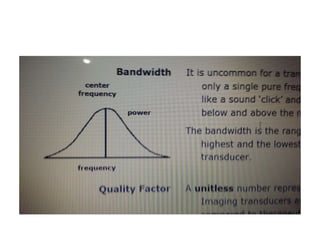
The bandwidth is the range of frequencies between the
•
highest and the lowest frequency emitted from the TXR
•
See slide (9)
•
–The bandwidth is related to the range of frequencies
generated by the crystal.
•
–The bandwidth determines @ the purity of sound and
@the length of time a sound persists, or (ring down time).
•
Narrow bandwidth TXRs produce a relatively pure frequency.
•
Pure sounds (narrow bandwidth) will persist for a long time.
•
Wide bandwidth transducers produce a wider
range of frequencies.
•
–Sounds with a broad range of frequencies last for only a very
short time.
•
Quality Factor : A unitless number representing the degree of
damping.
•
Imaging transducers are low-Q transducers when
•
compared to therapeutic transducers because imaging
•
transducers use backing material.
•
The Q-factor of typical imaging transducers can be
•
approximated by the number of cycles in the pulse
•
produced by the transducer (approximately 2 - 4).
•
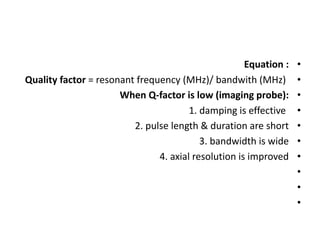
Equation :
•
Quality factor = resonant frequency (MHz)/ bandwith (MHz)
•
When Q-factor is low (imaging probe):
•
1. damping is effective
•
2. pulse length & duration are short
•
3. bandwidth is wide
•
4. axial resolution is improved
•
•
•
•
Transducer (TXR) Frequencies
•
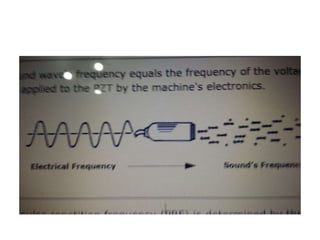
A) Continuos wave TXRs : Sound wave's frequency equals the
•
The frequency of the voltage applied to the PZT by the
•
machine's electronics.
•
slide (20)
•
B) Pulsed transducers : The pulse repetition frequency (PRF)
is determined by the
•
number of electrical pulses the US machine delivers to the
•
active element.
•
see slides (7/8)
•
•
The thickness of the PZT crystal equals ½ of
•
The wavelength of sound in the crystal.
•
The thickness of the matching layer is ¼ of the
•
wavelength of sound in the matching layer.
•
The frequencies used in therapy are typically
between 1.0 and 3.0 MHz (1 MHz = 1 million cycles
per second).
•
Sound Beams
•
Beam width
•
RULE: Narrow beams create better images
•
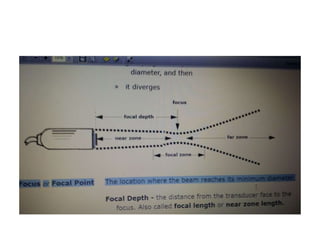
As sound travels, the width of the beam changes :
•
» starts out at exactly the same size as the transducer
•
diameter, gets progressively narrower until it reaches its
smallest diameter (focal point), then it diverges.
•
Focus or Focal Point is the location where the beam reaches
its minimum diameter.
•
•
Focusing
•
Results in: 1. a narrower “waist” in the US beam.
•
2. a decrease in focal depth (the focus is shallower).
•
3. a reduction in the size of the focal zone.
•
Effective mainly in the near field and the focal zone.
•
Electronic Focusing Phased array technology provides
dynamic, variable (adjustable)focusing or multifocusing
•
slide (19)
•
Focal Depth : is the distance from the transducer face to the
•
focus. Also called focal length or near zone length.
•
Near Zone (Fresnel Zone) is the region or zone in between
the
•
transducer and the focus.
•
Sound beams converge in the near zone
•
Far Zone (Fraunhofer Zone) is the region or zone deeper than
the focus, beyond the near field.
•
Sound beams diverge in the far zone.
•
The near field of the ultrasound beam is adjacent to the
transducer and is the region used for ultrasound imaging.
•
–The near field is also called the Fresnel zone.
•
–The length of the near field is r2/λ, where r is the transducer
radius and λ is the wavelength.
•
–For a 10-mm-diameter transducer operating at 3.5 MHz, the
near field extends ~6 cm in soft tissue.
•
–Doubling the transducer size increases the near field length
fourfold.
•
–Doubling the transducer frequency halves the wavelength,
which doubles the extent of the near field.
•
Focal Zone is the region surrounding the focus where the
beam is “sort of narrow” & the picure is relatively good
•
For an unfocused continuous wave disc transducer:
•
At the end of the near zone, the beam diameter is ½ the
•
transducer diameter.
•
At two near zone lengths, the beam diameter is equal to
•
the transducer diameter.
•
•
Focal Depth
•
Definition : is the distance from transducer to the focal point.
•
It is determined by two factors:
•
1. TXR diameter and 2. frequency of the ultrasound.
•
Shallow focus beams have small diameter & low frequency
•
Deep focus beams have large diameter & high frequency
•
Equation : focal length (focal depth) in cm =
•
TXR diameter (squared) X frequency/6
•
Sound Beam Divergence
•
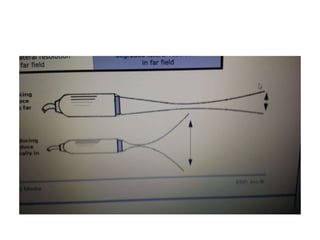
Describes the spread of the sound beam in the deep far zone.
•
It is determined by 2 factors :
•
1) TXR diameter and 2) ultrasound frequency
•
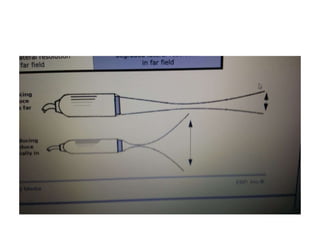
@ larger diameter crystals produce higher frequency sound &
produce beams that diverge less in the far field (narrow
beam) in addition to improved lateral resolution in far field.
•
@ Smaller diameter crystals produce lower frequency sound
& wider beam in the far field in addition to degraded lateral
resolution in far field. Slide (23)
•
Mechanical Scanning
•
Crystals : Scanhead contains one active element.
•
Steering : The active element is moved by a motor, oscillating
•
crystal or mirror through a pathway, automatically creating a
•
scan plane.
•
Focusing (Conventional or Fixed): curvature of the PZT or an
•
acoustic lens focuses the beam at a specific depth
•
Transducer Arrays
•
Array is a collection of active elements in a single transducer.
•
Element is a single slab of PZT cut into a collection of
separate
pieces called elements
•
Channel is when the electronic circuitry is connected to each
element.
•
Phased Arrays
phased meaning Adjustable focus or multi-focus; achieved
electronically.
•
Crystals, Steering & Focusing : is a collection of electric
pulses, separated by miniscule (extremely small) time delays,
(10 ns) is delivered to all of the transducer’s elements in
various patterns. The patterns focus & steer the US beam
•
during transmission.
•
Thus, focusing and steering are
electronic.
•
•
•
•
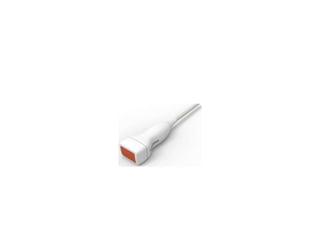
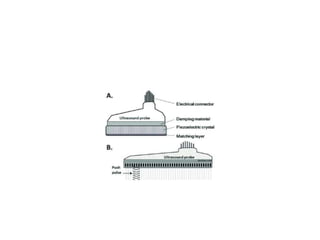
Transducers can produce an ultrasound beam in two way:
•
1- linear array (also called sequential array)
•
2- phased array
•
As a general rule, if the shape at the top of the images
matches the shape at the bottom of the image it is a
sequential array (linear).
•
If the shapes are different (e.g. rectangular at the top and
curved at the bottom) it is a phased array.
•
Slides (31/32/33)
•
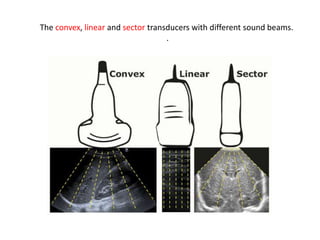
The convex, linear and sector transducers with different sound beams.
.
•
Convex probes (also called curved linear probes) have a
curved array that allows for a wider field of
view. Convex probes are primarily used for abdominal scans
due to their wider & deeper view.
•
A curvilinear probe uses lower frequency ultrasound allowing
a deep penetration and a wide depth of field, which is
excellent for viewing intra-abdominal structures.
•
How to hold the transducer
•
Hold the transducer like a pencil, not a flashlight. This gives
your wrist the greatest range of motion for moving in different
planes.
•
Hold the transducer close to the contact surface with the
patient. ...
•
Let the fourth and fifth fingertips of your scanning hand
contact the skin
•
Phased Arrays are arrays of US TXRs that fire individual
elements on the array in a specific sequence in order to direct
the sound wave in a specific direction. ... A phased array US
TXR typically will have a smaller footprint than a linear or
curved array, but can still image a large area.
•
With these transducers, a trapezoidal image
shape is produced.
•
A phased array US TXR is typically 2-3 cm long, consisting of
64-128 elements. It is a smaller assembly than a
sequential array and can be either linear or curvilinear. ...
Small delays in element firing allow for electronic field
steering and focusing without moving the ultrasound probe.
•
phased array usually means an electronically scanned array, a
computer-controlled array
•
Transducer Output
•
Synonyms : output gain, acoustic power, pulser power,
transmitter output, energy output.
•
Is determined by the excitation voltage from the pulser. And is
adjusted by sonographer.
•
Piezoelectric crystal vibrates with a magnitude related to
•
pulser voltage.
•
Effect upon image : slide (32)
•
1- When transducer output changes, every pulse transmitted
to the body changes.
•
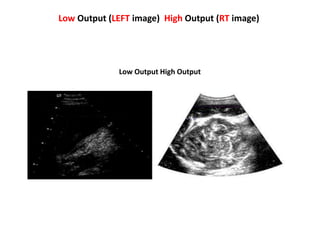
Low Output (LEFT image) High Output (RT image)
Low Output High Output
•
2- All reflections from structures in the body also change.
•
3- The brightness of the entire image changes.
•
4- Increasing transducer output improves signal-to-noise
ratio.
•
5- increasing TXR output affects patient exposure
•
6- Excessive output degrades axial resolution.
•
Diagnostic ultrasound transducers often have
better axial resolution than lateral resolution,
•
although the two may be comparable in the focal region of
strongly focused. 11.
•
At this depth, the effective beam diameter is approximately
equal to half the transducer diameter.
Us transducers (2)

Us transducers (2)

  • 1.
    US TRANSDUCERS (2) Dr.Kamal Sayed MSc US UAA Function/frequency/bandwidth/focusing/arrays/ soundbeams/Output/ OK
  • 2.
    • A. Function • –A transduceris a device that can convert one form of energy into another. • –Piezoelectric USs convert electrical energy into ultrasonic energy, and vice versa. • Piezoelectric means pressure electricity . • –The piezoelectric effect of a transducer is destroyed if heated above its Curie temperature.
  • 3.
    • US TXR materialsinclude lead-zirconate-titanate (PZT) , plastic polyvinylidene difluoride (PVDF), and the new monocrystalline transducers. US TXR materials include lead-zirconate-titanate (PZT) , plastic polyvinylidene difluoride (PVDF), and the new monocrystalline transducers PZT = P ; for Lead {Lead is a chemical element with the symbol [Pb] (from the Latin plumbum) and atomic number 82.) Z ; for Zirconate T ; for titanate
  • 4.
    High-frequency voltage oscillationsare produced by the scanner’s • front end and sent to the US TXRr over coaxial cables. • –Transducer crystals do not conduct electricity, but each side is coated with a thin layer of silver that acts as an electrode. • –The electrical energy causes the crystal to momentarily change shape (i.e., expand and contract). • –The nonconducting crystal changes shape in response to a voltage placed on its electrodes. • –This change in shape of the crystal increases and decreases the pressure in front of the transducer, thus producing ultrasound waves (transmitter). •
  • 5.
    • –When the crystalis subjected to pressure changes by the returning ultrasound echoes, the pressure changes are converted back into electrical energy signals. • –Voltage signals from returning echoes are transferred from the receiver to a computer, which are then used to create ultrasound images. • –Transducers may be operated in either pulsed or continuous- wave mode. • –Virtually all of medical ultrasound makes use of pulsed transducers.
  • 6.
    • B. Frequency • –The thicknessof a PZT determines the resonant frequency of the transducer. • –Transducer crystals are normally manufactured so that their thickness (t) is equal to one-half of the wavelength (λ) (i.e., t = λ/2). • –Changing the thickness of the crystal changes the frequency but not the ultrasound amplitude or velocity. • The matching layer thickness is one-fourth the wavelength of sound in that material and is referred to as quarter-wave matching.
  • 7.
    • –A thickness to1 mm and a velocity of sound of 4,000 m/s has a resonant frequency f = v/λ = v/(2 × t), or 2 MHz. • –High-frequency transducers are thin, and low- frequency transducers are thick. • –Transducers also emit ultrasound energy at frequencies other than the resonant frequency but at a lower intensity. • –Clinical scanners can drive their transducers at several different transmit frequencies.
  • 8.
    • Bandwidth and QualityFactor (Q-F) • Bandwidth : • It is uncommon for a TXR to emit a sound beam with • only a single pure frequency. Rather, the pulse is more like a sound ‘click’ and contains a range of frequencies • below and above the main frequency. • The bandwidth is the range of frequencies between the • highest and the lowest frequency emitted from the TXR • See slide (9)
  • 10.
    • –The bandwidth isrelated to the range of frequencies generated by the crystal. • –The bandwidth determines @ the purity of sound and @the length of time a sound persists, or (ring down time). • Narrow bandwidth TXRs produce a relatively pure frequency. • Pure sounds (narrow bandwidth) will persist for a long time. • Wide bandwidth transducers produce a wider range of frequencies. • –Sounds with a broad range of frequencies last for only a very short time.
  • 11.
    • Quality Factor :A unitless number representing the degree of damping. • Imaging transducers are low-Q transducers when • compared to therapeutic transducers because imaging • transducers use backing material. • The Q-factor of typical imaging transducers can be • approximated by the number of cycles in the pulse • produced by the transducer (approximately 2 - 4).
  • 12.
    • Equation : • Quality factor= resonant frequency (MHz)/ bandwith (MHz) • When Q-factor is low (imaging probe): • 1. damping is effective • 2. pulse length & duration are short • 3. bandwidth is wide • 4. axial resolution is improved • • •
  • 13.
    • Transducer (TXR) Frequencies • A)Continuos wave TXRs : Sound wave's frequency equals the • The frequency of the voltage applied to the PZT by the • machine's electronics. • slide (20) • B) Pulsed transducers : The pulse repetition frequency (PRF) is determined by the • number of electrical pulses the US machine delivers to the • active element. • see slides (7/8) •
  • 16.
    • The thickness ofthe PZT crystal equals ½ of • The wavelength of sound in the crystal. • The thickness of the matching layer is ¼ of the • wavelength of sound in the matching layer. • The frequencies used in therapy are typically between 1.0 and 3.0 MHz (1 MHz = 1 million cycles per second).
  • 17.
    • Sound Beams • Beam width • RULE:Narrow beams create better images • As sound travels, the width of the beam changes : • » starts out at exactly the same size as the transducer • diameter, gets progressively narrower until it reaches its smallest diameter (focal point), then it diverges. • Focus or Focal Point is the location where the beam reaches its minimum diameter. •
  • 18.
    • Focusing • Results in: 1.a narrower “waist” in the US beam. • 2. a decrease in focal depth (the focus is shallower). • 3. a reduction in the size of the focal zone. • Effective mainly in the near field and the focal zone. • Electronic Focusing Phased array technology provides dynamic, variable (adjustable)focusing or multifocusing • slide (19)
  • 20.
    • Focal Depth :is the distance from the transducer face to the • focus. Also called focal length or near zone length. • Near Zone (Fresnel Zone) is the region or zone in between the • transducer and the focus. • Sound beams converge in the near zone • Far Zone (Fraunhofer Zone) is the region or zone deeper than the focus, beyond the near field. • Sound beams diverge in the far zone.
  • 21.
    • The near fieldof the ultrasound beam is adjacent to the transducer and is the region used for ultrasound imaging. • –The near field is also called the Fresnel zone. • –The length of the near field is r2/λ, where r is the transducer radius and λ is the wavelength. • –For a 10-mm-diameter transducer operating at 3.5 MHz, the near field extends ~6 cm in soft tissue. • –Doubling the transducer size increases the near field length fourfold. • –Doubling the transducer frequency halves the wavelength, which doubles the extent of the near field.
  • 22.
    • Focal Zone isthe region surrounding the focus where the beam is “sort of narrow” & the picure is relatively good • For an unfocused continuous wave disc transducer: • At the end of the near zone, the beam diameter is ½ the • transducer diameter. • At two near zone lengths, the beam diameter is equal to • the transducer diameter. •
  • 24.
    • Focal Depth • Definition :is the distance from transducer to the focal point. • It is determined by two factors: • 1. TXR diameter and 2. frequency of the ultrasound. • Shallow focus beams have small diameter & low frequency • Deep focus beams have large diameter & high frequency • Equation : focal length (focal depth) in cm = • TXR diameter (squared) X frequency/6
  • 25.
    • Sound Beam Divergence • Describesthe spread of the sound beam in the deep far zone. • It is determined by 2 factors : • 1) TXR diameter and 2) ultrasound frequency • @ larger diameter crystals produce higher frequency sound & produce beams that diverge less in the far field (narrow beam) in addition to improved lateral resolution in far field. • @ Smaller diameter crystals produce lower frequency sound & wider beam in the far field in addition to degraded lateral resolution in far field. Slide (23)
  • 27.
    • Mechanical Scanning • Crystals :Scanhead contains one active element. • Steering : The active element is moved by a motor, oscillating • crystal or mirror through a pathway, automatically creating a • scan plane. • Focusing (Conventional or Fixed): curvature of the PZT or an • acoustic lens focuses the beam at a specific depth
  • 28.
    • Transducer Arrays • Array isa collection of active elements in a single transducer. • Element is a single slab of PZT cut into a collection of separate pieces called elements • Channel is when the electronic circuitry is connected to each element.
  • 29.
    • Phased Arrays phased meaningAdjustable focus or multi-focus; achieved electronically. • Crystals, Steering & Focusing : is a collection of electric pulses, separated by miniscule (extremely small) time delays, (10 ns) is delivered to all of the transducer’s elements in various patterns. The patterns focus & steer the US beam • during transmission. • Thus, focusing and steering are electronic. • • •
  • 30.
    • Transducers can producean ultrasound beam in two way: • 1- linear array (also called sequential array) • 2- phased array • As a general rule, if the shape at the top of the images matches the shape at the bottom of the image it is a sequential array (linear). • If the shapes are different (e.g. rectangular at the top and curved at the bottom) it is a phased array. • Slides (31/32/33) •
  • 34.
    The convex, linearand sector transducers with different sound beams. .
  • 35.
    • Convex probes (alsocalled curved linear probes) have a curved array that allows for a wider field of view. Convex probes are primarily used for abdominal scans due to their wider & deeper view. • A curvilinear probe uses lower frequency ultrasound allowing a deep penetration and a wide depth of field, which is excellent for viewing intra-abdominal structures.
  • 36.
    • How to holdthe transducer • Hold the transducer like a pencil, not a flashlight. This gives your wrist the greatest range of motion for moving in different planes. • Hold the transducer close to the contact surface with the patient. ... • Let the fourth and fifth fingertips of your scanning hand contact the skin
  • 37.
    • Phased Arrays arearrays of US TXRs that fire individual elements on the array in a specific sequence in order to direct the sound wave in a specific direction. ... A phased array US TXR typically will have a smaller footprint than a linear or curved array, but can still image a large area. • With these transducers, a trapezoidal image shape is produced.
  • 38.
    • A phased arrayUS TXR is typically 2-3 cm long, consisting of 64-128 elements. It is a smaller assembly than a sequential array and can be either linear or curvilinear. ... Small delays in element firing allow for electronic field steering and focusing without moving the ultrasound probe. • phased array usually means an electronically scanned array, a computer-controlled array
  • 39.
    • Transducer Output • Synonyms :output gain, acoustic power, pulser power, transmitter output, energy output. • Is determined by the excitation voltage from the pulser. And is adjusted by sonographer. • Piezoelectric crystal vibrates with a magnitude related to • pulser voltage. • Effect upon image : slide (32) • 1- When transducer output changes, every pulse transmitted to the body changes. •
  • 40.
    Low Output (LEFTimage) High Output (RT image) Low Output High Output
  • 41.
    • 2- All reflectionsfrom structures in the body also change. • 3- The brightness of the entire image changes. • 4- Increasing transducer output improves signal-to-noise ratio. • 5- increasing TXR output affects patient exposure • 6- Excessive output degrades axial resolution.
  • 42.
    • Diagnostic ultrasound transducersoften have better axial resolution than lateral resolution, • although the two may be comparable in the focal region of strongly focused. 11. • At this depth, the effective beam diameter is approximately equal to half the transducer diameter.