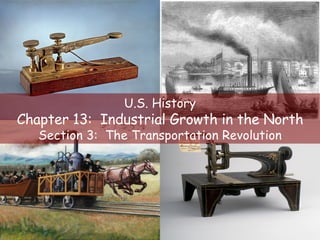
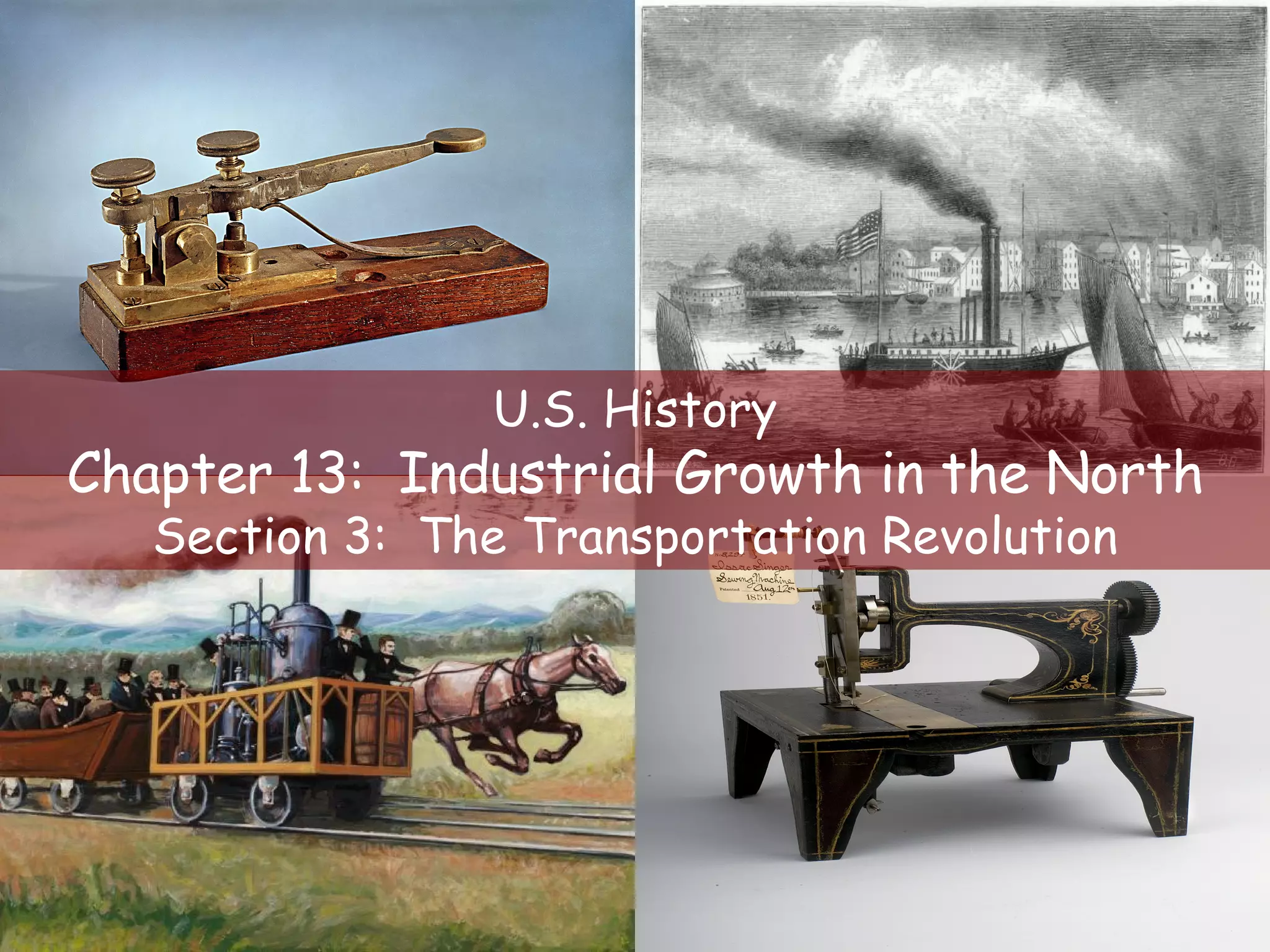
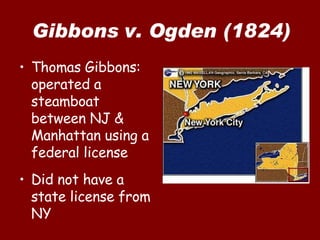
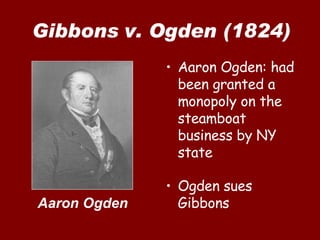
U.S. History Chapter 13:  Industrial Growth in the North Section 3:  The Transportation Revolution
New Ways to Travel Transportation Revolution Period of rapid growth in the speed & convenience in travel Created a boom in business
New Ways to Travel Roads, canals built New inventions Steamboat Railroad
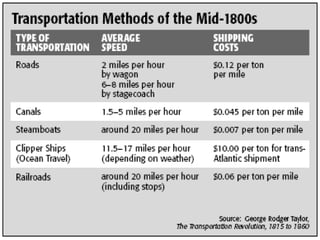
New Ways to Travel Shipping times reduced 1817:  shipping cargo from Cincinnati, OH to New York, NY took two months 1850s:  One week
New Ways to Travel Shipping costs reduced Overland:  $100 to ship a load of goods by land across NY state Canal:  $5
The Steamboat Steamboat : one of the first breakthroughs of the transportation revolution
The Steamboat Robert Fulton :  inventor who developed a steam-powered boat Robert Fulton
The Steamboat 1803: tested a steamboat in France Fulton demonstrating his steamboat to Napoleon Bonaparte
The Steamboat Clermont:  full-sized commercial steamboat
The Steamboat Advantages: Move quickly against the current Did not rely on wind power Shorter travel time, reduced costs
Gibbons v. Ogden (1824) Thomas Gibbons: operated a steamboat between NJ & Manhattan using a federal license  Did not have a state license from NY
Gibbons v. Ogden (1824) Aaron Ogden: had been granted a monopoly on the steamboat business by NY state Ogden sues Gibbons Aaron Ogden
Gibbons v. Ogden (1824) Supreme Court rules in favor of Gibbons Assertion of Congress’ power to regulate interstate commerce Federal law overruled state law
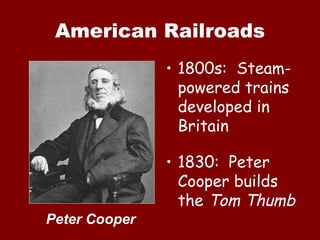
American Railroads 1800s:  Steam-powered trains developed in Britain 1830:  Peter Cooper builds the  Tom Thumb Peter Cooper
American Railroads Steam-powered trains became popular  after Cooper raced the  Tom Thumb  against a horse-drawn railcar
American Railroads 1840: 2000 miles of track laid Engineers built faster, more powerful locomotives Accidents common because  engineers would travel too fast
American Railroads 1860:  30,000 miles of track laid Shipping goods to distant markets Helped cities grow
 

US History Ch 13.3

  • 1.
    U.S. History Chapter13: Industrial Growth in the North Section 3: The Transportation Revolution
  • 2.
    New Ways toTravel Transportation Revolution Period of rapid growth in the speed & convenience in travel Created a boom in business
  • 3.
    New Ways toTravel Roads, canals built New inventions Steamboat Railroad
  • 4.
    New Ways toTravel Shipping times reduced 1817: shipping cargo from Cincinnati, OH to New York, NY took two months 1850s: One week
  • 5.
    New Ways toTravel Shipping costs reduced Overland: $100 to ship a load of goods by land across NY state Canal: $5
  • 6.
    The Steamboat Steamboat: one of the first breakthroughs of the transportation revolution
  • 7.
    The Steamboat RobertFulton : inventor who developed a steam-powered boat Robert Fulton
  • 8.
    The Steamboat 1803:tested a steamboat in France Fulton demonstrating his steamboat to Napoleon Bonaparte
  • 9.
    The Steamboat Clermont: full-sized commercial steamboat
  • 10.
    The Steamboat Advantages:Move quickly against the current Did not rely on wind power Shorter travel time, reduced costs
  • 11.
    Gibbons v. Ogden(1824) Thomas Gibbons: operated a steamboat between NJ & Manhattan using a federal license Did not have a state license from NY
  • 12.
    Gibbons v. Ogden(1824) Aaron Ogden: had been granted a monopoly on the steamboat business by NY state Ogden sues Gibbons Aaron Ogden
  • 13.
    Gibbons v. Ogden(1824) Supreme Court rules in favor of Gibbons Assertion of Congress’ power to regulate interstate commerce Federal law overruled state law
  • 14.
    American Railroads 1800s: Steam-powered trains developed in Britain 1830: Peter Cooper builds the Tom Thumb Peter Cooper
  • 15.
    American Railroads Steam-poweredtrains became popular after Cooper raced the Tom Thumb against a horse-drawn railcar
  • 16.
    American Railroads 1840:2000 miles of track laid Engineers built faster, more powerful locomotives Accidents common because engineers would travel too fast
  • 17.
    American Railroads 1860: 30,000 miles of track laid Shipping goods to distant markets Helped cities grow
  • 18.