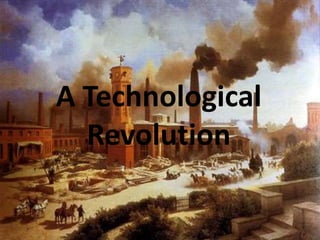
A Technological
  Revolution
What We Will Learn….
•   Why the Technological Revolution called “the Second
    Industrial Revolution
•   How daily lives changed in the decades following the Civil
    War.
•   How advances in electric power and communication
    affected people and businesses in the era.
•   The effects the development of railroads had on industrial
    growth.
•   The impact of the Bessemer process on American culture.
•   The contributions of African Americans during the growth
    of American Industry
•   Innovations developed by African American and how they
    helped to fuel industrial development in the United States
Vocabulary

• Patent- licenses that give an inventor the exclusive
  right to make, use, or sell and invention for a set
  period time.
• Productivity -the amount of goods and services
  created in a given period of time.
• Transcontinental railroad- railway extending from
  coast to coast.
• Bessemer process- The Bessemer process was the
  first inexpensive industrial process for the mass-
  production of steel from molten pig iron.
• Mass production- production in great amounts of
  steel.
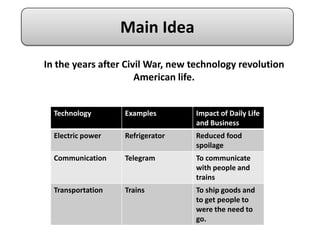
Main Idea
In the years after Civil War, new technology revolution
                      American life.


  Technology       Examples       Impact of Daily Life
                                  and Business
  Electric power   Refrigerator   Reduced food
                                  spoilage
  Communication    Telegram       To communicate
                                  with people and
                                  trains
  Transportation   Trains         To ship goods and
                                  to get people to
                                  were the need to
                                  go.
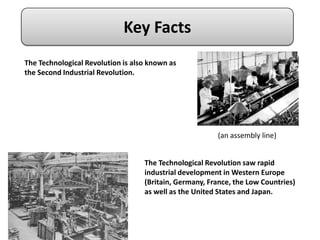
Key Facts
The Technological Revolution is also known as
the Second Industrial Revolution.


                                                        (an assembly line)


                                   The Technological Revolution saw rapid
                                   industrial development in Western Europe
                                   (Britain, Germany, France, the Low Countries)
                                   as well as the United States and Japan.
Why was the Technological
    Revolution called “The Second
       Industrial Revolution”
 The Technological was a phase of the larger Industrial
Revolution corresponding to the later half of the 19th
century until World War 1.
 The difference between the First Industrial Revolution and
the Second Industrial Revolution is that the Second
Industrial Revolution had inventions and innovations that
were science based.
Daily Life Changes

In the decades after the Civil War, Americans experienced
remarkable changes in their everyday life, from the clothes
they wore and food they ate to their opportunities for
recreation. Mail order catalogs allowed rural residents to buy
new equipment and follow the latest trends in fashion or
household appliances without ever going to a store. The
public school and university systems grew and developed as
the demand for education increased. Meanwhile, Americans
filled their leisure time with a diverse range of activities,
from sports to vaudeville to amusement parks. The impact of
these changes in lifestyle was reflected in both the serious
and popular literature of the time, which emphasized realism
and targeted the growing middle class.
Advances in electric power and
         communication
 With the ability to have electric power lots of homes and
industries were improved. With electric power industries
could produce products faster than usual people could stay
up longer and work longer hours because they were able to
see at night.
 Telegraph lines were installed along rail lines for
communicating with trains, evolved into a communication
network
The Effects the Development of
     Railroads Had on Industrial Growth
 Railroads became the dominant mode of land transportation in the last
half of the 19th century. Railroads flourished in England, from 1,000 miles
in 1836 to more than 7,000 miles built by 1852. Railroads provided a fast,
inexpensive, convenient, and efficient mode of transportation for many
passengers. By the 1850s, railways connected the Atlantic seaboard and
the Midwest in the United States. In 1869 the first transcontinental route
was completed to the Pacific coast. This provided the first transportation
for passengers across North America.
 Not only did people need better transportation, but manufactured
goods, raw materials and food also needed a quick, inexpensive mode of
transportation . The availability of manufactured goods and foods
increased because of railroads provided quick transportation. Costs of
products also decreased because of railroads.
The Impact of the Bessemer
         process on American culture
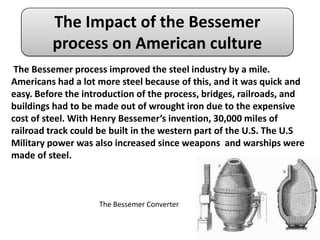
 The Bessemer process improved the steel industry by a mile.
Americans had a lot more steel because of this, and it was quick and
easy. Before the introduction of the process, bridges, railroads, and
buildings had to be made out of wrought iron due to the expensive
cost of steel. With Henry Bessemer’s invention, 30,000 miles of
railroad track could be built in the western part of the U.S. The U.S
Military power was also increased since weapons and warships were
made of steel.


                    The Bessemer Converter
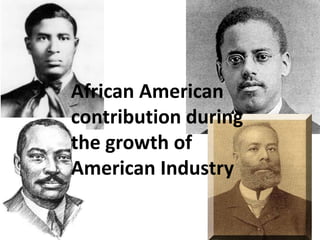
African American
contribution during
the growth of
American Industry
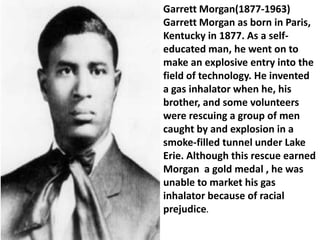
Garrett Morgan(1877-1963)
Garrett Morgan as born in Paris,
Kentucky in 1877. As a self-
educated man, he went on to
make an explosive entry into the
field of technology. He invented
a gas inhalator when he, his
brother, and some volunteers
were rescuing a group of men
caught by and explosion in a
smoke-filled tunnel under Lake
Erie. Although this rescue earned
Morgan a gold medal , he was
unable to market his gas
inhalator because of racial
prejudice.
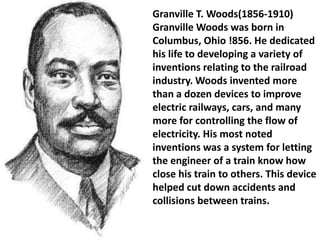
Granville T. Woods(1856-1910)
Granville Woods was born in
Columbus, Ohio !856. He dedicated
his life to developing a variety of
inventions relating to the railroad
industry. Woods invented more
than a dozen devices to improve
electric railways, cars, and many
more for controlling the flow of
electricity. His most noted
inventions was a system for letting
the engineer of a train know how
close his train to others. This device
helped cut down accidents and
collisions between trains.
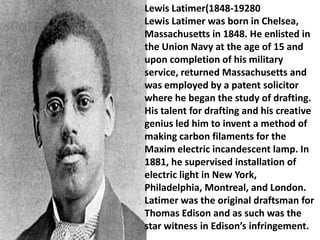
Lewis Latimer(1848-19280
Lewis Latimer was born in Chelsea,
Massachusetts in 1848. He enlisted in
the Union Navy at the age of 15 and
upon completion of his military
service, returned Massachusetts and
was employed by a patent solicitor
where he began the study of drafting.
His talent for drafting and his creative
genius led him to invent a method of
making carbon filaments for the
Maxim electric incandescent lamp. In
1881, he supervised installation of
electric light in New York,
Philadelphia, Montreal, and London.
Latimer was the original draftsman for
Thomas Edison and as such was the
star witness in Edison’s infringement.
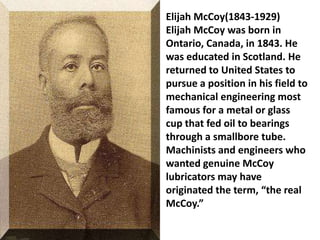
Elijah McCoy(1843-1929)
Elijah McCoy was born in
Ontario, Canada, in 1843. He
was educated in Scotland. He
returned to United States to
pursue a position in his field to
mechanical engineering most
famous for a metal or glass
cup that fed oil to bearings
through a smallbore tube.
Machinists and engineers who
wanted genuine McCoy
lubricators may have
originated the term, “the real
McCoy.”
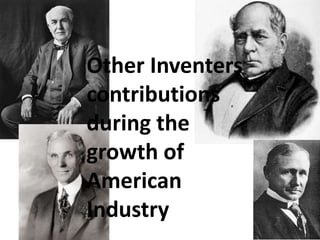
Other Inventers
contributions
during the
growth of
American
Industry
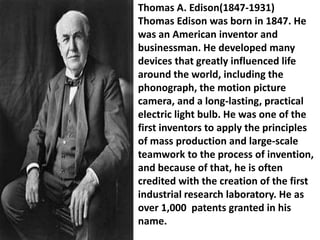
Thomas A. Edison(1847-1931)
Thomas Edison was born in 1847. He
was an American inventor and
businessman. He developed many
devices that greatly influenced life
around the world, including the
phonograph, the motion picture
camera, and a long-lasting, practical
electric light bulb. He was one of the
first inventors to apply the principles
of mass production and large-scale
teamwork to the process of invention,
and because of that, he is often
credited with the creation of the first
industrial research laboratory. He as
over 1,000 patents granted in his
name.
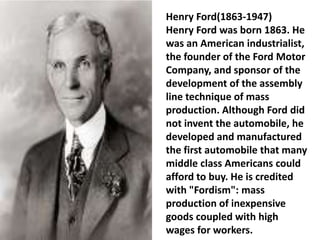
Henry Ford(1863-1947)
Henry Ford was born 1863. He
was an American industrialist,
the founder of the Ford Motor
Company, and sponsor of the
development of the assembly
line technique of mass
production. Although Ford did
not invent the automobile, he
developed and manufactured
the first automobile that many
middle class Americans could
afford to buy. He is credited
with "Fordism": mass
production of inexpensive
goods coupled with high
wages for workers.
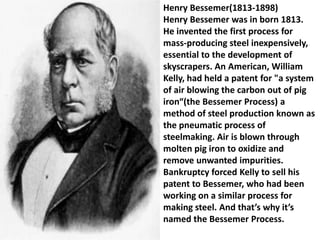
Henry Bessemer(1813-1898)
Henry Bessemer was in born 1813.
He invented the first process for
mass-producing steel inexpensively,
essential to the development of
skyscrapers. An American, William
Kelly, had held a patent for "a system
of air blowing the carbon out of pig
iron“(the Bessemer Process) a
method of steel production known as
the pneumatic process of
steelmaking. Air is blown through
molten pig iron to oxidize and
remove unwanted impurities.
Bankruptcy forced Kelly to sell his
patent to Bessemer, who had been
working on a similar process for
making steel. And that’s why it’s
named the Bessemer Process.
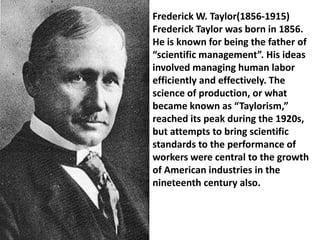
Frederick W. Taylor(1856-1915)
Frederick Taylor was born in 1856.
He is known for being the father of
“scientific management”. His ideas
involved managing human labor
efficiently and effectively. The
science of production, or what
became known as “Taylorism,”
reached its peak during the 1920s,
but attempts to bring scientific
standards to the performance of
workers were central to the growth
of American industries in the
nineteenth century also.

A technological revolution

  • 1.
    A Technological Revolution
  • 2.
    What We WillLearn…. • Why the Technological Revolution called “the Second Industrial Revolution • How daily lives changed in the decades following the Civil War. • How advances in electric power and communication affected people and businesses in the era. • The effects the development of railroads had on industrial growth. • The impact of the Bessemer process on American culture. • The contributions of African Americans during the growth of American Industry • Innovations developed by African American and how they helped to fuel industrial development in the United States
  • 3.
    Vocabulary • Patent- licensesthat give an inventor the exclusive right to make, use, or sell and invention for a set period time. • Productivity -the amount of goods and services created in a given period of time. • Transcontinental railroad- railway extending from coast to coast. • Bessemer process- The Bessemer process was the first inexpensive industrial process for the mass- production of steel from molten pig iron. • Mass production- production in great amounts of steel.
  • 4.
    Main Idea In theyears after Civil War, new technology revolution American life. Technology Examples Impact of Daily Life and Business Electric power Refrigerator Reduced food spoilage Communication Telegram To communicate with people and trains Transportation Trains To ship goods and to get people to were the need to go.
  • 5.
    Key Facts The TechnologicalRevolution is also known as the Second Industrial Revolution. (an assembly line) The Technological Revolution saw rapid industrial development in Western Europe (Britain, Germany, France, the Low Countries) as well as the United States and Japan.
  • 6.
    Why was theTechnological Revolution called “The Second Industrial Revolution” The Technological was a phase of the larger Industrial Revolution corresponding to the later half of the 19th century until World War 1. The difference between the First Industrial Revolution and the Second Industrial Revolution is that the Second Industrial Revolution had inventions and innovations that were science based.
  • 7.
    Daily Life Changes Inthe decades after the Civil War, Americans experienced remarkable changes in their everyday life, from the clothes they wore and food they ate to their opportunities for recreation. Mail order catalogs allowed rural residents to buy new equipment and follow the latest trends in fashion or household appliances without ever going to a store. The public school and university systems grew and developed as the demand for education increased. Meanwhile, Americans filled their leisure time with a diverse range of activities, from sports to vaudeville to amusement parks. The impact of these changes in lifestyle was reflected in both the serious and popular literature of the time, which emphasized realism and targeted the growing middle class.
  • 8.
    Advances in electricpower and communication With the ability to have electric power lots of homes and industries were improved. With electric power industries could produce products faster than usual people could stay up longer and work longer hours because they were able to see at night. Telegraph lines were installed along rail lines for communicating with trains, evolved into a communication network
  • 9.
    The Effects theDevelopment of Railroads Had on Industrial Growth Railroads became the dominant mode of land transportation in the last half of the 19th century. Railroads flourished in England, from 1,000 miles in 1836 to more than 7,000 miles built by 1852. Railroads provided a fast, inexpensive, convenient, and efficient mode of transportation for many passengers. By the 1850s, railways connected the Atlantic seaboard and the Midwest in the United States. In 1869 the first transcontinental route was completed to the Pacific coast. This provided the first transportation for passengers across North America. Not only did people need better transportation, but manufactured goods, raw materials and food also needed a quick, inexpensive mode of transportation . The availability of manufactured goods and foods increased because of railroads provided quick transportation. Costs of products also decreased because of railroads.
  • 10.
    The Impact ofthe Bessemer process on American culture The Bessemer process improved the steel industry by a mile. Americans had a lot more steel because of this, and it was quick and easy. Before the introduction of the process, bridges, railroads, and buildings had to be made out of wrought iron due to the expensive cost of steel. With Henry Bessemer’s invention, 30,000 miles of railroad track could be built in the western part of the U.S. The U.S Military power was also increased since weapons and warships were made of steel. The Bessemer Converter
  • 11.
    African American contribution during thegrowth of American Industry
  • 12.
    Garrett Morgan(1877-1963) Garrett Morganas born in Paris, Kentucky in 1877. As a self- educated man, he went on to make an explosive entry into the field of technology. He invented a gas inhalator when he, his brother, and some volunteers were rescuing a group of men caught by and explosion in a smoke-filled tunnel under Lake Erie. Although this rescue earned Morgan a gold medal , he was unable to market his gas inhalator because of racial prejudice.
  • 13.
    Granville T. Woods(1856-1910) GranvilleWoods was born in Columbus, Ohio !856. He dedicated his life to developing a variety of inventions relating to the railroad industry. Woods invented more than a dozen devices to improve electric railways, cars, and many more for controlling the flow of electricity. His most noted inventions was a system for letting the engineer of a train know how close his train to others. This device helped cut down accidents and collisions between trains.
  • 14.
    Lewis Latimer(1848-19280 Lewis Latimerwas born in Chelsea, Massachusetts in 1848. He enlisted in the Union Navy at the age of 15 and upon completion of his military service, returned Massachusetts and was employed by a patent solicitor where he began the study of drafting. His talent for drafting and his creative genius led him to invent a method of making carbon filaments for the Maxim electric incandescent lamp. In 1881, he supervised installation of electric light in New York, Philadelphia, Montreal, and London. Latimer was the original draftsman for Thomas Edison and as such was the star witness in Edison’s infringement.
  • 15.
    Elijah McCoy(1843-1929) Elijah McCoywas born in Ontario, Canada, in 1843. He was educated in Scotland. He returned to United States to pursue a position in his field to mechanical engineering most famous for a metal or glass cup that fed oil to bearings through a smallbore tube. Machinists and engineers who wanted genuine McCoy lubricators may have originated the term, “the real McCoy.”
  • 16.
  • 17.
    Thomas A. Edison(1847-1931) ThomasEdison was born in 1847. He was an American inventor and businessman. He developed many devices that greatly influenced life around the world, including the phonograph, the motion picture camera, and a long-lasting, practical electric light bulb. He was one of the first inventors to apply the principles of mass production and large-scale teamwork to the process of invention, and because of that, he is often credited with the creation of the first industrial research laboratory. He as over 1,000 patents granted in his name.
  • 18.
    Henry Ford(1863-1947) Henry Fordwas born 1863. He was an American industrialist, the founder of the Ford Motor Company, and sponsor of the development of the assembly line technique of mass production. Although Ford did not invent the automobile, he developed and manufactured the first automobile that many middle class Americans could afford to buy. He is credited with "Fordism": mass production of inexpensive goods coupled with high wages for workers.
  • 19.
    Henry Bessemer(1813-1898) Henry Bessemerwas in born 1813. He invented the first process for mass-producing steel inexpensively, essential to the development of skyscrapers. An American, William Kelly, had held a patent for "a system of air blowing the carbon out of pig iron“(the Bessemer Process) a method of steel production known as the pneumatic process of steelmaking. Air is blown through molten pig iron to oxidize and remove unwanted impurities. Bankruptcy forced Kelly to sell his patent to Bessemer, who had been working on a similar process for making steel. And that’s why it’s named the Bessemer Process.
  • 20.
    Frederick W. Taylor(1856-1915) FrederickTaylor was born in 1856. He is known for being the father of “scientific management”. His ideas involved managing human labor efficiently and effectively. The science of production, or what became known as “Taylorism,” reached its peak during the 1920s, but attempts to bring scientific standards to the performance of workers were central to the growth of American industries in the nineteenth century also.