Transportation Revolution Jackson Hr 5 APUSH
The Problems A growing nation in need of an economy and quick transportation. People spreading out with no way to buy necessities. Inland farming cities had to ship to port cities for export Long commutes would lead to communication problems and the price could vary greatly on the way. it took four days to go from New York City to Boston, Albany or Washington, DC, a week to get to Pittsburgh, and twenty-eight days to get to Detroit. Travel by water was slow. Flatboats were built to sail down but once they reached the end they were broken down and sold for firewood. Keelboats, essentially a flat with a rudder, could make it upstream but were very slow. Roads were limited and expensive to maintain Maintained by the town or state which had no way to bring in income. Horse drawn vehicles were incapable of hauling large loads.
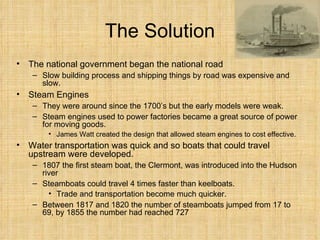
The Solution The national government began the national road Slow building process and shipping things by road was expensive and slow. Steam Engines They were around since the 1700’s but the early models were weak. Steam engines used to power factories became a great source of power for moving goods. James Watt created the design that allowed steam engines to cost effective. Water transportation was quick and so boats that could travel upstream were developed. 1807 the first steam boat, the Clermont, was introduced into the Hudson river Steamboats could travel 4 times faster than keelboats. Trade and transportation become much quicker. Between 1817 and 1820 the number of steamboats jumped from 17 to 69, by 1855 the number had reached 727
The Problems America was not covered in water and boats could only go so far. As a result private investors funded projects to build new canals and connect the cities Steamships were not very safe. Little was known about the stresses on the boat Collisions with debris would crack the hull and sink the ship Boilers could explode killing many and destroying the ships Ships carried flammable fuel and cargo Roads were still in poor quality. Some areas were to far from the water to benefit from boats. Massachusetts chartered a rail company to connect to the western railroad
The Solutions Steam engines were improved and made more efficient from the original designs The first American made steam locomotive was the Tom Thumb. A passing horse carriage challenged it to a race, the Tom Thumb led the race until a belt fell off and it lost power. The horse won. Developed to convince the Baltimore railroad company to use steam power. Rail travel was faster, cheaper and had a greater range than canal travel. Rail started to spread across the nation as towns found it to be inexpensive and reliable.
The Problems Railroads weren’t funded by the government and contractors had to do it Cost cutting measures used in the construction of rails lead to increased maintenance and safety hazards Using wooden planks covered in iron on the tracks Slower building process due to the inadequate funding Rail was inadequate to ship large bulky commodities. Steam trains could also explode with sometimes more disastrous results then the boats. Trains ran through populated areas where as boats travelled on relatively isolated canals.
Overall With the country quickly growing in size but not developing a transportation system the country would quickly fall apart. The innovation of the steam engine provided for the perfect way to power goods across the country With the new, faster forms of transportation commuting times were drastically reduced. News could travel quicker Shipping costs were reduced Goods could be shipped further People could spread out further There were few disadvantages to the faster forms of transportation

Transportation Revolution

  • 1.
  • 2.
    The Problems Agrowing nation in need of an economy and quick transportation. People spreading out with no way to buy necessities. Inland farming cities had to ship to port cities for export Long commutes would lead to communication problems and the price could vary greatly on the way. it took four days to go from New York City to Boston, Albany or Washington, DC, a week to get to Pittsburgh, and twenty-eight days to get to Detroit. Travel by water was slow. Flatboats were built to sail down but once they reached the end they were broken down and sold for firewood. Keelboats, essentially a flat with a rudder, could make it upstream but were very slow. Roads were limited and expensive to maintain Maintained by the town or state which had no way to bring in income. Horse drawn vehicles were incapable of hauling large loads.
  • 3.
    The Solution Thenational government began the national road Slow building process and shipping things by road was expensive and slow. Steam Engines They were around since the 1700’s but the early models were weak. Steam engines used to power factories became a great source of power for moving goods. James Watt created the design that allowed steam engines to cost effective. Water transportation was quick and so boats that could travel upstream were developed. 1807 the first steam boat, the Clermont, was introduced into the Hudson river Steamboats could travel 4 times faster than keelboats. Trade and transportation become much quicker. Between 1817 and 1820 the number of steamboats jumped from 17 to 69, by 1855 the number had reached 727
  • 4.
    The Problems Americawas not covered in water and boats could only go so far. As a result private investors funded projects to build new canals and connect the cities Steamships were not very safe. Little was known about the stresses on the boat Collisions with debris would crack the hull and sink the ship Boilers could explode killing many and destroying the ships Ships carried flammable fuel and cargo Roads were still in poor quality. Some areas were to far from the water to benefit from boats. Massachusetts chartered a rail company to connect to the western railroad
  • 5.
    The Solutions Steamengines were improved and made more efficient from the original designs The first American made steam locomotive was the Tom Thumb. A passing horse carriage challenged it to a race, the Tom Thumb led the race until a belt fell off and it lost power. The horse won. Developed to convince the Baltimore railroad company to use steam power. Rail travel was faster, cheaper and had a greater range than canal travel. Rail started to spread across the nation as towns found it to be inexpensive and reliable.
  • 6.
    The Problems Railroadsweren’t funded by the government and contractors had to do it Cost cutting measures used in the construction of rails lead to increased maintenance and safety hazards Using wooden planks covered in iron on the tracks Slower building process due to the inadequate funding Rail was inadequate to ship large bulky commodities. Steam trains could also explode with sometimes more disastrous results then the boats. Trains ran through populated areas where as boats travelled on relatively isolated canals.
  • 7.
    Overall With thecountry quickly growing in size but not developing a transportation system the country would quickly fall apart. The innovation of the steam engine provided for the perfect way to power goods across the country With the new, faster forms of transportation commuting times were drastically reduced. News could travel quicker Shipping costs were reduced Goods could be shipped further People could spread out further There were few disadvantages to the faster forms of transportation