Chapter 22:  Railroads & Farming Section 1:  The Growth of Railroads
New Railroad Lines State’s economic development slowed by transportation problems Rivers and roads unreliable Time consuming & expensive to ship goods
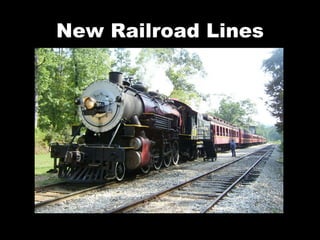
New Railroad Lines
New Railroad Lines Shipping goods by railroad  could reduce freight costs by more than 50% Civil War interrupted plans to build rail lines in Texas: 1861:  470 miles of rail line
New Railroad Lines Biggest difficulty in expanding railroads in Texas was  financing their construction Many cities issued  bonds to pay for rail construction Constitution of 1876 banned such local bonds
New Railroad Lines State of Texas enacted  a land grant law to help finance rail lines Railroad companies received 16 sq. miles of land for every mile of track completed
New Railroad Lines Railroads sold land to finance construction More than 30 million acres of public lands  were given to railroads to encourage them to lay track across Texas
The Railroad Boom 1876-1879:  750 miles of track laid in Texas Companies begin a race west Lines ran to Mexico border
The Railroad Boom Panhandle one of last regions to receive rail service Towns along railroads boomed w/ business 1879-1889:  6,000 miles of track laid in Texas
The Effects of the Rail Boom New cities born, new areas settled Texas more connected to rest of nation Goods could be shipped more easily out of state
The Effects of the Rail Boom Junction —meeting places of two or more rail lines Cities bypassed by railroads  suffered population & economic losses .
Farmers Move West Railroad companies  actively promoted farming in West Texas . Railroads sold parcels of land to farmers Settlers were  willing to locate their farms near railroads.
Farmers Move West Farming followed the railroads to the frontier because: Offered an inexpensive way to ship goods to market Land less expensive Companies promoted opportunities

TX History Ch 22.1

  • 1.
    Chapter 22: Railroads & Farming Section 1: The Growth of Railroads
  • 2.
    New Railroad LinesState’s economic development slowed by transportation problems Rivers and roads unreliable Time consuming & expensive to ship goods
  • 3.
  • 4.
    New Railroad LinesShipping goods by railroad could reduce freight costs by more than 50% Civil War interrupted plans to build rail lines in Texas: 1861: 470 miles of rail line
  • 5.
    New Railroad LinesBiggest difficulty in expanding railroads in Texas was financing their construction Many cities issued bonds to pay for rail construction Constitution of 1876 banned such local bonds
  • 6.
    New Railroad LinesState of Texas enacted a land grant law to help finance rail lines Railroad companies received 16 sq. miles of land for every mile of track completed
  • 7.
    New Railroad LinesRailroads sold land to finance construction More than 30 million acres of public lands were given to railroads to encourage them to lay track across Texas
  • 8.
    The Railroad Boom1876-1879: 750 miles of track laid in Texas Companies begin a race west Lines ran to Mexico border
  • 9.
    The Railroad BoomPanhandle one of last regions to receive rail service Towns along railroads boomed w/ business 1879-1889: 6,000 miles of track laid in Texas
  • 10.
    The Effects ofthe Rail Boom New cities born, new areas settled Texas more connected to rest of nation Goods could be shipped more easily out of state
  • 11.
    The Effects ofthe Rail Boom Junction —meeting places of two or more rail lines Cities bypassed by railroads suffered population & economic losses .
  • 12.
    Farmers Move WestRailroad companies actively promoted farming in West Texas . Railroads sold parcels of land to farmers Settlers were willing to locate their farms near railroads.
  • 13.
    Farmers Move WestFarming followed the railroads to the frontier because: Offered an inexpensive way to ship goods to market Land less expensive Companies promoted opportunities