10        11


12        13        14
   Modes of transportation in the United States
    were improved during the early to mid 1800s.
   Canals, roads, and railroads were built. Rivers
    were also utilized for a means of
    transportation.
   These advancements of places for
    transportation made way for new ways to get
    around the country.

                                                 SF
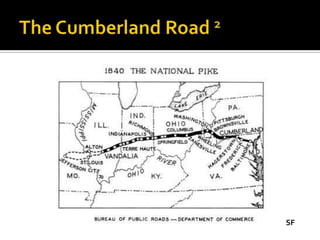
   The Cumberland Road was begun in 1811.
   This road was a way for people in the states to travel to the new
    frontier. 1
   Improved roads allowed for wagons, carriages, and other carts such
    as these to travel easier between the states.
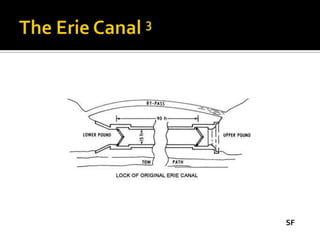
   The Erie Canal was finished in 1825.1
   This canal gave merchants the ability to send food, clothing, building
    materials, and other necessities to the people living on the frontier. 1


                                                                          SF
SF
SF
Erie Canal
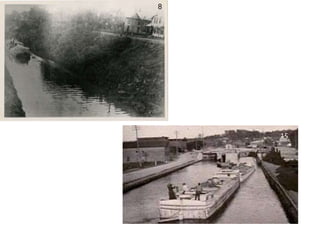
   1817-1825
   The Erie Canal revolutionized transportation.
   This Canal allowed the North East and North West to transport things
    back and forth easier, quicker, and less expensive. (North East= Buffalo,
    New York; North West= Great Lakes region)
   If the price of something used to be 100 dollars prior to the Canal, after
    the canal it was around 5 dollars.
   Also before the canal it took someone or something 20 days to get from
    east to west and the same from west to east, after the canal it took 6
    days.
   The Canal could transport not only products but also people. This helped
    immensely with westward expansion.
   Population especially grew on the canal and the great lakes.
   New York became more important than New Orleans because of this
    canal.
   However during the winter months the canal was not allowed to be used
    considering it was still water which would freeze from the cold. 17
                                                                           ML
8


    15
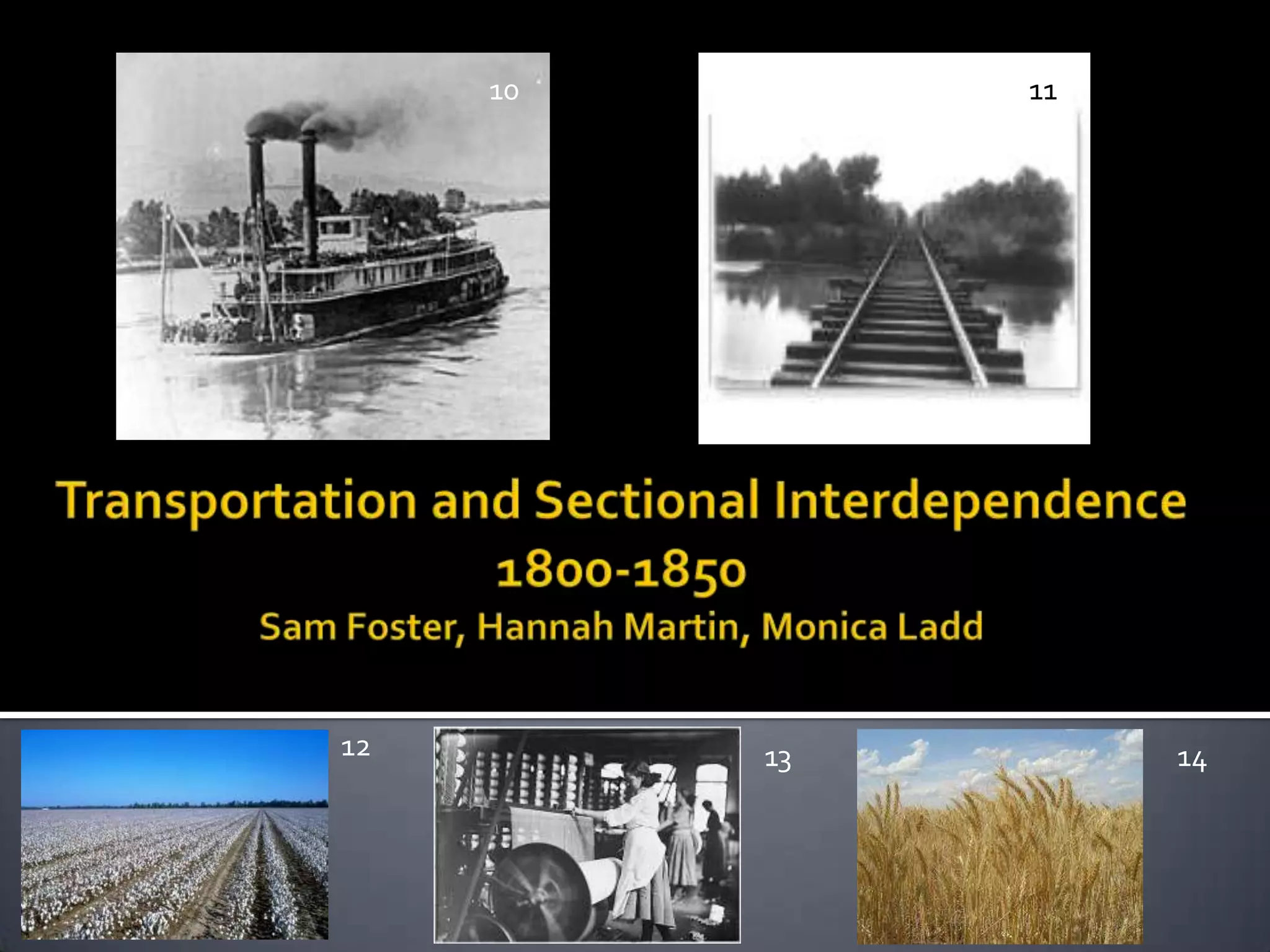
   The first steam engine was designed in 1803 by Samuel Homfray.4
   Prior to this, rails had been used for carts that were pulled by horses.4 Rails were
    used for these carts because it was more efficient than pulling a cart of dirt, rock,
    and other elements.4
   The steam engine was then added to a type of car in 1804 by Richard Trevithick.4
    This was the first train that was powered by steam.4 This steam-powered train
    could pull more of a load than the horse-drawn carts, which made it more of an
    resourceful way to haul goods across the country.4
   Stockton and Darlington Railroad Company was founded in 1825. 4 This company
    used the locomotive to transport people, as well as cargo, around the United
    States.4
   Railroads allowed people to travel easier between states, even more than the
    improved roads did. The powerful steam engine trains could pull more people
    than a wagon or carriage.


                                                                                        SF
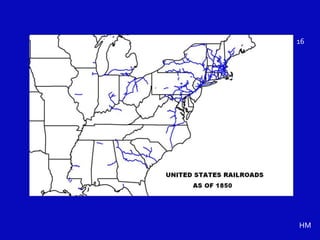
 In the 1840’s 75% of railroads were in the North
  East and North West. 17
 Trains were convenient for the North East and
  North West in the winter month’s considering
  they could continue to run no matter how cold it
  was. Also they could run the train as long as they
  got all of the snow off the tracks.
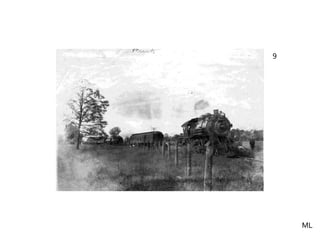
 Unfortunately the trains were not always
  successful.
 Their brakes were extremely poor. Also freight
  was not allowed on trains.
                                                  ML
9


    ML
16


HM
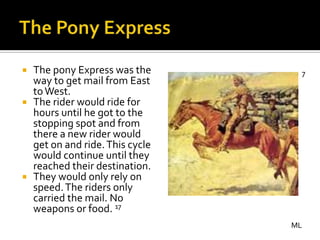
 The pony Express was the       7
  way to get mail from East
  to West.
 The rider would ride for
  hours until he got to the
  stopping spot and from
  there a new rider would
  get on and ride. This cycle
  would continue until they
  reached their destination.
 They would only rely on
  speed. The riders only
  carried the mail. No
  weapons or food. 17
                                ML
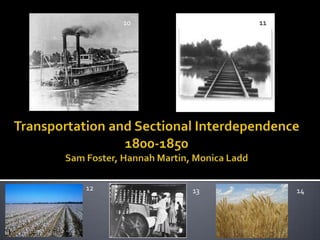
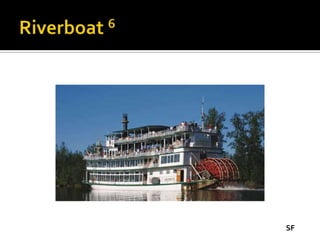
   This first successful riverboat trip was in 1807.5
   The boat was named “The Clermont,” and was developed by Robert
    Fulton. 5
   This trip went departed from New York City and arrived in Albany around
    two days later.5
   After this, the use of the riverboat quickly spread through the United
    States. 5 Riverboat trips were especially popular on the Mississippi River.5
   The riverboat could carry people, as well as other cargo, along the river.5
   The use of the riverboat was more efficient than the previous method of
    taking a raft down the river to sell goods, and then making a long journey
    back across hundreds of miles.


                                                                             SF
SF
   The use of roads, rivers, and railways were essential
    for the growth of the United States.
   Without these modes of transportation, food, building
    materials, clothing, and people would not have been
    able to move around the country and across the
    frontier as well. If the goods had not been able to be
    transported efficiently, then the growth of the
    country may not have occurred, or at the least
    stunted, because the goods may not have reached
    their intended destination.

                                                       SF
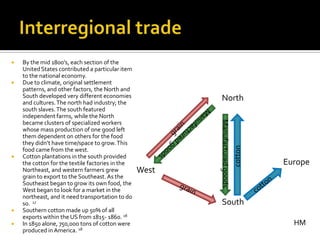
   By the mid 1800’s, each section of the
    United States contributed a particular item
    to the national economy.
   Due to climate, original settlement
    patterns, and other factors, the North and
    South developed very different economies               North
    and cultures. The north had industry; the
    south slaves. The south featured
    independent farms, while the North


                                                         Manufactured goods
    became clusters of specialized workers
    whose mass production of one good left
    them dependent on others for the food
    they didn’t have time/space to grow. This


                                                                              cotton
    food came from the west.
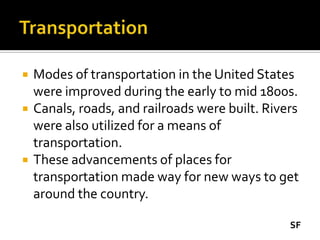
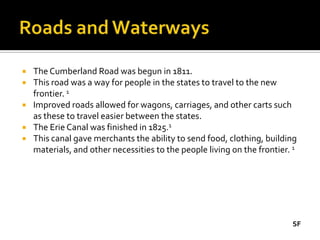
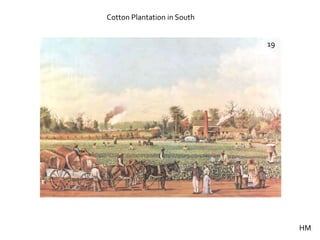
   Cotton plantations in the south provided
    the cotton for the textile factories in the                                        Europe
    Northeast, and western farmers grew           West
    grain to export to the Southeast. As the
    Southeast began to grow its own food, the
    West began to look for a market in the
    northeast, and it need transportation to do
    so. 17                                                 South
   Southern cotton made up 50% of all
    exports within the US from 1815- 1860. 18
   In 1850 alone, 750,00o tons of cotton were                                           HM
    produced in America. 18
Cotton Plantation in South


                             19


                                  HM
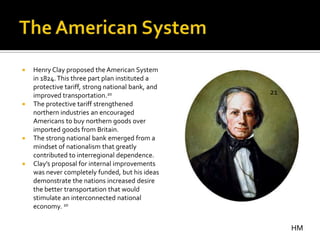
   Henry Clay proposed the American System
    in 1824. This three part plan instituted a
    protective tariff, strong national bank, and
    improved transportation.20                     21
   The protective tariff strengthened
    northern industries an encouraged
    Americans to buy northern goods over
    imported goods from Britain.
   The strong national bank emerged from a
    mindset of nationalism that greatly
    contributed to interregional dependence.
   Clay’s proposal for internal improvements
    was never completely funded, but his ideas
    demonstrate the nations increased desire
    the better transportation that would
    stimulate an interconnected national
    economy. 20


                                                        HM
   Before the transportation revolution of the 1800’s, the Mississippi River had been the primary
    way to send crops and goods between regions. However, travel was slow, and going upriver
    nearly impossible.
   The invention of the steamboat in 1807 allowed travel both directions on the Mississippi. This
    allowed Mid-western farmers to get their crops to New Orleans more rapidly. Cotton could go
    north faster; manufactured goods could be shipped south cheaper.
   The Mississippi and other rivers like it allowed trade between the north and the south, but the
    Appalachian mountains were a major obstacle in trade between the West and the East. As
    railroads and canals spread west, they allowed for greater westward expansion, allowed cheap
    and quick transportation between regions, and encouraged interregional trade (and
    interdependence).
   Trade between the West and the East became feasible, and eventually even more important than
    the former north-south trade. Once East- West transportation had improved, New York became
    the country’s most important port, replacing the former prominence of New Orleans. 17
   As the relationship between the Northeast and the Northwest grew stronger, a foundation was
    laid for their alliance against the south in the looming Civil War.
   As the North became more interconnected, the South became self-sufficient and developed less
    transportation systems than the North. This would also be important in the Civil War.


                                                                                                  HM
1. National Museum of American History.“Transportation Infrastructure, 1800-
      1900.” America on the Move. 26 October 2011.
      http://americanhistory.si.edu/onthemove/themes/story_47_1.html (26
      October 2011)
2 (Cumberland Road Picture).Weingroff, Richard F. “A Noteworthy Year.” Public
Roads. 2006.
<http://www.fhwa.dot.gov/publications/publicroads/06nov/02.cfm> (26
October 2011)
3 (Erie Canal Picture). “Locks on the Erie Canal.” The Erie Canal. 2000.
<http://www.eriecanal.org/locks.html> (26 October 2011)
4. Bellis, Mary. “Outline of Railroad History.” About.com, Inventors. 2011.
<http://inventors.about.com/library/inventors/blrailroad.htm> (26 October
2011)
5. Bellis, Mary. “The History of Steamboats.” About.com, Inventors. 2011.
<http://inventors.about.com/library/inventors/blsteamship.htm> (26 October
2011)
6. (Riverboat picture). “Welcome to Riverboat Discovery.” Riverboat Discovery.
2006. <http://riverboatdiscovery.com/>(26 October 2011)
                                                                            SF
   7.USHist, ”19th Century Horses and Tack,” Civilian and Military Horse Equipment, 5 August 2011,
    http://www.google.com/imgres?q=pony+express+in+the+1800s&hl=en&gbv=2&biw=1366&bih=541&tbm=isch&tbnid=5zq
    0-HBnPsMcZM:&imgrefurl=http://www.ushist.com/19th-century_saddles-
    tack_f.shtml&docid=2ZqAV0AAoYm5RM&imgurl=http://www.ushist.com/img/saddles/thumbs/saddle_pony-
    express_remington.jpg&w=140&h=133&ei=_UGsTqjlGpG6tgeU8qnWDg&zoom=1&iact=rc&dur=312&sig=10734095337647
    9123034&page=1&tbnh=106&tbnw=112&start=0&ndsp=12&ved=1t:429,r:1,s:0&tx=100&ty=62 (28 October 2011)
   8. Ohio Historical Society, “The Ohio-Erie Canal 1825- 1913,” Remarkable Ohio,
    http://www.google.com/imgres?q=erie+canal+1825&hl=en&biw=1366&bih=541&gbv=2&tbm=isch&tbnid=84Ch2bPmjXdt
    yM:&imgrefurl=http://www.remarkableohio.org/HistoricalMarker.aspx%3FhistoricalMarkerId%3D303&docid=grfBxIUIzRg
    KYM&imgurl=http://www.remarkableohio.org/UserContent/96616/2811.jpg&w=504&h=363&ei=2UCsTtWtEoGltwfGvvHT
    Dg&zoom=1&iact=hc&vpx=1054&vpy=230&dur=1950&hovh=190&hovw=265&tx=188&ty=158&sig=1073409533764791230
    34&page=1&tbnh=151&tbnw=200&start=0&ndsp=12&ved=1t:429,r:11,s:0 (28 October 2011)
   9. Shirley Hyatt, “Train Wreck,” Clintonville History, 10 October 2008,
    http://www.google.com/imgres?q=railroad+tracks+in+the+1800s&hl=en&gbv=2&biw=1366&bih=541&tbm=isch&tbnid=03
    awkMHS1jV1AM:&imgrefurl=http://clintonvillehistory.com/page/4/&docid=f3Op53WUyE9qTM&imgurl=http://clintonville
    history.com/wp-content/uploads/2008/11/1065b-train-wreck-
    100.jpg&w=1946&h=1330&ei=gEGsTqqvNMO4tgegnZ3vDg&zoom=1&iact=rc&dur=78&sig=107340953376479123034&pag
    e=1&tbnh=157&tbnw=209&start=0&ndsp=12&ved=1t:429,r:1,s:0&tx=136&ty=55 (28 October 2011)
   10. Kathy Alexander, “Weston, Missouri,” Legends of America, 2003,
    http://www.google.com/imgres?q=steamboat+1800&um=1&hl=en&safe=active&rlz=1G1GGLQ_ENUS244&biw=1440&bih=741&tbm
    =isch&tbnid=XuSsZTlISFqCkM:&imgrefurl=http://www.legendsofamerica.com/mo-weston2.html&docid=Y-
    PudWdSZRWO0M&imgurl=http://www.legendsofamerica.com/photos-missouri/MissouriSteamboat-
    LOC.jpg&w=225&h=201&ei=IAGqTqbTEpDBtgelyIH0Dg&zoom=1&iact=hc&vpx=1043&vpy=297&dur=2446&hovh=160&hovw=180&
    tx=102&ty=107&sig=108581704097597441647&page=1&tbnh=127&tbnw=145&start=0&ndsp=28&ved=1t:429,r:12,s:0 (30 October
    2011)
   11. KSFAMILY, “Railroad bridge,” 24 June 2007,
    http://www.google.com/imgres?q=railroad+1800s&um=1&hl=en&safe=active&rlz=1G1GGLQ_ENUS244&biw=1440&bih=741&tbm=i
    sch&tbnid=JzDUiCrRQtyatM:&imgrefurl=http://www.zazzle.com/1800s%2Bgifts&docid=P0V3jYMdl4JdVM&imgurl=http://rlv.zcache
    .com/railroad_bridge_1800s_postcard-
    p239908111421463187td81_152.jpg&w=152&h=152&ei=xAeqToHwN4bqtgeD2PXYDg&zoom=1&iact=rc&dur=497&sig=10858170409
    7597441647&page=1&tbnh=121&tbnw=121&start=0&ndsp=28&ved=1t:429,r:5,s:0&tx=84&ty=51 (30 October 2011)
   12. Georgia Agribusiness Council, “History,” Cotton: Georgia’s White Gold, http://georgiaag.com/?page_id=97 (30 October 2011)
   13. Pamela E. Mack, “The Lowell Labor System,” Textile Factories come to the U.S., 28 September 2005,
    http://www.clemson.edu/caah/history/FacultyPages/PamMack/lec122/amir.htm (30 October 2011)
   14. ARTiFactor, “Perennial Grain,” 27 June 2o1o, http://www.sciencebuzz.org/blog/bursts/perennial-grain (30 October 2011)
   15. Teacher’s Domain, “Building the Erie Canal,” 2002,
    http://www.google.com/imgres?q=construction+of+Erie+Canal+1800s&um=1&hl=en&safe=active&rlz=1G1GGLQ_ENUS244&biw=14
    40&bih=741&tbm=isch&tbnid=6JJNytHb5yySrM:&imgrefurl=http://www.teachersdomain.org/resource/midlit10.soc.splerie/&docid=
    sc7wwli9uIqgOM&imgurl=http://www.teachersdomain.org/assets/wgbh/midlit10/midlit10_img_spleriebarges/midlit10_img_splerieb
    arges.jpg&w=269&h=151&ei=owmqTqrrAcK3tgemvdjnDg&zoom=1&iact=hc&vpx=319&vpy=452&dur=2179&hovh=120&hovw=215&
    tx=135&ty=61&sig=108581704097597441647&page=1&tbnh=102&tbnw=181&start0&ndsp=28&ved=1t:429,r:15,s:0 (30 October 2011)
   16. Old Rail History, “United States Railroads,” Railroads 1846-1850, 2011,
    http://oldrailhistory.com/index.php?option=com_content&task=view&id=193&Itemid=225 (30 October 2011)


                                                                                                                                    HM
   17. David M. Kennedy, Lizabeth Cohen, and Thomas A.Bailey, The American Pageant, 13th ed.
    (Boston, MA: Houghton Mill Company, 2006, 287- 318
   18. Joyce E. Chaplin, “Cotton,” 21 July 2011, http://www.history.com/topics/cotton (30 October
    2011)
   19. Digital Library of Georgia, “Cotton Plantation 1850’s” Georgia Transportation Photos , 2011,
    http://www.google.com/imgres?q=cotton+plantation+1850s&um=1&hl=en&safe=active&sa=N&r
    lz=1G1GGLQ_ENUS244&biw=1440&bih=741&tbm=isch&tbnid=ofo3m62mR-
    59KM:&imgrefurl=http://georgiainfo.galileo.usg.edu/gatransportphotos/cottonplantation.htm&
    docid=xnekYP7uKjO3yM&itg=1&imgurl=http://georgiainfo.galileo.usg.edu/gatransportphotos/co
    ttonplantation.jpg&w=576&h=382&ei=sACqTvDnFMO4tgegnZ3vDg&zoom=1&iact=rc&dur=426
    &sig=108581704097597441647&page=1&tbnh=118&tbnw=163&start=0&ndsp=30&ved=1t:429,r:2
    ,s:0&tx=78&ty=78 (30 October 2011)
   20. Online Highways LLC, “Ideas and Movements,” American System, http://www.u-s-
    history.com/pages/h278.html ( 29 October 2011)
   21. Smithsonian National Portrait Gallery, “Henry Clay,” Matthew Brady Gallery, 18 October 2011,
    http://elektratig.blogspot.com/2009/05/henry-clay-outsmarts-john-randolph-of.html (29 October
    2011)


                                                                                                 HM

2011 AP US PP - Transportation 1800-1850

  • 1.
    10 11 12 13 14
  • 2.
    Modes of transportation in the United States were improved during the early to mid 1800s.  Canals, roads, and railroads were built. Rivers were also utilized for a means of transportation.  These advancements of places for transportation made way for new ways to get around the country. SF
  • 3.
    The Cumberland Road was begun in 1811.  This road was a way for people in the states to travel to the new frontier. 1  Improved roads allowed for wagons, carriages, and other carts such as these to travel easier between the states.  The Erie Canal was finished in 1825.1  This canal gave merchants the ability to send food, clothing, building materials, and other necessities to the people living on the frontier. 1 SF
  • 4.
  • 5.
  • 6.
    Erie Canal  1817-1825  The Erie Canal revolutionized transportation.  This Canal allowed the North East and North West to transport things back and forth easier, quicker, and less expensive. (North East= Buffalo, New York; North West= Great Lakes region)  If the price of something used to be 100 dollars prior to the Canal, after the canal it was around 5 dollars.  Also before the canal it took someone or something 20 days to get from east to west and the same from west to east, after the canal it took 6 days.  The Canal could transport not only products but also people. This helped immensely with westward expansion.  Population especially grew on the canal and the great lakes.  New York became more important than New Orleans because of this canal.  However during the winter months the canal was not allowed to be used considering it was still water which would freeze from the cold. 17 ML
  • 7.
    8 15
  • 8.
    The first steam engine was designed in 1803 by Samuel Homfray.4  Prior to this, rails had been used for carts that were pulled by horses.4 Rails were used for these carts because it was more efficient than pulling a cart of dirt, rock, and other elements.4  The steam engine was then added to a type of car in 1804 by Richard Trevithick.4 This was the first train that was powered by steam.4 This steam-powered train could pull more of a load than the horse-drawn carts, which made it more of an resourceful way to haul goods across the country.4  Stockton and Darlington Railroad Company was founded in 1825. 4 This company used the locomotive to transport people, as well as cargo, around the United States.4  Railroads allowed people to travel easier between states, even more than the improved roads did. The powerful steam engine trains could pull more people than a wagon or carriage. SF
  • 9.
     In the1840’s 75% of railroads were in the North East and North West. 17  Trains were convenient for the North East and North West in the winter month’s considering they could continue to run no matter how cold it was. Also they could run the train as long as they got all of the snow off the tracks.  Unfortunately the trains were not always successful.  Their brakes were extremely poor. Also freight was not allowed on trains. ML
  • 10.
    9 ML
  • 11.
  • 12.
     The ponyExpress was the 7 way to get mail from East to West.  The rider would ride for hours until he got to the stopping spot and from there a new rider would get on and ride. This cycle would continue until they reached their destination.  They would only rely on speed. The riders only carried the mail. No weapons or food. 17 ML
  • 13.
    This first successful riverboat trip was in 1807.5  The boat was named “The Clermont,” and was developed by Robert Fulton. 5  This trip went departed from New York City and arrived in Albany around two days later.5  After this, the use of the riverboat quickly spread through the United States. 5 Riverboat trips were especially popular on the Mississippi River.5  The riverboat could carry people, as well as other cargo, along the river.5  The use of the riverboat was more efficient than the previous method of taking a raft down the river to sell goods, and then making a long journey back across hundreds of miles. SF
  • 14.
  • 15.
    The use of roads, rivers, and railways were essential for the growth of the United States.  Without these modes of transportation, food, building materials, clothing, and people would not have been able to move around the country and across the frontier as well. If the goods had not been able to be transported efficiently, then the growth of the country may not have occurred, or at the least stunted, because the goods may not have reached their intended destination. SF
  • 16.
    By the mid 1800’s, each section of the United States contributed a particular item to the national economy.  Due to climate, original settlement patterns, and other factors, the North and South developed very different economies North and cultures. The north had industry; the south slaves. The south featured independent farms, while the North Manufactured goods became clusters of specialized workers whose mass production of one good left them dependent on others for the food they didn’t have time/space to grow. This cotton food came from the west.  Cotton plantations in the south provided the cotton for the textile factories in the Europe Northeast, and western farmers grew West grain to export to the Southeast. As the Southeast began to grow its own food, the West began to look for a market in the northeast, and it need transportation to do so. 17 South  Southern cotton made up 50% of all exports within the US from 1815- 1860. 18  In 1850 alone, 750,00o tons of cotton were HM produced in America. 18
  • 17.
  • 18.
    Henry Clay proposed the American System in 1824. This three part plan instituted a protective tariff, strong national bank, and improved transportation.20 21  The protective tariff strengthened northern industries an encouraged Americans to buy northern goods over imported goods from Britain.  The strong national bank emerged from a mindset of nationalism that greatly contributed to interregional dependence.  Clay’s proposal for internal improvements was never completely funded, but his ideas demonstrate the nations increased desire the better transportation that would stimulate an interconnected national economy. 20 HM
  • 19.
    Before the transportation revolution of the 1800’s, the Mississippi River had been the primary way to send crops and goods between regions. However, travel was slow, and going upriver nearly impossible.  The invention of the steamboat in 1807 allowed travel both directions on the Mississippi. This allowed Mid-western farmers to get their crops to New Orleans more rapidly. Cotton could go north faster; manufactured goods could be shipped south cheaper.  The Mississippi and other rivers like it allowed trade between the north and the south, but the Appalachian mountains were a major obstacle in trade between the West and the East. As railroads and canals spread west, they allowed for greater westward expansion, allowed cheap and quick transportation between regions, and encouraged interregional trade (and interdependence).  Trade between the West and the East became feasible, and eventually even more important than the former north-south trade. Once East- West transportation had improved, New York became the country’s most important port, replacing the former prominence of New Orleans. 17  As the relationship between the Northeast and the Northwest grew stronger, a foundation was laid for their alliance against the south in the looming Civil War.  As the North became more interconnected, the South became self-sufficient and developed less transportation systems than the North. This would also be important in the Civil War. HM
  • 20.
    1. National Museumof American History.“Transportation Infrastructure, 1800- 1900.” America on the Move. 26 October 2011. http://americanhistory.si.edu/onthemove/themes/story_47_1.html (26 October 2011) 2 (Cumberland Road Picture).Weingroff, Richard F. “A Noteworthy Year.” Public Roads. 2006. <http://www.fhwa.dot.gov/publications/publicroads/06nov/02.cfm> (26 October 2011) 3 (Erie Canal Picture). “Locks on the Erie Canal.” The Erie Canal. 2000. <http://www.eriecanal.org/locks.html> (26 October 2011) 4. Bellis, Mary. “Outline of Railroad History.” About.com, Inventors. 2011. <http://inventors.about.com/library/inventors/blrailroad.htm> (26 October 2011) 5. Bellis, Mary. “The History of Steamboats.” About.com, Inventors. 2011. <http://inventors.about.com/library/inventors/blsteamship.htm> (26 October 2011) 6. (Riverboat picture). “Welcome to Riverboat Discovery.” Riverboat Discovery. 2006. <http://riverboatdiscovery.com/>(26 October 2011) SF
  • 21.
    7.USHist, ”19th Century Horses and Tack,” Civilian and Military Horse Equipment, 5 August 2011, http://www.google.com/imgres?q=pony+express+in+the+1800s&hl=en&gbv=2&biw=1366&bih=541&tbm=isch&tbnid=5zq 0-HBnPsMcZM:&imgrefurl=http://www.ushist.com/19th-century_saddles- tack_f.shtml&docid=2ZqAV0AAoYm5RM&imgurl=http://www.ushist.com/img/saddles/thumbs/saddle_pony- express_remington.jpg&w=140&h=133&ei=_UGsTqjlGpG6tgeU8qnWDg&zoom=1&iact=rc&dur=312&sig=10734095337647 9123034&page=1&tbnh=106&tbnw=112&start=0&ndsp=12&ved=1t:429,r:1,s:0&tx=100&ty=62 (28 October 2011)  8. Ohio Historical Society, “The Ohio-Erie Canal 1825- 1913,” Remarkable Ohio, http://www.google.com/imgres?q=erie+canal+1825&hl=en&biw=1366&bih=541&gbv=2&tbm=isch&tbnid=84Ch2bPmjXdt yM:&imgrefurl=http://www.remarkableohio.org/HistoricalMarker.aspx%3FhistoricalMarkerId%3D303&docid=grfBxIUIzRg KYM&imgurl=http://www.remarkableohio.org/UserContent/96616/2811.jpg&w=504&h=363&ei=2UCsTtWtEoGltwfGvvHT Dg&zoom=1&iact=hc&vpx=1054&vpy=230&dur=1950&hovh=190&hovw=265&tx=188&ty=158&sig=1073409533764791230 34&page=1&tbnh=151&tbnw=200&start=0&ndsp=12&ved=1t:429,r:11,s:0 (28 October 2011)  9. Shirley Hyatt, “Train Wreck,” Clintonville History, 10 October 2008, http://www.google.com/imgres?q=railroad+tracks+in+the+1800s&hl=en&gbv=2&biw=1366&bih=541&tbm=isch&tbnid=03 awkMHS1jV1AM:&imgrefurl=http://clintonvillehistory.com/page/4/&docid=f3Op53WUyE9qTM&imgurl=http://clintonville history.com/wp-content/uploads/2008/11/1065b-train-wreck- 100.jpg&w=1946&h=1330&ei=gEGsTqqvNMO4tgegnZ3vDg&zoom=1&iact=rc&dur=78&sig=107340953376479123034&pag e=1&tbnh=157&tbnw=209&start=0&ndsp=12&ved=1t:429,r:1,s:0&tx=136&ty=55 (28 October 2011)
  • 22.
    10. Kathy Alexander, “Weston, Missouri,” Legends of America, 2003, http://www.google.com/imgres?q=steamboat+1800&um=1&hl=en&safe=active&rlz=1G1GGLQ_ENUS244&biw=1440&bih=741&tbm =isch&tbnid=XuSsZTlISFqCkM:&imgrefurl=http://www.legendsofamerica.com/mo-weston2.html&docid=Y- PudWdSZRWO0M&imgurl=http://www.legendsofamerica.com/photos-missouri/MissouriSteamboat- LOC.jpg&w=225&h=201&ei=IAGqTqbTEpDBtgelyIH0Dg&zoom=1&iact=hc&vpx=1043&vpy=297&dur=2446&hovh=160&hovw=180& tx=102&ty=107&sig=108581704097597441647&page=1&tbnh=127&tbnw=145&start=0&ndsp=28&ved=1t:429,r:12,s:0 (30 October 2011)  11. KSFAMILY, “Railroad bridge,” 24 June 2007, http://www.google.com/imgres?q=railroad+1800s&um=1&hl=en&safe=active&rlz=1G1GGLQ_ENUS244&biw=1440&bih=741&tbm=i sch&tbnid=JzDUiCrRQtyatM:&imgrefurl=http://www.zazzle.com/1800s%2Bgifts&docid=P0V3jYMdl4JdVM&imgurl=http://rlv.zcache .com/railroad_bridge_1800s_postcard- p239908111421463187td81_152.jpg&w=152&h=152&ei=xAeqToHwN4bqtgeD2PXYDg&zoom=1&iact=rc&dur=497&sig=10858170409 7597441647&page=1&tbnh=121&tbnw=121&start=0&ndsp=28&ved=1t:429,r:5,s:0&tx=84&ty=51 (30 October 2011)  12. Georgia Agribusiness Council, “History,” Cotton: Georgia’s White Gold, http://georgiaag.com/?page_id=97 (30 October 2011)  13. Pamela E. Mack, “The Lowell Labor System,” Textile Factories come to the U.S., 28 September 2005, http://www.clemson.edu/caah/history/FacultyPages/PamMack/lec122/amir.htm (30 October 2011)  14. ARTiFactor, “Perennial Grain,” 27 June 2o1o, http://www.sciencebuzz.org/blog/bursts/perennial-grain (30 October 2011)  15. Teacher’s Domain, “Building the Erie Canal,” 2002, http://www.google.com/imgres?q=construction+of+Erie+Canal+1800s&um=1&hl=en&safe=active&rlz=1G1GGLQ_ENUS244&biw=14 40&bih=741&tbm=isch&tbnid=6JJNytHb5yySrM:&imgrefurl=http://www.teachersdomain.org/resource/midlit10.soc.splerie/&docid= sc7wwli9uIqgOM&imgurl=http://www.teachersdomain.org/assets/wgbh/midlit10/midlit10_img_spleriebarges/midlit10_img_splerieb arges.jpg&w=269&h=151&ei=owmqTqrrAcK3tgemvdjnDg&zoom=1&iact=hc&vpx=319&vpy=452&dur=2179&hovh=120&hovw=215& tx=135&ty=61&sig=108581704097597441647&page=1&tbnh=102&tbnw=181&start0&ndsp=28&ved=1t:429,r:15,s:0 (30 October 2011)  16. Old Rail History, “United States Railroads,” Railroads 1846-1850, 2011, http://oldrailhistory.com/index.php?option=com_content&task=view&id=193&Itemid=225 (30 October 2011) HM
  • 23.
    17. David M. Kennedy, Lizabeth Cohen, and Thomas A.Bailey, The American Pageant, 13th ed. (Boston, MA: Houghton Mill Company, 2006, 287- 318  18. Joyce E. Chaplin, “Cotton,” 21 July 2011, http://www.history.com/topics/cotton (30 October 2011)  19. Digital Library of Georgia, “Cotton Plantation 1850’s” Georgia Transportation Photos , 2011, http://www.google.com/imgres?q=cotton+plantation+1850s&um=1&hl=en&safe=active&sa=N&r lz=1G1GGLQ_ENUS244&biw=1440&bih=741&tbm=isch&tbnid=ofo3m62mR- 59KM:&imgrefurl=http://georgiainfo.galileo.usg.edu/gatransportphotos/cottonplantation.htm& docid=xnekYP7uKjO3yM&itg=1&imgurl=http://georgiainfo.galileo.usg.edu/gatransportphotos/co ttonplantation.jpg&w=576&h=382&ei=sACqTvDnFMO4tgegnZ3vDg&zoom=1&iact=rc&dur=426 &sig=108581704097597441647&page=1&tbnh=118&tbnw=163&start=0&ndsp=30&ved=1t:429,r:2 ,s:0&tx=78&ty=78 (30 October 2011)  20. Online Highways LLC, “Ideas and Movements,” American System, http://www.u-s- history.com/pages/h278.html ( 29 October 2011)  21. Smithsonian National Portrait Gallery, “Henry Clay,” Matthew Brady Gallery, 18 October 2011, http://elektratig.blogspot.com/2009/05/henry-clay-outsmarts-john-randolph-of.html (29 October 2011) HM