©McGraw-Hill Education. All rights reserved. Authorized only for instructor use in the classroom. No reproduction or further distribution permitted without the prior written consent of McGraw-Hill Education.
1: The Collision of Cultures
Alan Brinkley, The Unfinished Nation, 8th Edition
©McGraw-Hill Education.
America before Columbus
• The Peoples of the Precontact Americas
– The “Clovis” people
– Archaeology and population diversity
– The Archaic period
©McGraw-Hill Education.
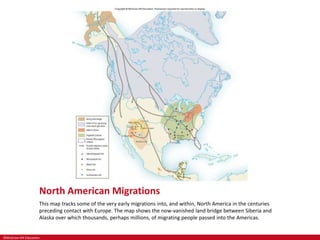
North American Migrations
This map tracks some of the very early migrations into, and within, North America in the centuries
preceding contact with Europe. The map shows the now-vanished land bridge between Siberia and
Alaska over which thousands, perhaps millions, of migrating people passed into the Americas.
©McGraw-Hill Education.
America before Columbus (Continued)
• The Growth of Civilizations: The South
– The Inca in Peru
– Mesoamerican civilizations
• Maya
• Aztec, or Mexica
©McGraw-Hill Education.
America before Columbus (Continued, 2)
• The Civilizations of the North
– Hunting, gathering, and fishing
– Agricultural societies
– Cahokia
– Gender relations
©McGraw-Hill Education.
How the Early North Americans Lived
Like most precommercial peoples, the Native Americans survived largely on the resources available in
their immediate surroundings. Note, for example, the reliance on the products of the sea of the tribes
along the northern coastlines of the continent, and the way in which tribes in relatively inhospitable
climates in the North—where agriculture was difficult—relied on hunting large game. Most Native
Americans were farmers.
©McGraw-Hill Education.
Europe Looks Westward
• Commerce and Sea Travel
– European population growth
– Strong monarchies
– Portuguese exploration
©McGraw-Hill Education.
Europe Looks Westward (Continued)
• Christopher Columbus
– Columbus’s first voyage
– Circumnavigation of the globe
©McGraw-Hill Education.
European Exploration and Conquest, 1492–1583
Note how Columbus and the Spanish explorers who followed him tended to move quickly into
the lands of Mexico, the Caribbean, and Central and South America, while the English and
French explored the northern territories of North America.
©McGraw-Hill Education.
Europe Looks Westward (Continued, 2)
• The Spanish Empire
– Conquistadores
• Cortés conquers the Aztecs
• Brutality and greed
• Spanish America
• Ordinances of discovery
• Catholic missions
©McGraw-Hill Education.
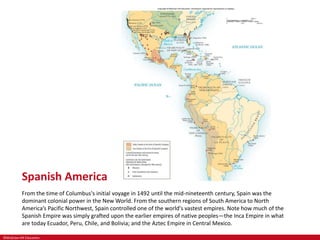
Spanish America
From the time of Columbus's initial voyage in 1492 until the mid-nineteenth century, Spain was the
dominant colonial power in the New World. From the southern regions of South America to North
America’s Pacific Northwest, Spain controlled one of the world's vastest empires. Note how much of the
Spanish Empire was simply grafted upon the earlier empires of native peoples—the Inca Empire in what
are today Ecuador, Peru, Chile, and Bolivia; and the Aztec Empire in Central Mexico.
©McGraw-Hill Education.
Europe Looks Westward (Continued, 3)
• Northern Outposts
– St. Augustine and Santa Fe
– Popé
• Pueblo revolt of 1680
– Assimilation and accommodation
©McGraw-Hill Education.
Europe Looks Westward (Continued, 4)
• Biological and Cultural Exchanges
– Beneficial and catastrophic exchanges
– Population loss from military brutality
– New World crops
– Complex racial hierarchy
• Intermarriage, mestizos
– Unfree Indian labor
©McGraw-Hill Education.
Europe Looks Westward (Continued, 5)
• Africa and America
– Trade states of west Africa
• Ghana and Mali
– Matrilineal societies
– African slavery
– Sugar and the slave trade
©McGraw-Hill Education.
The Arrival of the English
• Incentives for Colonization
– Scarce land
– Mercantilism
– Religious motives for colonization
• The English Reformation
– Puritans
– Irish colonization
©McGraw-Hill Education.
The Arrival of the English (Continued)
• The French and the Dutch in America
– French Traders and Jesuits in Canada
– Dutch Claims
• New Amsterdam
©McGraw-Hill Education.
The Arrival of the English (Continued, 2)
• The First English Settlements
– English naval power
• The Spanish Armada
– Gilbert and Raleigh
– Failed colony of Roanoke
©McGraw-Hill Education.
Roanoke
A drawing by one of the colonists in the ill-fated Roanoke expedition of 1585 became the basis
for this engraving by Theodor de Bry, published in England in 1590. A small European ship
approaches the island of Roanoke, at left. The wreckage of several larger vessels farther out to
sea and the presence of Indian settlements on the mainland and on Roanoke itself suggest
some of the perils the settlers encountered.
© The Gallery Collection/Corbis
©McGraw-Hill Education.
Consider the Source
• Bartolomé de Las Casas,
“Of the Island of Hispaniola” (1542)
©McGraw-Hill Education.
Debating the Past
• Why Do Historians So Often Differ?
©McGraw-Hill Education.
America in the World
• The Atlantic Context of Early American History
©McGraw-Hill Education. All rights reserved. Authorized only for instructor use in the classroom. No reproduction or further distribution permitted without the prior written consent of McGraw-Hill Education.
The Unfinished Nation, 8th Edition
Next: Chapter 2
Transplantations and Borderlands

Brinkleybr8 ppt ch01

  • 1.
    ©McGraw-Hill Education. Allrights reserved. Authorized only for instructor use in the classroom. No reproduction or further distribution permitted without the prior written consent of McGraw-Hill Education. 1: The Collision of Cultures Alan Brinkley, The Unfinished Nation, 8th Edition
  • 2.
    ©McGraw-Hill Education. America beforeColumbus • The Peoples of the Precontact Americas – The “Clovis” people – Archaeology and population diversity – The Archaic period
  • 3.
    ©McGraw-Hill Education. North AmericanMigrations This map tracks some of the very early migrations into, and within, North America in the centuries preceding contact with Europe. The map shows the now-vanished land bridge between Siberia and Alaska over which thousands, perhaps millions, of migrating people passed into the Americas.
  • 4.
    ©McGraw-Hill Education. America beforeColumbus (Continued) • The Growth of Civilizations: The South – The Inca in Peru – Mesoamerican civilizations • Maya • Aztec, or Mexica
  • 5.
    ©McGraw-Hill Education. America beforeColumbus (Continued, 2) • The Civilizations of the North – Hunting, gathering, and fishing – Agricultural societies – Cahokia – Gender relations
  • 6.
    ©McGraw-Hill Education. How theEarly North Americans Lived Like most precommercial peoples, the Native Americans survived largely on the resources available in their immediate surroundings. Note, for example, the reliance on the products of the sea of the tribes along the northern coastlines of the continent, and the way in which tribes in relatively inhospitable climates in the North—where agriculture was difficult—relied on hunting large game. Most Native Americans were farmers.
  • 7.
    ©McGraw-Hill Education. Europe LooksWestward • Commerce and Sea Travel – European population growth – Strong monarchies – Portuguese exploration
  • 8.
    ©McGraw-Hill Education. Europe LooksWestward (Continued) • Christopher Columbus – Columbus’s first voyage – Circumnavigation of the globe
  • 9.
    ©McGraw-Hill Education. European Explorationand Conquest, 1492–1583 Note how Columbus and the Spanish explorers who followed him tended to move quickly into the lands of Mexico, the Caribbean, and Central and South America, while the English and French explored the northern territories of North America.
  • 10.
    ©McGraw-Hill Education. Europe LooksWestward (Continued, 2) • The Spanish Empire – Conquistadores • Cortés conquers the Aztecs • Brutality and greed • Spanish America • Ordinances of discovery • Catholic missions
  • 11.
    ©McGraw-Hill Education. Spanish America Fromthe time of Columbus's initial voyage in 1492 until the mid-nineteenth century, Spain was the dominant colonial power in the New World. From the southern regions of South America to North America’s Pacific Northwest, Spain controlled one of the world's vastest empires. Note how much of the Spanish Empire was simply grafted upon the earlier empires of native peoples—the Inca Empire in what are today Ecuador, Peru, Chile, and Bolivia; and the Aztec Empire in Central Mexico.
  • 12.
    ©McGraw-Hill Education. Europe LooksWestward (Continued, 3) • Northern Outposts – St. Augustine and Santa Fe – Popé • Pueblo revolt of 1680 – Assimilation and accommodation
  • 13.
    ©McGraw-Hill Education. Europe LooksWestward (Continued, 4) • Biological and Cultural Exchanges – Beneficial and catastrophic exchanges – Population loss from military brutality – New World crops – Complex racial hierarchy • Intermarriage, mestizos – Unfree Indian labor
  • 14.
    ©McGraw-Hill Education. Europe LooksWestward (Continued, 5) • Africa and America – Trade states of west Africa • Ghana and Mali – Matrilineal societies – African slavery – Sugar and the slave trade
  • 15.
    ©McGraw-Hill Education. The Arrivalof the English • Incentives for Colonization – Scarce land – Mercantilism – Religious motives for colonization • The English Reformation – Puritans – Irish colonization
  • 16.
    ©McGraw-Hill Education. The Arrivalof the English (Continued) • The French and the Dutch in America – French Traders and Jesuits in Canada – Dutch Claims • New Amsterdam
  • 17.
    ©McGraw-Hill Education. The Arrivalof the English (Continued, 2) • The First English Settlements – English naval power • The Spanish Armada – Gilbert and Raleigh – Failed colony of Roanoke
  • 18.
    ©McGraw-Hill Education. Roanoke A drawingby one of the colonists in the ill-fated Roanoke expedition of 1585 became the basis for this engraving by Theodor de Bry, published in England in 1590. A small European ship approaches the island of Roanoke, at left. The wreckage of several larger vessels farther out to sea and the presence of Indian settlements on the mainland and on Roanoke itself suggest some of the perils the settlers encountered. © The Gallery Collection/Corbis
  • 19.
    ©McGraw-Hill Education. Consider theSource • Bartolomé de Las Casas, “Of the Island of Hispaniola” (1542)
  • 20.
    ©McGraw-Hill Education. Debating thePast • Why Do Historians So Often Differ?
  • 21.
    ©McGraw-Hill Education. America inthe World • The Atlantic Context of Early American History
  • 22.
    ©McGraw-Hill Education. Allrights reserved. Authorized only for instructor use in the classroom. No reproduction or further distribution permitted without the prior written consent of McGraw-Hill Education. The Unfinished Nation, 8th Edition Next: Chapter 2 Transplantations and Borderlands