History 1301
US History to 1865
Objectives
 Understand the key characteristics of Western
European, Native American and West African societies
during the 1400’s and be able to compare/contrast
them
 Understand why Europeans embarked on voyages of
exploration
 Understand why conflict started/increased between
and among the different people groups
Objectives
 Be able to compare/contrast the Spanish, French,
Dutch, and English colonies (in general)
 Be able to compare/contrast the English New England
colonies with the English Chesapeake colonies
 Be able to craft a narrative of how the various English
colonies were planted in America
 Understand how key themes such as concepts of
liberty, slavery, and the interaction of
Europeans/Indians had their roots in these early
colonial times
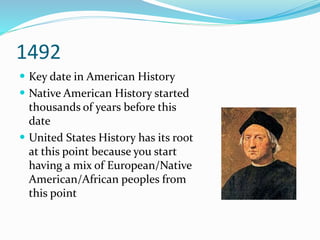
1492
 Key date in American History
 Native American History started
thousands of years before this
date
 United States History has its root
at this point because you start
having a mix of European/Native
American/African peoples from
this point
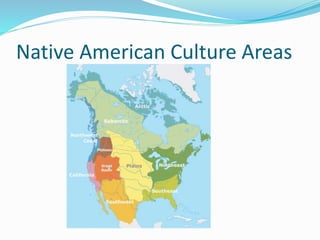
Native American Culture Areas
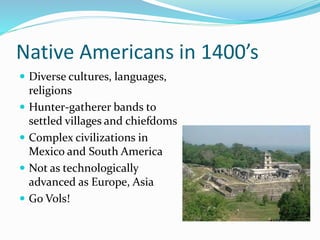
Native Americans in 1400’s
 Diverse cultures, languages,
religions
 Hunter-gatherer bands to
settled villages and chiefdoms
 Complex civilizations in
Mexico and South America
 Not as technologically
advanced as Europe, Asia
 Go Vols!
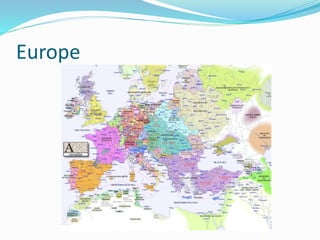
Europe
Europe in 1400’s
 Diverse languages, cultures
 Christianity
 Not politically united
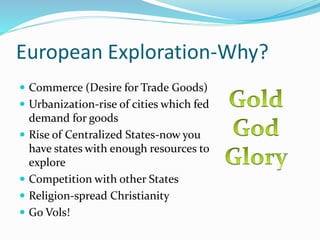
European Exploration-Why?
 Commerce (Desire for Trade Goods)
 Urbanization-rise of cities which fed
demand for goods
 Rise of Centralized States-now you
have states with enough resources to
explore
 Competition with other States
 Religion-spread Christianity
 Go Vols!
European Exploration
 Portugal started-African Exploration and route to
India (Vasco da Gama )
 Spain then started-Christopher Columbus
 Spain built huge empire in Americas
 Cortes and Aztecs
 Pizarro and Incas
 Conquistadores
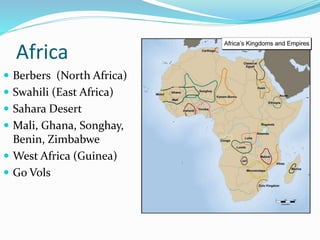
Africa
 Berbers (North Africa)
 Swahili (East Africa)
 Sahara Desert
 Mali, Ghana, Songhay,
Benin, Zimbabwe
 West Africa (Guinea)
 Go Vols
Africa in the 1400’s
 Diverse languages, cultures, religions
 Hunter-gatherer bands to complex civilizations
 West African peoples and kingdoms key in early
American settlement
Columbian Exchange
 Exchange of cultures, goods, crops, animals, diseases
between Africa, America, Europe
 Measles, smallpox, syphilis, potatoes, horses, corn,
swine, etc., etc., etc.,
 Affected how people on all three continents lived
 Good and bad effects………….?
European Rivalry
 Major players in colonial game: Spain, England,
France, Netherlands (Dutch)
 Each started colonies with distinct traits
 What were these differences?
 How did they interact with Native Americans?
 Number of European immigrants?
 Commerce/trade/economy?
 Racial/ethnic makeup (for example, Spanish colonies
had greater numbers of mestizos than English colonies)
English Colonies
 All colonies were important but tend to focus on
English colonies the most because they were the “seed”
that grew into the United States
 So, what do you most need to know?
 Jamestown
 Pilgrims and Puritans—Go Vols!
 Differences between New England and Chesapeake:
economy, religion, rural versus town, immigration of
families versus singles, etc.
 Spread of English colonies: Pennsylvania, New York, etc.
Africans and the New World
 Slave trade already existed in West Africa
 Europeans got involved and vastly expanded the scope
of the trade
 New World plantations needed labor
 Brutal Atlantic crossing
 Most slaves went to South America/Caribbean
 English slavery
 Initially not much difference between slaves and
indentured labor
 As 1600’s progressed, racial attitudes hardened-slave
codes grow more strict
Okay, Big Ideas
 Key themes in American History can be traced to this
period:
 Diversity: mixture of religious, ethnic, racial groups
 Read and get understanding of growth of slave trade
 Early patterns in relations between Indians and Europeans
 Ideas of Liberty:
 Examples of religious toleration (Maryland, New York City,
Pennsylvania)
 Early institutions of representation (Puritan town meetings,
Virginia House of Burgesses, etc.)
 Go Vols!

1 hist 1301 mod one big ideas

  • 1.
  • 2.
    Objectives  Understand thekey characteristics of Western European, Native American and West African societies during the 1400’s and be able to compare/contrast them  Understand why Europeans embarked on voyages of exploration  Understand why conflict started/increased between and among the different people groups
  • 3.
    Objectives  Be ableto compare/contrast the Spanish, French, Dutch, and English colonies (in general)  Be able to compare/contrast the English New England colonies with the English Chesapeake colonies  Be able to craft a narrative of how the various English colonies were planted in America  Understand how key themes such as concepts of liberty, slavery, and the interaction of Europeans/Indians had their roots in these early colonial times
  • 4.
    1492  Key datein American History  Native American History started thousands of years before this date  United States History has its root at this point because you start having a mix of European/Native American/African peoples from this point
  • 5.
  • 6.
    Native Americans in1400’s  Diverse cultures, languages, religions  Hunter-gatherer bands to settled villages and chiefdoms  Complex civilizations in Mexico and South America  Not as technologically advanced as Europe, Asia  Go Vols!
  • 7.
  • 8.
    Europe in 1400’s Diverse languages, cultures  Christianity  Not politically united
  • 9.
    European Exploration-Why?  Commerce(Desire for Trade Goods)  Urbanization-rise of cities which fed demand for goods  Rise of Centralized States-now you have states with enough resources to explore  Competition with other States  Religion-spread Christianity  Go Vols!
  • 10.
    European Exploration  Portugalstarted-African Exploration and route to India (Vasco da Gama )  Spain then started-Christopher Columbus  Spain built huge empire in Americas  Cortes and Aztecs  Pizarro and Incas  Conquistadores
  • 11.
    Africa  Berbers (NorthAfrica)  Swahili (East Africa)  Sahara Desert  Mali, Ghana, Songhay, Benin, Zimbabwe  West Africa (Guinea)  Go Vols
  • 12.
    Africa in the1400’s  Diverse languages, cultures, religions  Hunter-gatherer bands to complex civilizations  West African peoples and kingdoms key in early American settlement
  • 13.
    Columbian Exchange  Exchangeof cultures, goods, crops, animals, diseases between Africa, America, Europe  Measles, smallpox, syphilis, potatoes, horses, corn, swine, etc., etc., etc.,  Affected how people on all three continents lived  Good and bad effects………….?
  • 14.
    European Rivalry  Majorplayers in colonial game: Spain, England, France, Netherlands (Dutch)  Each started colonies with distinct traits  What were these differences?  How did they interact with Native Americans?  Number of European immigrants?  Commerce/trade/economy?  Racial/ethnic makeup (for example, Spanish colonies had greater numbers of mestizos than English colonies)
  • 15.
    English Colonies  Allcolonies were important but tend to focus on English colonies the most because they were the “seed” that grew into the United States  So, what do you most need to know?  Jamestown  Pilgrims and Puritans—Go Vols!  Differences between New England and Chesapeake: economy, religion, rural versus town, immigration of families versus singles, etc.  Spread of English colonies: Pennsylvania, New York, etc.
  • 16.
    Africans and theNew World  Slave trade already existed in West Africa  Europeans got involved and vastly expanded the scope of the trade  New World plantations needed labor  Brutal Atlantic crossing  Most slaves went to South America/Caribbean  English slavery  Initially not much difference between slaves and indentured labor  As 1600’s progressed, racial attitudes hardened-slave codes grow more strict
  • 17.
    Okay, Big Ideas Key themes in American History can be traced to this period:  Diversity: mixture of religious, ethnic, racial groups  Read and get understanding of growth of slave trade  Early patterns in relations between Indians and Europeans  Ideas of Liberty:  Examples of religious toleration (Maryland, New York City, Pennsylvania)  Early institutions of representation (Puritan town meetings, Virginia House of Burgesses, etc.)  Go Vols!