



Urinary System Structure and
Functions
Science V
What are the parts of the urinary
system?
What are the parts of the kidney?
Review
Checking of Assignment
Answer the following question:
1. How can you take good care of our
urinary system?
2. What foods are good to the urinary
system?
3. Why are salty foods not good to eat?
Motivation
• What is the shape of the kidney?
• Where are the kidneys located?
• Would you like to find out about their
structure and function/s?
Presentation
Watch the video clip
Excretory System Parts and Functions
Animation video for kids
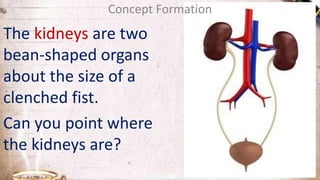
The kidneys are two
bean-shaped organs
about the size of a
clenched fist.
Can you point where
the kidneys are?
Concept Formation
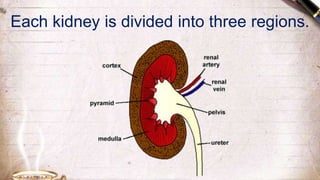
Each kidney is divided into three regions.
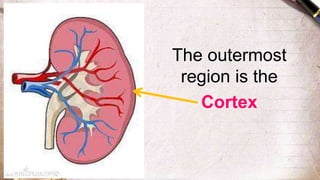
The outermost
region is the
Cortex
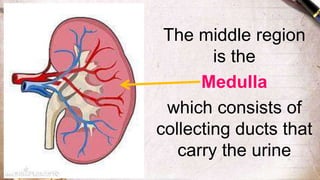
The middle region
is the
Medulla
which consists of
collecting ducts that
carry the urine
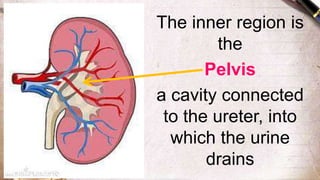
The inner region is
the
Pelvis
a cavity connected
to the ureter, into
which the urine
drains
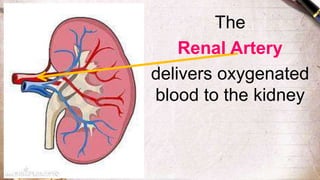
The
Renal Artery
delivers oxygenated
blood to the kidney
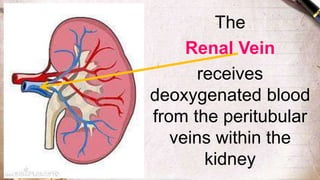
The
Renal Vein
receives
deoxygenated blood
from the peritubular
veins within the
kidney
Their vital functions include:
• Removal of extra water and waste products
from the blood in the form of urine.
• Keeping a stable balance of salts and other
substances in the body.
• Releasing hormones that help maintain the
normal number of red blood cells and
regulate blood pressure.
Concept Formation
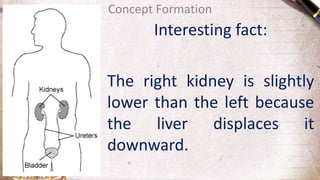
Interesting fact:
The right kidney is slightly
lower than the left because
the liver displaces it
downward.
Concept Formation
Concept Formation
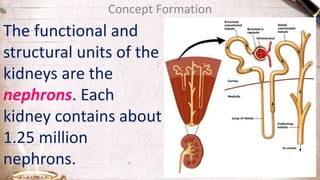
The functional and
structural units of the
kidneys are the
nephrons. Each
kidney contains about
1.25 million
nephrons.
Concept Formation
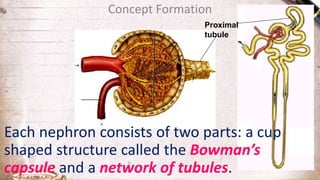
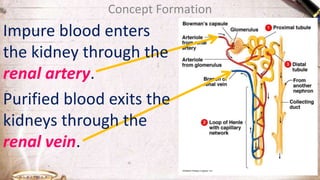
Each nephron consists of two parts: a cup
shaped structure called the Bowman’s
capsule and a network of tubules.
Proximal
tubule
Concept Formation
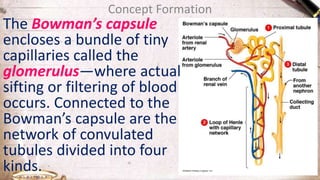
The Bowman’s capsule
encloses a bundle of tiny
capillaries called the
glomerulus—where actual
sifting or filtering of blood
occurs. Connected to the
Bowman’s capsule are the
network of convulated
tubules divided into four
kinds.
Concept Formation
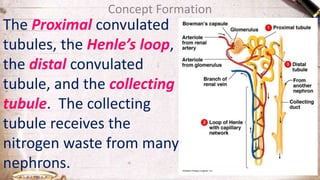
The Proximal convulated
tubules, the Henle’s loop,
the distal convulated
tubule, and the collecting
tubule. The collecting
tubule receives the
nitrogen waste from many
nephrons.
Concept Formation
Impure blood enters
the kidney through the
renal artery.
Purified blood exits the
kidneys through the
renal vein.
Concept Formation
At first, the tubules receive a combination
of waste materials and chemicals that your
body can still use. Some of these chemicals
include sodium, phosphorus, and potassium.
If your body is lacking any of these
chemicals, your kidneys can release them
back to the blood to maintain their normal
levels.
If these chemicals are in excess, the kidneys
will release it to become a part of the urine.
Concept Formation
This is how the kidneys maintain the
normal levels of chemicals inside your
body. The right balance is necessary for life,
but excess levels can be harmful too.
If the kidneys fail to function, a
condition called renal failure, this would
cause an excessive build up of toxins in the
body. You will need dialysis to rid of these
toxins.
Concept Formation
The kidneys also release important hormones
that help to maintain balance in the body.
Erythropoietin (eh-RITH-ro-POY-eh-tin) or EPO,
stimulates the bone marrow to make red blood
cells
Renin (REE-nin) regulates blood pressure
Calcitriol (kal-suh-TRY-ul), the active form of
vitamin D, helps maintain calcium for bones and
for normal chemical balance in the body
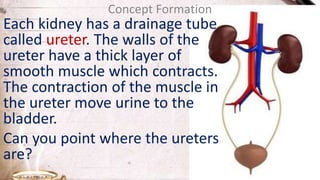
Each kidney has a drainage tube
called ureter. The walls of the
ureter have a thick layer of
smooth muscle which contracts.
The contraction of the muscle in
the ureter move urine to the
bladder.
Can you point where the ureters
are?
Concept Formation
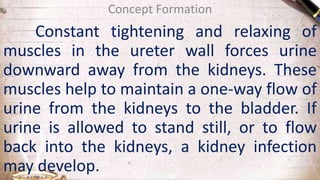
Constant tightening and relaxing of
muscles in the ureter wall forces urine
downward away from the kidneys. These
muscles help to maintain a one-way flow of
urine from the kidneys to the bladder. If
urine is allowed to stand still, or to flow
back into the kidneys, a kidney infection
may develop.
Concept Formation
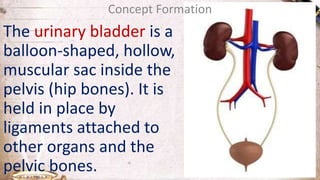
The urinary bladder is a
balloon-shaped, hollow,
muscular sac inside the
pelvis (hip bones). It is
held in place by
ligaments attached to
other organs and the
pelvic bones.
Concept Formation
The bladder stores urine until it is
released when you urinate. As urine flows
into the bladder, it becomes larger and the
shape becomes more rounded or spherical.
When it is empty, its size becomes smaller.
Small amounts of urine are emptied into
the bladder from the ureters about every
10 to 15 seconds.
Concept Formation
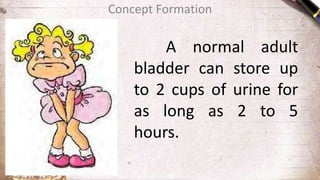
A normal adult
bladder can store up
to 2 cups of urine for
as long as 2 to 5
hours.
Concept Formation
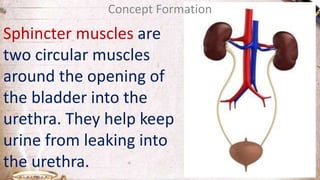
Sphincter muscles are
two circular muscles
around the opening of
the bladder into the
urethra. They help keep
urine from leaking into
the urethra.
Concept Formation
Concept Formation
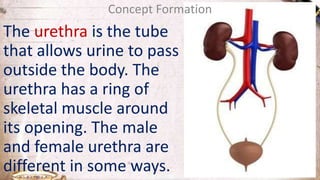
The urethra is the tube
that allows urine to pass
outside the body. The
urethra has a ring of
skeletal muscle around
its opening. The male
and female urethra are
different in some ways.
Concept Formation
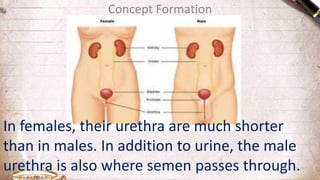
In females, their urethra are much shorter
than in males. In addition to urine, the male
urethra is also where semen passes through.
Application
Your mother sent you to the market to
buy a cow's kidney. Would you be able to
buy a cow's kidney by pointing the kidney
to the meat vendor? Can you tell the
function of the kidney?
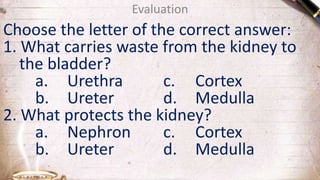
Evaluation
Choose the letter of the correct answer:
1. What carries waste from the kidney to
the bladder?
a. Urethra c. Cortex
b. Ureter d. Medulla
2. What protects the kidney?
a. Nephron c. Cortex
b. Ureter d. Medulla
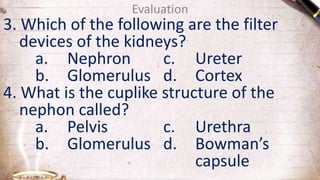
Evaluation
3. Which of the following are the filter
devices of the kidneys?
a. Nephron c. Ureter
b. Glomerulus d. Cortex
4. What is the cuplike structure of the
nephon called?
a. Pelvis c. Urethra
b. Glomerulus d. Bowman’s
capsule
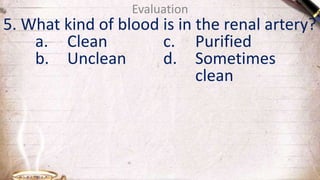
Evaluation
5. What kind of blood is in the renal artery?
a. Clean c. Purified
b. Unclean d. Sometimes
clean
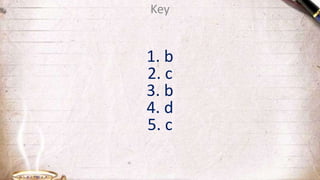
Key
1. b
2. c
3. b
4. d
5. c
Assignment
1. Do most people have two (2) kidneys?
2. Can a person live normally with only
one kidney?
3. What is the function of the kidney?
4. What part of the urinary system stores
urine?

1st science 19 urinary system structure and functions

  • 1.
    Urinary System Structureand Functions Science V
  • 2.
    What are theparts of the urinary system? What are the parts of the kidney? Review
  • 3.
    Checking of Assignment Answerthe following question: 1. How can you take good care of our urinary system? 2. What foods are good to the urinary system? 3. Why are salty foods not good to eat?
  • 4.
    Motivation • What isthe shape of the kidney? • Where are the kidneys located? • Would you like to find out about their structure and function/s?
  • 5.
    Presentation Watch the videoclip Excretory System Parts and Functions Animation video for kids
  • 6.
    The kidneys aretwo bean-shaped organs about the size of a clenched fist. Can you point where the kidneys are? Concept Formation
  • 7.
    Each kidney isdivided into three regions.
  • 8.
  • 9.
    The middle region isthe Medulla which consists of collecting ducts that carry the urine
  • 10.
    The inner regionis the Pelvis a cavity connected to the ureter, into which the urine drains
  • 11.
  • 12.
    The Renal Vein receives deoxygenated blood fromthe peritubular veins within the kidney
  • 13.
    Their vital functionsinclude: • Removal of extra water and waste products from the blood in the form of urine. • Keeping a stable balance of salts and other substances in the body. • Releasing hormones that help maintain the normal number of red blood cells and regulate blood pressure. Concept Formation
  • 14.
    Interesting fact: The rightkidney is slightly lower than the left because the liver displaces it downward. Concept Formation
  • 15.
    Concept Formation The functionaland structural units of the kidneys are the nephrons. Each kidney contains about 1.25 million nephrons.
  • 16.
    Concept Formation Each nephronconsists of two parts: a cup shaped structure called the Bowman’s capsule and a network of tubules. Proximal tubule
  • 17.
    Concept Formation The Bowman’scapsule encloses a bundle of tiny capillaries called the glomerulus—where actual sifting or filtering of blood occurs. Connected to the Bowman’s capsule are the network of convulated tubules divided into four kinds.
  • 18.
    Concept Formation The Proximalconvulated tubules, the Henle’s loop, the distal convulated tubule, and the collecting tubule. The collecting tubule receives the nitrogen waste from many nephrons.
  • 19.
    Concept Formation Impure bloodenters the kidney through the renal artery. Purified blood exits the kidneys through the renal vein.
  • 20.
    Concept Formation At first,the tubules receive a combination of waste materials and chemicals that your body can still use. Some of these chemicals include sodium, phosphorus, and potassium. If your body is lacking any of these chemicals, your kidneys can release them back to the blood to maintain their normal levels. If these chemicals are in excess, the kidneys will release it to become a part of the urine.
  • 21.
    Concept Formation This ishow the kidneys maintain the normal levels of chemicals inside your body. The right balance is necessary for life, but excess levels can be harmful too. If the kidneys fail to function, a condition called renal failure, this would cause an excessive build up of toxins in the body. You will need dialysis to rid of these toxins.
  • 22.
    Concept Formation The kidneysalso release important hormones that help to maintain balance in the body. Erythropoietin (eh-RITH-ro-POY-eh-tin) or EPO, stimulates the bone marrow to make red blood cells Renin (REE-nin) regulates blood pressure Calcitriol (kal-suh-TRY-ul), the active form of vitamin D, helps maintain calcium for bones and for normal chemical balance in the body
  • 23.
    Each kidney hasa drainage tube called ureter. The walls of the ureter have a thick layer of smooth muscle which contracts. The contraction of the muscle in the ureter move urine to the bladder. Can you point where the ureters are? Concept Formation
  • 24.
    Constant tightening andrelaxing of muscles in the ureter wall forces urine downward away from the kidneys. These muscles help to maintain a one-way flow of urine from the kidneys to the bladder. If urine is allowed to stand still, or to flow back into the kidneys, a kidney infection may develop. Concept Formation
  • 25.
    The urinary bladderis a balloon-shaped, hollow, muscular sac inside the pelvis (hip bones). It is held in place by ligaments attached to other organs and the pelvic bones. Concept Formation
  • 26.
    The bladder storesurine until it is released when you urinate. As urine flows into the bladder, it becomes larger and the shape becomes more rounded or spherical. When it is empty, its size becomes smaller. Small amounts of urine are emptied into the bladder from the ureters about every 10 to 15 seconds. Concept Formation
  • 27.
    A normal adult bladdercan store up to 2 cups of urine for as long as 2 to 5 hours. Concept Formation
  • 28.
    Sphincter muscles are twocircular muscles around the opening of the bladder into the urethra. They help keep urine from leaking into the urethra. Concept Formation
  • 29.
    Concept Formation The urethrais the tube that allows urine to pass outside the body. The urethra has a ring of skeletal muscle around its opening. The male and female urethra are different in some ways.
  • 30.
    Concept Formation In females,their urethra are much shorter than in males. In addition to urine, the male urethra is also where semen passes through.
  • 31.
    Application Your mother sentyou to the market to buy a cow's kidney. Would you be able to buy a cow's kidney by pointing the kidney to the meat vendor? Can you tell the function of the kidney?
  • 32.
    Evaluation Choose the letterof the correct answer: 1. What carries waste from the kidney to the bladder? a. Urethra c. Cortex b. Ureter d. Medulla 2. What protects the kidney? a. Nephron c. Cortex b. Ureter d. Medulla
  • 33.
    Evaluation 3. Which ofthe following are the filter devices of the kidneys? a. Nephron c. Ureter b. Glomerulus d. Cortex 4. What is the cuplike structure of the nephon called? a. Pelvis c. Urethra b. Glomerulus d. Bowman’s capsule
  • 34.
    Evaluation 5. What kindof blood is in the renal artery? a. Clean c. Purified b. Unclean d. Sometimes clean
  • 35.
    Key 1. b 2. c 3.b 4. d 5. c
  • 36.
    Assignment 1. Do mostpeople have two (2) kidneys? 2. Can a person live normally with only one kidney? 3. What is the function of the kidney? 4. What part of the urinary system stores urine?