
Urinary System Created by: Nelia B. Perez Rn, MSN Northeastern College, Santiago City
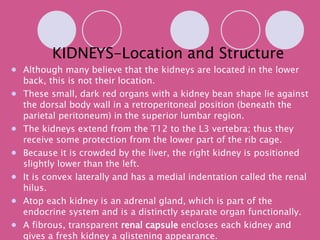
KIDNEYS-Location and Structure Although many believe that the kidneys are located in the lower back, this is not their location. These small, dark red organs with a kidney bean shape lie against the dorsal body wall in a retroperitoneal position (beneath the parietal peritoneum) in the superior lumbar region. The kidneys extend from the T12 to the L3 vertebra; thus they receive some protection from the lower part of the rib cage. Because it is crowded by the liver, the right kidney is positioned slightly lower than the left. It is convex laterally and has a medial indentation called the renal hilus. Atop each kidney is an adrenal gland, which is part of the endocrine system and is a distinctly separate organ functionally. A fibrous, transparent  renal capsule  encloses each kidney and gives a fresh kidney a glistening appearance. The adipose capsule, surrounds each kidney and helps hold it in place against the muscles of the trunk wall.
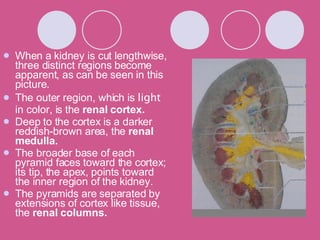
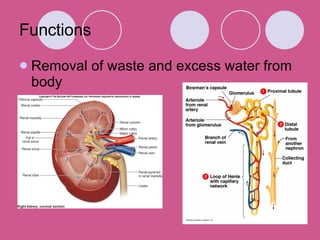
When a kidney is cut lengthwise, three distinct regions become apparent, as can be seen in this picture. The outer region, which is  light  in color, is the  renal cortex. Deep to the cortex is a darker reddish-brown area, the  renal medulla. The broader base of each pyramid faces toward the cortex; its tip, the apex, points toward the inner region of the kidney.  The pyramids are separated by extensions of cortex like tissue, the  renal columns.
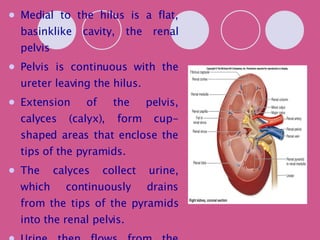
Medial to the hilus is a flat, basinklike cavity, the renal pelvis Pelvis is continuous with the ureter leaving the hilus. Extension of the pelvis, calyces (calyx), form cup-shaped areas that enclose the tips of the pyramids. The calyces collect urine, which continuously drains from the tips of the pyramids into the renal pelvis. Urine then flows from the pelvis into the ureter, which transport it to the bladder for temporary storage.
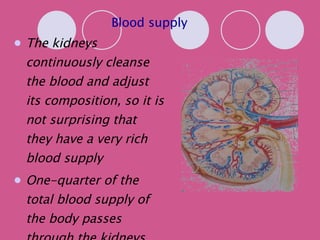
Blood supply The kidneys continuously cleanse the blood and adjust its composition, so it is not surprising that they have a very rich blood supply One-quarter of the total blood supply of the body passes through the kidneys each minute.
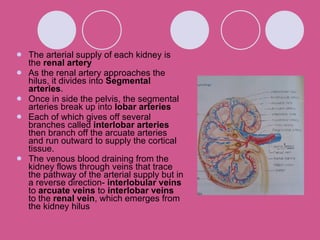
The arterial supply of each kidney is the  renal artery As the renal artery approaches the hilus, it divides into  Segmental arteries . Once in side the pelvis, the segmental arteries break up into  lobar arteries Each of which gives off several branches called  interlobar arteries  then branch off the arcuate arteries and run outward to supply the cortical tissue. The venous blood draining from the kidney flows through veins that trace the pathway of the arterial supply but in a reverse direction-  interlobular veins  to  arcuate veins  to  interlobar veins  to the  renal vein , which emerges from the kidney hilus
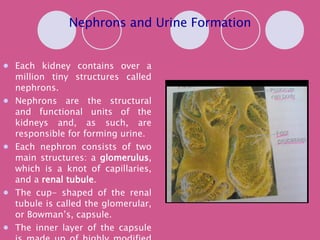
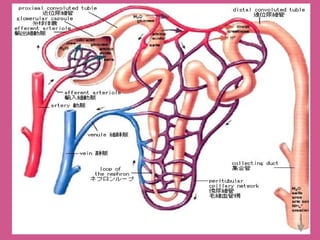
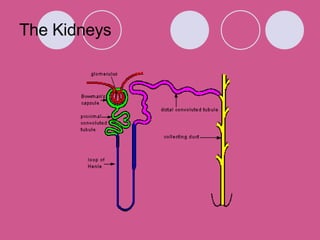
Nephrons and Urine Formation Each kidney contains over a million tiny structures called nephrons. Nephrons are the structural and functional units of the kidneys and, as such, are responsible for forming urine. Each nephron consists of two main structures: a  glomerulus , which is a knot of capillaries, and a  renal tubule .  The cup- shaped of the renal tubule is called the glomerular, or Bowman’s, capsule. The inner layer of the capsule is made up of highly modified octopus- like cells called  podocytes
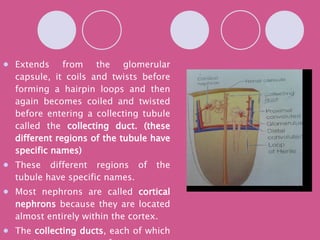
Extends from the glomerular capsule, it coils and twists before forming a hairpin loops and then again becomes coiled and twisted before entering a collecting tubule called the  collecting duct. (these different regions of the tubule have specific names) These different regions of the tubule have specific names. Most nephrons are called  cortical nephrons  because they are located almost entirely within the cortex. The  collecting ducts , each of which receives urine from many nephrons, run downward through the medullary pyramids, giving them their striped appearance.
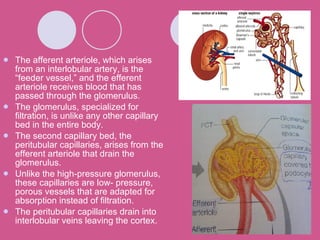
The afferent arteriole, which arises from an interlobular artery, is the “feeder vessel,” and the efferent arteriole receives blood that has passed through the glomerulus.  The glomerulus, specialized for filtration, is unlike any other capillary bed in the entire body. The second capillary bed, the peritubular capillaries, arises from the efferent arteriole that drain the glomerulus. Unlike the high-pressure glomerulus, these capillaries are low- pressure, porous vessels that are adapted for absorption instead of filtration. The peritubular capillaries drain into interlobular veins leaving the cortex.
Urine Formation It is a result of three processes: FILTRATION TUBULAR REABSORPTION TUBULAR SECRETION
Filtration Glomerulus Acts as a Filter Water and solutes smaller than proteins are forced through the capillary walls and pores of the glomerular capsule into the renal tubule. Both proteins and blood cells normally too large to pass through the filtration membrane and when either one of these appear in urine it is evident there is a problem with the glomerular filters
 
Con’t Also, systemic blood pressure has to be normal in order for filtration to happen If the arterial blood pressure falls too low, the glomerular pressure becomes inadequate to force substances out of the blood and into the tubules, and filtrate formation stops
Homeostatic Imbalance Oliguria: an abnormal low urinary output if it is between 100 and 400 ml/day Anuria if it is less than 100ml/day Low urinary output indicates that glomerural blood pressure is too low to cause filtration However, Anuria may also result from transfusion reactions and acute inflammation or from crush injuries of the kidneys
Con’t Blood from afferent arteriole flows into the glomerulus (capillaries) Due to blood pressure in the glomerulus, filtration occurs Water and small molecules (such as salts, amino acids, urea, uric acid, glucose) move from the blood plasma into the capsule Small molecules that escape being filtered and the nonfilterable components leave the glomerulus by the Efferent arteriole This produces a filtrate of blood, called glomerular filtrate
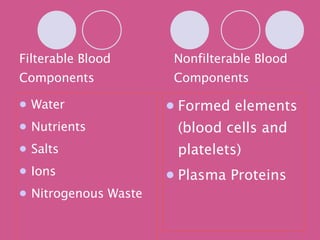
Filterable Blood Components Water Nutrients Salts Ions Nitrogenous Waste Nonfilterable Blood Components Formed elements (blood cells and platelets) Plasma Proteins
Tubular Reabsorption As the filtrate moves along the tubule some of the molecules and ions are actively and passively (by diffusion) reabsorbed into the capillary bed from the tubule Active transport: transport of molecules against a concentration gradient (from regions of low concentration to regions of high concentrations) with the aid of proteins in the cell membrane and energy from ATP
Con’t About 99% of filtered water and many useful molecules (such as salts, urea, nutrients, glucose, amino acids, sodium Ion Na+, chloride ion Cl-) returned to the blood Reabsorption of water is by osmosis Most of the reabsorption occurs in the proximal convoluted tubules, but the distal and the collecting duct are also active
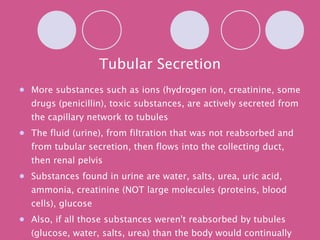
Tubular Secretion More substances such as ions (hydrogen ion, creatinine, some drugs (penicillin), toxic substances, are actively secreted from the capillary network to tubules The fluid (urine), from filtration that was not reabsorbed and from tubular secretion, then flows into the collecting duct, then renal pelvis Substances found in urine are water, salts, urea, uric acid, ammonia, creatinine (NOT large molecules (proteins, blood cells), glucose Also, if all those substances weren't reabsorbed by tubules (glucose, water, salts, urea) than the body would continually lose water, salt and nutrients
 
Characteristics of Urine Nephrons filter 125 ml of body fluid per minute; filtering the entire body fluid component 16 times each day In a 24 hour period nephrons produce 180 liters of filtrate, of which 178.5 liters are reabsorbed. The remaining 1.5 liters forms urine
Con’t Freshly voided urine is generally clear and pale to deep yellow The more solutes are in a urine, the deeper yellow its color; whereas dilute urine is a pale, straw color When formed, urine is sterile,  and its odor is slightly aromatic Ph is slightly acid (around 6) Urine weight more than distilled water (because it has water plus solutes)
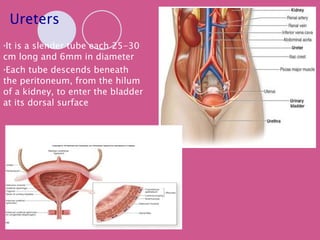
Ureters It is a slender tube each 25-30 cm long and 6mm in diameter Each tube descends beneath the peritoneum, from the hilum of a kidney, to enter the bladder at its dorsal surface
Con’t The ureters is a passageway that carry urine from the kidneys to the bladder Although it may seem like urine may drain to the bladder by gravity, but the ureters  do  play an active role in urine transport Smooth muscle layers in their walls contract to propel urine into the bladder by peristalsis (even if a person is laying down) Once urine has entered the bladder, it is prevented from flowing back into the ureters by small valvelike folds of bladder mucosa that flap over the ureter openings
Homeostatic Imbalance When urine becomes extremely concentrated, solutes such as uric acid salts form crystals that precipitate in the renal pelvis These crystals are called renal calculi, or  kidney stones The crystals may grow into a stone ranging in size from a grain of sand to a golf ball. Most stones form in the kidneys.  Very small stones can pass through the urinary system without causing problems. However, larger stones, when traveling from the kidney through the ureter to the bladder, can cause severe pain called colic. Most stones (70 to 80 percent) are made of calcium oxalate. A smaller number are made of uric acid or cystine
Con’t For treatment, surgery is a choice However, a newer noninvasive procedure (lithotripsy) may be used Uses ultrasound waves to break the stones into small fragments (about the size of grain of sand) They then can be eliminated painlessly in the urine
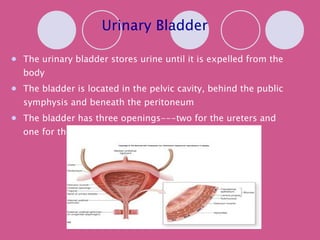
Urinary Bladder The urinary bladder stores urine until it is expelled from the body The bladder is located in the pelvic cavity, behind the public symphysis and beneath the peritoneum The bladder has three openings---two for the ureters and one for the urethra, which drains the bladder
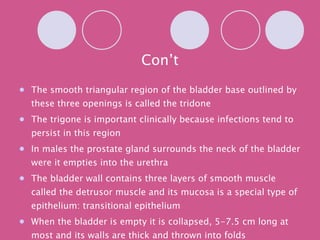
Con’t The smooth triangular region of the bladder base outlined by these three openings is called the tridone The trigone is important clinically because infections tend to persist in this region In males the prostate gland surrounds the neck of the bladder were it empties into the urethra The bladder wall contains three layers of smooth muscle called the detrusor muscle and its mucosa is a special type of epithelium: transitional epithelium  When the bladder is empty it is collapsed, 5-7.5 cm long at most and its walls are thick and thrown into folds
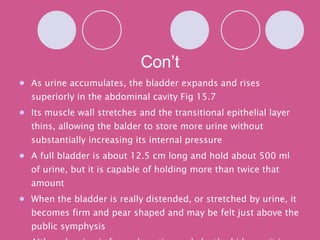
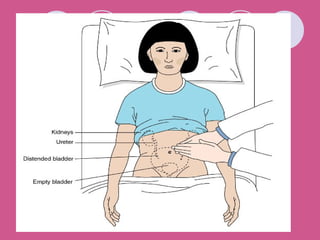
Con’t As urine accumulates, the bladder expands and rises superiorly in the abdominal cavity Fig 15.7 Its muscle wall stretches and the transitional epithelial layer thins, allowing the balder to store more urine without substantially increasing its internal pressure A full bladder is about 12.5 cm long and hold about 500 ml of urine, but it is capable of holding more than twice that amount When the bladder is really distended, or stretched by urine, it becomes firm and pear shaped and may be felt just above the public symphysis Although urine is formed continuously by the kidneys, it is usually stored in the bladder until its release is convenient
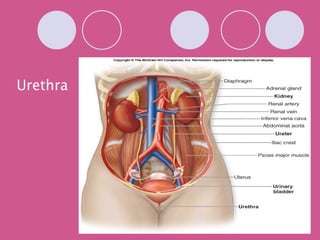
Urethra
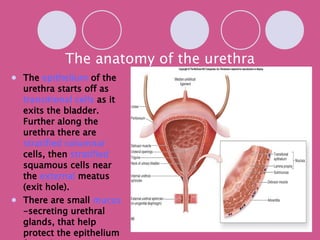
The anatomy of the urethra The  epithelium  of the urethra starts off as  transitional cells  as it exits the bladder. Further along the urethra there are  stratified columnar  cells, then  stratified  squamous  cells near the  external  meatus  (exit hole). There are small  mucus -secreting urethral glands, that help protect the epithelium from the corrosive urine
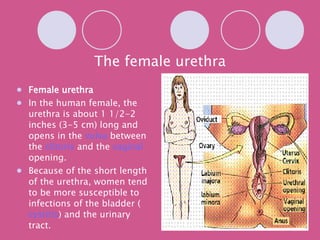
The female urethra Female urethra In the human female, the urethra is about 1 1/2-2 inches (3-5 cm) long and opens in the  vulva  between the  clitoris  and the  vaginal  opening. Because of the short length of the urethra, women tend to be more susceptible to infections of the bladder ( cystitis ) and the urinary tract.
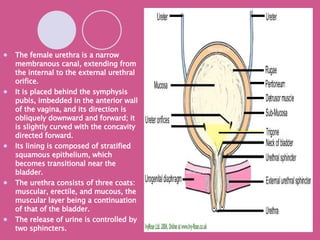
The female urethra is a narrow membranous canal, extending from the internal to the external urethral orifice.  It is placed behind the symphysis pubis, imbedded in the anterior wall of the vagina, and its direction is obliquely downward and forward; it is slightly curved with the concavity directed forward.  Its lining is composed of stratified squamous epithelium, which becomes transitional near the bladder.  The urethra consists of three coats: muscular, erectile, and mucous, the muscular layer being a continuation of that of the bladder. The release of urine is controlled by two sphincters. Internal urethral sphincter  External urethral sphincter
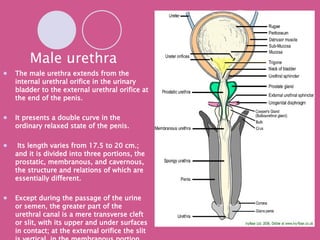
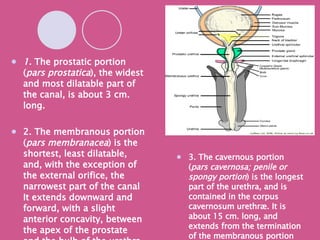
Male urethra The male urethra extends from the internal urethral orifice in the urinary bladder to the external urethral orifice at the end of the penis.  It presents a double curve in the ordinary relaxed state of the penis. Its length varies from 17.5 to 20 cm.; and it is divided into three portions, the prostatic, membranous, and cavernous, the structure and relations of which are essentially different.  Except during the passage of the urine or semen, the greater part of the urethral canal is a mere transverse cleft or slit, with its upper and under surfaces in contact; at the external orifice the slit is vertical, in the membranous portion irregular or stellate, and in the prostatic portion somewhat arched.      
1.  The prostatic portion ( pars prostatica ), the widest and most dilatable part of the canal, is about 3 cm. long. 2. The membranous portion ( pars membranacea ) is the shortest, least dilatable, and, with the exception of the external orifice, the narrowest part of the canal It extends downward and forward, with a slight anterior concavity, between the apex of the prostate and the bulb of the urethra, perforating the urogenital diaphragm about 2.5 cm. below and behind the pubic symphysis.  3. The cavernous portion ( pars cavernosa; penile or spongy portion ) is the longest part of the urethra, and is contained in the corpus cavernosum urethræ. It is about 15 cm. long, and extends from the termination of the membranous portion to the external urethral orifice.
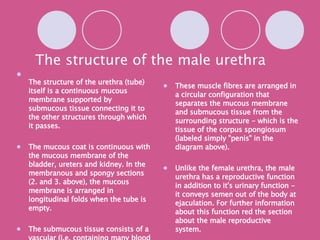
The structure of the male urethra The structure of the urethra (tube) itself is a continuous mucous membrane supported by submucous tissue connecting it to the other structures through which it passes. The mucous coat is continuous with the mucous membrane of the bladder, ureters and kidney. In the membranous and spongy sections (2. and 3. above), the mucous membrane is arranged in longitudinal folds when the tube is empty.  The submucous tissue consists of a vascular (i.e. containing many blood vessels) erectile layer surrounded by a layer of smooth (involuntary)  muscle  fibres . These muscle fibres are arranged in a circular configuration that separates the mucous membrane and submucous tissue from the surrounding structure - which is the tissue of the corpus spongiosum (labeled simply "penis" in the diagram above).  Unlike the female urethra, the male urethra has a reproductive function in addition to it's urinary function - it conveys semen out of the body at ejaculation. For further information about this function red the section about the male reproductive system.
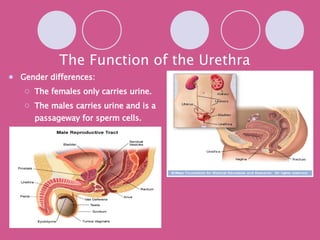
The Function of the Urethra Gender differences: The females only carries urine. The males carries urine and is a passageway for sperm cells.
Micturition of the urethra Male and female Both sphincter muscles must open to allow voiding. The internal urethral sphincter is relaxed after stretching of the bladder Activation is from an impulse sent to the spinal cord and then back via the pelvic splanchnic nerves. The external urethral sphincter must be voluntarily relaxed.
Fluid, Electrolyte, and Acid-Base Balance Blood composition depends on three major factors: Diet Cellular metabolism Urine output In general, the  kidneys  have four major roles to play, which help keep the blood composition relatively constant. Excretion of nitrogen containing wastes Maintaining water in the blood Maintaining electrolyte balance in the blood, and Ensuring proper blood pH
Maintaining Water and  Electrolyte  Balance of Blood Body Fluids and Fluid Compartments: Of the hundreds of compounds present in your body, the most abundant is water. Males weighing 154 pounds will have an average of 60% of their body weight, nearly 40L, as water.  Females about 50%. (based on nonobese individuals). The more fat present in the body, the less total water content per kg of body weight . Female body contains slightly less water per kg of weight because it contains slightly more fat than the male body.
In a newborn, water may account for up to 80% of body weight. That percentage increases if the infant is born premature. The percentage of body water decreases rapidly during the first 10 years of life. In elderly individuals, the amount of water per kg of body weight increases (because old ages is often accompanied by a decrease in muscle mass -65% water- and in increase in fat -20% water-) Water is the universal body solvent within which all solutes (including the very important electrolytes) are dissolved. *picture pg 619 body weight
Body Fluid Compartments: Total body water can be subdivided into two major fluid compartments called “extracellular” and “intracellular” fluid compartments. Extracellular: consists mainly of the liquid fraction of whole  blood called the plasma, found in the blood vessels and the interstitial fluid that surrounds the cell.  In addition, lymph, cerebrospinal fluid, humors of the eye, and the specialized joint fluids are also considered extracellular fluid. Intracellular: largest volume of water by far. Located inside of the cells. +diagram page 618
Mechanisms that maintain fluid balance 3 sources of fluid intake: the liquids we drink, the water in the food we eat, and the water formed by catabolism of foods. Fluid output from the body occurs through four organs: the kidneys, lungs, skin, and intestines.  The fluid output that changes the most is that from the kidneys. The body maintains fluid balance mainly by changing the volume of urine excreted to match changes in the volume of fluid intake
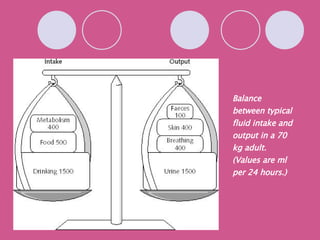
Regulation of  Fluid  Intake When fluid loss from the body exceeds fluid intake, salivary excretion decreases, producing a “dry mouth” feeling, and the sensation of thirst.  The individual then drinks water, thereby increasing fluid intake and compensating for previous fluid losses. This tends to restore fluid balance. Water is continually lost from the body through expired air and diffusion through the skin. Although the body adjusts fluid intake, factors that adjust fluid output, such as electrolytes and blood proteins, are far more important. (chart from yellow text!!!)
Balance between typical fluid intake and output in a 70 kg adult. (Values are ml per 24 hours.)
What are electrolytes? Electrolyte: substance that dissociates into ions in solution, rendering the solution capable of conducting an electric current. Electrolyte balance: homeostasis of electrolytes
The types and amounts of solutes in the body, especially electrolytes such as sodium, potassium, and calcium ions, are vitally important to overall homeostasis. Very small changes in electrolyte balance (solute concentrations in various fluid compartments) cause water to move from one fluid compartment to another.  This alters blood volume and blood pressure, but it can also severely impair the activity of irritable cells like the nerve and muscle cell. Chart from text book!
Importance of Electrolytes in Body Fluids Compounds such as ordinary table salt, or sodium chloride (NaCl) that have molecular bonds that permit them to break up, or dissociate, in water solution to separate particles (Na+ and Cl-) are electrolytes.  The dissociated particles of an electrolyte are ions and carry an electrical charge. Important positively charged ions include sodium (Na+), Calcium (Ca++), potassium (K+), and magnesium (Mg++). Important negatively charged ions include chloride (Cl-), bicarbonate (HCO3-), phosphate (HPO4-), and many proteins.  Although blood plasma contains a number of important electrolytes, by far the most abundant one is sodium chloride (table salt).
A variety of electrolytes have important nutrient or regulatory roles in the body. For example, Iron required for hemoglobin production.  Iodine must be available for synthesis of thyroid hormones. Electrolytes are also needed for many cellular activities such as nerve conduction and muscle contraction.
Electrolytes influence the movement of water among the three fluid compartments of the body. To remember how ECF electrolyte concentration affects fluid volumes, remember this one short sentence: “ Where sodium goes, water soon follows” For example, concentration of sodium in interstitial fluid spaces rises above normal, the volume of IF soon reaches abnormal levels too (edema) which results in tissue swelling.
Reabsorption of water and electrolytes by the kidney is regulated primarily by hormones. When blood volume drops for any reason, (ie due to hemorrhage or excessive water loss sweating or diarrhea), arterial blood pressure drops, which in turn decreases amount of filtrate formed by kidneys. In addition, highty sensitive cells in the hypothalamus called somoreceptions react to the change in blood composition. (That is. Less water and more solutes.)
Sodium imbalance, potassium imbalance, calcium imbalance
Maintaining Fluid Homeostasis Overall fluid balance requires that fluid output equal fluid intake. The type of fluid output that changes most is urine volume. Renal tubule regulation of salt and water is the most important factor in determining urine volume. Aldosterone controls sodium reabsorption in the kidney. The present of sodium forces water to move (Where sodium goes, water soon follows). The aldosterone mechanism helps restore normal ECF volume when it decreases below normal.
The kidney acts as the chief regulator of sodium levels in body fluids. Many electrolytes such as sodium not only pass into and out of the body but also move back and forth between a number of body fluids during each 24 hour period. During this 24 hour period, more than 8 liters of fluid containing 1000 to 1300 mEq of sodium are poured into the digestive system as part of saliva, gastric secretions, bile, pancreatic juice, and IF secretions. This sodium is almost completely reabsorbed in the large intestine. Very little sodium is lost in the feces. Precise regulation and control of sodium levels are required for survival. Chart in yellow text
Capillary Blood Pressure and Blood Proteins Capillary blood pressure = “water pushing” force If capillary blood pressure increases, more  fluid is pushed (filtered) out of blood into the IF. This effect transfers fluid from blood to IF. This fluid shift changes blood and IF volumes. IT DECREASES BLOOD VOLUME BY INCREASING IF VOLUME. If, on the other hand, capillary blood pressure decreases, less fluid filters out of blood into IF.
Plasma proteins act as a water-pulling or water-holding force.  They hold water in the blood and pull it into the blood from IF. e.g. if the concentration of proteins in blood decrease appreciably, less water moves into blood from IF.  As a result, blood volume decreases and IF volume increases. Of the 3 main body fluids, IF volume varies the most. Plasma volume usually fluctuates only slightly and briefly.  If a pronounced change in its volume occurs, adequate circulation cannot be maintained.
Fluid Imbalances Dehydration: seen most often.  In this potentially dangerous condition, IF volume decreases first, but eventually, if treatment has not been given, ICF and plasma volumes also decrease below normal levels. Prolonged diarrhea or vomiting may result in dehydration due to the loss of body fluids.  Loss of skin elasticity is a clinical sign of dehydration. Overhydration: less common than dehydration; giving intravenous fluids too rapidly or in too large of an amount can put too heavy a burden on the heart.
Assessment Health History Changes in Voiding GI Symptoms Physical Examination Abdominal assessment Palpation of kidneys Bladder percussion Prostate palpation Inspection of urinary meatus
 
Diagnostic Evaluation Urinalysis and Urine Culture Renal Function Tests X-ray and other imaging modalities Urological Endoscopic Procedures Biopsy Urodynamic Tests
 
Chapter 44 Management of Patients With Upper or Lower Urinary Tract Dysfunction
Urinary Incontinence Unplanned loss of urine that is sufficient to be considered a problem.  Stress —urine loss during physical activity that increases abdominal pressure (e.g., coughing, sneezing, laughing)  Urge —urine loss with urgent need to void and involuntary bladder contraction (also called detrusor instability)  Mixed—both stress and urge incontinence  Overflow —constant dribbling of urine; bladder never completely empties. Types of Incontinence
Nursing Management  Toileting assistance  *Timed voiding, scheduled toileting  *Habit training  *Prompted voiding Bladder training  Pelvic floor muscle exercise  Intermittent urinary catheterisation  Indwelling urinary catheterisation  External collection systems
Absorbent products  Skin care  Dietary and fluid management  Physical and environmental alterations  Patient and caregiver education  Nursing education
Urinary Retention Inability to empty the bladder completely during attempts to void.  Results from: diabetes prostatic enlargement urethral pathology trauma pregnancy neurologic disorders
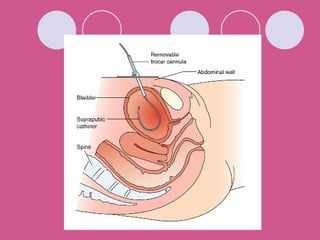
Catheterization Indwelling devices and infections Suprapubic catheterization Bladder retraining Intermittent self-catheterization
Kidney & Its Common Diseases
Content Kidneys & Functions  Kidney Failure/ESRD Risk factors Symptoms Treatment Hemodialysis Peritoneal Dialysis Common Kidney Diseases In the wards…
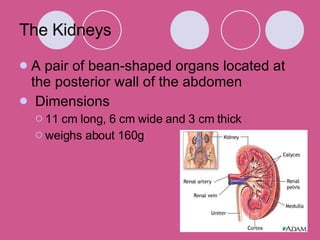
The Kidneys A pair of bean-shaped organs located at the posterior wall of the abdomen Dimensions 11 cm long, 6 cm wide and 3 cm thick weighs about 160g
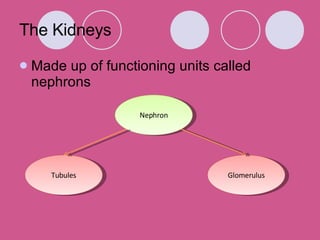
The Kidneys Made up of functioning units called nephrons Nephron Glomerulus Tubules
The Kidneys
Functions Removal of waste and excess water from body
Normal kidneys release several hormones Renin (regulates blood pressure) Erythropoietin (stimulates production of red blood cells) Activated form of Vitamin D (maintain normal bone structure) Functions
Kidney Failure or End-stage Renal Disease (ESRD) Occurs when the kidneys do not function properly or sufficiently, resulting in the accumulation of waste products and toxic materials may cause permanent and irreversible damage to body cells, tissues and organs kidneys that function <20% of required capacity  need renal replacement therapy
Risk Factors Chronic diseases Inflammatory diseases Blockage of urinary collecting system Chronic infections Rare genetic disorders
Symptoms Decreased urination Blood in the urine Nausea and vomiting Swollen hands and ankles Puffiness around the eyes Itching Sleep disturbances High blood pressure Loss of appetite
Treatment of Kidney Failure Blood creatinine rises to 900 µmol/ L Dialysis Hemodialysis Peritoneal Dialysis Transplant the best means of treatment
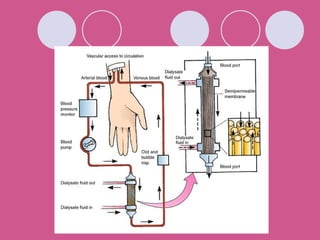
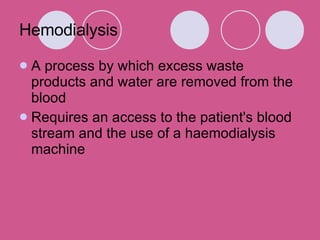
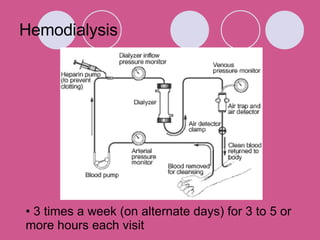
Hemodialysis A process by which excess waste products and water are removed from the blood Requires an access to the patient's blood stream and the use of a haemodialysis machine
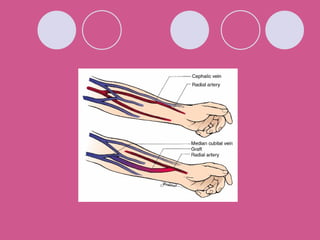
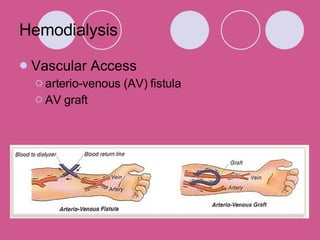
Hemodialysis Vascular Access arterio-venous (AV) fistula AV graft
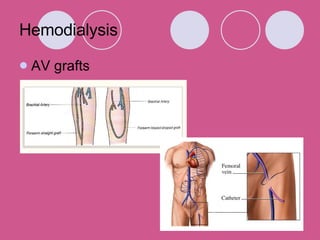
Hemodialysis AV grafts
Hemodialysis 3 times a week (on alternate days) for 3 to 5 or more hours each visit
Hemodialysis “ Washout Syndrome” feels weak, tremulous, extreme fatigue syndrome may begin toward the end of treatment or minutes following the treatment may last 30 minutes or 12-14 hours in a dissipating form
Hemodialysis Advantages Staff performs treatment in the dialysis centre Three treatments per week in the dialysis centre Permanent internal access required  Regular contact with people in the centre
Hemodialysis Disadvantages Requires travel to a dialysis centre  Fixed treatment schedule  Two needle sticks for each treatment; tie onto a machine and cannot move about during treatment  Diet and fluid intake restriction
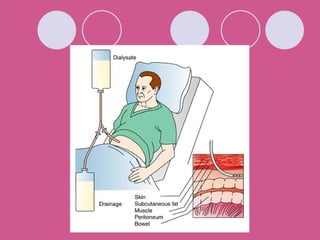
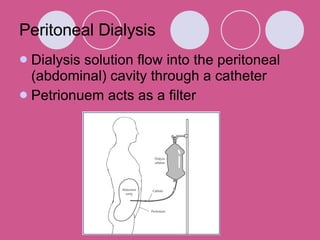
Peritoneal Dialysis Dialysis solution flow into the peritoneal (abdominal) cavity through a catheter Petrionuem acts as a filter
Peritoneal Dialysis 2 forms CAPD  (Continuous Ambulatory Peritoneal Dialysis) 4 exchanges during the day, 45 min each  APD (Automated Peritoneal Dialysis) exchanges are performed by the machine during the night while the patient is asleep
Peritoneal Dialysis Advantages Patient's involvement in self-care  Control over schedule Less diet & fluid restriction More steady physical condition as it provides slow, continuous therapy  Most similar to original kidneys. Can be done in the night as in automated peritoneal dialysis  Provide less severe cardiovascular instabilities in patients with underlying heart disease
Peritoneal Dialysis Disadvantages Four exchanges per day Permanent external catheter Change of body image Some risks of infection If on automated peritoneal dialysis, one will be tie onto a machine in the night Storage space is needed for supplies
Kidney Transplant A kidney from either a living related or a brain dead person is removed and surgically placed into the kidney failure patient.  Not all kidney failure patients are fit to undergo transplantation.   Medication to suppress their immunity given for the transplant may worsen their general health
Kidney Transplant Advantages Absence of need for frequent dialysis treatment Better quality of life Better health Reduced medical cost after first year No diet and fluid intake restriction Provide less severe cardiovascular instabilities in patients with underlying heart disease
Kidney Transplant Disadvantages Need for frequent physician visits  Pain, discomfort of surgery  Risk of transplant rejection  Prone to infections  On lifelong medications
Common Kidney Diseases Polycystic Kidney Disease Hypertensive Nephrosclerosis  Glomerulonephritis / Glomerulosclerosis Urinary Tract Infection (UTI)  Kidney Stones  Diabetic Kidney Disease Analgesic nephropathy
Genetically acquired  2 forms - dominant and recessive  In the dominant PKD form, one parent has the disease and passes it to the child. The chance of passing the gene to the offspring is 50%.  Cysts are abnormal pouches containing fluid. Eventually the cysts replace normal kidney tissue  -> suffers ESRD Polycystic Kidney Disease
Polycystic Kidney Disease Signs and Symptoms Dull pain at the side of the abdomen and back  Blood in the urine  Frequent urine tract infection  High blood pressure (often before cysts appear)  Upper abdominal discomfort (liver and pancreatic cysts)
Polycystic Kidney Disease Treatment Blood pressure - controlled and treated Kidney failure - supportive therapy until end-stage is reached when dialysis or transplantation is then required  Urine tract infection - treatment with antibiotics  Pain - analgesics are used. Alternatively, surgery to shrink or resect the cysts.
Hypertensive Nephrosclerosis  Poorly controlled high blood pressure (hypertension) can lead to kidney failure Thickening of blood vessels
Hypertensive Nephrosclerosis  Signs and Symptoms Headache  Giddiness (sometimes related to posture)  Neck discomfort  Easily tired  Nauseous and/or vomiting  Protein in urine
Hypertensive Nephrosclerosis  Treatment Medications to control blood pressure (anti-hypertensive)  Lowering of dietary salt (2g/day)  Exercise regularly
Glomerulonephritis / Glomerulosclerosis  Glomerulonephritis - An inflammatory condition that affects predominantly the glomeruli.  Causes IgA nephropathy Streptococcus bacteria Autoimmune Glomerulosclerosis - scarring of the glomeruli
Glomerulonephritis / Glomerulosclerosis  Signs and Symptoms Blood or protein in urine Frothy urine (signifying protein in urine)  Dark or pink-coloured urine  Leg swelling  Systemic disease like diabetes or autoimmune disease will have systemic manifestations, e.g. weight loss, arthritis, or skin rash
Glomerulonephritis / Glomerulosclerosis Treatment Specific Suppression of inflammation may be achieved by certain medications (eg steroids).  General Medications to decrease excretion of urinary protein  Control of blood pressure Dietary modifications
Urinary Tract Infection (UTI) Disease of the urinary tract Infection occurs when microorganisms attach themselves to the urethra and begins to multiply. May lead to infection of the kidneys (pyelonephritis) and cause permanent kidney damage, if left untreated.  Women are especially prone to get urinary tract infection.
Urinary Tract Infection (UTI) Conditions that increases risk of UTI Diabetes Situations where a urine catheter is needed Abnormalities of the urinary tract Obstructed urine flow (large prostate or stone) Being pregnant
Urinary Tract Infection (UTI) Signs and Symptoms Painful urination (burning sensation)  Hot and foul smelling urine  Blood in urine  Fever (sometimes with chills)  Painful lower abdomen  Increased urgency/frequency of wanting to pass urine  Nausea and/or vomiting
Urinary Tract Infection (UTI) Treatment Appropriate antibiotics  Drink plenty of water
Kidney Stones Start as salt/chemical crystals that precipitate out from urine Occurs when substance in urine that prevents crystalisation are ineffective
Kidney Stones Various forms of kidney stones - the most common is calcium in combination with either phosphate or oxalate More common in  Males 20-40 yo
Kidney Stones Signs and Symptoms Extreme pain at the site where the stone is causing the irritation Blood in the urine (abrasion along the urinary tract as the stone travels)  Painful and/or difficult urination  Unable to pass urine if the stone is large enough to obstruct the outlet completely
Kidney Stones Treatment With plenty of water, most stones can pass through if small  Pain-killers (as prescribed by the doctor)  Some medications may help 'breakdown' larger stone  Shockwave therapy (F-SWL) to break the stone  Surgical intervention - cystoscopy or open surgery
Diabetic Kidney Disease Common in chronic and poorly controlled diabetics  Diabetes damages blood vessels in the kidneys Occurs in both types of diabetes  Occurrence of high blood pressure in diabetics is a strong predictor for diabetic nephropathy  Most common cause of ESRD in many developed countries
Diabetic Kidney Disease Signs and Symptoms Frothy urine (signifying protein in urine)  Leg swelling (worse after walking/standing)  High blood pressure  Itching  Nausea and/or vomiting  Losing weight  Lethargy  Increased need to urinate at night
Diabetic Kidney Disease Treatment Good control of diabetes Good control of blood pressure (aiming for < 130/85 or lower in younger patients)  Medications to decrease protein excretion and preserve the function of kidneys  Lower protein diet Treat any urine tract infection (which is common in diabetics)
Analgesic Nephropathy Chronic kidney disease that occurs when there is a long period of painkiller/s ingestion (usually years) Associated with conditions which require constant need for painkiller medications May lead to ESRD
Analgesic Nephropathy Signs  and Symptoms Blood in the urine Protein in the urine Signs and symptoms related to kidney failure such as nausea, vomiting, lethargy, swelling, and poor appetite.
Analgesic Nephropathy Treatment Avoid long-term consumption of analgesics Those already with kidney disease of other kinds should certainly refrain from harmful analgesics as much as possible.
In the wards… Look out for… Vital signs BP Temp HR Catheterisation? Dialysis When? Eventful? Other electrolyte values Na K Creatinine Urea Etc  Blood count Hb
References Kidney Dialysis Foundation (2007). Normal Kidney Functions.  Health Guide [Online]. Available: http://www.kdf.org.sg/health.php (2008, June 01). National Kidney Foundation (2007). Common Kidney Diseases.  Education [Online]. Available: http://www.nkfs.org/index.php (2008, June 01).
 
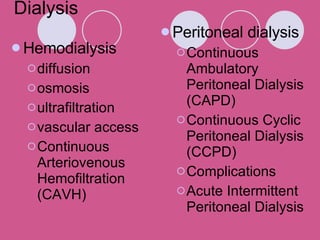
Dialysis Hemodialysis diffusion osmosis ultrafiltration vascular access Continuous Arteriovenous Hemofiltration (CAVH) Peritoneal dialysis Continuous Ambulatory Peritoneal Dialysis (CAPD) Continuous Cyclic Peritoneal Dialysis (CCPD) Complications Acute Intermittent Peritoneal Dialysis


Kidney Surgery Perioperative concerns Postoperative management drainage tubes nephrostomy drainage ureteral stents

Uri A

  • 1.
  • 2.
    Urinary System Createdby: Nelia B. Perez Rn, MSN Northeastern College, Santiago City
  • 3.
    KIDNEYS-Location and StructureAlthough many believe that the kidneys are located in the lower back, this is not their location. These small, dark red organs with a kidney bean shape lie against the dorsal body wall in a retroperitoneal position (beneath the parietal peritoneum) in the superior lumbar region. The kidneys extend from the T12 to the L3 vertebra; thus they receive some protection from the lower part of the rib cage. Because it is crowded by the liver, the right kidney is positioned slightly lower than the left. It is convex laterally and has a medial indentation called the renal hilus. Atop each kidney is an adrenal gland, which is part of the endocrine system and is a distinctly separate organ functionally. A fibrous, transparent renal capsule encloses each kidney and gives a fresh kidney a glistening appearance. The adipose capsule, surrounds each kidney and helps hold it in place against the muscles of the trunk wall.
  • 4.
    When a kidneyis cut lengthwise, three distinct regions become apparent, as can be seen in this picture. The outer region, which is light in color, is the renal cortex. Deep to the cortex is a darker reddish-brown area, the renal medulla. The broader base of each pyramid faces toward the cortex; its tip, the apex, points toward the inner region of the kidney. The pyramids are separated by extensions of cortex like tissue, the renal columns.
  • 5.
    Medial to thehilus is a flat, basinklike cavity, the renal pelvis Pelvis is continuous with the ureter leaving the hilus. Extension of the pelvis, calyces (calyx), form cup-shaped areas that enclose the tips of the pyramids. The calyces collect urine, which continuously drains from the tips of the pyramids into the renal pelvis. Urine then flows from the pelvis into the ureter, which transport it to the bladder for temporary storage.
  • 6.
    Blood supply Thekidneys continuously cleanse the blood and adjust its composition, so it is not surprising that they have a very rich blood supply One-quarter of the total blood supply of the body passes through the kidneys each minute.
  • 7.
    The arterial supplyof each kidney is the renal artery As the renal artery approaches the hilus, it divides into Segmental arteries . Once in side the pelvis, the segmental arteries break up into lobar arteries Each of which gives off several branches called interlobar arteries then branch off the arcuate arteries and run outward to supply the cortical tissue. The venous blood draining from the kidney flows through veins that trace the pathway of the arterial supply but in a reverse direction- interlobular veins to arcuate veins to interlobar veins to the renal vein , which emerges from the kidney hilus
  • 8.
    Nephrons and UrineFormation Each kidney contains over a million tiny structures called nephrons. Nephrons are the structural and functional units of the kidneys and, as such, are responsible for forming urine. Each nephron consists of two main structures: a glomerulus , which is a knot of capillaries, and a renal tubule . The cup- shaped of the renal tubule is called the glomerular, or Bowman’s, capsule. The inner layer of the capsule is made up of highly modified octopus- like cells called podocytes
  • 9.
    Extends from theglomerular capsule, it coils and twists before forming a hairpin loops and then again becomes coiled and twisted before entering a collecting tubule called the collecting duct. (these different regions of the tubule have specific names) These different regions of the tubule have specific names. Most nephrons are called cortical nephrons because they are located almost entirely within the cortex. The collecting ducts , each of which receives urine from many nephrons, run downward through the medullary pyramids, giving them their striped appearance.
  • 10.
    The afferent arteriole,which arises from an interlobular artery, is the “feeder vessel,” and the efferent arteriole receives blood that has passed through the glomerulus. The glomerulus, specialized for filtration, is unlike any other capillary bed in the entire body. The second capillary bed, the peritubular capillaries, arises from the efferent arteriole that drain the glomerulus. Unlike the high-pressure glomerulus, these capillaries are low- pressure, porous vessels that are adapted for absorption instead of filtration. The peritubular capillaries drain into interlobular veins leaving the cortex.
  • 11.
    Urine Formation Itis a result of three processes: FILTRATION TUBULAR REABSORPTION TUBULAR SECRETION
  • 12.
    Filtration Glomerulus Actsas a Filter Water and solutes smaller than proteins are forced through the capillary walls and pores of the glomerular capsule into the renal tubule. Both proteins and blood cells normally too large to pass through the filtration membrane and when either one of these appear in urine it is evident there is a problem with the glomerular filters
  • 13.
  • 14.
    Con’t Also, systemicblood pressure has to be normal in order for filtration to happen If the arterial blood pressure falls too low, the glomerular pressure becomes inadequate to force substances out of the blood and into the tubules, and filtrate formation stops
  • 15.
    Homeostatic Imbalance Oliguria:an abnormal low urinary output if it is between 100 and 400 ml/day Anuria if it is less than 100ml/day Low urinary output indicates that glomerural blood pressure is too low to cause filtration However, Anuria may also result from transfusion reactions and acute inflammation or from crush injuries of the kidneys
  • 16.
    Con’t Blood fromafferent arteriole flows into the glomerulus (capillaries) Due to blood pressure in the glomerulus, filtration occurs Water and small molecules (such as salts, amino acids, urea, uric acid, glucose) move from the blood plasma into the capsule Small molecules that escape being filtered and the nonfilterable components leave the glomerulus by the Efferent arteriole This produces a filtrate of blood, called glomerular filtrate
  • 17.
    Filterable Blood ComponentsWater Nutrients Salts Ions Nitrogenous Waste Nonfilterable Blood Components Formed elements (blood cells and platelets) Plasma Proteins
  • 18.
    Tubular Reabsorption Asthe filtrate moves along the tubule some of the molecules and ions are actively and passively (by diffusion) reabsorbed into the capillary bed from the tubule Active transport: transport of molecules against a concentration gradient (from regions of low concentration to regions of high concentrations) with the aid of proteins in the cell membrane and energy from ATP
  • 19.
    Con’t About 99%of filtered water and many useful molecules (such as salts, urea, nutrients, glucose, amino acids, sodium Ion Na+, chloride ion Cl-) returned to the blood Reabsorption of water is by osmosis Most of the reabsorption occurs in the proximal convoluted tubules, but the distal and the collecting duct are also active
  • 20.
    Tubular Secretion Moresubstances such as ions (hydrogen ion, creatinine, some drugs (penicillin), toxic substances, are actively secreted from the capillary network to tubules The fluid (urine), from filtration that was not reabsorbed and from tubular secretion, then flows into the collecting duct, then renal pelvis Substances found in urine are water, salts, urea, uric acid, ammonia, creatinine (NOT large molecules (proteins, blood cells), glucose Also, if all those substances weren't reabsorbed by tubules (glucose, water, salts, urea) than the body would continually lose water, salt and nutrients
  • 21.
  • 22.
    Characteristics of UrineNephrons filter 125 ml of body fluid per minute; filtering the entire body fluid component 16 times each day In a 24 hour period nephrons produce 180 liters of filtrate, of which 178.5 liters are reabsorbed. The remaining 1.5 liters forms urine
  • 23.
    Con’t Freshly voidedurine is generally clear and pale to deep yellow The more solutes are in a urine, the deeper yellow its color; whereas dilute urine is a pale, straw color When formed, urine is sterile, and its odor is slightly aromatic Ph is slightly acid (around 6) Urine weight more than distilled water (because it has water plus solutes)
  • 24.
    Ureters It isa slender tube each 25-30 cm long and 6mm in diameter Each tube descends beneath the peritoneum, from the hilum of a kidney, to enter the bladder at its dorsal surface
  • 25.
    Con’t The uretersis a passageway that carry urine from the kidneys to the bladder Although it may seem like urine may drain to the bladder by gravity, but the ureters do play an active role in urine transport Smooth muscle layers in their walls contract to propel urine into the bladder by peristalsis (even if a person is laying down) Once urine has entered the bladder, it is prevented from flowing back into the ureters by small valvelike folds of bladder mucosa that flap over the ureter openings
  • 26.
    Homeostatic Imbalance Whenurine becomes extremely concentrated, solutes such as uric acid salts form crystals that precipitate in the renal pelvis These crystals are called renal calculi, or kidney stones The crystals may grow into a stone ranging in size from a grain of sand to a golf ball. Most stones form in the kidneys. Very small stones can pass through the urinary system without causing problems. However, larger stones, when traveling from the kidney through the ureter to the bladder, can cause severe pain called colic. Most stones (70 to 80 percent) are made of calcium oxalate. A smaller number are made of uric acid or cystine
  • 27.
    Con’t For treatment,surgery is a choice However, a newer noninvasive procedure (lithotripsy) may be used Uses ultrasound waves to break the stones into small fragments (about the size of grain of sand) They then can be eliminated painlessly in the urine
  • 28.
    Urinary Bladder Theurinary bladder stores urine until it is expelled from the body The bladder is located in the pelvic cavity, behind the public symphysis and beneath the peritoneum The bladder has three openings---two for the ureters and one for the urethra, which drains the bladder
  • 29.
    Con’t The smoothtriangular region of the bladder base outlined by these three openings is called the tridone The trigone is important clinically because infections tend to persist in this region In males the prostate gland surrounds the neck of the bladder were it empties into the urethra The bladder wall contains three layers of smooth muscle called the detrusor muscle and its mucosa is a special type of epithelium: transitional epithelium When the bladder is empty it is collapsed, 5-7.5 cm long at most and its walls are thick and thrown into folds
  • 30.
    Con’t As urineaccumulates, the bladder expands and rises superiorly in the abdominal cavity Fig 15.7 Its muscle wall stretches and the transitional epithelial layer thins, allowing the balder to store more urine without substantially increasing its internal pressure A full bladder is about 12.5 cm long and hold about 500 ml of urine, but it is capable of holding more than twice that amount When the bladder is really distended, or stretched by urine, it becomes firm and pear shaped and may be felt just above the public symphysis Although urine is formed continuously by the kidneys, it is usually stored in the bladder until its release is convenient
  • 31.
  • 32.
    The anatomy ofthe urethra The epithelium of the urethra starts off as transitional cells as it exits the bladder. Further along the urethra there are stratified columnar cells, then stratified squamous cells near the external meatus (exit hole). There are small mucus -secreting urethral glands, that help protect the epithelium from the corrosive urine
  • 33.
    The female urethraFemale urethra In the human female, the urethra is about 1 1/2-2 inches (3-5 cm) long and opens in the vulva between the clitoris and the vaginal opening. Because of the short length of the urethra, women tend to be more susceptible to infections of the bladder ( cystitis ) and the urinary tract.
  • 34.
    The female urethrais a narrow membranous canal, extending from the internal to the external urethral orifice. It is placed behind the symphysis pubis, imbedded in the anterior wall of the vagina, and its direction is obliquely downward and forward; it is slightly curved with the concavity directed forward. Its lining is composed of stratified squamous epithelium, which becomes transitional near the bladder. The urethra consists of three coats: muscular, erectile, and mucous, the muscular layer being a continuation of that of the bladder. The release of urine is controlled by two sphincters. Internal urethral sphincter External urethral sphincter
  • 35.
    Male urethra Themale urethra extends from the internal urethral orifice in the urinary bladder to the external urethral orifice at the end of the penis. It presents a double curve in the ordinary relaxed state of the penis. Its length varies from 17.5 to 20 cm.; and it is divided into three portions, the prostatic, membranous, and cavernous, the structure and relations of which are essentially different. Except during the passage of the urine or semen, the greater part of the urethral canal is a mere transverse cleft or slit, with its upper and under surfaces in contact; at the external orifice the slit is vertical, in the membranous portion irregular or stellate, and in the prostatic portion somewhat arched.     
  • 36.
    1. Theprostatic portion ( pars prostatica ), the widest and most dilatable part of the canal, is about 3 cm. long. 2. The membranous portion ( pars membranacea ) is the shortest, least dilatable, and, with the exception of the external orifice, the narrowest part of the canal It extends downward and forward, with a slight anterior concavity, between the apex of the prostate and the bulb of the urethra, perforating the urogenital diaphragm about 2.5 cm. below and behind the pubic symphysis. 3. The cavernous portion ( pars cavernosa; penile or spongy portion ) is the longest part of the urethra, and is contained in the corpus cavernosum urethræ. It is about 15 cm. long, and extends from the termination of the membranous portion to the external urethral orifice.
  • 37.
    The structure ofthe male urethra The structure of the urethra (tube) itself is a continuous mucous membrane supported by submucous tissue connecting it to the other structures through which it passes. The mucous coat is continuous with the mucous membrane of the bladder, ureters and kidney. In the membranous and spongy sections (2. and 3. above), the mucous membrane is arranged in longitudinal folds when the tube is empty. The submucous tissue consists of a vascular (i.e. containing many blood vessels) erectile layer surrounded by a layer of smooth (involuntary) muscle fibres . These muscle fibres are arranged in a circular configuration that separates the mucous membrane and submucous tissue from the surrounding structure - which is the tissue of the corpus spongiosum (labeled simply &quot;penis&quot; in the diagram above). Unlike the female urethra, the male urethra has a reproductive function in addition to it's urinary function - it conveys semen out of the body at ejaculation. For further information about this function red the section about the male reproductive system.
  • 38.
    The Function ofthe Urethra Gender differences: The females only carries urine. The males carries urine and is a passageway for sperm cells.
  • 39.
    Micturition of theurethra Male and female Both sphincter muscles must open to allow voiding. The internal urethral sphincter is relaxed after stretching of the bladder Activation is from an impulse sent to the spinal cord and then back via the pelvic splanchnic nerves. The external urethral sphincter must be voluntarily relaxed.
  • 40.
    Fluid, Electrolyte, andAcid-Base Balance Blood composition depends on three major factors: Diet Cellular metabolism Urine output In general, the kidneys have four major roles to play, which help keep the blood composition relatively constant. Excretion of nitrogen containing wastes Maintaining water in the blood Maintaining electrolyte balance in the blood, and Ensuring proper blood pH
  • 41.
    Maintaining Water and Electrolyte Balance of Blood Body Fluids and Fluid Compartments: Of the hundreds of compounds present in your body, the most abundant is water. Males weighing 154 pounds will have an average of 60% of their body weight, nearly 40L, as water. Females about 50%. (based on nonobese individuals). The more fat present in the body, the less total water content per kg of body weight . Female body contains slightly less water per kg of weight because it contains slightly more fat than the male body.
  • 42.
    In a newborn,water may account for up to 80% of body weight. That percentage increases if the infant is born premature. The percentage of body water decreases rapidly during the first 10 years of life. In elderly individuals, the amount of water per kg of body weight increases (because old ages is often accompanied by a decrease in muscle mass -65% water- and in increase in fat -20% water-) Water is the universal body solvent within which all solutes (including the very important electrolytes) are dissolved. *picture pg 619 body weight
  • 43.
    Body Fluid Compartments:Total body water can be subdivided into two major fluid compartments called “extracellular” and “intracellular” fluid compartments. Extracellular: consists mainly of the liquid fraction of whole blood called the plasma, found in the blood vessels and the interstitial fluid that surrounds the cell. In addition, lymph, cerebrospinal fluid, humors of the eye, and the specialized joint fluids are also considered extracellular fluid. Intracellular: largest volume of water by far. Located inside of the cells. +diagram page 618
  • 44.
    Mechanisms that maintainfluid balance 3 sources of fluid intake: the liquids we drink, the water in the food we eat, and the water formed by catabolism of foods. Fluid output from the body occurs through four organs: the kidneys, lungs, skin, and intestines. The fluid output that changes the most is that from the kidneys. The body maintains fluid balance mainly by changing the volume of urine excreted to match changes in the volume of fluid intake
  • 45.
    Regulation of Fluid Intake When fluid loss from the body exceeds fluid intake, salivary excretion decreases, producing a “dry mouth” feeling, and the sensation of thirst. The individual then drinks water, thereby increasing fluid intake and compensating for previous fluid losses. This tends to restore fluid balance. Water is continually lost from the body through expired air and diffusion through the skin. Although the body adjusts fluid intake, factors that adjust fluid output, such as electrolytes and blood proteins, are far more important. (chart from yellow text!!!)
  • 46.
    Balance between typicalfluid intake and output in a 70 kg adult. (Values are ml per 24 hours.)
  • 47.
    What are electrolytes?Electrolyte: substance that dissociates into ions in solution, rendering the solution capable of conducting an electric current. Electrolyte balance: homeostasis of electrolytes
  • 48.
    The types andamounts of solutes in the body, especially electrolytes such as sodium, potassium, and calcium ions, are vitally important to overall homeostasis. Very small changes in electrolyte balance (solute concentrations in various fluid compartments) cause water to move from one fluid compartment to another. This alters blood volume and blood pressure, but it can also severely impair the activity of irritable cells like the nerve and muscle cell. Chart from text book!
  • 49.
    Importance of Electrolytesin Body Fluids Compounds such as ordinary table salt, or sodium chloride (NaCl) that have molecular bonds that permit them to break up, or dissociate, in water solution to separate particles (Na+ and Cl-) are electrolytes. The dissociated particles of an electrolyte are ions and carry an electrical charge. Important positively charged ions include sodium (Na+), Calcium (Ca++), potassium (K+), and magnesium (Mg++). Important negatively charged ions include chloride (Cl-), bicarbonate (HCO3-), phosphate (HPO4-), and many proteins. Although blood plasma contains a number of important electrolytes, by far the most abundant one is sodium chloride (table salt).
  • 50.
    A variety ofelectrolytes have important nutrient or regulatory roles in the body. For example, Iron required for hemoglobin production. Iodine must be available for synthesis of thyroid hormones. Electrolytes are also needed for many cellular activities such as nerve conduction and muscle contraction.
  • 51.
    Electrolytes influence themovement of water among the three fluid compartments of the body. To remember how ECF electrolyte concentration affects fluid volumes, remember this one short sentence: “ Where sodium goes, water soon follows” For example, concentration of sodium in interstitial fluid spaces rises above normal, the volume of IF soon reaches abnormal levels too (edema) which results in tissue swelling.
  • 52.
    Reabsorption of waterand electrolytes by the kidney is regulated primarily by hormones. When blood volume drops for any reason, (ie due to hemorrhage or excessive water loss sweating or diarrhea), arterial blood pressure drops, which in turn decreases amount of filtrate formed by kidneys. In addition, highty sensitive cells in the hypothalamus called somoreceptions react to the change in blood composition. (That is. Less water and more solutes.)
  • 53.
    Sodium imbalance, potassiumimbalance, calcium imbalance
  • 54.
    Maintaining Fluid HomeostasisOverall fluid balance requires that fluid output equal fluid intake. The type of fluid output that changes most is urine volume. Renal tubule regulation of salt and water is the most important factor in determining urine volume. Aldosterone controls sodium reabsorption in the kidney. The present of sodium forces water to move (Where sodium goes, water soon follows). The aldosterone mechanism helps restore normal ECF volume when it decreases below normal.
  • 55.
    The kidney actsas the chief regulator of sodium levels in body fluids. Many electrolytes such as sodium not only pass into and out of the body but also move back and forth between a number of body fluids during each 24 hour period. During this 24 hour period, more than 8 liters of fluid containing 1000 to 1300 mEq of sodium are poured into the digestive system as part of saliva, gastric secretions, bile, pancreatic juice, and IF secretions. This sodium is almost completely reabsorbed in the large intestine. Very little sodium is lost in the feces. Precise regulation and control of sodium levels are required for survival. Chart in yellow text
  • 56.
    Capillary Blood Pressureand Blood Proteins Capillary blood pressure = “water pushing” force If capillary blood pressure increases, more fluid is pushed (filtered) out of blood into the IF. This effect transfers fluid from blood to IF. This fluid shift changes blood and IF volumes. IT DECREASES BLOOD VOLUME BY INCREASING IF VOLUME. If, on the other hand, capillary blood pressure decreases, less fluid filters out of blood into IF.
  • 57.
    Plasma proteins actas a water-pulling or water-holding force. They hold water in the blood and pull it into the blood from IF. e.g. if the concentration of proteins in blood decrease appreciably, less water moves into blood from IF. As a result, blood volume decreases and IF volume increases. Of the 3 main body fluids, IF volume varies the most. Plasma volume usually fluctuates only slightly and briefly. If a pronounced change in its volume occurs, adequate circulation cannot be maintained.
  • 58.
    Fluid Imbalances Dehydration:seen most often. In this potentially dangerous condition, IF volume decreases first, but eventually, if treatment has not been given, ICF and plasma volumes also decrease below normal levels. Prolonged diarrhea or vomiting may result in dehydration due to the loss of body fluids. Loss of skin elasticity is a clinical sign of dehydration. Overhydration: less common than dehydration; giving intravenous fluids too rapidly or in too large of an amount can put too heavy a burden on the heart.
  • 59.
    Assessment Health HistoryChanges in Voiding GI Symptoms Physical Examination Abdominal assessment Palpation of kidneys Bladder percussion Prostate palpation Inspection of urinary meatus
  • 60.
  • 61.
    Diagnostic Evaluation Urinalysisand Urine Culture Renal Function Tests X-ray and other imaging modalities Urological Endoscopic Procedures Biopsy Urodynamic Tests
  • 62.
  • 63.
    Chapter 44 Managementof Patients With Upper or Lower Urinary Tract Dysfunction
  • 64.
    Urinary Incontinence Unplannedloss of urine that is sufficient to be considered a problem. Stress —urine loss during physical activity that increases abdominal pressure (e.g., coughing, sneezing, laughing) Urge —urine loss with urgent need to void and involuntary bladder contraction (also called detrusor instability) Mixed—both stress and urge incontinence Overflow —constant dribbling of urine; bladder never completely empties. Types of Incontinence
  • 65.
    Nursing Management Toileting assistance *Timed voiding, scheduled toileting *Habit training *Prompted voiding Bladder training Pelvic floor muscle exercise Intermittent urinary catheterisation Indwelling urinary catheterisation External collection systems
  • 66.
    Absorbent products Skin care Dietary and fluid management Physical and environmental alterations Patient and caregiver education Nursing education
  • 67.
    Urinary Retention Inabilityto empty the bladder completely during attempts to void. Results from: diabetes prostatic enlargement urethral pathology trauma pregnancy neurologic disorders
  • 68.
    Catheterization Indwelling devicesand infections Suprapubic catheterization Bladder retraining Intermittent self-catheterization
  • 69.
    Kidney & ItsCommon Diseases
  • 70.
    Content Kidneys &Functions Kidney Failure/ESRD Risk factors Symptoms Treatment Hemodialysis Peritoneal Dialysis Common Kidney Diseases In the wards…
  • 71.
    The Kidneys Apair of bean-shaped organs located at the posterior wall of the abdomen Dimensions 11 cm long, 6 cm wide and 3 cm thick weighs about 160g
  • 72.
    The Kidneys Madeup of functioning units called nephrons Nephron Glomerulus Tubules
  • 73.
  • 74.
    Functions Removal ofwaste and excess water from body
  • 75.
    Normal kidneys releaseseveral hormones Renin (regulates blood pressure) Erythropoietin (stimulates production of red blood cells) Activated form of Vitamin D (maintain normal bone structure) Functions
  • 76.
    Kidney Failure orEnd-stage Renal Disease (ESRD) Occurs when the kidneys do not function properly or sufficiently, resulting in the accumulation of waste products and toxic materials may cause permanent and irreversible damage to body cells, tissues and organs kidneys that function <20% of required capacity need renal replacement therapy
  • 77.
    Risk Factors Chronicdiseases Inflammatory diseases Blockage of urinary collecting system Chronic infections Rare genetic disorders
  • 78.
    Symptoms Decreased urinationBlood in the urine Nausea and vomiting Swollen hands and ankles Puffiness around the eyes Itching Sleep disturbances High blood pressure Loss of appetite
  • 79.
    Treatment of KidneyFailure Blood creatinine rises to 900 µmol/ L Dialysis Hemodialysis Peritoneal Dialysis Transplant the best means of treatment
  • 80.
    Hemodialysis A processby which excess waste products and water are removed from the blood Requires an access to the patient's blood stream and the use of a haemodialysis machine
  • 81.
    Hemodialysis Vascular Accessarterio-venous (AV) fistula AV graft
  • 82.
  • 83.
    Hemodialysis 3 timesa week (on alternate days) for 3 to 5 or more hours each visit
  • 84.
    Hemodialysis “ WashoutSyndrome” feels weak, tremulous, extreme fatigue syndrome may begin toward the end of treatment or minutes following the treatment may last 30 minutes or 12-14 hours in a dissipating form
  • 85.
    Hemodialysis Advantages Staffperforms treatment in the dialysis centre Three treatments per week in the dialysis centre Permanent internal access required Regular contact with people in the centre
  • 86.
    Hemodialysis Disadvantages Requirestravel to a dialysis centre Fixed treatment schedule Two needle sticks for each treatment; tie onto a machine and cannot move about during treatment Diet and fluid intake restriction
  • 87.
    Peritoneal Dialysis Dialysissolution flow into the peritoneal (abdominal) cavity through a catheter Petrionuem acts as a filter
  • 88.
    Peritoneal Dialysis 2forms CAPD (Continuous Ambulatory Peritoneal Dialysis) 4 exchanges during the day, 45 min each APD (Automated Peritoneal Dialysis) exchanges are performed by the machine during the night while the patient is asleep
  • 89.
    Peritoneal Dialysis AdvantagesPatient's involvement in self-care Control over schedule Less diet & fluid restriction More steady physical condition as it provides slow, continuous therapy Most similar to original kidneys. Can be done in the night as in automated peritoneal dialysis Provide less severe cardiovascular instabilities in patients with underlying heart disease
  • 90.
    Peritoneal Dialysis DisadvantagesFour exchanges per day Permanent external catheter Change of body image Some risks of infection If on automated peritoneal dialysis, one will be tie onto a machine in the night Storage space is needed for supplies
  • 91.
    Kidney Transplant Akidney from either a living related or a brain dead person is removed and surgically placed into the kidney failure patient.  Not all kidney failure patients are fit to undergo transplantation.  Medication to suppress their immunity given for the transplant may worsen their general health
  • 92.
    Kidney Transplant AdvantagesAbsence of need for frequent dialysis treatment Better quality of life Better health Reduced medical cost after first year No diet and fluid intake restriction Provide less severe cardiovascular instabilities in patients with underlying heart disease
  • 93.
    Kidney Transplant DisadvantagesNeed for frequent physician visits Pain, discomfort of surgery Risk of transplant rejection Prone to infections On lifelong medications
  • 94.
    Common Kidney DiseasesPolycystic Kidney Disease Hypertensive Nephrosclerosis Glomerulonephritis / Glomerulosclerosis Urinary Tract Infection (UTI) Kidney Stones Diabetic Kidney Disease Analgesic nephropathy
  • 95.
    Genetically acquired 2 forms - dominant and recessive In the dominant PKD form, one parent has the disease and passes it to the child. The chance of passing the gene to the offspring is 50%. Cysts are abnormal pouches containing fluid. Eventually the cysts replace normal kidney tissue -> suffers ESRD Polycystic Kidney Disease
  • 96.
    Polycystic Kidney DiseaseSigns and Symptoms Dull pain at the side of the abdomen and back Blood in the urine Frequent urine tract infection High blood pressure (often before cysts appear) Upper abdominal discomfort (liver and pancreatic cysts)
  • 97.
    Polycystic Kidney DiseaseTreatment Blood pressure - controlled and treated Kidney failure - supportive therapy until end-stage is reached when dialysis or transplantation is then required Urine tract infection - treatment with antibiotics Pain - analgesics are used. Alternatively, surgery to shrink or resect the cysts.
  • 98.
    Hypertensive Nephrosclerosis Poorly controlled high blood pressure (hypertension) can lead to kidney failure Thickening of blood vessels
  • 99.
    Hypertensive Nephrosclerosis Signs and Symptoms Headache Giddiness (sometimes related to posture) Neck discomfort Easily tired Nauseous and/or vomiting Protein in urine
  • 100.
    Hypertensive Nephrosclerosis Treatment Medications to control blood pressure (anti-hypertensive) Lowering of dietary salt (2g/day) Exercise regularly
  • 101.
    Glomerulonephritis / Glomerulosclerosis Glomerulonephritis - An inflammatory condition that affects predominantly the glomeruli. Causes IgA nephropathy Streptococcus bacteria Autoimmune Glomerulosclerosis - scarring of the glomeruli
  • 102.
    Glomerulonephritis / Glomerulosclerosis Signs and Symptoms Blood or protein in urine Frothy urine (signifying protein in urine) Dark or pink-coloured urine Leg swelling Systemic disease like diabetes or autoimmune disease will have systemic manifestations, e.g. weight loss, arthritis, or skin rash
  • 103.
    Glomerulonephritis / GlomerulosclerosisTreatment Specific Suppression of inflammation may be achieved by certain medications (eg steroids). General Medications to decrease excretion of urinary protein Control of blood pressure Dietary modifications
  • 104.
    Urinary Tract Infection(UTI) Disease of the urinary tract Infection occurs when microorganisms attach themselves to the urethra and begins to multiply. May lead to infection of the kidneys (pyelonephritis) and cause permanent kidney damage, if left untreated. Women are especially prone to get urinary tract infection.
  • 105.
    Urinary Tract Infection(UTI) Conditions that increases risk of UTI Diabetes Situations where a urine catheter is needed Abnormalities of the urinary tract Obstructed urine flow (large prostate or stone) Being pregnant
  • 106.
    Urinary Tract Infection(UTI) Signs and Symptoms Painful urination (burning sensation) Hot and foul smelling urine Blood in urine Fever (sometimes with chills) Painful lower abdomen Increased urgency/frequency of wanting to pass urine Nausea and/or vomiting
  • 107.
    Urinary Tract Infection(UTI) Treatment Appropriate antibiotics Drink plenty of water
  • 108.
    Kidney Stones Startas salt/chemical crystals that precipitate out from urine Occurs when substance in urine that prevents crystalisation are ineffective
  • 109.
    Kidney Stones Variousforms of kidney stones - the most common is calcium in combination with either phosphate or oxalate More common in Males 20-40 yo
  • 110.
    Kidney Stones Signsand Symptoms Extreme pain at the site where the stone is causing the irritation Blood in the urine (abrasion along the urinary tract as the stone travels) Painful and/or difficult urination Unable to pass urine if the stone is large enough to obstruct the outlet completely
  • 111.
    Kidney Stones TreatmentWith plenty of water, most stones can pass through if small Pain-killers (as prescribed by the doctor) Some medications may help 'breakdown' larger stone Shockwave therapy (F-SWL) to break the stone Surgical intervention - cystoscopy or open surgery
  • 112.
    Diabetic Kidney DiseaseCommon in chronic and poorly controlled diabetics Diabetes damages blood vessels in the kidneys Occurs in both types of diabetes Occurrence of high blood pressure in diabetics is a strong predictor for diabetic nephropathy Most common cause of ESRD in many developed countries
  • 113.
    Diabetic Kidney DiseaseSigns and Symptoms Frothy urine (signifying protein in urine) Leg swelling (worse after walking/standing) High blood pressure Itching Nausea and/or vomiting Losing weight Lethargy Increased need to urinate at night
  • 114.
    Diabetic Kidney DiseaseTreatment Good control of diabetes Good control of blood pressure (aiming for < 130/85 or lower in younger patients) Medications to decrease protein excretion and preserve the function of kidneys Lower protein diet Treat any urine tract infection (which is common in diabetics)
  • 115.
    Analgesic Nephropathy Chronickidney disease that occurs when there is a long period of painkiller/s ingestion (usually years) Associated with conditions which require constant need for painkiller medications May lead to ESRD
  • 116.
    Analgesic Nephropathy Signs and Symptoms Blood in the urine Protein in the urine Signs and symptoms related to kidney failure such as nausea, vomiting, lethargy, swelling, and poor appetite.
  • 117.
    Analgesic Nephropathy TreatmentAvoid long-term consumption of analgesics Those already with kidney disease of other kinds should certainly refrain from harmful analgesics as much as possible.
  • 118.
    In the wards…Look out for… Vital signs BP Temp HR Catheterisation? Dialysis When? Eventful? Other electrolyte values Na K Creatinine Urea Etc Blood count Hb
  • 119.
    References Kidney DialysisFoundation (2007). Normal Kidney Functions. Health Guide [Online]. Available: http://www.kdf.org.sg/health.php (2008, June 01). National Kidney Foundation (2007). Common Kidney Diseases. Education [Online]. Available: http://www.nkfs.org/index.php (2008, June 01).
  • 120.
  • 121.
    Dialysis Hemodialysis diffusionosmosis ultrafiltration vascular access Continuous Arteriovenous Hemofiltration (CAVH) Peritoneal dialysis Continuous Ambulatory Peritoneal Dialysis (CAPD) Continuous Cyclic Peritoneal Dialysis (CCPD) Complications Acute Intermittent Peritoneal Dialysis
  • 122.
  • 123.
  • 124.
  • 125.
    Kidney Surgery Perioperativeconcerns Postoperative management drainage tubes nephrostomy drainage ureteral stents