OVERVIEW OFURINARYSYSTEM
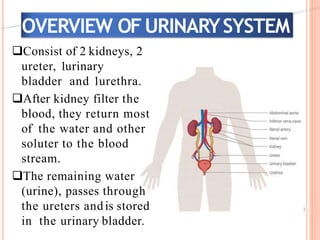
Consist of 2 kidneys, 2
ureter, 1urinary
bladder and 1urethra.
After kidney filter the
blood, they return most
of the water and other
soluter to the blood
stream.
The remaining water
(urine), passes through
the ureters andis stored
in the urinary bladder.
OVERVIEW OF THE URINARYSYSTEM
FUNCTION OFTHEURINARY SYSTEM
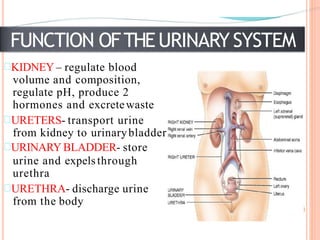
KIDNEY– regulate blood
volume and composition,
regulate pH, produce 2
hormones and excretewaste
URETERS- transport urine
from kidney to urinarybladder
URINARY BLADDER- store
urine and expelsthrough
urethra
URETHRA- discharge urine
from the body
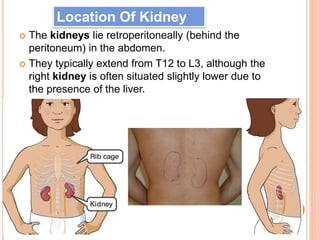
 The kidneys lie retroperitoneally (behind the
peritoneum) in the abdomen.
 They typically extend from T12 to L3, although the
right kidney is often situated slightly lower due to
the presence of the liver.
Location Of Kidney
FUNCTIONS OFKIDNEY
Regulation of ions in blood
Sodium-Na+, potassium-K+, calcium-Ca2+, Cl-,
phosphate HPO42-
Regulation of blood volume
adjust the volume of blood or eliminating it in
the urine
Regulation of blood pH
Regulate by excrete a variable amount of H+ in
theurine, conserve bicarbonate HCO3-
Production of hormones
Calcitrole- calcium homeostasis
Erythropoietin- production of RBC
Excretion of waste
Ammonia and urea- amino acid
Creatinine- creatinine phosphate
Drugs ect
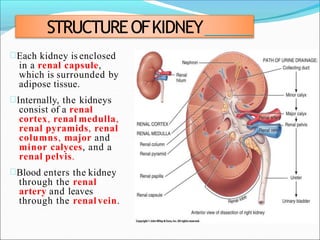
STRUCTUREOFKIDNEY
Each kidney is enclosed
in a renal capsule,
which is surrounded by
adipose tissue.
Internally, the kidneys
consist of a renal
cortex, renal medulla,
renal pyramids, renal
columns, major and
minor calyces, and a
renal pelvis.
Blood enters the kidney
through the renal
artery and leaves
through the renalvein.
NEPHRON
NEPHRONS
The functional unit of thekidney is
called the nephron
About a million in eachkidney
Consist of 2 part: renal corpuscle, and
renal tubule
Renal corpuscle =
glomerular (bowman’s capsule)
glomerulus
Renal tube
Proximal convoluted tubules
Nephron loop (descending &
ascending)
Distal convoluted tubules
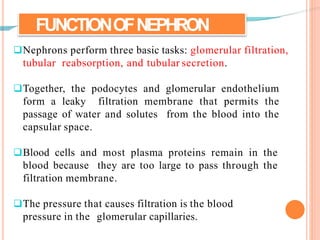
FUNCTIONOFNEPHRON
Nephrons perform three basic tasks: glomerular filtration,
tubular reabsorption, and tubular secretion.
Together, the podocytes and glomerular endothelium
form a leaky filtration membrane that permits the
passage of water and solutes from the blood into the
capsular space.
Blood cells and most plasma proteins remain in the
blood because they are too large to pass through the
filtration membrane.
The pressure that causes filtration is the blood
pressure in the glomerular capillaries.
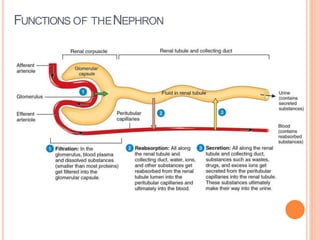
FUNCTIONSOFNEURON
 Epithelial cells all along the renal tubules and collecting
ducts carry out tubular reabsorption and tubular
secretion. Tubular reabsorption retains substances
needed by the body, including water, glucose, amino
acids, and ions such as sodium (Na+), potassium (K+),
chloride (Cl-), bicarbonate (HCO3 ), -
calcium (Ca2+), and magnesium (Mg2+).
Tubular secretion discharges chemicals not needed by the body
into the urine. Included are excess ions, nitrogenous wastes,
hormones, and certain drugs. The kidneys help maintain
blood pH by secreting H+. Tubular secretion also helps maintain
proper levels of K+in the blood
FUNCTIONS OF THENEPHRON
GLOMERULAR FILTRATION
SUBSTANCES FILTERED, REABSORBED,AND
EXCRETED IN URINE PER DAY
PHYSICALCHARACTERISTICS OF NORMAL URINE
URETERS
The ureters transport
urine from the renal
pelves of the right and
left kidneys tothe
urinary bladder
25 to 30cmin long
diameter from 1-8mm
URETER
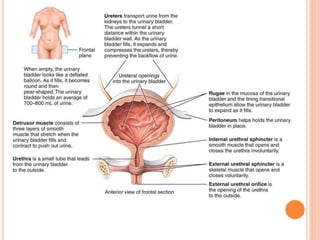
URINARYBLADDER
The Urinary bladder is posterior to
the pubic symphysis
The shape of urinary bladder
depends on how much urine is
contain. when empty, it look like a
deflated balloon
Capacity ~300-400mL because, uterus
occupies the space superior tothe
urinary bladder
Toward the base of urinary bladder,
the ureter drains into the urinary
bladder via the ureteral opening.
URINARY BLADDER
URETHRA
The terminal portion of
the urinary bladder to
the exterior of the body.
In both male and female,
the urethra is the
passageway for
discharging urine from
the body.
The male urethra also
serves as the duct
through which semen is
ejaculated.
URETHRA
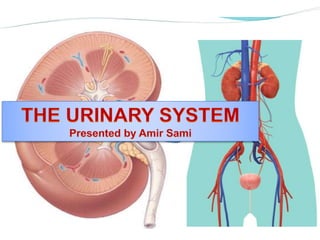
The urinary system
The urinary system

The urinary system

  • 2.
    OVERVIEW OFURINARYSYSTEM Consist of2 kidneys, 2 ureter, 1urinary bladder and 1urethra. After kidney filter the blood, they return most of the water and other soluter to the blood stream. The remaining water (urine), passes through the ureters andis stored in the urinary bladder.
  • 3.
    OVERVIEW OF THEURINARYSYSTEM
  • 4.
    FUNCTION OFTHEURINARY SYSTEM KIDNEY–regulate blood volume and composition, regulate pH, produce 2 hormones and excretewaste URETERS- transport urine from kidney to urinarybladder URINARY BLADDER- store urine and expelsthrough urethra URETHRA- discharge urine from the body
  • 5.
     The kidneyslie retroperitoneally (behind the peritoneum) in the abdomen.  They typically extend from T12 to L3, although the right kidney is often situated slightly lower due to the presence of the liver. Location Of Kidney
  • 6.
    FUNCTIONS OFKIDNEY Regulation ofions in blood Sodium-Na+, potassium-K+, calcium-Ca2+, Cl-, phosphate HPO42- Regulation of blood volume adjust the volume of blood or eliminating it in the urine Regulation of blood pH Regulate by excrete a variable amount of H+ in theurine, conserve bicarbonate HCO3- Production of hormones Calcitrole- calcium homeostasis Erythropoietin- production of RBC Excretion of waste Ammonia and urea- amino acid Creatinine- creatinine phosphate Drugs ect
  • 7.
    STRUCTUREOFKIDNEY Each kidney isenclosed in a renal capsule, which is surrounded by adipose tissue. Internally, the kidneys consist of a renal cortex, renal medulla, renal pyramids, renal columns, major and minor calyces, and a renal pelvis. Blood enters the kidney through the renal artery and leaves through the renalvein.
  • 8.
  • 9.
    NEPHRONS The functional unitof thekidney is called the nephron About a million in eachkidney Consist of 2 part: renal corpuscle, and renal tubule Renal corpuscle = glomerular (bowman’s capsule) glomerulus Renal tube Proximal convoluted tubules Nephron loop (descending & ascending) Distal convoluted tubules
  • 10.
    FUNCTIONOFNEPHRON Nephrons perform threebasic tasks: glomerular filtration, tubular reabsorption, and tubular secretion. Together, the podocytes and glomerular endothelium form a leaky filtration membrane that permits the passage of water and solutes from the blood into the capsular space. Blood cells and most plasma proteins remain in the blood because they are too large to pass through the filtration membrane. The pressure that causes filtration is the blood pressure in the glomerular capillaries.
  • 11.
    FUNCTIONSOFNEURON  Epithelial cellsall along the renal tubules and collecting ducts carry out tubular reabsorption and tubular secretion. Tubular reabsorption retains substances needed by the body, including water, glucose, amino acids, and ions such as sodium (Na+), potassium (K+), chloride (Cl-), bicarbonate (HCO3 ), - calcium (Ca2+), and magnesium (Mg2+). Tubular secretion discharges chemicals not needed by the body into the urine. Included are excess ions, nitrogenous wastes, hormones, and certain drugs. The kidneys help maintain blood pH by secreting H+. Tubular secretion also helps maintain proper levels of K+in the blood
  • 12.
  • 13.
  • 14.
  • 15.
  • 16.
    URETERS The ureters transport urinefrom the renal pelves of the right and left kidneys tothe urinary bladder 25 to 30cmin long diameter from 1-8mm URETER
  • 17.
    URINARYBLADDER The Urinary bladderis posterior to the pubic symphysis The shape of urinary bladder depends on how much urine is contain. when empty, it look like a deflated balloon Capacity ~300-400mL because, uterus occupies the space superior tothe urinary bladder Toward the base of urinary bladder, the ureter drains into the urinary bladder via the ureteral opening. URINARY BLADDER
  • 18.
    URETHRA The terminal portionof the urinary bladder to the exterior of the body. In both male and female, the urethra is the passageway for discharging urine from the body. The male urethra also serves as the duct through which semen is ejaculated. URETHRA