The urinary system
Lecturer:
Dr-Abdirizak yusuf olow
MBchB
Introduction
• The urinary system is the main excretory system and
consists of the following structures:
– 2 kidneys, which secrete urine
– 2 ureters that convey the urine from the kidneys to the
urinary bladder
– the urinary bladder, which collects and stores urine
– the urethra through which urine leaves the body.
• The urinary system plays a vital part in maintaining
homeostasis of water and electrolytes within the body.
The kidneys produce urine that contains metabolic
waste products, including the nitrogenous compounds
urea and uric acid, excess ions and some drugs
Cont
• . The main functions of the kidneys are:
– Formation of urine, maintaining water, electrolyte
and acid–base balance
– Excretion of waste products
– Production and secretion of erythropoietin, the
hormone that stimulates formation of red blood
cells.
– Production and secretion of renin, an important
enzyme in the control of blood pressure (p. 225).
• Urine is stored in the bladder and excreted by
the process of micturition.
Kidneys
• The kidneys lie on the posterior abdominal
wall, one on each side of the vertebral
column, behind the peritoneum and below
the diaphragm. They extend from the level
of the 12th thoracic vertebra to the 3rd
lumbar vertebra, receiving some protection
from the lower rib cage. The right kidney is
usually slightly lower than the left,
probably because of the considerable
space occupied by the liver.
Cont
• Kidneys are bean-shaped organs, about
11 cm long, 6 cm wide, 3 cm thick and
weigh 150 g. They are embedded in, and
held in position by, a mass of fat. A sheath
of fibrous connective tissue, the renal
fascia, encloses the kidney and the renal
fat.
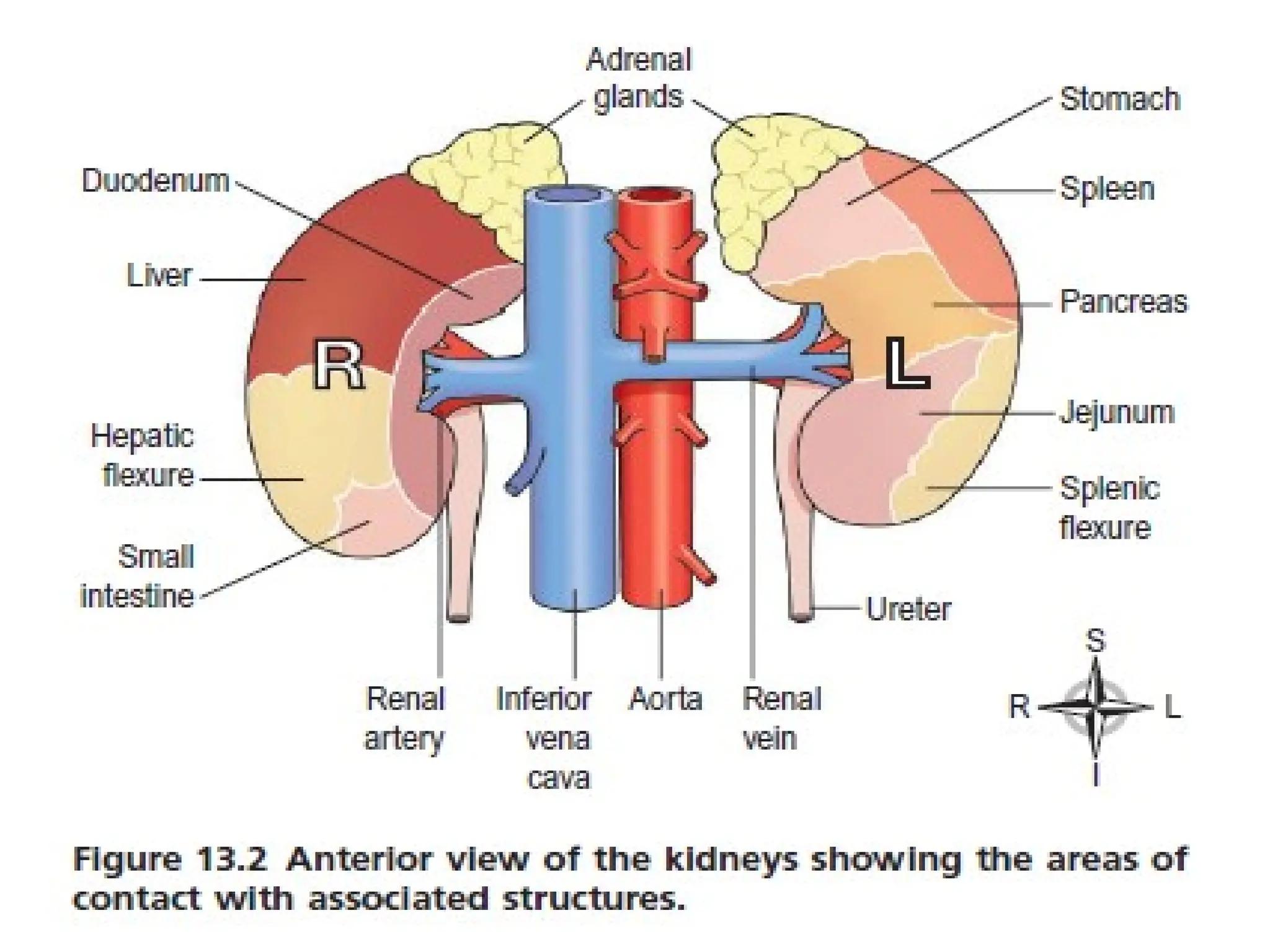
Organs associated with the kidneys (Figs 13.1
and 13.2)
• As the kidneys lie on either side of the vertebral
column, each is associated with different
structures.
• Right kidney
• Superiorly – the right adrenal gland
• Anteriorly – the right lobe of the liver, the
duodenum and the hepatic flexure of the colon
• Posteriorly – the diaphragm, and muscles of
the posterior abdominal wall.
Con’t
• Left kidney
• Superiorly – the left adrenal gland
• Anteriorly – the spleen, stomach,
pancreas, jejunum and splenic flexure of
the colon
• Posteriorly – the diaphragm and muscles
of the posterior abdominal wall.
Gross structure of the kidney
• There are three areas of tissue that can be
distinguished when a longitudinal section of the
kidney is viewed with the naked eye:
– An outer fibrous capsule, surrounding the kidney
– The cortex, a reddish-brown layer of tissue immediately
below the capsule and outside the renal pyramids
– The medulla, the innermost layer, consisting of pale
conical-shaped striations, the renal pyramids.
• The hilum is the concave medial border of the
kidney where the renal blood and lymph vessels,
the ureter and nerves enter.
• Urine formed within the kidney passes
through a renal papilla at the apex of a
pyramid into a minor calyx Several minor
calyces merge into a major calyx and two or
three major calyces combine forming the
renal pelvis, a funnel shaped structure that
narrows when it leaves the kidney as the
ureter.
• The walls of the calyces and renal pelvis
are lined with transitional epithelium and
contain smooth muscle. Peristalsis,
intrinsic contraction of smooth muscle,
propels urine through the calyces, renal
pelvis and ureters to the bladder.
Microscopic structure of the kidney
• The kidney contains about 1–2 million
functional units, the nephrons, and a much
smaller number of collecting ducts. The
collecting ducts transport urine through the
pyramids to the calyces.
• The collecting ducts are supported by
connective tissue, containing blood
vessels, nerves and lymph vessels.
The nephron
• The nephron is essentially a tubule closed
at one end that joins a collecting duct at
the other end. The closed or blind end is
indented to form the cup-shaped
glomerular capsule (Bowman’s capsule),
which almost completely encloses a
network of tiny arterial capillaries, the
glomerulus.
• These resemble a coiled tuft and are shown
in Figure 13.4 Continuing from the
glomerular capsule, the remainder of the
nephron is about 3 cm long and described
in three parts:
–The proximal convoluted tubule
–The medullary loop (loop of Henle)
–The distal convoluted tubule, leading into
a collecting duct.
• The collecting ducts unite, forming larger
ducts that empty into the minor calyces.
• The kidneys receive about 20% of the
cardiac output. After entering the kidney at
the hilum, the renal artery divides into
smaller arteries and arterioles. In the
cortex an arteriole, the afferent arteriole,
enters each glomerular capsule and then
subdivides into a cluster of tiny arterial
capillaries, forming the glomerulus.
• Between these capillary loops are
connective tissue phagocytic mesangial
cells, which are part of the monocyte–
macrophage defence system.
• The blood vessel leading away from the
glomerulus is the efferent arteriole.
• The afferent arteriole has a larger
diameter than the efferent arteriole, which
increases pressure inside the glomerulus
and drives filtration across the glomerular
capillary walls (Fig. 13.6). The efferent
arteriole divides into a second peritubular
(meaning ‘around tubules’) capillary
network, which wraps around the
remainder of the tubule, allowing
exchange between the fluid in the tubule
and the bloodstream.
Cont
• This maintains the local supply of oxygen
and nutrients and removes waste
products. Venous blood drained from this
capillary bed eventually leaves the kidney
in the renal vein, which empties into the
inferior vena cava.
• The walls of the glomerulus and the
glomerular capsule consist of a single
layer of flattened epithelial cells. The
glomerular walls are more permeable than
those of other capillaries.
Cont
• The remainder of the nephron and the
collecting duct are formed by a single layer
of simple squamous epithelium.
• Renal blood vessels are supplied by both
sympathetic and parasympathetic nerves.
The presence of both divisions of the
autonomic nervous system controls renal
blood vessel diameter and renal blood flow
independently of Autoregulation.
Functions of the kidney
• Formation of urine: The kidneys form
urine, which passes to the bladder for
storage prior to excretion.
• There are three processes involved in the
formation of urine:
– filtration
– selective reabsorption
– secretion.
Filtration
• This takes place through the
semipermeable walls of the glomerulus
(Fig. 13.9) and glomerular capsule. Water
and other small molecules readily pass
through, although some are reabsorbed
later. Blood cells, plasma proteins and
other large molecules are too large to filter
through and therefore remain in the
capillaries.
• Filtration takes place because there is a
difference between the blood pressure in
the glomerulus and the pressure of the
filtrate in the glomerular capsule.
• The volume of filtrate formed by both kidneys
each minute is called the glomerular filtration
rate (GFR). In a healthy adult the GFR is
about 125 mL/min, i.e. 180 litres of filtrate are
formed each day by the two kidneys.
• Nearly all of the filtrate is later reabsorbed
from the kidney tubules with less than 1%, i.e.
1–1.5 litres, excreted as urine. The
differences in volume and concentration are
due to selective reabsorption of some filtrate
constituents and tubular secretion of others.
Selective reabsorption
• Most reabsorption from the filtrate back
into the blood takes place in the proximal
convoluted tubule, whose walls are lined
with microvilli to increase surface area for
absorption. Many substances are
reabsorbed here, including some water,
electrolytes and organic nutrients such as
glucose. Some reabsorption is passive,
but some substances, e.g. glucose, are
actively transported.
• Only 60–70% of filtrate reaches the
medullary loop. Much of this, especially
water, sodium and chloride, is reabsorbed
in the loop, so that only 15–20% of the
original filtrate reaches the distal
convoluted tubule, and the composition of
the filtrate is now very different. The main
function of the collecting ducts is to
reabsorb as much water as the body
needs.
Hormones that influence selective
reabsorption.
• Parathyroid hormone. This is secreted
by the parathyroid glands and together
with calcitonin from the thyroid gland
regulates the reabsorption of calcium and
phosphate from the distal collecting
tubules, so that normal blood levels are
maintained. Parathyroid hormone
increases the blood calcium level and
calcitonin lowers it.
Cont
• Antidiuretic hormone, ADH. This is secreted by
the posterior pituitary. It increases the permeability
of the distal convoluted tubules and collecting
tubules, increasing water reabsorption. Secretion
of ADH is controlled by a negative feedback
system.
• Aldosterone. Secreted by the adrenal cortex, this
hormone increases the reabsorption of sodium
and water, and the excretion of potassium.
Secretion is regulated through a negative
feedback system.
Cont
• Atrial natriuretic peptide, ANP. This
hormone is secreted by the atria of the
heart in response to stretching of the Atrial
wall when blood volume is increased. It
decreases reabsorption of sodium and
water from the proximal convoluted
tubules and collecting ducts. Secretion of
ANP is also regulated by a negative
feedback system.
Tubular secretion.
• Filtration occurs as blood flows through
the glomerulus. Substances not required
and foreign materials, e.g. drugs including
penicillin and aspirin, may not be entirely
filtered out of the blood because of the
short time it remains in the glomerulus.
Such substances are cleared by secretion
from the peritubular capillaries into the
filtrate within the convoluted tubules.
Tubular secretion of hydrogen ions (H+) is
important in maintaining normal blood pH.
Composition of urine
• Urine is clear and amber in colour due to the
presence of urobilin, a bile pigment altered in
the intestine, reabsorbed then excreted by the
kidneys.
• The specific gravity is between 1020 and 1030,
and the pH is around 6 (normal range 4.5–8). A
healthy adult passes from 1000 to 1500 mL per
day. The volume of urine produced and the
specific gravity vary according to fluid intake
and the amount of solute excreted.
The constituents of urine are:
5.The urinary system.ppppppppppppppppptx

5.The urinary system.ppppppppppppppppptx

  • 1.
  • 2.
    Introduction • The urinarysystem is the main excretory system and consists of the following structures: – 2 kidneys, which secrete urine – 2 ureters that convey the urine from the kidneys to the urinary bladder – the urinary bladder, which collects and stores urine – the urethra through which urine leaves the body. • The urinary system plays a vital part in maintaining homeostasis of water and electrolytes within the body. The kidneys produce urine that contains metabolic waste products, including the nitrogenous compounds urea and uric acid, excess ions and some drugs
  • 4.
    Cont • . Themain functions of the kidneys are: – Formation of urine, maintaining water, electrolyte and acid–base balance – Excretion of waste products – Production and secretion of erythropoietin, the hormone that stimulates formation of red blood cells. – Production and secretion of renin, an important enzyme in the control of blood pressure (p. 225). • Urine is stored in the bladder and excreted by the process of micturition.
  • 5.
    Kidneys • The kidneyslie on the posterior abdominal wall, one on each side of the vertebral column, behind the peritoneum and below the diaphragm. They extend from the level of the 12th thoracic vertebra to the 3rd lumbar vertebra, receiving some protection from the lower rib cage. The right kidney is usually slightly lower than the left, probably because of the considerable space occupied by the liver.
  • 6.
    Cont • Kidneys arebean-shaped organs, about 11 cm long, 6 cm wide, 3 cm thick and weigh 150 g. They are embedded in, and held in position by, a mass of fat. A sheath of fibrous connective tissue, the renal fascia, encloses the kidney and the renal fat.
  • 7.
    Organs associated withthe kidneys (Figs 13.1 and 13.2) • As the kidneys lie on either side of the vertebral column, each is associated with different structures. • Right kidney • Superiorly – the right adrenal gland • Anteriorly – the right lobe of the liver, the duodenum and the hepatic flexure of the colon • Posteriorly – the diaphragm, and muscles of the posterior abdominal wall.
  • 8.
    Con’t • Left kidney •Superiorly – the left adrenal gland • Anteriorly – the spleen, stomach, pancreas, jejunum and splenic flexure of the colon • Posteriorly – the diaphragm and muscles of the posterior abdominal wall.
  • 10.
    Gross structure ofthe kidney • There are three areas of tissue that can be distinguished when a longitudinal section of the kidney is viewed with the naked eye: – An outer fibrous capsule, surrounding the kidney – The cortex, a reddish-brown layer of tissue immediately below the capsule and outside the renal pyramids – The medulla, the innermost layer, consisting of pale conical-shaped striations, the renal pyramids. • The hilum is the concave medial border of the kidney where the renal blood and lymph vessels, the ureter and nerves enter.
  • 11.
    • Urine formedwithin the kidney passes through a renal papilla at the apex of a pyramid into a minor calyx Several minor calyces merge into a major calyx and two or three major calyces combine forming the renal pelvis, a funnel shaped structure that narrows when it leaves the kidney as the ureter.
  • 12.
    • The wallsof the calyces and renal pelvis are lined with transitional epithelium and contain smooth muscle. Peristalsis, intrinsic contraction of smooth muscle, propels urine through the calyces, renal pelvis and ureters to the bladder.
  • 14.
    Microscopic structure ofthe kidney • The kidney contains about 1–2 million functional units, the nephrons, and a much smaller number of collecting ducts. The collecting ducts transport urine through the pyramids to the calyces. • The collecting ducts are supported by connective tissue, containing blood vessels, nerves and lymph vessels.
  • 15.
    The nephron • Thenephron is essentially a tubule closed at one end that joins a collecting duct at the other end. The closed or blind end is indented to form the cup-shaped glomerular capsule (Bowman’s capsule), which almost completely encloses a network of tiny arterial capillaries, the glomerulus.
  • 16.
    • These resemblea coiled tuft and are shown in Figure 13.4 Continuing from the glomerular capsule, the remainder of the nephron is about 3 cm long and described in three parts: –The proximal convoluted tubule –The medullary loop (loop of Henle) –The distal convoluted tubule, leading into a collecting duct. • The collecting ducts unite, forming larger ducts that empty into the minor calyces.
  • 18.
    • The kidneysreceive about 20% of the cardiac output. After entering the kidney at the hilum, the renal artery divides into smaller arteries and arterioles. In the cortex an arteriole, the afferent arteriole, enters each glomerular capsule and then subdivides into a cluster of tiny arterial capillaries, forming the glomerulus.
  • 19.
    • Between thesecapillary loops are connective tissue phagocytic mesangial cells, which are part of the monocyte– macrophage defence system. • The blood vessel leading away from the glomerulus is the efferent arteriole.
  • 20.
    • The afferentarteriole has a larger diameter than the efferent arteriole, which increases pressure inside the glomerulus and drives filtration across the glomerular capillary walls (Fig. 13.6). The efferent arteriole divides into a second peritubular (meaning ‘around tubules’) capillary network, which wraps around the remainder of the tubule, allowing exchange between the fluid in the tubule and the bloodstream.
  • 21.
    Cont • This maintainsthe local supply of oxygen and nutrients and removes waste products. Venous blood drained from this capillary bed eventually leaves the kidney in the renal vein, which empties into the inferior vena cava. • The walls of the glomerulus and the glomerular capsule consist of a single layer of flattened epithelial cells. The glomerular walls are more permeable than those of other capillaries.
  • 22.
    Cont • The remainderof the nephron and the collecting duct are formed by a single layer of simple squamous epithelium. • Renal blood vessels are supplied by both sympathetic and parasympathetic nerves. The presence of both divisions of the autonomic nervous system controls renal blood vessel diameter and renal blood flow independently of Autoregulation.
  • 23.
    Functions of thekidney • Formation of urine: The kidneys form urine, which passes to the bladder for storage prior to excretion. • There are three processes involved in the formation of urine: – filtration – selective reabsorption – secretion.
  • 24.
    Filtration • This takesplace through the semipermeable walls of the glomerulus (Fig. 13.9) and glomerular capsule. Water and other small molecules readily pass through, although some are reabsorbed later. Blood cells, plasma proteins and other large molecules are too large to filter through and therefore remain in the capillaries.
  • 25.
    • Filtration takesplace because there is a difference between the blood pressure in the glomerulus and the pressure of the filtrate in the glomerular capsule.
  • 26.
    • The volumeof filtrate formed by both kidneys each minute is called the glomerular filtration rate (GFR). In a healthy adult the GFR is about 125 mL/min, i.e. 180 litres of filtrate are formed each day by the two kidneys. • Nearly all of the filtrate is later reabsorbed from the kidney tubules with less than 1%, i.e. 1–1.5 litres, excreted as urine. The differences in volume and concentration are due to selective reabsorption of some filtrate constituents and tubular secretion of others.
  • 27.
    Selective reabsorption • Mostreabsorption from the filtrate back into the blood takes place in the proximal convoluted tubule, whose walls are lined with microvilli to increase surface area for absorption. Many substances are reabsorbed here, including some water, electrolytes and organic nutrients such as glucose. Some reabsorption is passive, but some substances, e.g. glucose, are actively transported.
  • 28.
    • Only 60–70%of filtrate reaches the medullary loop. Much of this, especially water, sodium and chloride, is reabsorbed in the loop, so that only 15–20% of the original filtrate reaches the distal convoluted tubule, and the composition of the filtrate is now very different. The main function of the collecting ducts is to reabsorb as much water as the body needs.
  • 29.
    Hormones that influenceselective reabsorption. • Parathyroid hormone. This is secreted by the parathyroid glands and together with calcitonin from the thyroid gland regulates the reabsorption of calcium and phosphate from the distal collecting tubules, so that normal blood levels are maintained. Parathyroid hormone increases the blood calcium level and calcitonin lowers it.
  • 30.
    Cont • Antidiuretic hormone,ADH. This is secreted by the posterior pituitary. It increases the permeability of the distal convoluted tubules and collecting tubules, increasing water reabsorption. Secretion of ADH is controlled by a negative feedback system. • Aldosterone. Secreted by the adrenal cortex, this hormone increases the reabsorption of sodium and water, and the excretion of potassium. Secretion is regulated through a negative feedback system.
  • 31.
    Cont • Atrial natriureticpeptide, ANP. This hormone is secreted by the atria of the heart in response to stretching of the Atrial wall when blood volume is increased. It decreases reabsorption of sodium and water from the proximal convoluted tubules and collecting ducts. Secretion of ANP is also regulated by a negative feedback system.
  • 32.
    Tubular secretion. • Filtrationoccurs as blood flows through the glomerulus. Substances not required and foreign materials, e.g. drugs including penicillin and aspirin, may not be entirely filtered out of the blood because of the short time it remains in the glomerulus. Such substances are cleared by secretion from the peritubular capillaries into the filtrate within the convoluted tubules. Tubular secretion of hydrogen ions (H+) is important in maintaining normal blood pH.
  • 33.
    Composition of urine •Urine is clear and amber in colour due to the presence of urobilin, a bile pigment altered in the intestine, reabsorbed then excreted by the kidneys. • The specific gravity is between 1020 and 1030, and the pH is around 6 (normal range 4.5–8). A healthy adult passes from 1000 to 1500 mL per day. The volume of urine produced and the specific gravity vary according to fluid intake and the amount of solute excreted.
  • 34.