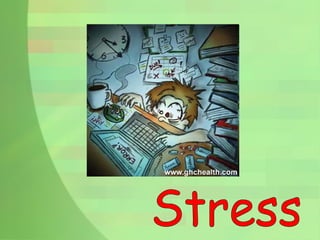







You know you're stressed when: The sun is too loud. Trees begin to chase you.  You can see individual air molecules vibrating.  Things become "very clear." Everything is "very clear, indeed."  You begin to talk to yourself, then disagree about the subject, get into a nasty tiff over it, lose and refuse to speak to yourself for the next day. You keep yelling "Stop touching me!!!" even though you are the only one in the room. Antacid tablets become your sole source of nutrition. You have an irresistible urge to bite the noses of the people you are talking to. Losing your mind was okay, but when the voices in your head quieted, it was like losing your best friend. You wonder if brewing is really a necessary step for the consumption of coffee. Suddenly you can hear mimes.
You ask the drive-thru attendant if you can get your order to go. You can achieve a "runner's high" by just sitting up. You can see individual air molecules vibrating. You listen to your relaxation tapes on high speed. You call your voice mail from your car using your cell phone while driving to work to remind yourself of tasks to do during the day. Your e-mail notification tune is Taps. You call Time & Weather because that lady "really understands you." You take the "Don't Walk" sign personally. Your pager is set to stun. And from Beth ... Your Depends are only good for 15 minutes. Working a K-mart sale day sounds like a vacation in Tahiti. You break into the Ex-Lax in desperation for  anything  chocolate. A pre-dawn toaster fire, your evil stepchild's escaped pet tarantula alert and the arrival of the furniture-repo team are mere asides to the otherwise tooth-jarring routine.
And from Beth ... Your Depends are only good for 15 minutes. Working a K-mart sale day sounds like a vacation in Tahiti. You break into the Ex-Lax in desperation for  anything  chocolate. A pre-dawn toaster fire, your evil stepchild's escaped pet tarantula alert and the arrival of the furniture-repo team are mere asides to the otherwise tooth-jarring routine.
Homeostasis, Stress, and Adaptation
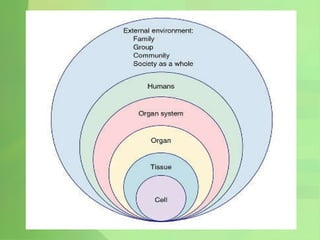
Homeostasis, Stress, and Adaptation The goal of the interaction of the body’s subsystems is to produce a dynamic balance or  steady state Stress is a state produced by change in the environment Adaptation is the adjustment to change Stressors are threats to the steady state
 
The manner in which you choose to interpret,  react to and handle a perceived stress can  very often be far more damaging to you  than the actual stress could ever be on its own. Reaction to Stress Men are disturbed not by the things that happen, but by their opinion of the things that happen.  Greek Philosopher – Epictetus
Types of Stressors Physical Cold  Heat Chemical agents
Physiologic Pain Fatigue
Psychosocial Fear of failing an examination losing a job
Classification of Stressors Day-to-day frustrations or hassles Major complex occurrences involving large groups, even entire nations; Stressors that occur less frequently and involve fewer people
Classification according  to Duration Acute, time limited stressor Stressor sequence Chronic intermittent stressor Chronic enduring stressor
Stress as a stimulus for disease Adolph Meyer observed linked illness to critical life events Holmes and Rahe developed life events scales that assign numerical values, called life-changing units, to typical life events.
Psychological responses to stress Appraisal of the Stressful event Coping with the stressful event
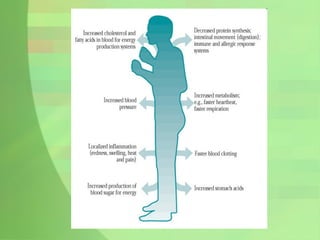
I ndividuals respond differently to stress. Personality, general health and the support of friends and colleagues all affect this response. A group of people exposed to the same type of stressors may experience different health effects. Nonetheless, the body’s physical response to stress is generally the same for everyone. It is commonly known as the  generalized stress response . Excessive stress has been associated with heart disease, high blood pressure, digestive ailments, skin rashes, insomnia, nervous or emotional disorders, substance abuse and interpersonal and family dysfunction. As long as stressful experiences are brief and infrequent, the body quickly returns to normal. In nature, this phenomenon is known as the  fight or flight  reaction. But a person who is in a continuous state of stress throughout every working day may experience a wide variety of potential health effects.
 
Physiologic Response to Stress General Adaptation Syndrome Local Adaptation Syndrome Sympathetic-Adrenal-Medullary Response Hypothalamic-Pituitary Response Immunologic Response
 
Maladaptive Responses to Stress Alcohol and/or drug use Denial Avoidance Illness
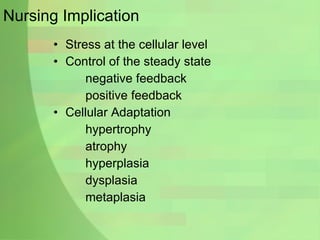
Nursing Implication Stress at the cellular level Control of the steady state negative feedback positive feedback Cellular Adaptation hypertrophy atrophy hyperplasia dysplasia metaplasia
 
Cellular Injury Hypoxia Nutritional Imbalance Physical Agents Chemical Agents Infectious agents Disordered Immune Response Genetic Disorders
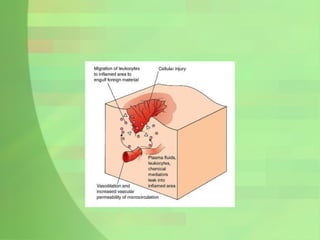
Cellular Response to Injury:  Inflammation  Inflammation :  defensive reaction intended to neutralize, control, or eliminate the offending agent and to prepare the site for repair.
Chemical Mediators Histamine  present in many tissues of the body but is concentrated in the mast cells.  released when injury occurs and is responsible for the early changes in vasodilation and vascular permeability. Kinins increase vasodilation and vascular permeability, attract neutrophils to the area. Prostaglandins another group of chemical substances, are also suspected of causing increased permeability.
Systemic Response to Inflammation Fever Leukocytosis General non-specific symptoms develop, including malaise, loss of appetite, aching and weakness
TYPES OF INFLAMMATION Acute : characterized by the local vascular and exudative changes described earlier and usually lasts less than 2 weeks. Chronic : develops if injurious agent persists and the acute response is perpetuated.
Stress
MANAGING STRESS Our  goal  is  not  to  eliminate   stress but to learn how to  manage  and  use  it  to  help  us.
Managing Stress Become aware of your stressors and your emotional and physical reactions. Recognize what you can change.  Reduce the intensity of your emotional reactions to stress.  Learn to moderate your physical reactions to stress.  Build your physical reserves. Maintain your emotional reserves.  Learn to Respond, Not React
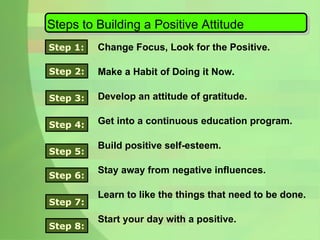
Steps to Building a Positive Attitude Change Focus, Look for the Positive. Make a Habit of Doing it Now. Develop an attitude of gratitude. Get into a continuous education program. Build positive self-esteem. Stay away from negative influences. Learn to like the things that need to be done. Start your day with a positive. Step 1: Step 2: Step 3: Step 4: Step 5: Step 6: Step 7: Step 8:
Stress-Aggravating Foods Sugar Salt Fats  Additives Caffeine Alcohol
Stress-Helpful Foods Vitamin A Brewers’ Yeast Vitamin C Iron Zinc Iodine Calcium Ginseng Evening Primrose Oil Selenium Molasses Chlorella
Eat fresh foods Eat regular meals Eat slowly Resist the temptation to overeat Eat a variety of foods The acid/alkaline balance Fluids Snacks Fiber Stress-Friendly Diet
Tips on Handling Stress Work smarter, not harder.  Carry reading material with you.  Accept that time will be spent on activities outside your control. Don’t dwell upon things not done. Record daily activities, achievements, goals, sources of delay, and time waste to realize hidden opportunities.
Tips on Handling Stress Always maintain a short-task list. Continually ask yourself, “What is the best use of my time right now?” Be physically active to relieve tension. Make quick decisions. Carefully mix work & breaks. Have a positive attitude. Relax.
Pain Management
The Fifth Vital Sign Acute pain Chronic (malignant)pain Cancer-related pain Pain classified by location Pain classified by etiology
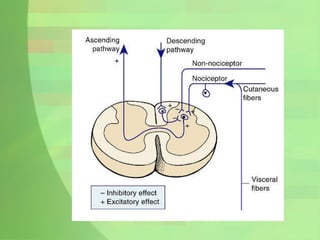
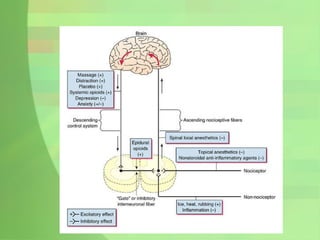
Pathophysiology of Pain Pain transmission Factors influencing the pain response Placebo effect
 
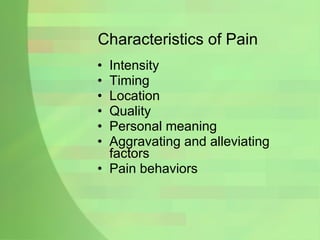
Characteristics of Pain Intensity Timing Location Quality Personal meaning Aggravating and alleviating factors Pain behaviors
 
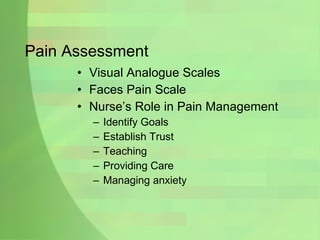
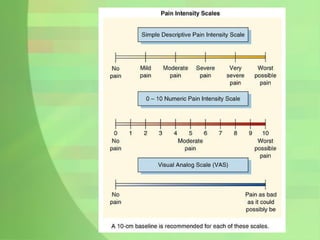
Pain Assessment Visual Analogue Scales Faces Pain Scale Nurse’s Role in Pain Management Identify Goals Establish Trust Teaching Providing Care Managing anxiety
 
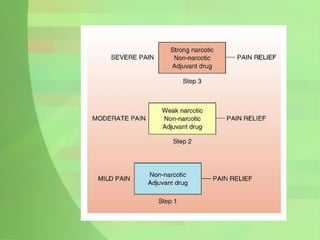
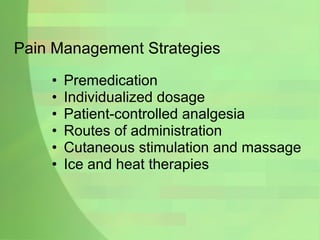
Pain Management Strategies Premedication Individualized dosage Patient-controlled analgesia Routes of administration Cutaneous stimulation and massage Ice and heat therapies
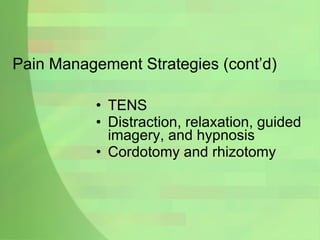
Pain Management Strategies (cont’d) TENS Distraction, relaxation, guided imagery, and hypnosis Cordotomy and rhizotomy


Presentation1

  • 1.
    You know you'restressed when: The sun is too loud. Trees begin to chase you. You can see individual air molecules vibrating. Things become "very clear." Everything is "very clear, indeed." You begin to talk to yourself, then disagree about the subject, get into a nasty tiff over it, lose and refuse to speak to yourself for the next day. You keep yelling "Stop touching me!!!" even though you are the only one in the room. Antacid tablets become your sole source of nutrition. You have an irresistible urge to bite the noses of the people you are talking to. Losing your mind was okay, but when the voices in your head quieted, it was like losing your best friend. You wonder if brewing is really a necessary step for the consumption of coffee. Suddenly you can hear mimes.
  • 2.
    You ask thedrive-thru attendant if you can get your order to go. You can achieve a "runner's high" by just sitting up. You can see individual air molecules vibrating. You listen to your relaxation tapes on high speed. You call your voice mail from your car using your cell phone while driving to work to remind yourself of tasks to do during the day. Your e-mail notification tune is Taps. You call Time & Weather because that lady "really understands you." You take the "Don't Walk" sign personally. Your pager is set to stun. And from Beth ... Your Depends are only good for 15 minutes. Working a K-mart sale day sounds like a vacation in Tahiti. You break into the Ex-Lax in desperation for anything chocolate. A pre-dawn toaster fire, your evil stepchild's escaped pet tarantula alert and the arrival of the furniture-repo team are mere asides to the otherwise tooth-jarring routine.
  • 3.
    And from Beth... Your Depends are only good for 15 minutes. Working a K-mart sale day sounds like a vacation in Tahiti. You break into the Ex-Lax in desperation for anything chocolate. A pre-dawn toaster fire, your evil stepchild's escaped pet tarantula alert and the arrival of the furniture-repo team are mere asides to the otherwise tooth-jarring routine.
  • 4.
  • 5.
    Homeostasis, Stress, andAdaptation The goal of the interaction of the body’s subsystems is to produce a dynamic balance or steady state Stress is a state produced by change in the environment Adaptation is the adjustment to change Stressors are threats to the steady state
  • 6.
  • 7.
    The manner inwhich you choose to interpret, react to and handle a perceived stress can very often be far more damaging to you than the actual stress could ever be on its own. Reaction to Stress Men are disturbed not by the things that happen, but by their opinion of the things that happen. Greek Philosopher – Epictetus
  • 8.
    Types of StressorsPhysical Cold Heat Chemical agents
  • 9.
  • 10.
    Psychosocial Fear offailing an examination losing a job
  • 11.
    Classification of StressorsDay-to-day frustrations or hassles Major complex occurrences involving large groups, even entire nations; Stressors that occur less frequently and involve fewer people
  • 12.
    Classification according to Duration Acute, time limited stressor Stressor sequence Chronic intermittent stressor Chronic enduring stressor
  • 13.
    Stress as astimulus for disease Adolph Meyer observed linked illness to critical life events Holmes and Rahe developed life events scales that assign numerical values, called life-changing units, to typical life events.
  • 14.
    Psychological responses tostress Appraisal of the Stressful event Coping with the stressful event
  • 15.
    I ndividuals responddifferently to stress. Personality, general health and the support of friends and colleagues all affect this response. A group of people exposed to the same type of stressors may experience different health effects. Nonetheless, the body’s physical response to stress is generally the same for everyone. It is commonly known as the generalized stress response . Excessive stress has been associated with heart disease, high blood pressure, digestive ailments, skin rashes, insomnia, nervous or emotional disorders, substance abuse and interpersonal and family dysfunction. As long as stressful experiences are brief and infrequent, the body quickly returns to normal. In nature, this phenomenon is known as the fight or flight reaction. But a person who is in a continuous state of stress throughout every working day may experience a wide variety of potential health effects.
  • 16.
  • 17.
    Physiologic Response toStress General Adaptation Syndrome Local Adaptation Syndrome Sympathetic-Adrenal-Medullary Response Hypothalamic-Pituitary Response Immunologic Response
  • 18.
  • 19.
    Maladaptive Responses toStress Alcohol and/or drug use Denial Avoidance Illness
  • 20.
    Nursing Implication Stressat the cellular level Control of the steady state negative feedback positive feedback Cellular Adaptation hypertrophy atrophy hyperplasia dysplasia metaplasia
  • 21.
  • 22.
    Cellular Injury HypoxiaNutritional Imbalance Physical Agents Chemical Agents Infectious agents Disordered Immune Response Genetic Disorders
  • 23.
    Cellular Response toInjury: Inflammation Inflammation : defensive reaction intended to neutralize, control, or eliminate the offending agent and to prepare the site for repair.
  • 24.
    Chemical Mediators Histamine present in many tissues of the body but is concentrated in the mast cells. released when injury occurs and is responsible for the early changes in vasodilation and vascular permeability. Kinins increase vasodilation and vascular permeability, attract neutrophils to the area. Prostaglandins another group of chemical substances, are also suspected of causing increased permeability.
  • 25.
    Systemic Response toInflammation Fever Leukocytosis General non-specific symptoms develop, including malaise, loss of appetite, aching and weakness
  • 26.
    TYPES OF INFLAMMATIONAcute : characterized by the local vascular and exudative changes described earlier and usually lasts less than 2 weeks. Chronic : develops if injurious agent persists and the acute response is perpetuated.
  • 27.
  • 28.
    MANAGING STRESS Our goal is not to eliminate stress but to learn how to manage and use it to help us.
  • 29.
    Managing Stress Becomeaware of your stressors and your emotional and physical reactions. Recognize what you can change. Reduce the intensity of your emotional reactions to stress. Learn to moderate your physical reactions to stress. Build your physical reserves. Maintain your emotional reserves. Learn to Respond, Not React
  • 30.
    Steps to Buildinga Positive Attitude Change Focus, Look for the Positive. Make a Habit of Doing it Now. Develop an attitude of gratitude. Get into a continuous education program. Build positive self-esteem. Stay away from negative influences. Learn to like the things that need to be done. Start your day with a positive. Step 1: Step 2: Step 3: Step 4: Step 5: Step 6: Step 7: Step 8:
  • 31.
    Stress-Aggravating Foods SugarSalt Fats Additives Caffeine Alcohol
  • 32.
    Stress-Aggravating Foods SugarSalt Fats Additives Caffeine Alcohol
  • 33.
    Stress-Helpful Foods VitaminA Brewers’ Yeast Vitamin C Iron Zinc Iodine Calcium Ginseng Evening Primrose Oil Selenium Molasses Chlorella
  • 34.
    Eat fresh foodsEat regular meals Eat slowly Resist the temptation to overeat Eat a variety of foods The acid/alkaline balance Fluids Snacks Fiber Stress-Friendly Diet
  • 35.
    Tips on HandlingStress Work smarter, not harder. Carry reading material with you. Accept that time will be spent on activities outside your control. Don’t dwell upon things not done. Record daily activities, achievements, goals, sources of delay, and time waste to realize hidden opportunities.
  • 36.
    Tips on HandlingStress Always maintain a short-task list. Continually ask yourself, “What is the best use of my time right now?” Be physically active to relieve tension. Make quick decisions. Carefully mix work & breaks. Have a positive attitude. Relax.
  • 37.
  • 38.
    The Fifth VitalSign Acute pain Chronic (malignant)pain Cancer-related pain Pain classified by location Pain classified by etiology
  • 39.
    Pathophysiology of PainPain transmission Factors influencing the pain response Placebo effect
  • 40.
  • 41.
    Characteristics of PainIntensity Timing Location Quality Personal meaning Aggravating and alleviating factors Pain behaviors
  • 42.
  • 43.
    Pain Assessment VisualAnalogue Scales Faces Pain Scale Nurse’s Role in Pain Management Identify Goals Establish Trust Teaching Providing Care Managing anxiety
  • 44.
  • 45.
    Pain Management StrategiesPremedication Individualized dosage Patient-controlled analgesia Routes of administration Cutaneous stimulation and massage Ice and heat therapies
  • 46.
    Pain Management Strategies(cont’d) TENS Distraction, relaxation, guided imagery, and hypnosis Cordotomy and rhizotomy
  • 47.
  • 48.
  • 49.
  • 50.
  • 51.
  • 52.
  • 53.
  • 54.