









Safe Drug Administration Nelia B. Perez RN, MSN Northeastern College – Nursing Department Santiago City, Philippines 3311
RIGHTS IN DRUG ADMINISTRATION Right Patient Right Route Right Drug Right Frequency Right Dose
Right Approach Right Assessment Right to refuse Right Education Right Evaluation Right Documentation
Nursing  Management Nursing : An Art and a Science The Nursing Process 1.  Assessment 2.  Nursing Diagnosis 3.  Planning 4.  Interventions 5.  Evaluation
ASSESSMENT History -  chronic conditions -  Drug Use -  Allergies -  level of education -  level of understanding of Disease and therapy
Social Supports Financial Supports Pattern of Health Care Physical Assessment 1.  weight 2.  age 3.  Physical Parameters r/t disease or drug effects
NURSING DIAGNOSIS IT MAY BE: 1.  two part 2.  three part Should be based on NANDA
PLANNING Should be SMART Can be short term or long term
INTERVENTIONS 7 points to Proper Drug Administration Drug Storage Route Dosage Preparation Timing recording
Comfort measures Placebo effect Managing adverse effects Lifestyle adjustment Patient and Family Education
KEY ELEMENTS TO PATIENT EDUCATION Name, Dose and action of Drug Timing of Administration Special Storage and preparation instructions Special comfort or safety measures Safety measures Specific points about drug toxicity Special warnings about drug discontinuation
EVALUATION The evaluation is an integral part in the nursing process. The effectivity of the drug therapy is determined through evaluation.
DOSAGE CALCULATIONS Measuring Systems -  Metric System -  Apothecary System -  Household system
Converting between Systems Ratio and proportion
Calculating Dosage Oral Drugs Parenteral Drugs Intravenous solutions Pediatric considerations
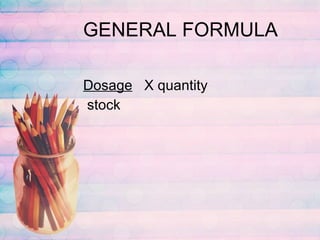
GENERAL FORMULA Dosage   X quantity stock
ORAL DRUGS Amt of drug available  =  amt of drug prescribed one tablet or capsule  no. of tabs or caps
PARENTERAL DRUGS Amt of drug available  =  amt of drug prescribed volume available  volume to administer
Intravenous Solution Drops/min =  mL of sol pres/hr x drops delivered / mL   60 minutes / 1 hour
1. Clark's Rule for Infants or Children: Clark’s rule is based upon the weight of the child. To determine the proper dosage for children, divide child’s weight in pounds by 150 to get the correct fraction of adult dose. Example: For a 50 pound child give 50/150 (or 1/3) of the adult dose. Therefore, if the adult dose is 30 drops taken 3 times per day, the child’s dose will be 10 drops taken 3 times per day (not 30 drops taken 1 time per day!)  (Weight in pounds x (Adult dose)     150 (That's: Child's weight in pounds times adult dose divided by 150)
2. Fried's Rule for Infants and Children up to 1 to 2 Years: (Age in Months) x (Adult Dose)   150 (That's: Child's age in months times adult dose divided by 150)
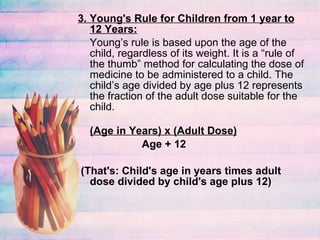
3. Young's Rule for Children from 1 year to 12 Years: Young’s rule is based upon the age of the child, regardless of its weight. It is a “rule of the thumb” method for calculating the dose of medicine to be administered to a child. The child’s age divided by age plus 12 represents the fraction of the adult dose suitable for the child.   (Age in Years) x (Adult Dose)   Age + 12 (That's: Child's age in years times adult dose divided by child's age plus 12)
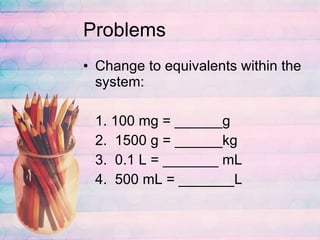
Problems Change to equivalents within the system: 1. 100 mg = ______g 2.  1500 g = ______kg 3.  0.1 L = _______ mL 4.  500 mL = _______L
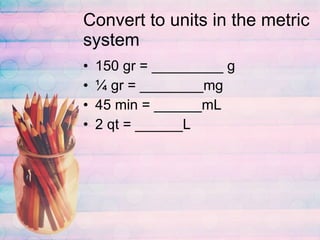
Convert to units in the metric system 150 gr = _________ g ¼ gr = ________mg 45 min = ______mL 2 qt = ______L
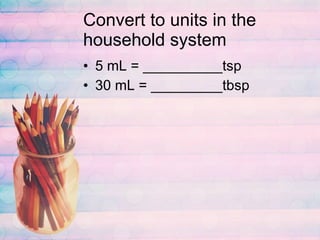
Convert to units in the household system 5 mL = __________tsp 30 mL = _________tbsp
Convert the weights in the following problems A patient weighs 170 lb.  What is the patient’s weight in kilograms? A patient weighs 3200 g.  What is the patient’s weight in pounds?
Robitussin cough syrup 225 mg PO is ordered.  The bottle reads:  600 mg in 1 ounce.  How much cough syrup should be given?
A postoperative order is written for ¼ gr codeine every 4 hours as needed for pain.  Each dose given will contain how many milligrams of codeine?
Thank You... have a nice day!

Week 2 Pharma

  • 1.
    Safe Drug AdministrationNelia B. Perez RN, MSN Northeastern College – Nursing Department Santiago City, Philippines 3311
  • 2.
    RIGHTS IN DRUGADMINISTRATION Right Patient Right Route Right Drug Right Frequency Right Dose
  • 3.
    Right Approach RightAssessment Right to refuse Right Education Right Evaluation Right Documentation
  • 4.
    Nursing ManagementNursing : An Art and a Science The Nursing Process 1. Assessment 2. Nursing Diagnosis 3. Planning 4. Interventions 5. Evaluation
  • 5.
    ASSESSMENT History - chronic conditions - Drug Use - Allergies - level of education - level of understanding of Disease and therapy
  • 6.
    Social Supports FinancialSupports Pattern of Health Care Physical Assessment 1. weight 2. age 3. Physical Parameters r/t disease or drug effects
  • 7.
    NURSING DIAGNOSIS ITMAY BE: 1. two part 2. three part Should be based on NANDA
  • 8.
    PLANNING Should beSMART Can be short term or long term
  • 9.
    INTERVENTIONS 7 pointsto Proper Drug Administration Drug Storage Route Dosage Preparation Timing recording
  • 10.
    Comfort measures Placeboeffect Managing adverse effects Lifestyle adjustment Patient and Family Education
  • 11.
    KEY ELEMENTS TOPATIENT EDUCATION Name, Dose and action of Drug Timing of Administration Special Storage and preparation instructions Special comfort or safety measures Safety measures Specific points about drug toxicity Special warnings about drug discontinuation
  • 12.
    EVALUATION The evaluationis an integral part in the nursing process. The effectivity of the drug therapy is determined through evaluation.
  • 13.
    DOSAGE CALCULATIONS MeasuringSystems - Metric System - Apothecary System - Household system
  • 14.
    Converting between SystemsRatio and proportion
  • 15.
    Calculating Dosage OralDrugs Parenteral Drugs Intravenous solutions Pediatric considerations
  • 16.
    GENERAL FORMULA Dosage X quantity stock
  • 17.
    ORAL DRUGS Amtof drug available = amt of drug prescribed one tablet or capsule no. of tabs or caps
  • 18.
    PARENTERAL DRUGS Amtof drug available = amt of drug prescribed volume available volume to administer
  • 19.
    Intravenous Solution Drops/min= mL of sol pres/hr x drops delivered / mL 60 minutes / 1 hour
  • 20.
    1. Clark's Rulefor Infants or Children: Clark’s rule is based upon the weight of the child. To determine the proper dosage for children, divide child’s weight in pounds by 150 to get the correct fraction of adult dose. Example: For a 50 pound child give 50/150 (or 1/3) of the adult dose. Therefore, if the adult dose is 30 drops taken 3 times per day, the child’s dose will be 10 drops taken 3 times per day (not 30 drops taken 1 time per day!) (Weight in pounds x (Adult dose) 150 (That's: Child's weight in pounds times adult dose divided by 150)
  • 21.
    2. Fried's Rulefor Infants and Children up to 1 to 2 Years: (Age in Months) x (Adult Dose) 150 (That's: Child's age in months times adult dose divided by 150)
  • 22.
    3. Young's Rulefor Children from 1 year to 12 Years: Young’s rule is based upon the age of the child, regardless of its weight. It is a “rule of the thumb” method for calculating the dose of medicine to be administered to a child. The child’s age divided by age plus 12 represents the fraction of the adult dose suitable for the child. (Age in Years) x (Adult Dose) Age + 12 (That's: Child's age in years times adult dose divided by child's age plus 12)
  • 23.
    Problems Change toequivalents within the system: 1. 100 mg = ______g 2. 1500 g = ______kg 3. 0.1 L = _______ mL 4. 500 mL = _______L
  • 24.
    Convert to unitsin the metric system 150 gr = _________ g ¼ gr = ________mg 45 min = ______mL 2 qt = ______L
  • 25.
    Convert to unitsin the household system 5 mL = __________tsp 30 mL = _________tbsp
  • 26.
    Convert the weightsin the following problems A patient weighs 170 lb. What is the patient’s weight in kilograms? A patient weighs 3200 g. What is the patient’s weight in pounds?
  • 27.
    Robitussin cough syrup225 mg PO is ordered. The bottle reads: 600 mg in 1 ounce. How much cough syrup should be given?
  • 28.
    A postoperative orderis written for ¼ gr codeine every 4 hours as needed for pain. Each dose given will contain how many milligrams of codeine?
  • 29.
    Thank You... havea nice day!