HUMAN
SETTLEMENT
By: Amna Zafar & Humna
Azam
•A settlement is a place
where people live.
•They vary in terms of their
size, composition, location,
arrangement, organization,
function, and history.
Primitive non-organized human settlements
(started with the evolution of man.)
Primitive organized settlements ( the period of
villages - eopolis - which lasted about 10,000
years.)
Static urban settlements or cities (polis -
which lasted about 5,000-6,000 years.)
Dynamic urban settlements (dynapolis -
which lasted 200 - 400 years.)
The universal city (ecumenopolis - which is
now beginning.)
TIMELINE
•Site refers to the actual piece of ground
on which the settlement is built.
The site of a settlement is its exact
location.
SITES
The physical geography of an area was very important to
early people when they were deciding on the site for a new
settlement.
Site Factors:
•Water supply: a clean supply of water was needed for
drinking, cooking and cleaning.
Water could be taken from a river or a well.
•Relief- the area needed to be high enough to be safe from
flooding, but low enough to be sheltered from strong
winds.
•Defence - a hilltop, or the inside of a river meander, would
provide protection from attackers.
•Transport - a site at a crossroads, on a river or at the
coast gave easier access to other settlements.
•Soil - deep fertile soil made it easier to farm crops and rear
animals.
•Resources - a source of timber or rock was needed for
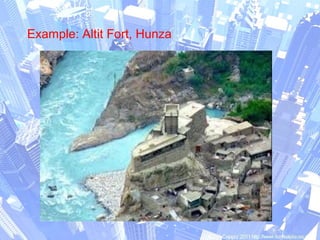
Example: Altit Fort, Hunza
Situation or Position refers to the location
of the village or town in relation to
surrounding areas.
•If a settlement had good access to
natural resources, and to other
settlements, it would grow in size.
Many settlements with a good site and
situation have grown into large cities.
SituationSituation
Settlement patternsSettlement patterns
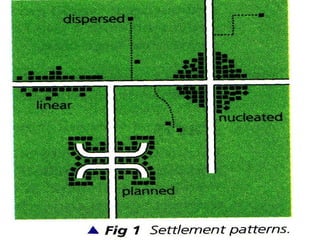
•When early settlements began to grow there were
no planning regulations.
•People built houses where they wanted to. Some
houses were built far apart from each other
(dispersed). Other houses were built close together,
making villages.
• Some settlements became long and narrow
(linear), others stayed clustered together (nucleated).
•Today, people must have permission from the local
authority to build houses. Settlements now grow in a
planned way.
Dispersed settlements
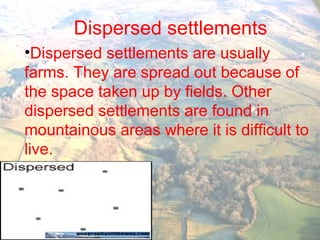
•Dispersed settlements are usually
farms. They are spread out because of
the space taken up by fields. Other
dispersed settlements are found in
mountainous areas where it is difficult to
live.
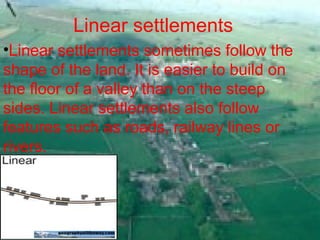
Linear settlements
•Linear settlements sometimes follow the
shape of the land. It is easier to build on
the floor of a valley than on the steep
sides. Linear settlements also follow
features such as roads, railway lines or
rivers.
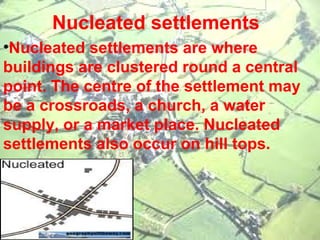
Nucleated settlements
•Nucleated settlements are where
buildings are clustered round a central
point. The centre of the settlement may
be a crossroads, a church, a water
supply, or a market place. Nucleated
settlements also occur on hill tops.
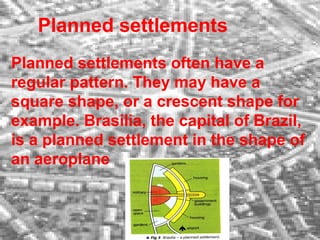
Planned settlements often have a
regular pattern. They may have a
square shape, or a crescent shape for
example. Brasilia, the capital of Brazil,
is a planned settlement in the shape of
an aeroplane
Planned settlements
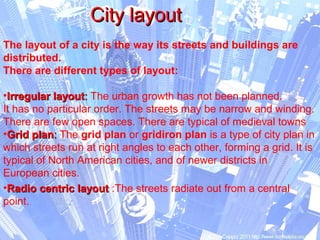
The layout of a city is the way its streets and buildings are
distributed.
There are different types of layout:
•Irregular layoutIrregular layout:: The urban growth has not been planned.
It has no particular order. The streets may be narrow and winding.
There are few open spaces. There are typical of medieval towns
•Grid planGrid plan:: The grid plan or gridiron plan is a type of city plan in
which streets run at right angles to each other, forming a grid. It is
typical of North American cities, and of newer districts in
European cities.
•Radio centric layoutRadio centric layout :The streets radiate out from a central
point.
City layoutCity layout
The functions of a settlement are
the things that happen there.
The function of most early settlements
was farming. As settlements grew, the
functions increased to include things
such as markets and inns. Today
settlements have many functions,
which continue to change over time.
Settlement functionsSettlement functions
ResidentialResidential
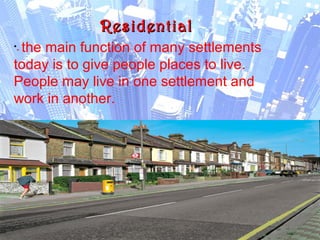
•- the main function of many settlements
today is to give people places to live.
People may live in one settlement and
work in another.
AdministrativeAdministrative
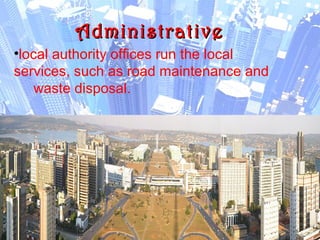
•local authority offices run the local
services, such as road maintenance and
waste disposal.
IndustrialIndustrial
Goods are manufactured in factories. Today
many factories are located in business parks
on the outskirts of settlements. They are near
to the places where products are to be
transported i.e markets.
CommercialCommercial
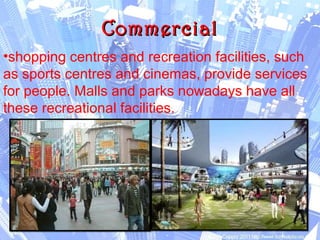
•shopping centres and recreation facilities, such
as sports centres and cinemas, provide services
for people. Malls and parks nowadays have all
these recreational facilities.
ServicesServices
•settlements contain public services, such
as schools, hospitals, old homes, orphan
ages and libraries.
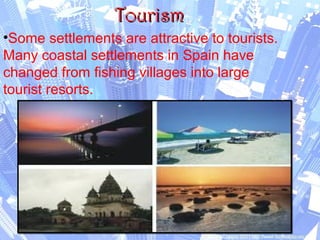
TourismTourism
•Some settlements are attractive to tourists.
Many coastal settlements in Spain have
changed from fishing villages into large
tourist resorts.
THANK YOU 

Human settlements 1

  • 1.
  • 2.
    •A settlement isa place where people live. •They vary in terms of their size, composition, location, arrangement, organization, function, and history.
  • 3.
    Primitive non-organized humansettlements (started with the evolution of man.) Primitive organized settlements ( the period of villages - eopolis - which lasted about 10,000 years.) Static urban settlements or cities (polis - which lasted about 5,000-6,000 years.) Dynamic urban settlements (dynapolis - which lasted 200 - 400 years.) The universal city (ecumenopolis - which is now beginning.) TIMELINE
  • 5.
    •Site refers tothe actual piece of ground on which the settlement is built. The site of a settlement is its exact location. SITES
  • 6.
    The physical geographyof an area was very important to early people when they were deciding on the site for a new settlement. Site Factors: •Water supply: a clean supply of water was needed for drinking, cooking and cleaning. Water could be taken from a river or a well. •Relief- the area needed to be high enough to be safe from flooding, but low enough to be sheltered from strong winds. •Defence - a hilltop, or the inside of a river meander, would provide protection from attackers. •Transport - a site at a crossroads, on a river or at the coast gave easier access to other settlements. •Soil - deep fertile soil made it easier to farm crops and rear animals. •Resources - a source of timber or rock was needed for
  • 7.
  • 9.
    Situation or Positionrefers to the location of the village or town in relation to surrounding areas. •If a settlement had good access to natural resources, and to other settlements, it would grow in size. Many settlements with a good site and situation have grown into large cities. SituationSituation
  • 10.
    Settlement patternsSettlement patterns •Whenearly settlements began to grow there were no planning regulations. •People built houses where they wanted to. Some houses were built far apart from each other (dispersed). Other houses were built close together, making villages. • Some settlements became long and narrow (linear), others stayed clustered together (nucleated). •Today, people must have permission from the local authority to build houses. Settlements now grow in a planned way.
  • 12.
    Dispersed settlements •Dispersed settlementsare usually farms. They are spread out because of the space taken up by fields. Other dispersed settlements are found in mountainous areas where it is difficult to live.
  • 13.
    Linear settlements •Linear settlementssometimes follow the shape of the land. It is easier to build on the floor of a valley than on the steep sides. Linear settlements also follow features such as roads, railway lines or rivers.
  • 14.
    Nucleated settlements •Nucleated settlementsare where buildings are clustered round a central point. The centre of the settlement may be a crossroads, a church, a water supply, or a market place. Nucleated settlements also occur on hill tops.
  • 15.
    Planned settlements oftenhave a regular pattern. They may have a square shape, or a crescent shape for example. Brasilia, the capital of Brazil, is a planned settlement in the shape of an aeroplane Planned settlements
  • 16.
    The layout ofa city is the way its streets and buildings are distributed. There are different types of layout: •Irregular layoutIrregular layout:: The urban growth has not been planned. It has no particular order. The streets may be narrow and winding. There are few open spaces. There are typical of medieval towns •Grid planGrid plan:: The grid plan or gridiron plan is a type of city plan in which streets run at right angles to each other, forming a grid. It is typical of North American cities, and of newer districts in European cities. •Radio centric layoutRadio centric layout :The streets radiate out from a central point. City layoutCity layout
  • 17.
    The functions ofa settlement are the things that happen there. The function of most early settlements was farming. As settlements grew, the functions increased to include things such as markets and inns. Today settlements have many functions, which continue to change over time. Settlement functionsSettlement functions
  • 18.
    ResidentialResidential •- the mainfunction of many settlements today is to give people places to live. People may live in one settlement and work in another.
  • 19.
    AdministrativeAdministrative •local authority officesrun the local services, such as road maintenance and waste disposal.
  • 20.
    IndustrialIndustrial Goods are manufacturedin factories. Today many factories are located in business parks on the outskirts of settlements. They are near to the places where products are to be transported i.e markets.
  • 21.
    CommercialCommercial •shopping centres andrecreation facilities, such as sports centres and cinemas, provide services for people. Malls and parks nowadays have all these recreational facilities.
  • 22.
    ServicesServices •settlements contain publicservices, such as schools, hospitals, old homes, orphan ages and libraries.
  • 23.
    TourismTourism •Some settlements areattractive to tourists. Many coastal settlements in Spain have changed from fishing villages into large tourist resorts.
  • 24.