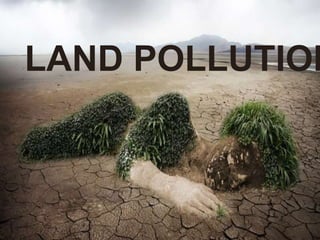
LAND POLLUTION
POLLUTION
 The word pollution is derived from the Latin
word Pollutionem (meaning to make dirty or
defile).
 Pollution is the addition of constituents to air,
water, soil or land which alters the natural
quality of the environment adversely.
 In 2015, pollution killed 9 million people.
Pollutant
The materials which cause pollution of the
environment are known as pollutants.
This maybe defined as:-
It is a harmful solid, liquid or gaseous substance
present in such concentration in the
environment which tends to be injurious for the
whole living community.
A pollutant maybe:-
 A chemical substance e.g., an organo-
phosphorous compound.
 A physical property, e.g., heat, noise etc.
 A geochemical substance, e.g., dust, sediment
etc.
 A biological organism and product.
TYPES OF POLLUTION
 Air Pollution
 Water Pollution
 Noise Pollution
 Land Pollution
LAND POLLUTION
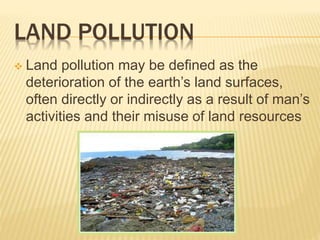
 Land pollution may be defined as the
deterioration of the earth’s land surfaces,
often directly or indirectly as a result of man’s
activities and their misuse of land resources
CAUSES OF LAND
POLLUTION
DEFORESTATION
 Humans depend upon trees for many things.
 We have cut down millions of acres of tree for wood,
construction, farming and mining purposes, and
never planted new trees back.
 Without protection of trees, the land becomes barren
over time and starts to explode. Land conversion,
meaning the alteration or modification of the original
properties of the land to make it use-worthy for a
specific purpose is another major cause.
 There is constant waste of land.
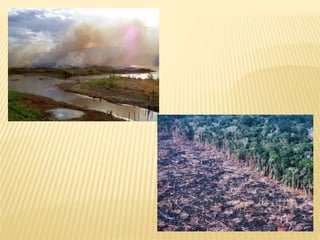
 In the Amazon rain forest in Brazil, an area the size of
a football field is clear-cut by loggers every second.
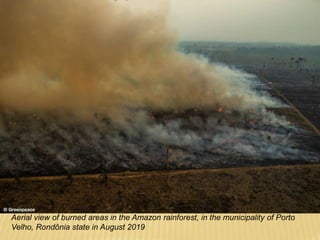
 Brazilian Amazon fires scientifically linked to 2019
deforestation according to a report released by the
Monitoring of the Andean Amazon Project (MAAP).
 At least 52,500 hectares (130,000 acres) of the
Brazilian Amazon — the equivalent to 72,000
soccer fields — were cleared through 2019 and
then burned in August. The findings offer a base
map overlapping 2019 deforestation and fire
hotspots, and include 16 high-resolution time lapse
videos unveiling newly cleared agricultural lands
linked to fire occurrences.
 The major issue is deforestation. Now it makes
sense why the fires were so smoky. It looks like a
forest fire, it’s smoky as a forest fire [would be], but
it’s burning recent deforested areas.
Aerial view of burned areas in the Amazon rainforest, in the municipality of Porto
Velho, Rondônia state in August 2019
AGRICULTURE CHEMICALS
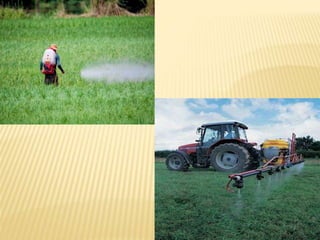
 Use of harmful pesticides and insecticides.
 Chemical fertilizers impact land quality .
 Pesticides impact crop growth, animals and
plants.
 Decreases land fertility .
 A 2010 study of the agriculture herbicide atrazine
revealed that of the 36 million kilograms applied
annually, 225,000 kilograms washed back to earth in
the rain, sometimes 1,000 miles from the source.
 A dead zone at the mouth of the Mississippi River
from fertilizer runoff primarily from corn fields along its
banks, covers more than 7700 square miles (20,000
sq km) in the Gulf of Mexico during the summer
months. The runoff is not only continuing, unabated,
but is expected to increase as the demand for corn to
feed cattle and as a biofuel increases.
 According to 2006 and 2007 estimations by the
Pesticides Industry sales and usage, 821 and 857
million pounds of active conventional pesticides
ingredients were used respectively. The estimation
reveals just how agricultural chemicals contribute to
land pollution.
INDUSTRIALIZATION
 Due to an increase in demand for food,
shelter, and house, more goods are
produced.
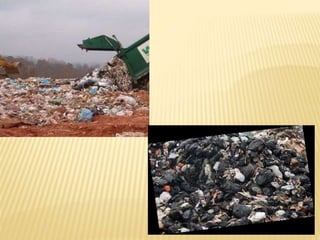
 Industrial activities often release toxic and
material wastes onto the land or into the
atmosphere where they settle onto the land.
 Impacts plants and animals
 Damages environment.
URBANIZATION
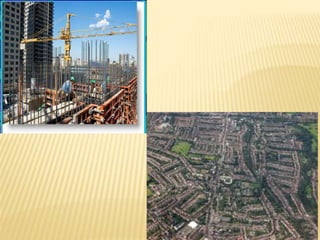
 Due to urbanization, a large number of
construction activities are taking place which
has resulted in large waste articles like wood,
metal, bricks, plastic that can be seen by
naked eyes outside any building or office
which is under construction.
MINING
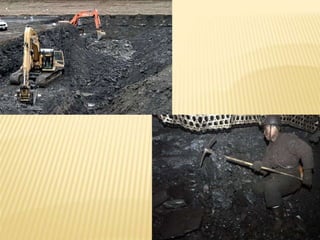
 Forty percent of the world’s mines are strip
mines. Strip mines obviously remove the
topsoil and contribute to erosion.
 Underground mining brings a lot of waste
earth and rocks to the surface where it is
left. This waste often becomes toxic when
exposed to air and water.
 Heavy minerals, sulfuric acid and other toxic
material leak from mining waste into soil.
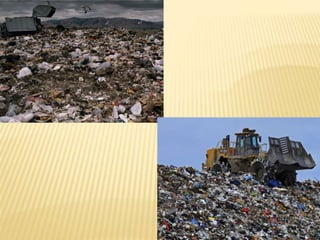
LANDFILLS AND WASTE
 Each household produces tonnes of garbage each
year.
 Waste like plastic, cloth, wood, paper is collected
and sent to local recycling unit . Items that cannot
be recycled become a part of the landfills.
 Waste found in the landfills is toxic. During toxins
are washed into other areas and the pollution is
spread.
 From the Stone Age to the Plastic Age: Pollution in
fossil record gives scientists name for modern era.
Deposits of plastic have increased exponentially since
the end of the Second World War, doubling around
every 15 years, the researchers said after
combing through 200 years of sediment in
California’s Santa Barbara Basin.
 Scientists estimate that between 4.8 and 12.7 million
metric tons of plastic waste enter the ocean every year.
 Previous research by Scripps found microplastics at
depths of up to 1,000m (3,300ft) off Monterey in
California. In April, an explorer visited the Mariana
Trench in the western Pacific Ocean – the deepest
natural trench in the world – and found plastic bags.
 Researchers found there had been a “significant
increase” in larger plastic items found in the ocean from
1957 to 2016. If these trends continue, marine plastic is
set to outweigh fish by 2050.
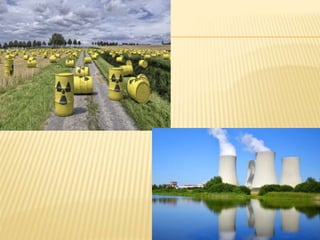
NUCLEAR WASTE
 Nuclear plants can produce a huge amount of
energy through nuclear fission and fusion. The left
over radioactive material contains harmful and toxic
chemicals that can affect human health.
 They are dumped beneath the earth to avoid any
casualty.
 Radon is a serious pollutant gas that appears
naturally in soil as a result of uranium breakdown
process. This can have hazardous effect on the
health of humans and wildlife.
SEWAGE TREATMENT
 A large amount of solid waste is leftover once the
sewage has been treated. The leftover material is
sent to landfill site which end up in polluting the
environment.
 Untreated human waste can produce toxic gases
that can seep into the ground.
EFFECTS OF LAND
POLLUTION
 SOIL POLLUTION- Soil pollution is another form
of land pollution, where the upper layer of the soil is
damaged. This is caused by the overuse of
chemical fertilizers, soil erosion caused by running
water and other pest control measures; this leads
to loss of fertile land for agriculture, forest cover,
fodder patches for grazing etc.
 CHANGE IN CLIMATIC PATTERNS-The
effects of land pollution are very hazardous and can
lead to the loss of ecosystems. When land is
polluted, it directly or indirectly affects the climate
patterns. Land pollutions leads to loss in the forest
cover of Earth. This is in turn going to affect the
amount of rain. Less rain mean lesser vegetation.
 ENVIRONMENTAL IMPACT-When deforestation is
committed, the tree cover is compromised. This leads
to a steep imbalance in the rain cycle. A disturbed rain
cycle affects a lot of factors. To begin with, the green
cover is reduced. Trees and plants help balance the
atmosphere, without them we are subjected to various
concerns like Global warming, the greenhouse effect,
irregular rainfall and flash floods among other
imbalances.
 EFFECT ON HUMAN HEALTH-The land when
contaminated with toxic chemicals and pesticides lead
to the problem of skin cancer and the human
respiratory system. The toxic chemicals can reach our
body through foods and vegetables that we eat as they
are grown in polluted soil.
 CAUSES AIR POLLUTION-Landfills across the
city keep on growing due to an increase in waste
and are later burned which leads to air pollution.
They become home for rodents, mice, etc which in
turn transmit diseases.
 DISTRACTION FOR TOURISTS-The city
loses its attraction as a tourist destination
as landfills do not look good when you move
around the city. It leads to a loss of revenue for the
state government.
 SHIFITING HABITAT-As deforestation and soil
erosion progress, animals are forced to move to
find shelter and food. For some animals, the
change is too traumatic and this leads to some
dying. As a result some species are at greater risk
of extinction.
 EFFECT ON WILDLIFE-The animal kingdom
has suffered most in the past decades. They face a
serious threat with regards to the loss of habitat and
natural environment. The constant human activity on
land, is leaving it polluted; forcing these species to
move further away and adapt to new regions or die
trying to adjust. Several species are pushed to the
verge of extinction, due to no homeland.
Other issues that we face include increased
temperature, unseasonal weather activity, acid rains,
etc. The discharge of chemicals on land, makes it
dangerous for the ecosystem too. These chemicals
are consumed by the animals and plants and thereby
make their way in the ecosystem. This process is
called biomagnification.
PREVENTION OF
LAND POLLUTION
PERSONAL LEVEL
 As you may have realized, land pollution is indeed
going to affect a lot more things than we thought it
will. Hence, I leave you with some corrective
measure you can take on a personal level to
reduce land pollution.
 Encourage organic farming - buy organic food.
 Proper garbage disposal - separate your garbage
before you give it to the garbage collector; and
strictly say NO to plastic.
 Encourage recycling - buy recycled products,
notebooks, paper, etc. Restrict use of herbicides
and pesticides - they are not only used in farm, but
in your own backyard as well.
DISPOSAL OF WASTES
 Proper waste management is the most important thing to do
for the prevention of land pollution. Several steps should be
taken to ensure that the waste gets disposed in the most
harmless way, i.e. produces less or no toxins.
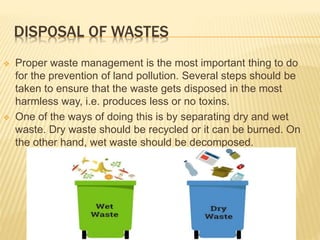
 One of the ways of doing this is by separating dry and wet
waste. Dry waste should be recycled or it can be burned. On
the other hand, wet waste should be decomposed.
RECYCLING AND REUSE
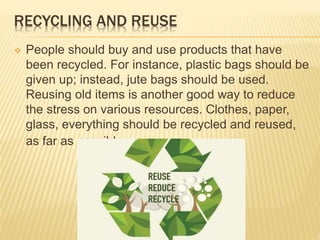
 People should buy and use products that have
been recycled. For instance, plastic bags should be
given up; instead, jute bags should be used.
Reusing old items is another good way to reduce
the stress on various resources. Clothes, paper,
glass, everything should be recycled and reused,
as far as possible.
BIODEGRADABLE PRODUCTS
 People should buy biodegradable products.
Go organic- that's the mantra for avoiding
land pollution. Organic farming, lessening the
use of pesticides, buying organic fruits and
vegetables and other products, will keep land
pollution in check.
GROW MORE TREES
 Initiative should be taken to grow more trees. Researches
show that trees can actually fertilize the soil. This means
that by growing trees, soil will become fertile, agriculture will
get boosted and land pollution will greatly reduce
 Ireland Will Plant 440 Million Trees By 2040 To Combat
Climate Change.
 With the help of the local population, Haidar el Ali has led a
programme that has planted 152 million mangrove buds in
the Casamance Delta of southern Senegal over the past
decade. The reforestation project in southern Senegal has
become one of the largest of its kind in the world.
 Green Yatra is a popular Mumbai based NGO that
sensitized people and school children all across
Maharashtra about the value and importance of the
environment and how every individual can contribute to
make our country greener and more sustainable.
 SankalpTaru Foundation is an IT enabled NGO,
spreading greenery with its core philosophy of “planting
trees for the people, by the people”. Having planted
more than half a million trees across 16 states, they are
not only saving the environment but at the same time
creating employment opportunities for people in rural
areas, who are given the responsibility to plant trees
and then nurture them.
 Green Trees an NGO has been successful in planting
more than 3.9 million trees in India, thereby, educing
carbon emissions each year by a massive 78,252,500
kg. At Green-Trees, most tree planting initiatives
are spearheaded by tribal and local communities –
people, mostly women, whose lives are intertwined with
forests. This is essential as this is enabling these
women a source to sustain their livelihood. The best
part? Green Trees will plant a tree for you at a
subsidized cost of Rs 85.
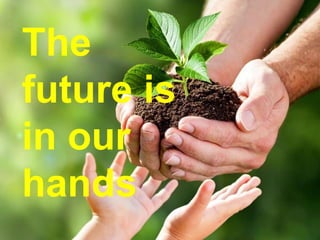
The
future is
in our
hands

Land pollution by Mannat

  • 1.
  • 2.
    POLLUTION  The wordpollution is derived from the Latin word Pollutionem (meaning to make dirty or defile).  Pollution is the addition of constituents to air, water, soil or land which alters the natural quality of the environment adversely.  In 2015, pollution killed 9 million people.
  • 3.
    Pollutant The materials whichcause pollution of the environment are known as pollutants. This maybe defined as:- It is a harmful solid, liquid or gaseous substance present in such concentration in the environment which tends to be injurious for the whole living community. A pollutant maybe:-  A chemical substance e.g., an organo- phosphorous compound.  A physical property, e.g., heat, noise etc.  A geochemical substance, e.g., dust, sediment etc.  A biological organism and product.
  • 4.
    TYPES OF POLLUTION Air Pollution  Water Pollution  Noise Pollution  Land Pollution
  • 5.
    LAND POLLUTION  Landpollution may be defined as the deterioration of the earth’s land surfaces, often directly or indirectly as a result of man’s activities and their misuse of land resources
  • 6.
  • 7.
    DEFORESTATION  Humans dependupon trees for many things.  We have cut down millions of acres of tree for wood, construction, farming and mining purposes, and never planted new trees back.  Without protection of trees, the land becomes barren over time and starts to explode. Land conversion, meaning the alteration or modification of the original properties of the land to make it use-worthy for a specific purpose is another major cause.  There is constant waste of land.  In the Amazon rain forest in Brazil, an area the size of a football field is clear-cut by loggers every second.
  • 8.
     Brazilian Amazonfires scientifically linked to 2019 deforestation according to a report released by the Monitoring of the Andean Amazon Project (MAAP).  At least 52,500 hectares (130,000 acres) of the Brazilian Amazon — the equivalent to 72,000 soccer fields — were cleared through 2019 and then burned in August. The findings offer a base map overlapping 2019 deforestation and fire hotspots, and include 16 high-resolution time lapse videos unveiling newly cleared agricultural lands linked to fire occurrences.  The major issue is deforestation. Now it makes sense why the fires were so smoky. It looks like a forest fire, it’s smoky as a forest fire [would be], but it’s burning recent deforested areas.
  • 9.
    Aerial view ofburned areas in the Amazon rainforest, in the municipality of Porto Velho, Rondônia state in August 2019
  • 11.
    AGRICULTURE CHEMICALS  Useof harmful pesticides and insecticides.  Chemical fertilizers impact land quality .  Pesticides impact crop growth, animals and plants.  Decreases land fertility .
  • 12.
     A 2010study of the agriculture herbicide atrazine revealed that of the 36 million kilograms applied annually, 225,000 kilograms washed back to earth in the rain, sometimes 1,000 miles from the source.  A dead zone at the mouth of the Mississippi River from fertilizer runoff primarily from corn fields along its banks, covers more than 7700 square miles (20,000 sq km) in the Gulf of Mexico during the summer months. The runoff is not only continuing, unabated, but is expected to increase as the demand for corn to feed cattle and as a biofuel increases.  According to 2006 and 2007 estimations by the Pesticides Industry sales and usage, 821 and 857 million pounds of active conventional pesticides ingredients were used respectively. The estimation reveals just how agricultural chemicals contribute to land pollution.
  • 14.
    INDUSTRIALIZATION  Due toan increase in demand for food, shelter, and house, more goods are produced.  Industrial activities often release toxic and material wastes onto the land or into the atmosphere where they settle onto the land.  Impacts plants and animals  Damages environment.
  • 16.
    URBANIZATION  Due tourbanization, a large number of construction activities are taking place which has resulted in large waste articles like wood, metal, bricks, plastic that can be seen by naked eyes outside any building or office which is under construction.
  • 18.
    MINING  Forty percentof the world’s mines are strip mines. Strip mines obviously remove the topsoil and contribute to erosion.  Underground mining brings a lot of waste earth and rocks to the surface where it is left. This waste often becomes toxic when exposed to air and water.  Heavy minerals, sulfuric acid and other toxic material leak from mining waste into soil.
  • 20.
    LANDFILLS AND WASTE Each household produces tonnes of garbage each year.  Waste like plastic, cloth, wood, paper is collected and sent to local recycling unit . Items that cannot be recycled become a part of the landfills.  Waste found in the landfills is toxic. During toxins are washed into other areas and the pollution is spread.
  • 21.
     From theStone Age to the Plastic Age: Pollution in fossil record gives scientists name for modern era. Deposits of plastic have increased exponentially since the end of the Second World War, doubling around every 15 years, the researchers said after combing through 200 years of sediment in California’s Santa Barbara Basin.  Scientists estimate that between 4.8 and 12.7 million metric tons of plastic waste enter the ocean every year.  Previous research by Scripps found microplastics at depths of up to 1,000m (3,300ft) off Monterey in California. In April, an explorer visited the Mariana Trench in the western Pacific Ocean – the deepest natural trench in the world – and found plastic bags.  Researchers found there had been a “significant increase” in larger plastic items found in the ocean from 1957 to 2016. If these trends continue, marine plastic is set to outweigh fish by 2050.
  • 22.
    NUCLEAR WASTE  Nuclearplants can produce a huge amount of energy through nuclear fission and fusion. The left over radioactive material contains harmful and toxic chemicals that can affect human health.  They are dumped beneath the earth to avoid any casualty.  Radon is a serious pollutant gas that appears naturally in soil as a result of uranium breakdown process. This can have hazardous effect on the health of humans and wildlife.
  • 24.
    SEWAGE TREATMENT  Alarge amount of solid waste is leftover once the sewage has been treated. The leftover material is sent to landfill site which end up in polluting the environment.  Untreated human waste can produce toxic gases that can seep into the ground.
  • 26.
  • 27.
     SOIL POLLUTION-Soil pollution is another form of land pollution, where the upper layer of the soil is damaged. This is caused by the overuse of chemical fertilizers, soil erosion caused by running water and other pest control measures; this leads to loss of fertile land for agriculture, forest cover, fodder patches for grazing etc.  CHANGE IN CLIMATIC PATTERNS-The effects of land pollution are very hazardous and can lead to the loss of ecosystems. When land is polluted, it directly or indirectly affects the climate patterns. Land pollutions leads to loss in the forest cover of Earth. This is in turn going to affect the amount of rain. Less rain mean lesser vegetation.
  • 28.
     ENVIRONMENTAL IMPACT-Whendeforestation is committed, the tree cover is compromised. This leads to a steep imbalance in the rain cycle. A disturbed rain cycle affects a lot of factors. To begin with, the green cover is reduced. Trees and plants help balance the atmosphere, without them we are subjected to various concerns like Global warming, the greenhouse effect, irregular rainfall and flash floods among other imbalances.  EFFECT ON HUMAN HEALTH-The land when contaminated with toxic chemicals and pesticides lead to the problem of skin cancer and the human respiratory system. The toxic chemicals can reach our body through foods and vegetables that we eat as they are grown in polluted soil.
  • 29.
     CAUSES AIRPOLLUTION-Landfills across the city keep on growing due to an increase in waste and are later burned which leads to air pollution. They become home for rodents, mice, etc which in turn transmit diseases.  DISTRACTION FOR TOURISTS-The city loses its attraction as a tourist destination as landfills do not look good when you move around the city. It leads to a loss of revenue for the state government.  SHIFITING HABITAT-As deforestation and soil erosion progress, animals are forced to move to find shelter and food. For some animals, the change is too traumatic and this leads to some dying. As a result some species are at greater risk of extinction.
  • 30.
     EFFECT ONWILDLIFE-The animal kingdom has suffered most in the past decades. They face a serious threat with regards to the loss of habitat and natural environment. The constant human activity on land, is leaving it polluted; forcing these species to move further away and adapt to new regions or die trying to adjust. Several species are pushed to the verge of extinction, due to no homeland. Other issues that we face include increased temperature, unseasonal weather activity, acid rains, etc. The discharge of chemicals on land, makes it dangerous for the ecosystem too. These chemicals are consumed by the animals and plants and thereby make their way in the ecosystem. This process is called biomagnification.
  • 31.
  • 32.
    PERSONAL LEVEL  Asyou may have realized, land pollution is indeed going to affect a lot more things than we thought it will. Hence, I leave you with some corrective measure you can take on a personal level to reduce land pollution.  Encourage organic farming - buy organic food.  Proper garbage disposal - separate your garbage before you give it to the garbage collector; and strictly say NO to plastic.  Encourage recycling - buy recycled products, notebooks, paper, etc. Restrict use of herbicides and pesticides - they are not only used in farm, but in your own backyard as well.
  • 33.
    DISPOSAL OF WASTES Proper waste management is the most important thing to do for the prevention of land pollution. Several steps should be taken to ensure that the waste gets disposed in the most harmless way, i.e. produces less or no toxins.  One of the ways of doing this is by separating dry and wet waste. Dry waste should be recycled or it can be burned. On the other hand, wet waste should be decomposed.
  • 34.
    RECYCLING AND REUSE People should buy and use products that have been recycled. For instance, plastic bags should be given up; instead, jute bags should be used. Reusing old items is another good way to reduce the stress on various resources. Clothes, paper, glass, everything should be recycled and reused, as far as possible.
  • 35.
    BIODEGRADABLE PRODUCTS  Peopleshould buy biodegradable products. Go organic- that's the mantra for avoiding land pollution. Organic farming, lessening the use of pesticides, buying organic fruits and vegetables and other products, will keep land pollution in check.
  • 36.
    GROW MORE TREES Initiative should be taken to grow more trees. Researches show that trees can actually fertilize the soil. This means that by growing trees, soil will become fertile, agriculture will get boosted and land pollution will greatly reduce  Ireland Will Plant 440 Million Trees By 2040 To Combat Climate Change.  With the help of the local population, Haidar el Ali has led a programme that has planted 152 million mangrove buds in the Casamance Delta of southern Senegal over the past decade. The reforestation project in southern Senegal has become one of the largest of its kind in the world.  Green Yatra is a popular Mumbai based NGO that sensitized people and school children all across Maharashtra about the value and importance of the environment and how every individual can contribute to make our country greener and more sustainable.
  • 37.
     SankalpTaru Foundationis an IT enabled NGO, spreading greenery with its core philosophy of “planting trees for the people, by the people”. Having planted more than half a million trees across 16 states, they are not only saving the environment but at the same time creating employment opportunities for people in rural areas, who are given the responsibility to plant trees and then nurture them.  Green Trees an NGO has been successful in planting more than 3.9 million trees in India, thereby, educing carbon emissions each year by a massive 78,252,500 kg. At Green-Trees, most tree planting initiatives are spearheaded by tribal and local communities – people, mostly women, whose lives are intertwined with forests. This is essential as this is enabling these women a source to sustain their livelihood. The best part? Green Trees will plant a tree for you at a subsidized cost of Rs 85.
  • 38.