PRESENTED BY 
GUNUKULA SAI SANGEETHA 
MPT 2NDYEAR 
SRM COLLEGE OF PHYSIOTHERAPY 
SRM UNIVERSITY
Wheelchair is truly is mobility orthosis. 
A properly prescribed wheelchair can be 
useful device in reintegrating a person with a 
disability into the community.
Sufficient support. 
Deter the effect of deforming forces. 
Allow for maximum functional mobility.
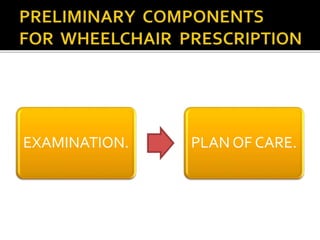
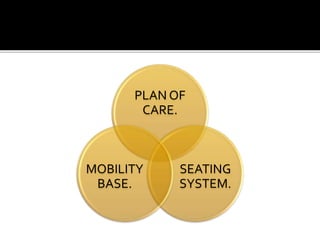
EXAMINATION. PLAN OF CARE.
PLAN OF 
CARE. 
SEATING 
SYSTEM. 
MOBILITY 
BASE.
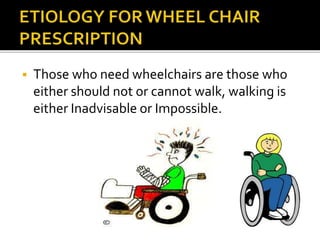
 Those who need wheelchairs are those who 
either should not or cannot walk, walking is 
either Inadvisable or Impossible.
Inadvisability of ambulation may be because of 
 Contraindications to weight-bearing. 
 Interference with wound healing. 
 Prior to ambulation. 
 Inadequate safety in walking . or 
 Deficiency of the patient’s judgment. 
In all of these conditions, the restriction against 
walking may be temporary.
Deficiency in ambulation 
results usually from the involvement of both 
lower limbs by one or more of such conditions 
as: 
Absence of an essential part. 
Paralysis. 
Deformity, 
Pain on weight bearing. 
Incoordination. 
In all of these conditions, the use of wheel 
chair may be permanent.
Fit correctly. 
Cosmetic to the user. 
Light weight. 
Yet strong as possible. 
Modified based on needs.
Age, size & weight. 
Disability & prognosis. 
Functional skills. 
Indoor / outdoor use. 
Portability / accessibility.
 Reliability / durability. 
 Cosmetic features. 
 Options available. 
 Service. 
 Cost. 
 Level of acceptance (Environment).
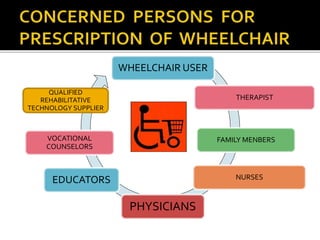
WHEELCHAIR USER 
THERAPIST 
FAMILY MENBERS 
NURSES 
PHYSICIANS 
QUALIFIED 
REHABILITATIVE 
TECHNOLOGY SUPPLIER 
VOCATIONAL 
COUNSELORS 
EDUCATORS
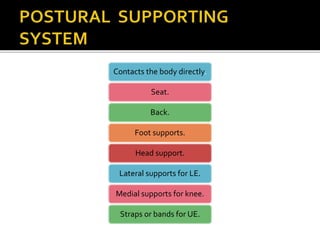
Contacts the body directly. 
Seat. 
Back. 
Foot supports. 
Head support. 
Lateral supports for LE. 
Medial supports for knee. 
Straps or bands for UE.
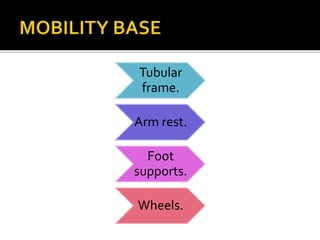
Tubular 
frame. 
Arm rest. 
Foot 
supports. 
Wheels.
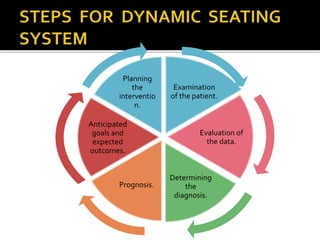
Examination 
of the patient. 
Evaluation of 
the data. 
Determining 
the 
diagnosis. 
Planning 
interventio 
Anticipated 
goals and 
expected 
outcomes. 
the 
n. 
Prognosis.
History of the patient. 
Interview. 
Medical and surgical history. 
Tests and measures. 
Neurological status. 
Postural control. 
Musculoskeletal status.
Sensory status. 
Functional skills level. 
Cognitive perceptual behavioural status. 
Communication level.
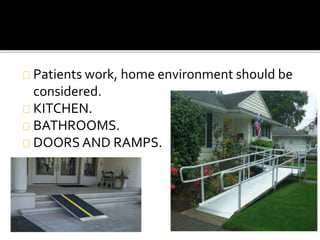
Patients work, home environment should be 
considered. 
KITCHEN. 
BATHROOMS. 
DOORS AND RAMPS.
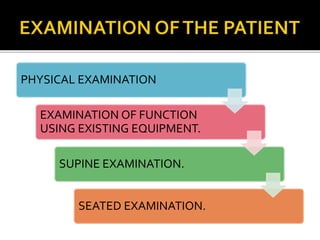
PHYSICAL EXAMINATION 
EXAMINATION OF FUNCTION 
USING EXISTING EQUIPMENT. 
SUPINE EXAMINATION. 
SEATED EXAMINATION.
Examined in gravity minimized 
position (supine or side lying). 
Gravity dependent 
position(sitting).
Under thigh length. 
Leg length. 
Distance from seat to the 
lower scapula. 
Midscapula. 
Shoulder.
Distance from hanging elbow to seat surface. 
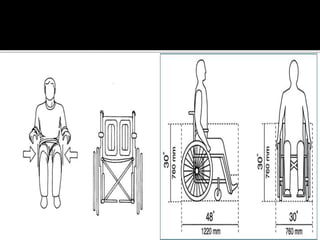
Width across the hips. 
Outside the knee to outside the opposite 
knee.
Good measurements has to be considered to 
avoid many problems: 
Too narrow seat: 
Uncomfortable. 
Difficult access. 
Developing pressure sores. 
Too wide seat: 
Leaning to one side. 
Promoting scoliosis. 
Difficult propulsion.
Too shallow seat: 
Less area of contact 
More pressures over soft tissues 
Less support to feet & legs 
Poor balance 
Too deep seat: 
Restricted leg circulations 
Extended leg / forward slide in the chair 
Difficult propulsion.
ROM for LE is determined. 
Pelvic tilt should be neutralized. 
Knee flexed to 90 to 100 to eliminate effect of 
hamstrings.
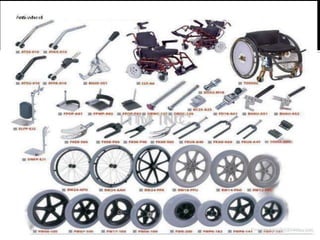
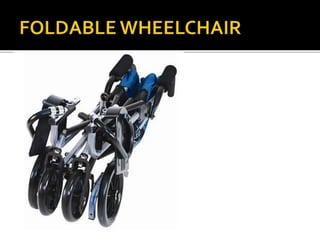
 Wheelchair frame: stationary or foldable. 
 Seat and cushion 
 Arm rests: fixed or adjustable. Stationary or 
removable. 
 Leg rests: adjustable or removable 
 Foot rests: 
 Restraints: chest belts
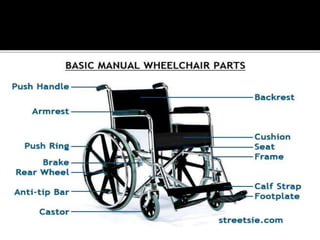
1. Push handle bracket tube 
2. Backrest 
3. Swing-away, padded armrest 
4. Pneumatic tire 
5. Aluminum handrim
6. Aluminum wheel rim 
7. Spokes 
8. Rear wheel hub 
9. Release axel 
10. Axel plate
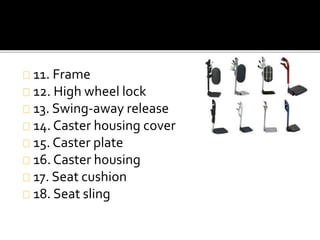
11. Frame 
12. High wheel lock 
13. Swing-away release 
14. Caster housing cover 
15. Caster plate 
16. Caster housing 
17. Seat cushion 
18. Seat sling
19. X-Hinge 
20. Swing-away foot rest 
21. Cross brace 
22. Caster fork 
23. Caster wheel 
24. Caster tire 
25. Flip-up foot rest 
26. Heel loop
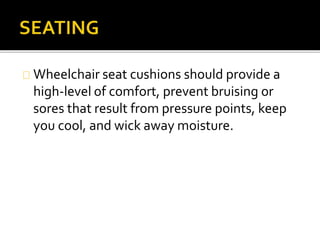
Wheelchair seat cushions should provide a 
high-level of comfort, prevent bruising or 
sores that result from pressure points, keep 
you cool, and wick away moisture.
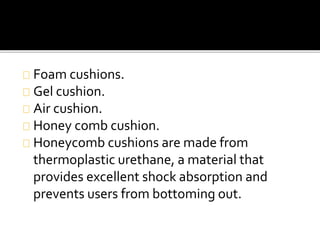
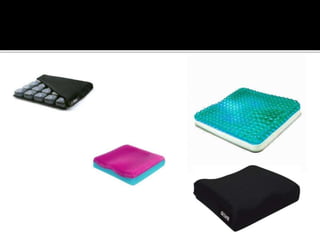
Foam cushions. 
Gel cushion. 
Air cushion. 
Honey comb cushion. 
Honeycomb cushions are made from 
thermoplastic urethane, a material that 
provides excellent shock absorption and 
prevents users from bottoming out.
v
Caster locks: 
CRUTHCH OR CANE HOLDER. 
ANTI-TIPPING DEVICES. 
HILL HOLDER DEVICE. 
Lock extensions. 
Wheel / rim covers. 
Rim projections. 
Detachable footrest.
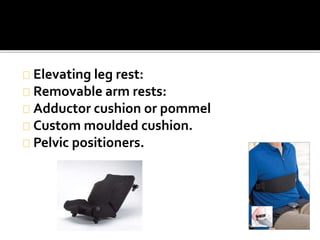
Elevating leg rest: 
Removable arm rests: 
Adductor cushion or pommel 
Custom moulded cushion. 
Pelvic positioners.
1. Standard wheelchair 
2. Standard light weight wheelchair. 
3. Ultra lightweight transport wheelchair. 
4. Bathroom wheelchair. 
5. Reclining back rigid frame sports chair. 
6. Tennis chair. 
7. Rugby wheelchair. 
8. Heavy duty pediatric wheelchair. 
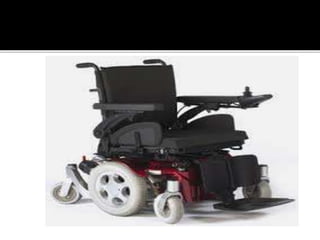
9. Power wheelchair.
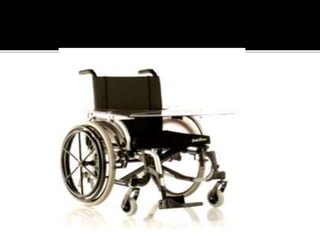
A chair that is designed to be low the ground, 
allowing propulsion with the non involved 
upper and lower extremity. Use low seat 
measurements. Some therapists do not 
choose to use these chairs since they feel it 
reinforces abnormal reflexes. The patient 
must have good perceptual motor skills.
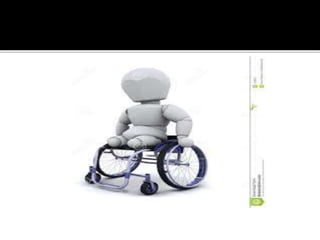
For patients who have bilateral lower 
extremity amputation, the wheelchair has to 
be modified by placing the axis of the rear 
wheels back approximately 2 inches to 
increases the base of support in this direction. 
Without the change, the seated amputee has 
a high and posterior center of gravity 
compared to a non amputee and the chair 
could tip backwards more easily.
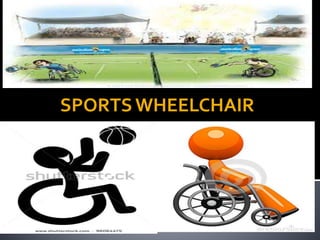
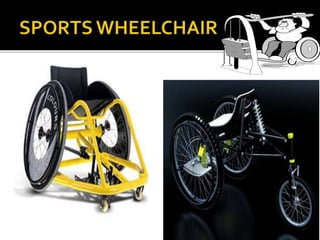
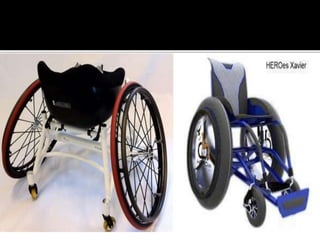
SPORTS WHEELCHAIR
People active in recreational and competitive 
sports. 
Some people need more than one 
wheelchair. 
Street or everday wheelchair 
Competitive chair.
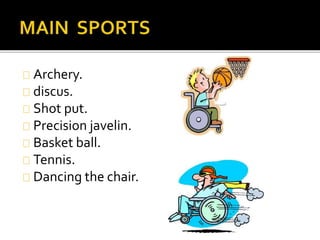
Archery. 
discus. 
Shot put. 
Precision javelin. 
Basket ball. 
Tennis. 
Dancing the chair.
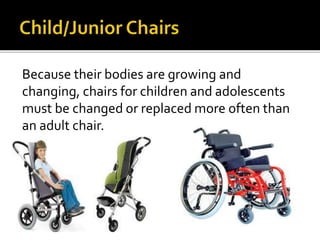
Because their bodies are growing and 
changing, chairs for children and adolescents 
must be changed or replaced more often than 
an adult chair.
Add-on Power devices provide motorised 
power to the standard manual wheelchair 
Rear wheel, Mid wheel and Front wheel drive 
versions 
Indoor and outdoor 
Typically controlled by a joystick but there 
are various other inputs 
Tilt-in-space and reclining systems are 
available
POV/scooter 
Transportable power 
Basic power (non-adjustable) 
Power assist 
Power Base 
Off Road
Tilt 
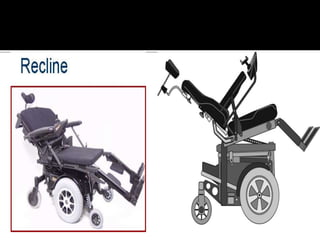
Recline 
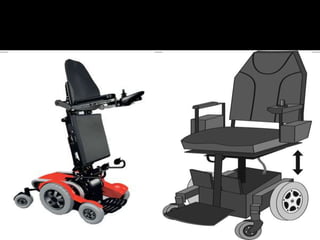
Standing 
Seat Elevation 
Power Elevating Leg Rest
Increased functional ability 
Greater social inclusion 
Access to education and employment 
Reduced dependence on carers 
Reduced fatigue 
Better performance & efficiency
Access adaptations such as wheelchair spaces 
on public transport and wheelchair lifts are 
frequently designed around a typical manual 
wheelchairs 
Because of the weight and size they typically 
cannot be self propelled by the user
Require daily charging 
Generally non-foldable and requiring tie-downs 
in a van for transportation 
Expensive
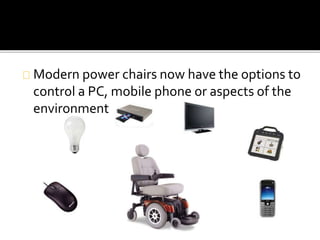
Modern power chairs now have the options to 
control a PC, mobile phone or aspects of the 
environment
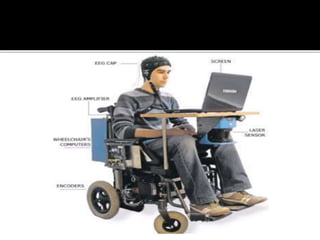
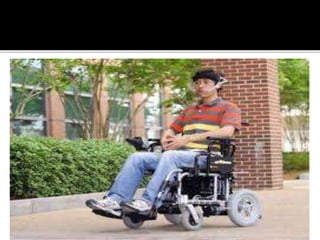
TONGUE OPERATED WHEELCHAIR. 
VOICE OPERATED WHEELCHAIR. 
HAND GESTURE BASED WHEELCHAIR 
MOVEMENT CONTROL FOR DISABLE. 
Smart wheel chair based on voice recognition 
for handicapped
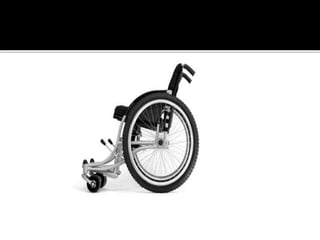
directional stability (tracks in a straight line) 
Largest turning radius 
Pivot point behind the user 
Excellent traction up inclines, poor down 
inclines 
Fastest speeds
Slightly slower 
Good traction down hill 
Best climbing ability 
Smoothest on rough terrain because of long 
wheel base. 
Shorter turning radius than rear wheel drive
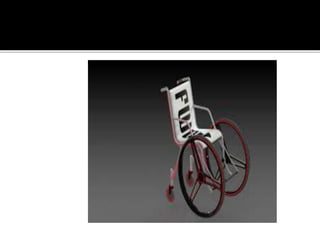
 Smallest turning radius 
 Slower than rear wheel drive for safe control 
 Traction about equal for up and down inclines 
 Pivot point under the driver 
 Additional casters for stability. 
 May experience a more significant rocking 
motion over obstacles
Wheelchair Tyres for Racing, Activity and 
Day Chairs 
Pneumatic Wheelchair Tyres 
Airless Wheelchair Tyres
Semi-pneumatic tires for wheelchairs – made 
of solid rubber or plastic with a ring of air 
running through the centre. 
Foam tyres for wheelchairs – constructed 
from pneumatic tire inserts filled with 
polyurethane foam instead of air. 
Solid tyres for wheelchairs – moulded from 
rubber or plastic, these are the heaviest and 
most durable.
Using for first time requires training. 
Learns how to propel in all directions. 
Operating the wheelchair assesories. 
Wheel locks. 
Foot supports. 
Arm rests.
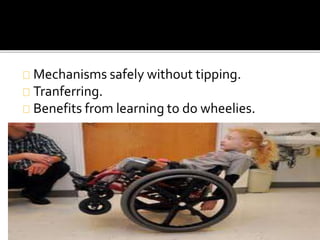
Mechanisms safely without tipping. 
Tranferring. 
Benefits from learning to do wheelies.
Driving skills and safety. 
Hand control with joy stick. 
Head control with individual switches. 
User awareness. 
Responding in vareity of situation and 
obstacles.
Pushrim biomechanical changes with progressive increases 
in slope during motorized treadmill manual wheelchair 
propulsion in individuals with spinal cord injury. 
Gagnon DH, BabineauAC, Champagne A, Desroches G, 
Aissaoui R.J Rehabil Res Dev. 2014;51(5):789-802. doi: 
10.1682/JRRD.2013.07.0168. 
Feasibility of closed-loop controller for righting seated 
posture after spinal cord injury. 
Murphy JO; BSE, Audu ML, Lombardo LM, Foglyano KM; 
BSE, Triolo RJ.J Rehabil Res Dev. 2014;51(5):747-60. doi: 
10.1682/JRRD.2013.09.0200.
Wheelchair Tilt-in-Space and Recline Does Not Reduce 
Sacral Skin Perfusion as Changing From the Upright to the 
Tilted and Reclined Position in People With Spinal Cord Injury 
Yih-Kuen Jan, Barbara A. Crane DOI: 
http://dx.doi.org/10.1016/j.apmr.2013.01.004 
Archives of Physical Medicine and Rehabilitation, Vol. 
94, Issue 6 
The manual wheelchair wheelie: a review of our current 
understanding of an important motor skill. 
Kirby RL1, Smith C, Seaman R, Macleod DA, Parker K.
Barriers, facilitators, and access for wheelchair users: 
substantive and methodologic lessons from a pilot study 
of environmental effects. 
Meyers AR1, Anderson JJ, Miller DR, Shipp K, Hoenig H. 
2002 Oct;55(8):1435-46.
1. Albert M. Cook, Susan M. Hussey 2002 Assistive technologies: principles 
and practice 
2. Learner J, Beverly J, 2008, Learning Disabilities and Related Mild 
Disabilities 
3. Chan J, Davey C, Bath Institute of Medical Engineer, Buyers Guide Add on 
power devices for manual wheelchairs Aug 2008 
4. D.A. Hobson,September 1999, viewed 10th May 2010 
http://www.wheelchairnet.org/ 
5. DX System Manual, Dynamic Controls, 
http://www.dynamiccontrols.com/index.cfm/1,81,html 
6. Wikipedia, Mobility scooter, viewed 10th May 2010 
 http://en.wikipedia.org/wiki/Mobility_scooter 
 May fish tail at higher speeds
http://www.mobility-advisor.com/wheelchair-seat- 
cushions.html#sthash.niOhDZyn.dpuf 
Physical Rehabilitation (O'Sullivan, Physical Rehabilitation) 
2006. by Susan B. O'Sullivan (Author)5th edition.
THANK YOU

Wheelchairs

  • 1.
    PRESENTED BY GUNUKULASAI SANGEETHA MPT 2NDYEAR SRM COLLEGE OF PHYSIOTHERAPY SRM UNIVERSITY
  • 2.
    Wheelchair is trulyis mobility orthosis. A properly prescribed wheelchair can be useful device in reintegrating a person with a disability into the community.
  • 3.
    Sufficient support. Deterthe effect of deforming forces. Allow for maximum functional mobility.
  • 4.
  • 5.
    PLAN OF CARE. SEATING SYSTEM. MOBILITY BASE.
  • 6.
     Those whoneed wheelchairs are those who either should not or cannot walk, walking is either Inadvisable or Impossible.
  • 7.
    Inadvisability of ambulationmay be because of  Contraindications to weight-bearing.  Interference with wound healing.  Prior to ambulation.  Inadequate safety in walking . or  Deficiency of the patient’s judgment. In all of these conditions, the restriction against walking may be temporary.
  • 8.
    Deficiency in ambulation results usually from the involvement of both lower limbs by one or more of such conditions as: Absence of an essential part. Paralysis. Deformity, Pain on weight bearing. Incoordination. In all of these conditions, the use of wheel chair may be permanent.
  • 10.
    Fit correctly. Cosmeticto the user. Light weight. Yet strong as possible. Modified based on needs.
  • 11.
    Age, size &weight. Disability & prognosis. Functional skills. Indoor / outdoor use. Portability / accessibility.
  • 12.
     Reliability /durability.  Cosmetic features.  Options available.  Service.  Cost.  Level of acceptance (Environment).
  • 13.
    WHEELCHAIR USER THERAPIST FAMILY MENBERS NURSES PHYSICIANS QUALIFIED REHABILITATIVE TECHNOLOGY SUPPLIER VOCATIONAL COUNSELORS EDUCATORS
  • 14.
    Contacts the bodydirectly. Seat. Back. Foot supports. Head support. Lateral supports for LE. Medial supports for knee. Straps or bands for UE.
  • 16.
    Tubular frame. Armrest. Foot supports. Wheels.
  • 17.
    Examination of thepatient. Evaluation of the data. Determining the diagnosis. Planning interventio Anticipated goals and expected outcomes. the n. Prognosis.
  • 18.
    History of thepatient. Interview. Medical and surgical history. Tests and measures. Neurological status. Postural control. Musculoskeletal status.
  • 19.
    Sensory status. Functionalskills level. Cognitive perceptual behavioural status. Communication level.
  • 20.
    Patients work, homeenvironment should be considered. KITCHEN. BATHROOMS. DOORS AND RAMPS.
  • 21.
    PHYSICAL EXAMINATION EXAMINATIONOF FUNCTION USING EXISTING EQUIPMENT. SUPINE EXAMINATION. SEATED EXAMINATION.
  • 22.
    Examined in gravityminimized position (supine or side lying). Gravity dependent position(sitting).
  • 23.
    Under thigh length. Leg length. Distance from seat to the lower scapula. Midscapula. Shoulder.
  • 24.
    Distance from hangingelbow to seat surface. Width across the hips. Outside the knee to outside the opposite knee.
  • 25.
    Good measurements hasto be considered to avoid many problems: Too narrow seat: Uncomfortable. Difficult access. Developing pressure sores. Too wide seat: Leaning to one side. Promoting scoliosis. Difficult propulsion.
  • 26.
    Too shallow seat: Less area of contact More pressures over soft tissues Less support to feet & legs Poor balance Too deep seat: Restricted leg circulations Extended leg / forward slide in the chair Difficult propulsion.
  • 27.
    ROM for LEis determined. Pelvic tilt should be neutralized. Knee flexed to 90 to 100 to eliminate effect of hamstrings.
  • 28.
     Wheelchair frame:stationary or foldable.  Seat and cushion  Arm rests: fixed or adjustable. Stationary or removable.  Leg rests: adjustable or removable  Foot rests:  Restraints: chest belts
  • 29.
    1. Push handlebracket tube 2. Backrest 3. Swing-away, padded armrest 4. Pneumatic tire 5. Aluminum handrim
  • 30.
    6. Aluminum wheelrim 7. Spokes 8. Rear wheel hub 9. Release axel 10. Axel plate
  • 31.
    11. Frame 12.High wheel lock 13. Swing-away release 14. Caster housing cover 15. Caster plate 16. Caster housing 17. Seat cushion 18. Seat sling
  • 32.
    19. X-Hinge 20.Swing-away foot rest 21. Cross brace 22. Caster fork 23. Caster wheel 24. Caster tire 25. Flip-up foot rest 26. Heel loop
  • 34.
    Wheelchair seat cushionsshould provide a high-level of comfort, prevent bruising or sores that result from pressure points, keep you cool, and wick away moisture.
  • 35.
    Foam cushions. Gelcushion. Air cushion. Honey comb cushion. Honeycomb cushions are made from thermoplastic urethane, a material that provides excellent shock absorption and prevents users from bottoming out.
  • 36.
  • 37.
    Caster locks: CRUTHCHOR CANE HOLDER. ANTI-TIPPING DEVICES. HILL HOLDER DEVICE. Lock extensions. Wheel / rim covers. Rim projections. Detachable footrest.
  • 38.
    Elevating leg rest: Removable arm rests: Adductor cushion or pommel Custom moulded cushion. Pelvic positioners.
  • 39.
    1. Standard wheelchair 2. Standard light weight wheelchair. 3. Ultra lightweight transport wheelchair. 4. Bathroom wheelchair. 5. Reclining back rigid frame sports chair. 6. Tennis chair. 7. Rugby wheelchair. 8. Heavy duty pediatric wheelchair. 9. Power wheelchair.
  • 40.
    A chair thatis designed to be low the ground, allowing propulsion with the non involved upper and lower extremity. Use low seat measurements. Some therapists do not choose to use these chairs since they feel it reinforces abnormal reflexes. The patient must have good perceptual motor skills.
  • 42.
    For patients whohave bilateral lower extremity amputation, the wheelchair has to be modified by placing the axis of the rear wheels back approximately 2 inches to increases the base of support in this direction. Without the change, the seated amputee has a high and posterior center of gravity compared to a non amputee and the chair could tip backwards more easily.
  • 44.
  • 45.
    People active inrecreational and competitive sports. Some people need more than one wheelchair. Street or everday wheelchair Competitive chair.
  • 46.
    Archery. discus. Shotput. Precision javelin. Basket ball. Tennis. Dancing the chair.
  • 50.
    Because their bodiesare growing and changing, chairs for children and adolescents must be changed or replaced more often than an adult chair.
  • 51.
    Add-on Power devicesprovide motorised power to the standard manual wheelchair Rear wheel, Mid wheel and Front wheel drive versions Indoor and outdoor Typically controlled by a joystick but there are various other inputs Tilt-in-space and reclining systems are available
  • 52.
    POV/scooter Transportable power Basic power (non-adjustable) Power assist Power Base Off Road
  • 53.
    Tilt Recline Standing Seat Elevation Power Elevating Leg Rest
  • 56.
    Increased functional ability Greater social inclusion Access to education and employment Reduced dependence on carers Reduced fatigue Better performance & efficiency
  • 57.
    Access adaptations suchas wheelchair spaces on public transport and wheelchair lifts are frequently designed around a typical manual wheelchairs Because of the weight and size they typically cannot be self propelled by the user
  • 58.
    Require daily charging Generally non-foldable and requiring tie-downs in a van for transportation Expensive
  • 59.
    Modern power chairsnow have the options to control a PC, mobile phone or aspects of the environment
  • 60.
    TONGUE OPERATED WHEELCHAIR. VOICE OPERATED WHEELCHAIR. HAND GESTURE BASED WHEELCHAIR MOVEMENT CONTROL FOR DISABLE. Smart wheel chair based on voice recognition for handicapped
  • 64.
    directional stability (tracksin a straight line) Largest turning radius Pivot point behind the user Excellent traction up inclines, poor down inclines Fastest speeds
  • 66.
    Slightly slower Goodtraction down hill Best climbing ability Smoothest on rough terrain because of long wheel base. Shorter turning radius than rear wheel drive
  • 68.
     Smallest turningradius  Slower than rear wheel drive for safe control  Traction about equal for up and down inclines  Pivot point under the driver  Additional casters for stability.  May experience a more significant rocking motion over obstacles
  • 70.
    Wheelchair Tyres forRacing, Activity and Day Chairs Pneumatic Wheelchair Tyres Airless Wheelchair Tyres
  • 71.
    Semi-pneumatic tires forwheelchairs – made of solid rubber or plastic with a ring of air running through the centre. Foam tyres for wheelchairs – constructed from pneumatic tire inserts filled with polyurethane foam instead of air. Solid tyres for wheelchairs – moulded from rubber or plastic, these are the heaviest and most durable.
  • 72.
    Using for firsttime requires training. Learns how to propel in all directions. Operating the wheelchair assesories. Wheel locks. Foot supports. Arm rests.
  • 73.
    Mechanisms safely withouttipping. Tranferring. Benefits from learning to do wheelies.
  • 74.
    Driving skills andsafety. Hand control with joy stick. Head control with individual switches. User awareness. Responding in vareity of situation and obstacles.
  • 75.
    Pushrim biomechanical changeswith progressive increases in slope during motorized treadmill manual wheelchair propulsion in individuals with spinal cord injury. Gagnon DH, BabineauAC, Champagne A, Desroches G, Aissaoui R.J Rehabil Res Dev. 2014;51(5):789-802. doi: 10.1682/JRRD.2013.07.0168. Feasibility of closed-loop controller for righting seated posture after spinal cord injury. Murphy JO; BSE, Audu ML, Lombardo LM, Foglyano KM; BSE, Triolo RJ.J Rehabil Res Dev. 2014;51(5):747-60. doi: 10.1682/JRRD.2013.09.0200.
  • 76.
    Wheelchair Tilt-in-Space andRecline Does Not Reduce Sacral Skin Perfusion as Changing From the Upright to the Tilted and Reclined Position in People With Spinal Cord Injury Yih-Kuen Jan, Barbara A. Crane DOI: http://dx.doi.org/10.1016/j.apmr.2013.01.004 Archives of Physical Medicine and Rehabilitation, Vol. 94, Issue 6 The manual wheelchair wheelie: a review of our current understanding of an important motor skill. Kirby RL1, Smith C, Seaman R, Macleod DA, Parker K.
  • 77.
    Barriers, facilitators, andaccess for wheelchair users: substantive and methodologic lessons from a pilot study of environmental effects. Meyers AR1, Anderson JJ, Miller DR, Shipp K, Hoenig H. 2002 Oct;55(8):1435-46.
  • 78.
    1. Albert M.Cook, Susan M. Hussey 2002 Assistive technologies: principles and practice 2. Learner J, Beverly J, 2008, Learning Disabilities and Related Mild Disabilities 3. Chan J, Davey C, Bath Institute of Medical Engineer, Buyers Guide Add on power devices for manual wheelchairs Aug 2008 4. D.A. Hobson,September 1999, viewed 10th May 2010 http://www.wheelchairnet.org/ 5. DX System Manual, Dynamic Controls, http://www.dynamiccontrols.com/index.cfm/1,81,html 6. Wikipedia, Mobility scooter, viewed 10th May 2010  http://en.wikipedia.org/wiki/Mobility_scooter  May fish tail at higher speeds
  • 79.
    http://www.mobility-advisor.com/wheelchair-seat- cushions.html#sthash.niOhDZyn.dpuf PhysicalRehabilitation (O'Sullivan, Physical Rehabilitation) 2006. by Susan B. O'Sullivan (Author)5th edition.
  • 80.