ULTRA PERFORMANCE LIQUID
CHROMAROGRAPHY
Presented by
Mr. Atish Khilari
M. Pharm. 1st sem
(2016-2017)
Guided By
Prof. Mr. M. T. Mohite
Department of pharmaceutics
Dr. D. Y. Patil College of Pharmacy, Akurdi,Pune-44
CONTENT
INTRODUCTION
ADVANTAGES
DISADVANTAGES
PRINCIPLE
INSTRUMENTATION
BASIC DIFF. IN HPLC AND UPLC
APPLICATIONS
REFERENCE
INTRODUCTION
CHROMATOGRAPHY-
(Chromo-color, logos-writing)
 “It is separation technique involving
mass transfer between stationary phase
and mobile phase”
Separated species appeared as colored
bands on columns.
INTRODUCTION
UPLC-
It refers “Ultra Performance Liquid
Chromatography”.
Which used in analytical techniques.
It improves three areas-Speed, resolution,
sensitivity.
Speed-1.5min
Pressure-15000psi
Sensitivity-3-5µl
ADVANTAGES
Decreases run time and increases sensitivity.
Provides the selectivity, sensitivity, and
Maintaining resolution performance.
UPLC’s fast resolving power quickly
quantifies related and unrelated compounds.
Use of multi residue method.
Reduces process cycle time.
Less solvent consumption .
DISADVANTAGES
Due to increased pressure requires more
maintenance and Reduces the life of the
columns.
The phases of less than 2μm are generally
non-regenerable.
PRINCIPLE
Principle of UPLC is based on Van-Deemter
equation which describes relationship
between flow rate and HETP or column
efficiency.
H=A+B/µ+Cµ
Where,
A is related to the mobile phase movement
through paths in the stationary phase.
B describes longitudinal diffusion.
C relates the analyte to mass transfer between
the pores of the stationary phase
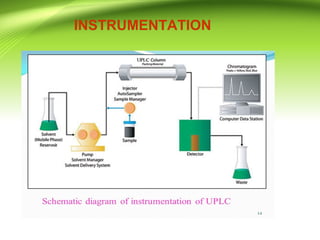
INSTRUMENTATION
INSTRUMENTATION
Solvent Reservoir-
 The most common type of solvent reservoir is
glass bottle.
 Most of manufacturers supply these bottles with
special caps, tubing and filters to connect to the
pump inlet and so the purge gas (Helium) used
to remove dissolved air.
INSTRUMENTATION
Pump-
 Constant pressure pump-
 constant pressure is used only for column
packing. .
 Constant flow pump-This type is mostly used
in all common UPLC application.
 Reciprocating piston pump.
 Dual piston pump.
INSTRUMENTATION
Sample injection system-
 To protect the column from extreme back
pressure fluctuations.
 The injection system must be relatively pulse
free and fast injection cycle time is needed
 thats why low volume injection system are used
which can deliver 3-5 microltr sample.
 Low volume injection also require to increase
sensitivity.
INSTRUMENTATION
Columns-
 Paricle size of packing material is
approximately 1.7 μm.
 Which increase speed of separation and
efficiency of column.
 Separation of the component of sample require
bonded phase that provide both selectivity and
retension.
That bonded phases are-
INSTRUMENTATION
ACQUITY UPLC BEH C18 AND C8 columns-
 These are straight alkyl chains.
 Columns were designed to be the universal
columns of choice for most UPLC
separation by providing widest pH range.
ACQUITY UPLC BEH Shield RP18-
 Columns are designed to provide selectivities
that complement the ACQUITY UPLC BEH C18
and C8 phases.
INSTRUMENTATION
 Unique bonding chemistry provides
complementary selectivity and enhances the
peak shape for basic compounds and
 Yielding compatibility with 100% aqueous mobile
phases.
BEH phenyl columns:
 Phenyl group attach with C6 alkyl.
 Each column chemistry provides different
combination of hydrophobicity, hydrolytic
stability and chemical interaction with analyte.
INSTRUMENTATION
Detectors-
Tunable ultra violet detectors-
UV detectors are most frequently used to
measure components showing an absorption
spectrum in the ultraviolet or visible region.
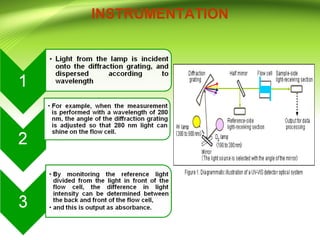
A UV detector uses deuterium discharge lamp
(D2 lamp) as a light source, with the wavelength of
its light ranging from 190 to 380 nm
INSTRUMENTATION
INSTRUMENTATION
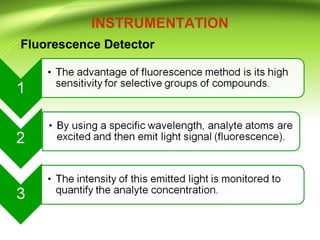
Fluorescence Detector
INSTRUMENTATION
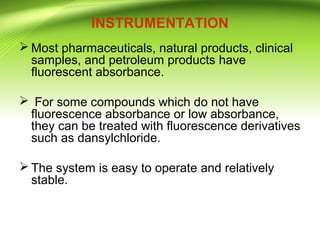
 Most pharmaceuticals, natural products, clinical
samples, and petroleum products have
fluorescent absorbance.
 For some compounds which do not have
fluorescence absorbance or low absorbance,
they can be treated with fluorescence derivatives
such as dansylchloride.
 The system is easy to operate and relatively
stable.
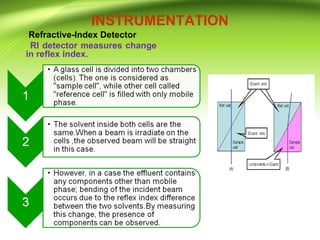
Refractive-Index Detector
RI detector measures change
in reflex index.
INSTRUMENTATION
INSTRUMENTATION
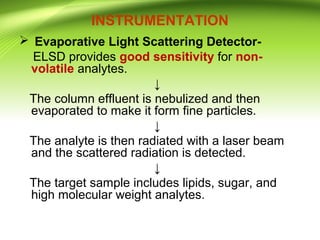
 Evaporative Light Scattering Detector-
ELSD provides good sensitivity for non-
volatile analytes.
↓
The column effluent is nebulized and then
evaporated to make it form fine particles.
↓
The analyte is then radiated with a laser beam
and the scattered radiation is detected.
↓
The target sample includes lipids, sugar, and
high molecular weight analytes.
BASIC DIFFERENCE
Characteristics HPLC UPLC
Speed 10 min. 1.5 min.
Pressure 6000PSi 15000PSi
Particle size >4 µm Appr.1.7µm
Injection Volume 20 µl 3-5 µl
Colum dimension 150 ×3.2 mm 150× 2.1 mm
Analytical column C8 and C18 Bonded phase column
are used.(UPLC BEH
C18)
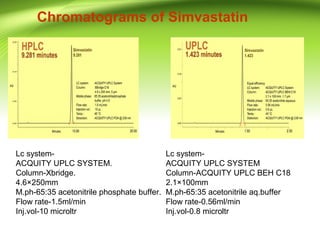
Chromatograms of Simvastatin
Lc system-
ACQUITY UPLC SYSTEM.
Column-Xbridge.
4.6×250mm
M.ph-65:35 acetonitrile phosphate buffer.
Flow rate-1.5ml/min
Inj.vol-10 microltr
Lc system-
ACQUITY UPLC SYSTEM
Column-ACQUITY UPLC BEH C18
2.1×100mm
M.ph-65:35 acetonitrile aq.buffer
Flow rate-0.56ml/min
Inj.vol-0.8 microltr
APPLICATIONS
Drug Discovery -UPLC improves the drug
discovery process by means of high
throughput screening, combinational
chemistry.
Analysis of natural products and herbal
traditional medicines.
Analysis of Dosage form- It provides
high speed, accuracy and reproducible
results for analysis of drugs and their related
substance. Thus method development time
decrease.
APPLICATIONS
 Analysis of amino acids-
UPLC used for accurate, reliable and
reproducible analysis of amino acids in area of
protein characterisation, cell culture monitoring
and nutritional analysis of food.
 Study of metabonomics/ metabolomics-
 Metabonomics studies are carried out in labs to
accelerate development of new medicines.
REFERENCE
1. Chatwal G. Anand S. Instrumental
Methods of Chemical Analysis. 5th
edition,
Himalaya publication house, 2006, 2.691-
2.699.
2. Kasture A., Wadodkar S.,
Pharmaceutical Analysis, 6th edition, Vol-2,
Nirali Prakashan, 2005, 22-26.
3.Jerkovitch AD, Mellors JS, and Jorgenson
JW. LCGC North America, 2003;7.
4. Lippert JA, and Lee ML. J. Chromotogr.
2001; 911: 1.
REFERENCE
5 T. Sunil Kumar Reddy, G. Balammal,
International journal of pharmaceutical research
and analysis, UPLC: An introduction and review,
Vol. 2 , Issue 1,2012,24-31
6. Patil V.P,Tathe R.D,T.,UPLC-A Review, IRJP
2(6), 2011,39-44.
THANK
YOU

Uplc ppt

  • 1.
    ULTRA PERFORMANCE LIQUID CHROMAROGRAPHY Presentedby Mr. Atish Khilari M. Pharm. 1st sem (2016-2017) Guided By Prof. Mr. M. T. Mohite Department of pharmaceutics Dr. D. Y. Patil College of Pharmacy, Akurdi,Pune-44
  • 2.
  • 3.
    INTRODUCTION CHROMATOGRAPHY- (Chromo-color, logos-writing)  “Itis separation technique involving mass transfer between stationary phase and mobile phase” Separated species appeared as colored bands on columns.
  • 4.
    INTRODUCTION UPLC- It refers “UltraPerformance Liquid Chromatography”. Which used in analytical techniques. It improves three areas-Speed, resolution, sensitivity. Speed-1.5min Pressure-15000psi Sensitivity-3-5µl
  • 5.
    ADVANTAGES Decreases run timeand increases sensitivity. Provides the selectivity, sensitivity, and Maintaining resolution performance. UPLC’s fast resolving power quickly quantifies related and unrelated compounds. Use of multi residue method. Reduces process cycle time. Less solvent consumption .
  • 6.
    DISADVANTAGES Due to increasedpressure requires more maintenance and Reduces the life of the columns. The phases of less than 2μm are generally non-regenerable.
  • 7.
    PRINCIPLE Principle of UPLCis based on Van-Deemter equation which describes relationship between flow rate and HETP or column efficiency. H=A+B/µ+Cµ Where, A is related to the mobile phase movement through paths in the stationary phase. B describes longitudinal diffusion. C relates the analyte to mass transfer between the pores of the stationary phase
  • 8.
  • 9.
    INSTRUMENTATION Solvent Reservoir-  Themost common type of solvent reservoir is glass bottle.  Most of manufacturers supply these bottles with special caps, tubing and filters to connect to the pump inlet and so the purge gas (Helium) used to remove dissolved air.
  • 10.
    INSTRUMENTATION Pump-  Constant pressurepump-  constant pressure is used only for column packing. .  Constant flow pump-This type is mostly used in all common UPLC application.  Reciprocating piston pump.  Dual piston pump.
  • 11.
    INSTRUMENTATION Sample injection system- To protect the column from extreme back pressure fluctuations.  The injection system must be relatively pulse free and fast injection cycle time is needed  thats why low volume injection system are used which can deliver 3-5 microltr sample.  Low volume injection also require to increase sensitivity.
  • 12.
    INSTRUMENTATION Columns-  Paricle sizeof packing material is approximately 1.7 μm.  Which increase speed of separation and efficiency of column.  Separation of the component of sample require bonded phase that provide both selectivity and retension. That bonded phases are-
  • 13.
    INSTRUMENTATION ACQUITY UPLC BEHC18 AND C8 columns-  These are straight alkyl chains.  Columns were designed to be the universal columns of choice for most UPLC separation by providing widest pH range. ACQUITY UPLC BEH Shield RP18-  Columns are designed to provide selectivities that complement the ACQUITY UPLC BEH C18 and C8 phases.
  • 14.
    INSTRUMENTATION  Unique bondingchemistry provides complementary selectivity and enhances the peak shape for basic compounds and  Yielding compatibility with 100% aqueous mobile phases. BEH phenyl columns:  Phenyl group attach with C6 alkyl.  Each column chemistry provides different combination of hydrophobicity, hydrolytic stability and chemical interaction with analyte.
  • 15.
    INSTRUMENTATION Detectors- Tunable ultra violetdetectors- UV detectors are most frequently used to measure components showing an absorption spectrum in the ultraviolet or visible region. A UV detector uses deuterium discharge lamp (D2 lamp) as a light source, with the wavelength of its light ranging from 190 to 380 nm
  • 16.
  • 17.
  • 18.
    INSTRUMENTATION  Most pharmaceuticals,natural products, clinical samples, and petroleum products have fluorescent absorbance.  For some compounds which do not have fluorescence absorbance or low absorbance, they can be treated with fluorescence derivatives such as dansylchloride.  The system is easy to operate and relatively stable.
  • 19.
    Refractive-Index Detector RI detectormeasures change in reflex index. INSTRUMENTATION
  • 20.
    INSTRUMENTATION  Evaporative LightScattering Detector- ELSD provides good sensitivity for non- volatile analytes. ↓ The column effluent is nebulized and then evaporated to make it form fine particles. ↓ The analyte is then radiated with a laser beam and the scattered radiation is detected. ↓ The target sample includes lipids, sugar, and high molecular weight analytes.
  • 21.
    BASIC DIFFERENCE Characteristics HPLCUPLC Speed 10 min. 1.5 min. Pressure 6000PSi 15000PSi Particle size >4 µm Appr.1.7µm Injection Volume 20 µl 3-5 µl Colum dimension 150 ×3.2 mm 150× 2.1 mm Analytical column C8 and C18 Bonded phase column are used.(UPLC BEH C18)
  • 22.
    Chromatograms of Simvastatin Lcsystem- ACQUITY UPLC SYSTEM. Column-Xbridge. 4.6×250mm M.ph-65:35 acetonitrile phosphate buffer. Flow rate-1.5ml/min Inj.vol-10 microltr Lc system- ACQUITY UPLC SYSTEM Column-ACQUITY UPLC BEH C18 2.1×100mm M.ph-65:35 acetonitrile aq.buffer Flow rate-0.56ml/min Inj.vol-0.8 microltr
  • 23.
    APPLICATIONS Drug Discovery -UPLCimproves the drug discovery process by means of high throughput screening, combinational chemistry. Analysis of natural products and herbal traditional medicines. Analysis of Dosage form- It provides high speed, accuracy and reproducible results for analysis of drugs and their related substance. Thus method development time decrease.
  • 24.
    APPLICATIONS  Analysis ofamino acids- UPLC used for accurate, reliable and reproducible analysis of amino acids in area of protein characterisation, cell culture monitoring and nutritional analysis of food.  Study of metabonomics/ metabolomics-  Metabonomics studies are carried out in labs to accelerate development of new medicines.
  • 25.
    REFERENCE 1. Chatwal G.Anand S. Instrumental Methods of Chemical Analysis. 5th edition, Himalaya publication house, 2006, 2.691- 2.699. 2. Kasture A., Wadodkar S., Pharmaceutical Analysis, 6th edition, Vol-2, Nirali Prakashan, 2005, 22-26. 3.Jerkovitch AD, Mellors JS, and Jorgenson JW. LCGC North America, 2003;7. 4. Lippert JA, and Lee ML. J. Chromotogr. 2001; 911: 1.
  • 26.
    REFERENCE 5 T. SunilKumar Reddy, G. Balammal, International journal of pharmaceutical research and analysis, UPLC: An introduction and review, Vol. 2 , Issue 1,2012,24-31 6. Patil V.P,Tathe R.D,T.,UPLC-A Review, IRJP 2(6), 2011,39-44.
  • 27.