Basics of - HPLC Kaumil Bhavsar Date -21/08/07
Index What is HPLC ? Applications  Types of HPLC HPLC Instrumentation Solvent system Pumping system Sample injector system Column Detectors P9 RP-HPLC salient features
What is HPLC ? Originally referred to as H igh  P ressure  L iquid  C hromatography Now more commonly called  H igh  P erformance  L iquid  C hromatography HPLC is an analytical technique used to separate component of mixture by using variety of chemical interaction between the analyte and the chromatography column. Why  HPLC ? Automated version of LC Provides enhanced separations in short time duration. It’s a most practiced quantitative, chromatographic technique which can separates wide range of molecule types and sizes.
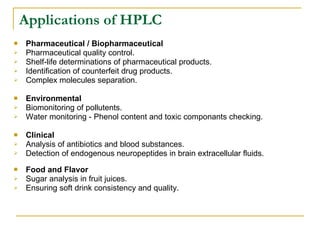
Applications of HPLC Pharmaceutical / Biopharmaceutical Pharmaceutical quality control. Shelf-life determinations of pharmaceutical products. Identification of counterfeit drug products. Complex molecules separation.  Environmental Biomonitoring of pollutents. Water monitoring - Phenol content and toxic componants checking. Clinical  Analysis of antibiotics and blood substances. Detection of endogenous neuropeptides in brain extracellular fluids.  Food and Flavor Sugar analysis in fruit juices. Ensuring soft drink consistency and quality.
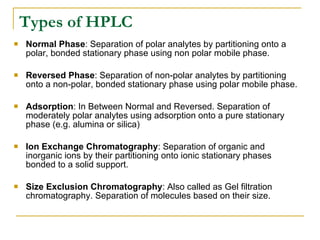
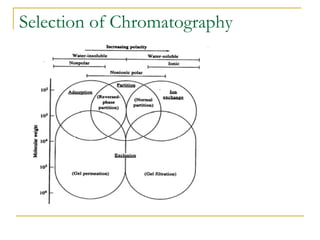
Types of HPLC Normal Phase : Separation of polar analytes by partitioning onto a polar, bonded stationary phase using non polar mobile phase. Reversed Phase : Separation of non-polar analytes by partitioning onto a non-polar, bonded stationary phase using polar mobile phase. Adsorption : In Between Normal and Reversed. Separation of moderately polar analytes using adsorption onto a pure stationary phase (e.g. alumina or silica) Ion Exchange Chromatography : Separation of organic and inorganic ions by their partitioning onto ionic stationary phases bonded to a solid support. Size Exclusion Chromatography : Also called as Gel filtration chromatography. Separation of molecules based on their size.
Selection of Chromatography
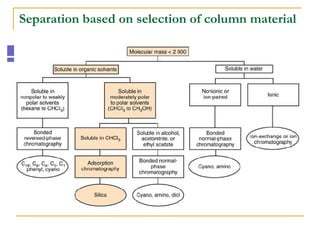
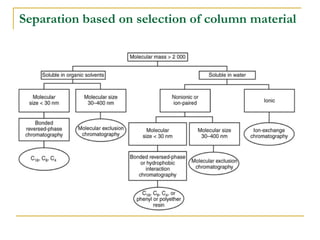
Separation based on selection of column material
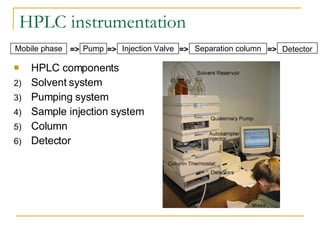
HPLC instrumentation HPLC components Solvent system Pumping system Sample injection system Column Detector Detector Mobile phase Pump Injection Valve Separation column => => => =>
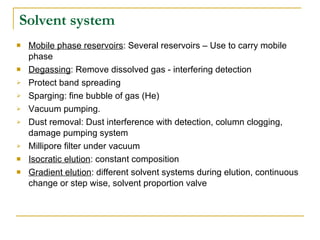
Solvent system Mobile phase reservoirs : Several reservoirs – Use to carry mobile phase Degassing : Remove dissolved gas - interfering detection Protect band spreading  Sparging: fine bubble of gas (He) Vacuum pumping. Dust removal: Dust interference with detection, column clogging, damage pumping system Millipore filter under vacuum Isocratic elution : constant composition Gradient elution : different solvent systems during elution, continuous change or step wise, solvent proportion valve
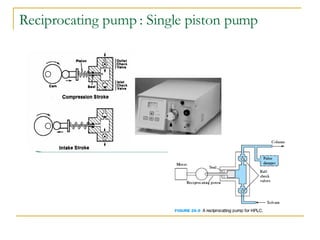
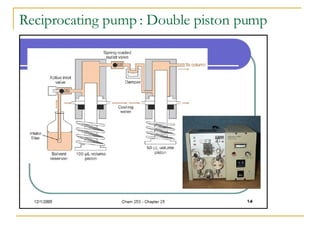
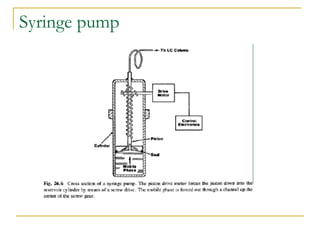
Pumping system Requirements for HPLC pump. High pressure (up to 6000 psi) •  pulse free, prevents remixing of solutes •  control flow rate from 0.1 to 10 mL/min Types of HPLC pumps 1)  Reciprocating pumps : Most commonly used.   Disadvantage: pulses from single piston. 2)  Syringe pumps : Generates pulse free output.  Disadvantage: Limited mobile phase capasity.
Reciprocating pump : Single piston pump
Reciprocating pump : Double piston pump
Syringe pump
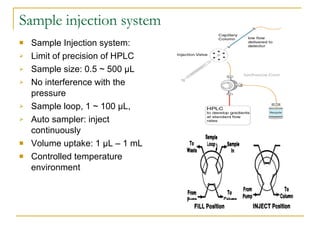
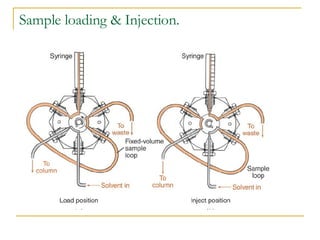
Sample injection system Sample Injection system: Limit of precision of HPLC Sample size: 0.5 ~ 500 μL No interference with the pressure Sample loop, 1 ~ 100 μL, Auto sampler: inject continuously Volume uptake: 1 μL – 1 mL Controlled temperature environment
Sample loading & Injection.
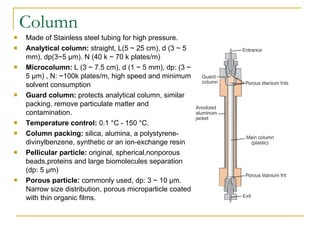
Column Made of Stainless steel tubing for high pressure. Analytical column:  straight, L(5 ~ 25 cm), d (3 ~ 5 mm), dp(3~5 μm). N (40 k ~ 70 k plates/m) Microcolumn:  L (3 ~ 7.5 cm), d (1 ~ 5 mm), dp: (3 ~ 5 μm) , N: ~100k plates/m, high speed and minimum solvent consumption Guard column:  protects analytical column, similar packing, remove particulate matter and contamination. Temperature control:  0.1 °C - 150 °C. Column packing:  silica, alumina, a polystyrene-divinylbenzene, synthetic or an ion-exchange resin Pellicular particle:  original, spherical,nonporous beads,proteins and large biomolecules separation (dp: 5 μm) Porous particle:  commonly used, dp: 3 ~ 10 μm. Narrow size distribution, porous microparticle coated with thin organic films.
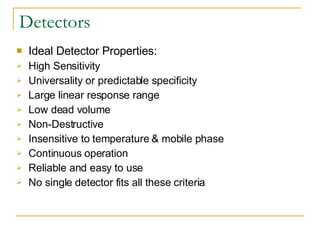
Detectors Ideal Detector Properties: High Sensitivity  Universality or predictable specificity Large linear response range  Low dead volume Non-Destructive Insensitive to temperature & mobile phase Continuous operation Reliable and easy to use No single detector fits all these criteria
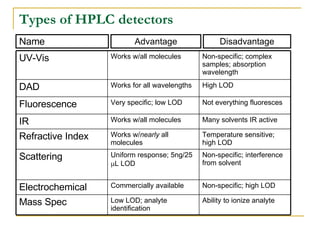
Types of HPLC detectors Ability to ionize analyte Low LOD; analyte identification Mass Spec Non-specific; high LOD Commercially available Electrochemical Non-specific; interference from solvent Uniform response; 5ng/25  L LOD Scattering Temperature sensitive; high LOD Works w/ nearly  all molecules Refractive Index Many solvents IR active Works w/all molecules IR Not everything fluoresces Very specific; low LOD Fluorescence High LOD Works for all wavelengths DAD Non-specific; complex samples; absorption wavelength Works w/all molecules UV-Vis Name Advantage Disadvantage
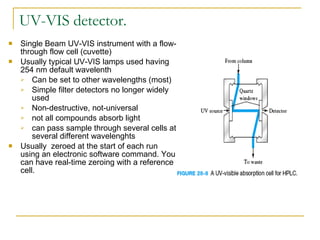
UV-VIS detector. Single Beam UV-VIS instrument with a flow-through flow cell (cuvette) Usually typical UV-VIS lamps used having 254 nm default wavelenth Can be set to other wavelengths (most) Simple filter detectors no longer widely used Non-destructive, not-universal not all compounds absorb light can pass sample through several cells at several different wavelenghts Usually  zeroed at the start of each run using an electronic software command. You can have real-time zeroing with a reference cell.
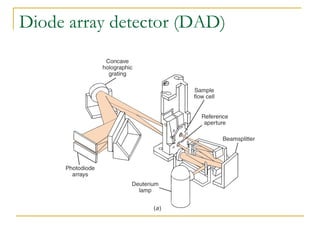
Diode array detector (DAD)
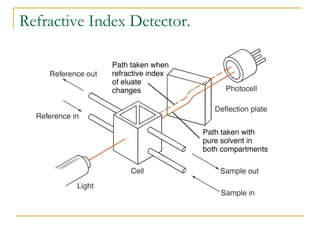
Refractive Index Detector.
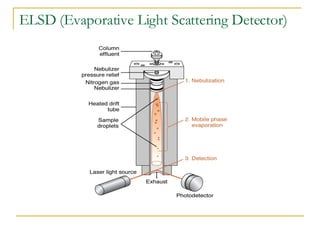
ELSD (Evaporative Light Scattering Detector)
P9 RP- HPLC Salient features. Reverse phase HPLC. 15 min method, RT- Between 4 to 6 min. Mobile phase : A - Water + TFA    B - ACN + TFA Column:  Brand Name - Discovery Type of Column:Reverse phase C18 column Specification of ColumnDiameter: 4.6mm Length: 50mm Porosity: 300•A, Particle size: 5 Micron Guard column  Brand Name - Zorbex 300 SB (Agilent)  Type of Column:Reverse phase  Zorbax 300 SB-C18 Specification of ColumnDiameter: 4.6mm, Length: 35 mmPorosity: 300•A, Particle size: 5 Micron
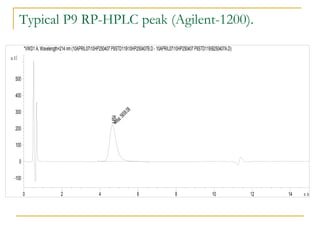
Typical P9 RP-HPLC peak (Agilent-1200).
Thank You

Kaumil Hplc

  • 1.
    Basics of -HPLC Kaumil Bhavsar Date -21/08/07
  • 2.
    Index What isHPLC ? Applications Types of HPLC HPLC Instrumentation Solvent system Pumping system Sample injector system Column Detectors P9 RP-HPLC salient features
  • 3.
    What is HPLC? Originally referred to as H igh P ressure L iquid C hromatography Now more commonly called H igh P erformance L iquid C hromatography HPLC is an analytical technique used to separate component of mixture by using variety of chemical interaction between the analyte and the chromatography column. Why HPLC ? Automated version of LC Provides enhanced separations in short time duration. It’s a most practiced quantitative, chromatographic technique which can separates wide range of molecule types and sizes.
  • 4.
    Applications of HPLCPharmaceutical / Biopharmaceutical Pharmaceutical quality control. Shelf-life determinations of pharmaceutical products. Identification of counterfeit drug products. Complex molecules separation. Environmental Biomonitoring of pollutents. Water monitoring - Phenol content and toxic componants checking. Clinical Analysis of antibiotics and blood substances. Detection of endogenous neuropeptides in brain extracellular fluids. Food and Flavor Sugar analysis in fruit juices. Ensuring soft drink consistency and quality.
  • 5.
    Types of HPLCNormal Phase : Separation of polar analytes by partitioning onto a polar, bonded stationary phase using non polar mobile phase. Reversed Phase : Separation of non-polar analytes by partitioning onto a non-polar, bonded stationary phase using polar mobile phase. Adsorption : In Between Normal and Reversed. Separation of moderately polar analytes using adsorption onto a pure stationary phase (e.g. alumina or silica) Ion Exchange Chromatography : Separation of organic and inorganic ions by their partitioning onto ionic stationary phases bonded to a solid support. Size Exclusion Chromatography : Also called as Gel filtration chromatography. Separation of molecules based on their size.
  • 6.
  • 7.
    Separation based onselection of column material
  • 8.
    Separation based onselection of column material
  • 9.
    HPLC instrumentation HPLCcomponents Solvent system Pumping system Sample injection system Column Detector Detector Mobile phase Pump Injection Valve Separation column => => => =>
  • 10.
    Solvent system Mobilephase reservoirs : Several reservoirs – Use to carry mobile phase Degassing : Remove dissolved gas - interfering detection Protect band spreading Sparging: fine bubble of gas (He) Vacuum pumping. Dust removal: Dust interference with detection, column clogging, damage pumping system Millipore filter under vacuum Isocratic elution : constant composition Gradient elution : different solvent systems during elution, continuous change or step wise, solvent proportion valve
  • 11.
    Pumping system Requirementsfor HPLC pump. High pressure (up to 6000 psi) • pulse free, prevents remixing of solutes • control flow rate from 0.1 to 10 mL/min Types of HPLC pumps 1) Reciprocating pumps : Most commonly used. Disadvantage: pulses from single piston. 2) Syringe pumps : Generates pulse free output. Disadvantage: Limited mobile phase capasity.
  • 12.
    Reciprocating pump :Single piston pump
  • 13.
    Reciprocating pump :Double piston pump
  • 14.
  • 15.
    Sample injection systemSample Injection system: Limit of precision of HPLC Sample size: 0.5 ~ 500 μL No interference with the pressure Sample loop, 1 ~ 100 μL, Auto sampler: inject continuously Volume uptake: 1 μL – 1 mL Controlled temperature environment
  • 16.
    Sample loading &Injection.
  • 17.
    Column Made ofStainless steel tubing for high pressure. Analytical column: straight, L(5 ~ 25 cm), d (3 ~ 5 mm), dp(3~5 μm). N (40 k ~ 70 k plates/m) Microcolumn: L (3 ~ 7.5 cm), d (1 ~ 5 mm), dp: (3 ~ 5 μm) , N: ~100k plates/m, high speed and minimum solvent consumption Guard column: protects analytical column, similar packing, remove particulate matter and contamination. Temperature control: 0.1 °C - 150 °C. Column packing: silica, alumina, a polystyrene-divinylbenzene, synthetic or an ion-exchange resin Pellicular particle: original, spherical,nonporous beads,proteins and large biomolecules separation (dp: 5 μm) Porous particle: commonly used, dp: 3 ~ 10 μm. Narrow size distribution, porous microparticle coated with thin organic films.
  • 18.
    Detectors Ideal DetectorProperties: High Sensitivity Universality or predictable specificity Large linear response range Low dead volume Non-Destructive Insensitive to temperature & mobile phase Continuous operation Reliable and easy to use No single detector fits all these criteria
  • 19.
    Types of HPLCdetectors Ability to ionize analyte Low LOD; analyte identification Mass Spec Non-specific; high LOD Commercially available Electrochemical Non-specific; interference from solvent Uniform response; 5ng/25  L LOD Scattering Temperature sensitive; high LOD Works w/ nearly all molecules Refractive Index Many solvents IR active Works w/all molecules IR Not everything fluoresces Very specific; low LOD Fluorescence High LOD Works for all wavelengths DAD Non-specific; complex samples; absorption wavelength Works w/all molecules UV-Vis Name Advantage Disadvantage
  • 20.
    UV-VIS detector. SingleBeam UV-VIS instrument with a flow-through flow cell (cuvette) Usually typical UV-VIS lamps used having 254 nm default wavelenth Can be set to other wavelengths (most) Simple filter detectors no longer widely used Non-destructive, not-universal not all compounds absorb light can pass sample through several cells at several different wavelenghts Usually zeroed at the start of each run using an electronic software command. You can have real-time zeroing with a reference cell.
  • 21.
  • 22.
  • 23.
    ELSD (Evaporative LightScattering Detector)
  • 24.
    P9 RP- HPLCSalient features. Reverse phase HPLC. 15 min method, RT- Between 4 to 6 min. Mobile phase : A - Water + TFA B - ACN + TFA Column: Brand Name - Discovery Type of Column:Reverse phase C18 column Specification of ColumnDiameter: 4.6mm Length: 50mm Porosity: 300•A, Particle size: 5 Micron Guard column Brand Name - Zorbex 300 SB (Agilent) Type of Column:Reverse phase Zorbax 300 SB-C18 Specification of ColumnDiameter: 4.6mm, Length: 35 mmPorosity: 300•A, Particle size: 5 Micron
  • 25.
    Typical P9 RP-HPLCpeak (Agilent-1200).
  • 26.