SAGAR SAVALE 1
Ultra Performance Liquid Chromatography or Ultra
Pressure Liquid chromatography (UPLC)
Mr. Savale Sagar Kishor
(Department of Pharmaceutics, North Maharashtra University, college of R.C.Patel Institute
of Pharmaceutical Education and Research, Shirpur, 425405, Dist.Dhule, Maharashtra.)
avengersagar16@gmail.com
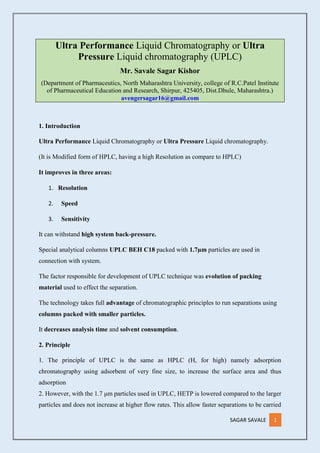
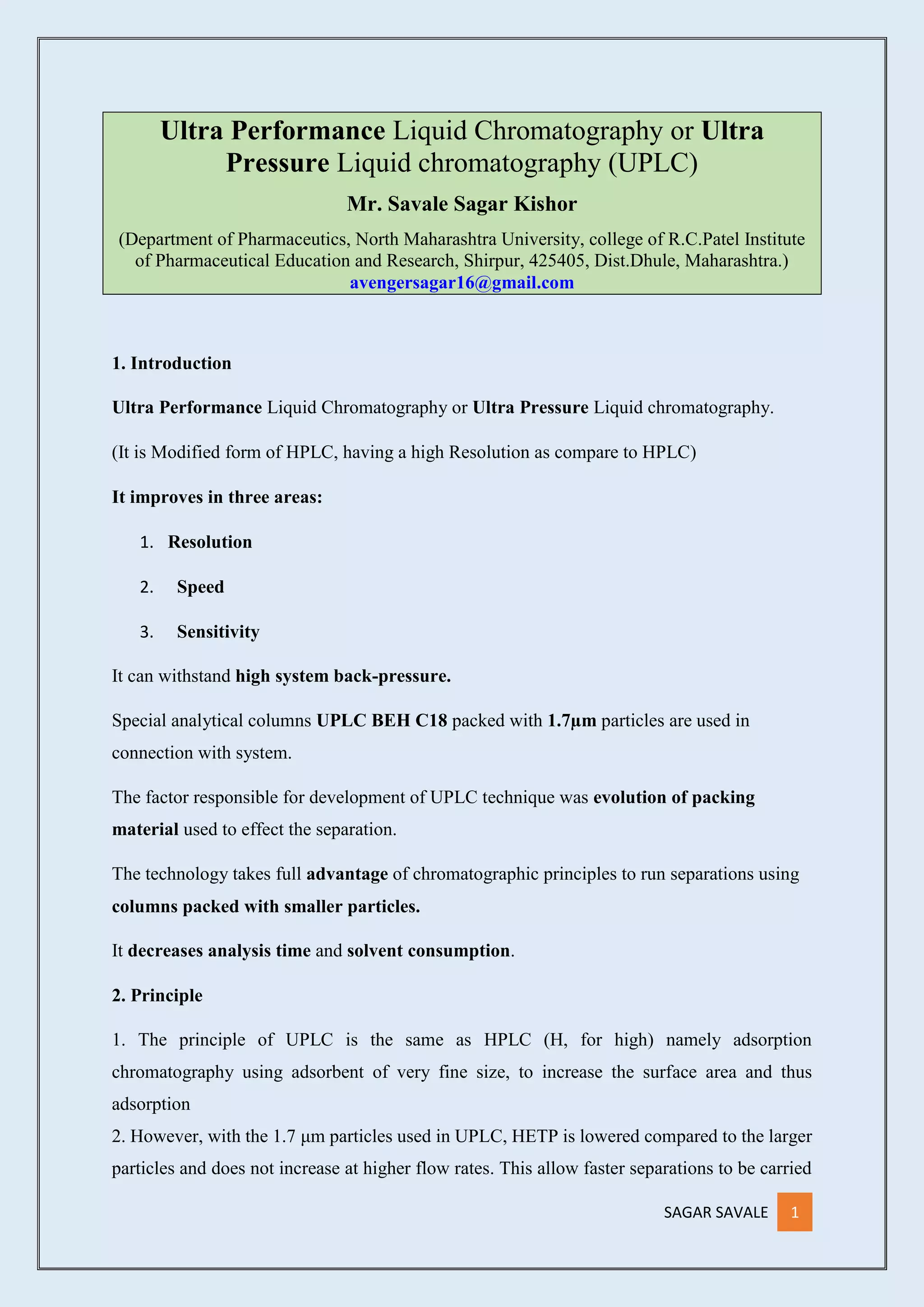
1. Introduction
Ultra Performance Liquid Chromatography or Ultra Pressure Liquid chromatography.
(It is Modified form of HPLC, having a high Resolution as compare to HPLC)
It improves in three areas:
1. Resolution
2. Speed
3. Sensitivity
It can withstand high system back-pressure.
Special analytical columns UPLC BEH C18 packed with 1.7µm particles are used in
connection with system.
The factor responsible for development of UPLC technique was evolution of packing
material used to effect the separation.
The technology takes full advantage of chromatographic principles to run separations using
columns packed with smaller particles.
It decreases analysis time and solvent consumption.
2. Principle
1. The principle of UPLC is the same as HPLC (H, for high) namely adsorption
chromatography using adsorbent of very fine size, to increase the surface area and thus
adsorption
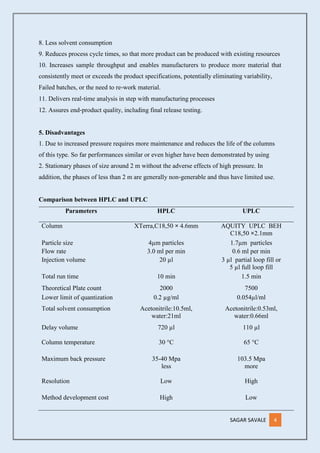
2. However, with the 1.7 μm particles used in UPLC, HETP is lowered compared to the larger
particles and does not increase at higher flow rates. This allow faster separations to be carried
SAGAR SAVALE 2
out on shorter columns and/or with higher flow rates, leading to column increased resolution
between specific peak pairs and increased peak capacity, defined as the number of peaks that
can be separated with specified resolution in a given time interval.
3. The principle of UPLC is based on Van Deemeter equation which describes the
relationship between flow rate and HETP or column efficiency
H=A+B/µ + Cµ
Where,
 A = Eddy diffusion
 B = Longitudinal diffusion
 C = Equilibrium mass transfer
 µ = Flow rate
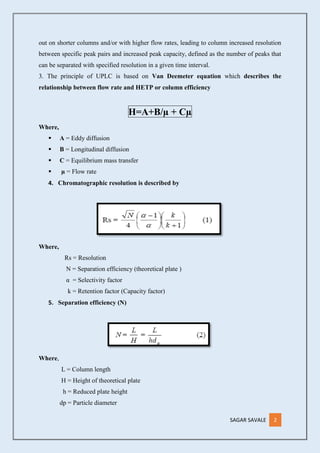
4. Chromatographic resolution is described by
Where,
Rs = Resolution
N = Separation efficiency (theoretical plate )
α = Selectivity factor
k = Retention factor (Capacity factor)
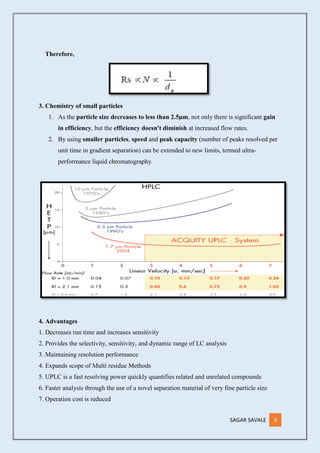
5. Separation efficiency (N)
Where,
L = Column length
H = Height of theoretical plate
h = Reduced plate height
dp = Particle diameter
SAGAR SAVALE 3
Therefore,
3. Chemistry of small particles
1. As the particle size decreases to less than 2.5µm, not only there is significant gain
in efficiency, but the efficiency doesn't diminish at increased flow rates.
2. By using smaller particles, speed and peak capacity (number of peaks resolved per
unit time in gradient separation) can be extended to new limits, termed ultra-
performance liquid chromatography.
4. Advantages
1. Decreases run time and increases sensitivity
2. Provides the selectivity, sensitivity, and dynamic range of LC analysis
3. Maintaining resolution performance
4. Expands scope of Multi residue Methods
5. UPLC is a fast resolving power quickly quantifies related and unrelated compounds
6. Faster analysis through the use of a novel separation material of very fine particle size
7. Operation cost is reduced
SAGAR SAVALE 4
8. Less solvent consumption
9. Reduces process cycle times, so that more product can be produced with existing resources
10. Increases sample throughput and enables manufacturers to produce more material that
consistently meet or exceeds the product specifications, potentially eliminating variability,
Failed batches, or the need to re‐work material.
11. Delivers real‐time analysis in step with manufacturing processes
12. Assures end‐product quality, including final release testing.
5. Disadvantages
1. Due to increased pressure requires more maintenance and reduces the life of the columns
of this type. So far performances similar or even higher have been demonstrated by using
2. Stationary phases of size around 2 m without the adverse effects of high pressure. In
addition, the phases of less than 2 m are generally non‐generable and thus have limited use.
Comparison between HPLC and UPLC
Parameters HPLC UPLC
Column XTerra,C18,50 × 4.6mm AQUITY UPLC BEH
C18,50 ×2.1mm
Particle size 4µm particles 1.7µm particles
Flow rate 3.0 ml per min 0.6 ml per min
Injection volume 20 µl 3 µl partial loop fill or
5 µl full loop fill
Total run time 10 min 1.5 min
Theoretical Plate count 2000 7500
Lower limit of quantization 0.2 µg/ml 0.054µl/ml
Total solvent consumption Acetonitrile:10.5ml,
water:21ml
Acetonitrile:0.53ml,
water:0.66ml
Delay volume 720 µl 110 µl
Column temperature 30 °C 65 °C
Maximum back pressure 35-40 Mpa
less
103.5 Mpa
more
Resolution Low High
Method development cost High Low
SAGAR SAVALE 5
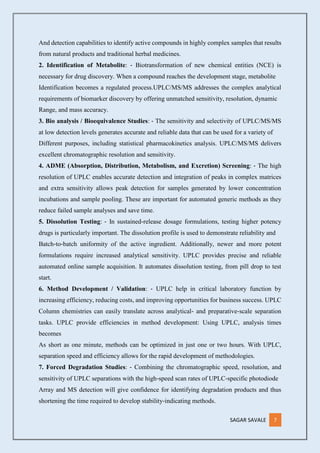
6. Instrumentation
1. A completely new system design with advanced technology in the pump, auto
sampler, detector, data system, and service diagnostics was required.
2. The ACQUITY UPLC system has been designed for low system and dwell
volume.
3. Achieving small particle, high peak capacity separations requires a greater pressure
range than that achievable by HPLC system.
Instrumental Parts
1] Sample injector
2] UPLC Columns
4] Pump
3] Detectors
1] Sample Injection
In UPLC, sample introduction is critical. Conventional injection valves, either automated or
manual, are not designed and hardened to work at extreme pressure. To protect the column
SAGAR SAVALE 6
from extreme pressure fluctuations, the injection process must be relatively pulse‐free and the
swept volume of the device also needs to be minimal to reduce potential band spreading. A fast
injection cycle time is needed to fully capitalize on the speed afforded by UPLC, which in turn
requires a high sample capacity. Low volume injections with minimal carryover are also
required to increase sensitivity.
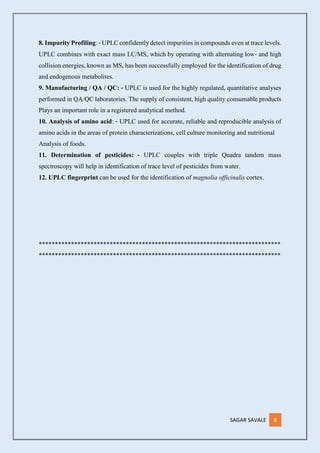
2] UPLC Columns
Resolution is increased in a 1.7m particle packed column because efficiency is better.
Separation of the components of a sample requires a bonded phase that provides both retention
and selectivity. Four bonded phases are available for UPLC separations:
ACQUITY UPLCTM BEH C18 and C8 (straight chain alkyl columns),
ACQUITY UPLC BEH Shield RP18 (embedded polar group columns)
ACQUITY UPLC BEH Phenyl (phenyl group tethered to the silyl functionality with a C6
alkyl) each column chemistry provides a different combination of hydrophobicity, silanol
activity, hydrolytic stability and chemical interaction with analytes.
ACQUITY UPLC BEH C18 and C8 columns are considered the universal columns of choice
for most UPLC separations by providing the widest pH range.
3] Pumps
Pumps are capable of delivering solvent smoothly and reproducibly. Calculated pressure drop
at optimum flow rate for maximum efficiency across the 15cm long column packed with 1.7µm
particle is approximately 15000 psi.
4] Detectors
In UPLC System mainly used following types of Detector
1. UV detectors
2. Fluorescent detector
3. Refractive index detector
4. Light scattering detector
5. Electrochemical detector
6. Mass spectrometric detector
7. Application
1. Analysis of Natural Products and Traditional Herbal Medicine: ‐ UPLC is widely used
for analysis of natural products and herbal medicines. UPLC provides high‐quality separations
SAGAR SAVALE 7
And detection capabilities to identify active compounds in highly complex samples that results
from natural products and traditional herbal medicines.
2. Identification of Metabolite: ‐ Biotransformation of new chemical entities (NCE) is
necessary for drug discovery. When a compound reaches the development stage, metabolite
Identification becomes a regulated process.UPLC/MS/MS addresses the complex analytical
requirements of biomarker discovery by offering unmatched sensitivity, resolution, dynamic
Range, and mass accuracy.
3. Bio analysis / Bioequivalence Studies: ‐ The sensitivity and selectivity of UPLC/MS/MS
at low detection levels generates accurate and reliable data that can be used for a variety of
Different purposes, including statistical pharmacokinetics analysis. UPLC/MS/MS delivers
excellent chromatographic resolution and sensitivity.
4. ADME (Absorption, Distribution, Metabolism, and Excretion) Screening: ‐ The high
resolution of UPLC enables accurate detection and integration of peaks in complex matrices
and extra sensitivity allows peak detection for samples generated by lower concentration
incubations and sample pooling. These are important for automated generic methods as they
reduce failed sample analyses and save time.
5. Dissolution Testing: ‐ In sustained‐release dosage formulations, testing higher potency
drugs is particularly important. The dissolution profile is used to demonstrate reliability and
Batch‐to‐batch uniformity of the active ingredient. Additionally, newer and more potent
formulations require increased analytical sensitivity. UPLC provides precise and reliable
automated online sample acquisition. It automates dissolution testing, from pill drop to test
start.
6. Method Development / Validation: ‐ UPLC help in critical laboratory function by
increasing efficiency, reducing costs, and improving opportunities for business success. UPLC
Column chemistries can easily translate across analytical‐ and preparative‐scale separation
tasks. UPLC provide efficiencies in method development: Using UPLC, analysis times
becomes
As short as one minute, methods can be optimized in just one or two hours. With UPLC,
separation speed and efficiency allows for the rapid development of methodologies.
7. Forced Degradation Studies: ‐ Combining the chromatographic speed, resolution, and
sensitivity of UPLC separations with the high‐speed scan rates of UPLC‐specific photodiode
Array and MS detection will give confidence for identifying degradation products and thus
shortening the time required to develop stability‐indicating methods.
SAGAR SAVALE 8
8. Impurity Profiling: ‐ UPLC confidently detect impurities in compounds even at trace levels.
UPLC combines with exact mass LC/MS, which by operating with alternating low‐ and high
collision energies, known as MS, has been successfully employed for the identification of drug
and endogenous metabolites.
9. Manufacturing / QA / QC: ‐ UPLC is used for the highly regulated, quantitative analyses
performed in QA/QC laboratories. The supply of consistent, high quality consumable products
Plays an important role in a registered analytical method.
10. Analysis of amino acid: ‐ UPLC used for accurate, reliable and reproducible analysis of
amino acids in the areas of protein characterizations, cell culture monitoring and nutritional
Analysis of foods.
11. Determination of pesticides: ‐ UPLC couples with triple Quadra tandem mass
spectroscopy will help in identification of trace level of pesticides from water.
12. UPLC fingerprint can be used for the identification of magnolia officinalis cortex.
***************************************************************************
***************************************************************************

Uplc

  • 1.
    SAGAR SAVALE 1 UltraPerformance Liquid Chromatography or Ultra Pressure Liquid chromatography (UPLC) Mr. Savale Sagar Kishor (Department of Pharmaceutics, North Maharashtra University, college of R.C.Patel Institute of Pharmaceutical Education and Research, Shirpur, 425405, Dist.Dhule, Maharashtra.) avengersagar16@gmail.com 1. Introduction Ultra Performance Liquid Chromatography or Ultra Pressure Liquid chromatography. (It is Modified form of HPLC, having a high Resolution as compare to HPLC) It improves in three areas: 1. Resolution 2. Speed 3. Sensitivity It can withstand high system back-pressure. Special analytical columns UPLC BEH C18 packed with 1.7µm particles are used in connection with system. The factor responsible for development of UPLC technique was evolution of packing material used to effect the separation. The technology takes full advantage of chromatographic principles to run separations using columns packed with smaller particles. It decreases analysis time and solvent consumption. 2. Principle 1. The principle of UPLC is the same as HPLC (H, for high) namely adsorption chromatography using adsorbent of very fine size, to increase the surface area and thus adsorption 2. However, with the 1.7 μm particles used in UPLC, HETP is lowered compared to the larger particles and does not increase at higher flow rates. This allow faster separations to be carried
  • 2.
    SAGAR SAVALE 2 outon shorter columns and/or with higher flow rates, leading to column increased resolution between specific peak pairs and increased peak capacity, defined as the number of peaks that can be separated with specified resolution in a given time interval. 3. The principle of UPLC is based on Van Deemeter equation which describes the relationship between flow rate and HETP or column efficiency H=A+B/µ + Cµ Where,  A = Eddy diffusion  B = Longitudinal diffusion  C = Equilibrium mass transfer  µ = Flow rate 4. Chromatographic resolution is described by Where, Rs = Resolution N = Separation efficiency (theoretical plate ) α = Selectivity factor k = Retention factor (Capacity factor) 5. Separation efficiency (N) Where, L = Column length H = Height of theoretical plate h = Reduced plate height dp = Particle diameter
  • 3.
    SAGAR SAVALE 3 Therefore, 3.Chemistry of small particles 1. As the particle size decreases to less than 2.5µm, not only there is significant gain in efficiency, but the efficiency doesn't diminish at increased flow rates. 2. By using smaller particles, speed and peak capacity (number of peaks resolved per unit time in gradient separation) can be extended to new limits, termed ultra- performance liquid chromatography. 4. Advantages 1. Decreases run time and increases sensitivity 2. Provides the selectivity, sensitivity, and dynamic range of LC analysis 3. Maintaining resolution performance 4. Expands scope of Multi residue Methods 5. UPLC is a fast resolving power quickly quantifies related and unrelated compounds 6. Faster analysis through the use of a novel separation material of very fine particle size 7. Operation cost is reduced
  • 4.
    SAGAR SAVALE 4 8.Less solvent consumption 9. Reduces process cycle times, so that more product can be produced with existing resources 10. Increases sample throughput and enables manufacturers to produce more material that consistently meet or exceeds the product specifications, potentially eliminating variability, Failed batches, or the need to re‐work material. 11. Delivers real‐time analysis in step with manufacturing processes 12. Assures end‐product quality, including final release testing. 5. Disadvantages 1. Due to increased pressure requires more maintenance and reduces the life of the columns of this type. So far performances similar or even higher have been demonstrated by using 2. Stationary phases of size around 2 m without the adverse effects of high pressure. In addition, the phases of less than 2 m are generally non‐generable and thus have limited use. Comparison between HPLC and UPLC Parameters HPLC UPLC Column XTerra,C18,50 × 4.6mm AQUITY UPLC BEH C18,50 ×2.1mm Particle size 4µm particles 1.7µm particles Flow rate 3.0 ml per min 0.6 ml per min Injection volume 20 µl 3 µl partial loop fill or 5 µl full loop fill Total run time 10 min 1.5 min Theoretical Plate count 2000 7500 Lower limit of quantization 0.2 µg/ml 0.054µl/ml Total solvent consumption Acetonitrile:10.5ml, water:21ml Acetonitrile:0.53ml, water:0.66ml Delay volume 720 µl 110 µl Column temperature 30 °C 65 °C Maximum back pressure 35-40 Mpa less 103.5 Mpa more Resolution Low High Method development cost High Low
  • 5.
    SAGAR SAVALE 5 6.Instrumentation 1. A completely new system design with advanced technology in the pump, auto sampler, detector, data system, and service diagnostics was required. 2. The ACQUITY UPLC system has been designed for low system and dwell volume. 3. Achieving small particle, high peak capacity separations requires a greater pressure range than that achievable by HPLC system. Instrumental Parts 1] Sample injector 2] UPLC Columns 4] Pump 3] Detectors 1] Sample Injection In UPLC, sample introduction is critical. Conventional injection valves, either automated or manual, are not designed and hardened to work at extreme pressure. To protect the column
  • 6.
    SAGAR SAVALE 6 fromextreme pressure fluctuations, the injection process must be relatively pulse‐free and the swept volume of the device also needs to be minimal to reduce potential band spreading. A fast injection cycle time is needed to fully capitalize on the speed afforded by UPLC, which in turn requires a high sample capacity. Low volume injections with minimal carryover are also required to increase sensitivity. 2] UPLC Columns Resolution is increased in a 1.7m particle packed column because efficiency is better. Separation of the components of a sample requires a bonded phase that provides both retention and selectivity. Four bonded phases are available for UPLC separations: ACQUITY UPLCTM BEH C18 and C8 (straight chain alkyl columns), ACQUITY UPLC BEH Shield RP18 (embedded polar group columns) ACQUITY UPLC BEH Phenyl (phenyl group tethered to the silyl functionality with a C6 alkyl) each column chemistry provides a different combination of hydrophobicity, silanol activity, hydrolytic stability and chemical interaction with analytes. ACQUITY UPLC BEH C18 and C8 columns are considered the universal columns of choice for most UPLC separations by providing the widest pH range. 3] Pumps Pumps are capable of delivering solvent smoothly and reproducibly. Calculated pressure drop at optimum flow rate for maximum efficiency across the 15cm long column packed with 1.7µm particle is approximately 15000 psi. 4] Detectors In UPLC System mainly used following types of Detector 1. UV detectors 2. Fluorescent detector 3. Refractive index detector 4. Light scattering detector 5. Electrochemical detector 6. Mass spectrometric detector 7. Application 1. Analysis of Natural Products and Traditional Herbal Medicine: ‐ UPLC is widely used for analysis of natural products and herbal medicines. UPLC provides high‐quality separations
  • 7.
    SAGAR SAVALE 7 Anddetection capabilities to identify active compounds in highly complex samples that results from natural products and traditional herbal medicines. 2. Identification of Metabolite: ‐ Biotransformation of new chemical entities (NCE) is necessary for drug discovery. When a compound reaches the development stage, metabolite Identification becomes a regulated process.UPLC/MS/MS addresses the complex analytical requirements of biomarker discovery by offering unmatched sensitivity, resolution, dynamic Range, and mass accuracy. 3. Bio analysis / Bioequivalence Studies: ‐ The sensitivity and selectivity of UPLC/MS/MS at low detection levels generates accurate and reliable data that can be used for a variety of Different purposes, including statistical pharmacokinetics analysis. UPLC/MS/MS delivers excellent chromatographic resolution and sensitivity. 4. ADME (Absorption, Distribution, Metabolism, and Excretion) Screening: ‐ The high resolution of UPLC enables accurate detection and integration of peaks in complex matrices and extra sensitivity allows peak detection for samples generated by lower concentration incubations and sample pooling. These are important for automated generic methods as they reduce failed sample analyses and save time. 5. Dissolution Testing: ‐ In sustained‐release dosage formulations, testing higher potency drugs is particularly important. The dissolution profile is used to demonstrate reliability and Batch‐to‐batch uniformity of the active ingredient. Additionally, newer and more potent formulations require increased analytical sensitivity. UPLC provides precise and reliable automated online sample acquisition. It automates dissolution testing, from pill drop to test start. 6. Method Development / Validation: ‐ UPLC help in critical laboratory function by increasing efficiency, reducing costs, and improving opportunities for business success. UPLC Column chemistries can easily translate across analytical‐ and preparative‐scale separation tasks. UPLC provide efficiencies in method development: Using UPLC, analysis times becomes As short as one minute, methods can be optimized in just one or two hours. With UPLC, separation speed and efficiency allows for the rapid development of methodologies. 7. Forced Degradation Studies: ‐ Combining the chromatographic speed, resolution, and sensitivity of UPLC separations with the high‐speed scan rates of UPLC‐specific photodiode Array and MS detection will give confidence for identifying degradation products and thus shortening the time required to develop stability‐indicating methods.
  • 8.
    SAGAR SAVALE 8 8.Impurity Profiling: ‐ UPLC confidently detect impurities in compounds even at trace levels. UPLC combines with exact mass LC/MS, which by operating with alternating low‐ and high collision energies, known as MS, has been successfully employed for the identification of drug and endogenous metabolites. 9. Manufacturing / QA / QC: ‐ UPLC is used for the highly regulated, quantitative analyses performed in QA/QC laboratories. The supply of consistent, high quality consumable products Plays an important role in a registered analytical method. 10. Analysis of amino acid: ‐ UPLC used for accurate, reliable and reproducible analysis of amino acids in the areas of protein characterizations, cell culture monitoring and nutritional Analysis of foods. 11. Determination of pesticides: ‐ UPLC couples with triple Quadra tandem mass spectroscopy will help in identification of trace level of pesticides from water. 12. UPLC fingerprint can be used for the identification of magnolia officinalis cortex. *************************************************************************** ***************************************************************************