NANO LIQUID
CHROMATOGRAPHY & ULTRA
PERFORMANCE LIQUID
CHROMATOGRAPHY
Srinivasa Rao college of Pharmacy, P.M.palem, Visakhapatnam
2016-2018
By
M.Trilochana M.Pharm
Pharmaceutical analysis and quality assurance
Contents:
 Introduction
 Classification of HPLC systems
 Advantages over HPLC
 Instrumentation
 Applications
 Nano High performance liquid chromatography
(Nano HPLC) is an important qualitative and
quantitative technique, generally used for the
estimation of pharmaceutical and biological
samples.
 After a little modification in HPLC, in 1988
Karlsson and Novotny were introduced the Nano
Liquid chromatography (NanoLC) technique.
 NanoLC systems has been driven by biological
applications and primarily proteomics research.
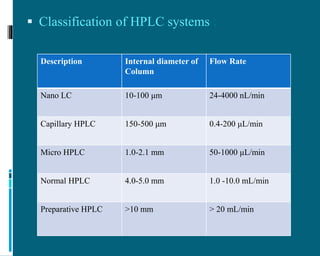
 Classification of HPLC systems :
Description Internal diameter of
Column
Flow Rate
Nano LC 10-100 μm 24-4000 nL/min
Capillary HPLC 150-500 μm 0.4-200 μL/min
Micro HPLC 1.0-2.1 mm 50-1000 μL/min
Normal HPLC 4.0-5.0 mm 1.0 -10.0 mL/min
Preparative HPLC >10 mm > 20 mL/min
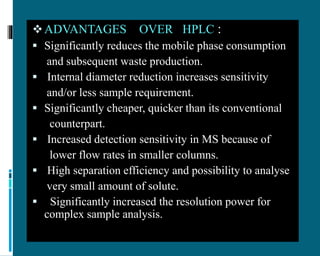
ADVANTAGES OVER HPLC :
 Significantly reduces the mobile phase consumption
and subsequent waste production.
 Internal diameter reduction increases sensitivity
and/or less sample requirement.
 Significantly cheaper, quicker than its conventional
counterpart.
 Increased detection sensitivity in MS because of
lower flow rates in smaller columns.
 High separation efficiency and possibility to analyse
very small amount of solute.
 Significantly increased the resolution power for
complex sample analysis.
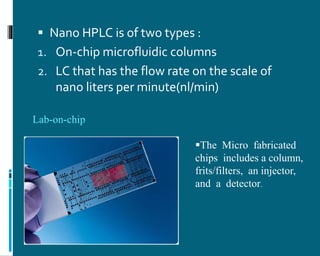
 Nano HPLC is of two types :
1. On-chip microfluidic columns
2. LC that has the flow rate on the scale of
nano liters per minute(nl/min)
Lab-on-chip
The Micro fabricated
chips includes a column,
frits/filters, an injector,
and a detector.
 A relatively recent development in nanoLC is
the introduction of chip-based structures.
 Chip based systems aim at integrating the
connections , columns, and spray needle in
one device to make installation and operation
of nanoLC system easier.
 This is also called as “Lab-on-a-chip.”
 LOC devices make use of microfluidic
techniques, which use small amounts of fluids
(10-9 to 10-18 litres), and channels with
dimensions of tens to hundreds of micrometres.
INSTRUMENTATION :
 Pumps : Split pumps and Splitless pumps.
 Columns: Internal diameter of nanoLC is
75μm.
 Injectors: Direct injection setups can be used
in nano-LC systems.
 Detectors: Diode array detector (DAD)
Applications :
 The study of proteins and nucleic acids in
proteomics and genomics.
 Separation of sulfonamides : Nano-liquid
chromatography coupled with mass
spectrometry was used for the simultaneous
determination of 18 sulfonamides.
 Water analysis : Quantitation of
perfluorooctanoic acid (PFOA) and
perfluorooctane sulphonate (PFOS) in surface
water by using a combination of on-line solid-
phase extraction, nano-liquid chromatography,
and nano spray mass spectrometry.
 Nano-LC for glyco bioanalysis : Structural
heterogeneity of glyco conjugates and glycans
in biological matrices.
 Determination of abused drugs and
metabolites in human hair
 Other applications :
 In the analysis of Biological and
environmental samples: When small amounts
of samples are available such as blood of
infants, cerebrospinal fluid , hormones,
enzymes and xenobiotics at nano levels.
 High throughput screening (HTS) and drug
discovery where the limits of detection are
very low.
 Proteomic and genomic research.
 Detection of accumulated drug samples in the
body.
Ultra performance liquid
chromatography
 Introduction
 Advantages
 Disadvantages
 Instrumentation
 Comparison between UPLC, HPLC &
NanoLC
 Applications
 Ultra Performance Liquid Chromatography
(UPLC) is a relatively new technique giving
new possibilities in liquid chromatography,
especially concerning decrease of time and
solvent consumption.
 The separation on UPLC is performed under
very high pressures (up to 100 MPa) .
 It improves in three areas: chromatographic
resolution, speed and sensitivity analysis.
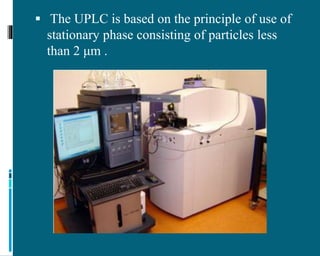
 The UPLC is based on the principle of use of
stationary phase consisting of particles less
than 2 μm .
Advantages :
 Decreases run time and increases sensitivity
 Provides the selectivity, sensitivity, and dynamic
range of LC analysis
 Maintaining resolution performance.
 Expands scope of Multi residue Methods
 UPLC’s fast resolving power quickly quantifies
related and unrelated compounds
 Faster analysis through the use of a novel
separation material of very fine particle size
Cont..
 Operation cost is reduced
 Less solvent consumption
 Reduces process cycle times, so that more
product can be produced with existing
resources
 Increases sample throughput and enables
manufacturers to produce more material.
 Delivers real-time analysis in step with
manufacturing processes
 Assures end-product quality, including final
release testing
Disadvantages :
 Due to increased pressure requires more
maintenance and reduces the life of the
columns of this type.
 So far performance similar or even higher has
been demonstrated by using stationary phases
of size around 2 μm without the adverse effects
of high pressure.
 In addition, the phases of less than 2 μm are
generally non-regenerable.
Instrumentation :
 The Acquity UPLC system consists of :
 Binary solvent manager
 Sample manager including the column heater
 Optional Sample manager
 Pumps
 Detector
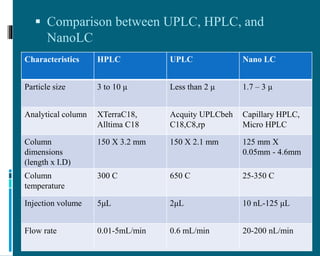
 Comparison between UPLC, HPLC, and
NanoLC
Characteristics HPLC UPLC Nano LC
Particle size 3 to 10 μ Less than 2 μ 1.7 – 3 μ
Analytical column XTerraC18,
Alltima C18
Acquity UPLCbeh
C18,C8,rp
Capillary HPLC,
Micro HPLC
Column
dimensions
(length x I.D)
150 X 3.2 mm 150 X 2.1 mm 125 mm X
0.05mm - 4.6mm
Column
temperature
300 C 650 C 25-350 C
Injection volume 5μL 2μL 10 nL-125 μL
Flow rate 0.01-5mL/min 0.6 mL/min 20-200 nL/min
 Applications of UPLC :
 Drug Discovery : UPLC improves the drug
discovery process by means of high
throughput screening, combinational
chemistry.
 Analysis of Dosage form : It provides high
speed, accuracy and reproducible results for
isocratic and gradient analysis of drugs and
their related substance. Thus method
development time decrease.
 Analysis of amino acids : UPLC used from
accurate, reliable and reproducible analysis of
amino acids.
 Determination of Pesticides : UPLC couples
with triple Quadra-pole tandem mass
spectroscopy will help in identification of trace
level of pesticides from water.
 High throughput quantitative analysis :
UPLC coupled with time of flight mass
spectroscopy give the metabolic stability assay.
 Bioanalysis / Bioequivalence Studies : UPLC
delivers excellent chromatographic resolution
and sensitivity.
 Dissolution Testing : UPLC provides precise
and reliable automated online sample
acquisition.
References:
 http://www.justchromatography.com/hplc/nano-
liquid-chromatography
 http://www.chromatographyonline.com/nano-
lc-principles-evolution-and-state-art-
technique?id=&sk=&date=&%0A%09%09%0
9&pageID=4
 https://www.researchgate.net/publication/27473
4689
 https://www.news-medical.net/life-
sciences/What-is-Lab-on-a-Chip.aspx
Nano LC and UPLC

Nano LC and UPLC

  • 1.
    NANO LIQUID CHROMATOGRAPHY &ULTRA PERFORMANCE LIQUID CHROMATOGRAPHY Srinivasa Rao college of Pharmacy, P.M.palem, Visakhapatnam 2016-2018 By M.Trilochana M.Pharm Pharmaceutical analysis and quality assurance
  • 2.
    Contents:  Introduction  Classificationof HPLC systems  Advantages over HPLC  Instrumentation  Applications
  • 3.
     Nano Highperformance liquid chromatography (Nano HPLC) is an important qualitative and quantitative technique, generally used for the estimation of pharmaceutical and biological samples.  After a little modification in HPLC, in 1988 Karlsson and Novotny were introduced the Nano Liquid chromatography (NanoLC) technique.  NanoLC systems has been driven by biological applications and primarily proteomics research.
  • 4.
     Classification ofHPLC systems : Description Internal diameter of Column Flow Rate Nano LC 10-100 μm 24-4000 nL/min Capillary HPLC 150-500 μm 0.4-200 μL/min Micro HPLC 1.0-2.1 mm 50-1000 μL/min Normal HPLC 4.0-5.0 mm 1.0 -10.0 mL/min Preparative HPLC >10 mm > 20 mL/min
  • 5.
    ADVANTAGES OVER HPLC:  Significantly reduces the mobile phase consumption and subsequent waste production.  Internal diameter reduction increases sensitivity and/or less sample requirement.  Significantly cheaper, quicker than its conventional counterpart.  Increased detection sensitivity in MS because of lower flow rates in smaller columns.  High separation efficiency and possibility to analyse very small amount of solute.  Significantly increased the resolution power for complex sample analysis.
  • 6.
     Nano HPLCis of two types : 1. On-chip microfluidic columns 2. LC that has the flow rate on the scale of nano liters per minute(nl/min) Lab-on-chip The Micro fabricated chips includes a column, frits/filters, an injector, and a detector.
  • 7.
     A relativelyrecent development in nanoLC is the introduction of chip-based structures.  Chip based systems aim at integrating the connections , columns, and spray needle in one device to make installation and operation of nanoLC system easier.  This is also called as “Lab-on-a-chip.”  LOC devices make use of microfluidic techniques, which use small amounts of fluids (10-9 to 10-18 litres), and channels with dimensions of tens to hundreds of micrometres.
  • 8.
    INSTRUMENTATION :  Pumps: Split pumps and Splitless pumps.  Columns: Internal diameter of nanoLC is 75μm.  Injectors: Direct injection setups can be used in nano-LC systems.  Detectors: Diode array detector (DAD)
  • 9.
    Applications :  Thestudy of proteins and nucleic acids in proteomics and genomics.  Separation of sulfonamides : Nano-liquid chromatography coupled with mass spectrometry was used for the simultaneous determination of 18 sulfonamides.
  • 10.
     Water analysis: Quantitation of perfluorooctanoic acid (PFOA) and perfluorooctane sulphonate (PFOS) in surface water by using a combination of on-line solid- phase extraction, nano-liquid chromatography, and nano spray mass spectrometry.  Nano-LC for glyco bioanalysis : Structural heterogeneity of glyco conjugates and glycans in biological matrices.  Determination of abused drugs and metabolites in human hair
  • 11.
     Other applications:  In the analysis of Biological and environmental samples: When small amounts of samples are available such as blood of infants, cerebrospinal fluid , hormones, enzymes and xenobiotics at nano levels.  High throughput screening (HTS) and drug discovery where the limits of detection are very low.  Proteomic and genomic research.  Detection of accumulated drug samples in the body.
  • 12.
    Ultra performance liquid chromatography Introduction  Advantages  Disadvantages  Instrumentation  Comparison between UPLC, HPLC & NanoLC  Applications
  • 13.
     Ultra PerformanceLiquid Chromatography (UPLC) is a relatively new technique giving new possibilities in liquid chromatography, especially concerning decrease of time and solvent consumption.  The separation on UPLC is performed under very high pressures (up to 100 MPa) .  It improves in three areas: chromatographic resolution, speed and sensitivity analysis.
  • 14.
     The UPLCis based on the principle of use of stationary phase consisting of particles less than 2 μm .
  • 15.
    Advantages :  Decreasesrun time and increases sensitivity  Provides the selectivity, sensitivity, and dynamic range of LC analysis  Maintaining resolution performance.  Expands scope of Multi residue Methods  UPLC’s fast resolving power quickly quantifies related and unrelated compounds  Faster analysis through the use of a novel separation material of very fine particle size
  • 16.
    Cont..  Operation costis reduced  Less solvent consumption  Reduces process cycle times, so that more product can be produced with existing resources  Increases sample throughput and enables manufacturers to produce more material.  Delivers real-time analysis in step with manufacturing processes  Assures end-product quality, including final release testing
  • 17.
    Disadvantages :  Dueto increased pressure requires more maintenance and reduces the life of the columns of this type.  So far performance similar or even higher has been demonstrated by using stationary phases of size around 2 μm without the adverse effects of high pressure.  In addition, the phases of less than 2 μm are generally non-regenerable.
  • 18.
    Instrumentation :  TheAcquity UPLC system consists of :  Binary solvent manager  Sample manager including the column heater  Optional Sample manager  Pumps  Detector
  • 19.
     Comparison betweenUPLC, HPLC, and NanoLC Characteristics HPLC UPLC Nano LC Particle size 3 to 10 μ Less than 2 μ 1.7 – 3 μ Analytical column XTerraC18, Alltima C18 Acquity UPLCbeh C18,C8,rp Capillary HPLC, Micro HPLC Column dimensions (length x I.D) 150 X 3.2 mm 150 X 2.1 mm 125 mm X 0.05mm - 4.6mm Column temperature 300 C 650 C 25-350 C Injection volume 5μL 2μL 10 nL-125 μL Flow rate 0.01-5mL/min 0.6 mL/min 20-200 nL/min
  • 20.
     Applications ofUPLC :  Drug Discovery : UPLC improves the drug discovery process by means of high throughput screening, combinational chemistry.  Analysis of Dosage form : It provides high speed, accuracy and reproducible results for isocratic and gradient analysis of drugs and their related substance. Thus method development time decrease.
  • 21.
     Analysis ofamino acids : UPLC used from accurate, reliable and reproducible analysis of amino acids.  Determination of Pesticides : UPLC couples with triple Quadra-pole tandem mass spectroscopy will help in identification of trace level of pesticides from water.  High throughput quantitative analysis : UPLC coupled with time of flight mass spectroscopy give the metabolic stability assay.
  • 22.
     Bioanalysis /Bioequivalence Studies : UPLC delivers excellent chromatographic resolution and sensitivity.  Dissolution Testing : UPLC provides precise and reliable automated online sample acquisition.
  • 23.