©
     Donald E. Hanna
      University of Wisconsin
       dehanna@wisc.edu
Open University of Catalunya
      April 14, 2011
My research framework and interests


!   Organizational models and frameworks that support
    innovation and change
!   The importance of organizational leadership and vision
!   The importance of social and group interaction in
    learning
!   Organizational adaptation toward change
!   Building quality into learning frameworks
My work at UOC


!   Publication/scholarship
   !    Chapter on emerging technologies and organisational
        models for universities—Michael Moore, Handbook of
        Distance Education
   !    Chapter on organising learning in online environments—
        Diane Salter book entitled: Lessons from Award Winning
        Teachers: Implications for Staff Development and Institutional
        Change
   !    Atlantis Proposal—Benchmarking eLearning in the
        European Union and the USA; funding proposal
        submitted to EU and USA FIPSE program
   !    Also looking at educational model of UOC as a case
        study for comparison—this has taken more time than I
        thought it would
Thank you all


!   Albert and Enric
!   Cris and Yolanda
!   All of you as colleagues and friends
Today’s conversation


!   Fostering a Learning Culture: Strategies
    Toward Excellence

   !    Changing   times and contexts
   !    Changing   learners
   !    Changing   teaching and learning
   !    Changing   organisational structures
   !    Changing   services to learners
University of Wisconsin


     Madison, Wisconsin
University of Wisconsin
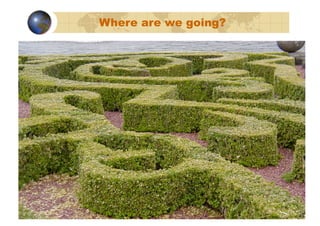
Where are we going?
http://www.youtube.com/watch?v=L2zqTYgcpfg
Changing times


!  “Through education, a person and his or her world come
to terms and he or she becomes what he or she is within
it.” Russell Kleis
!  “Good teachers possess a capacity for connectedness. To
teach is to create a safe place for learning.” Parker Palmer
!  “The mind is not a vessel to be filled but a fire to be
kindled. Plutarch
!  What we have to learn to do, we learn by doing.”     Aristotle

!  “Life moves pretty fast sometimes. If you don't stop and
look around once in a while, you could miss it.” Ferris Bueller
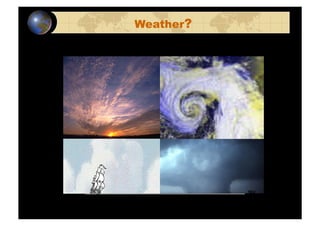
Weather?
In the United States


!   Currently approximately 38% of adults of working age—
    25-64 years old—have a 4 year college degree
!   By 2020, it is estimated that 62% of all jobs will require
    advanced education currently certified by at least a 4
    year degree
!   Meeting this challenge will require a dramatic expansion
    of places in universities, greater efficiency, and new
    educational models
Changes in context


!   The new context and need for learning
!   The importance of education in building democratic
    societies
!   The knowledge economy
!   From standardization to customization
!   From isolation of knowledge to connection of knowledge
   !    across   disciplines
   !    across   organizational boundaries
   !    across   cultures
   !    across   people
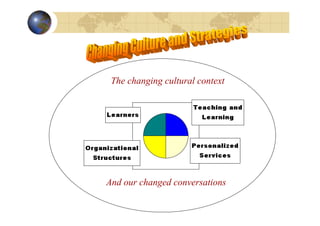
The changing cultural context


And our changed conversations
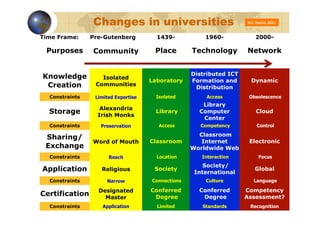
Changes in universities                              D.E.	
  Hanna,	
  2011	


Time Frame:     Pre-Gutenberg          1439-           1960-               2000-

 Purposes       Community             Place        Technology        Network


                                                   Distributed ICT
Knowledge          Isolated
                                     Laboratory    Formation and        Dynamic
 Creation        Communities
                                                    Distribution
  Constraints    Limited Expertise     Isolated         Access        Obsolescence
                                                      Library
                   Alexandria
  Storage         Irish Monks
                                       Library       Computer               Cloud
                                                      Center
  Constraints      Preservation         Access        Competency             Control
                                                     Classroom
 Sharing/
                Word of Mouth        Classroom        Internet        Electronic
 Exchange                                          Worldwide Web
  Constraints         Reach            Location       Interaction             Focus
                                                       Society/
Application        Religious          Society
                                                    International
                                                                           Global

  Constraints        Narrow          Connections       Culture            Language

                  Designated         Conferred       Conferred       Competency
Certification       Master            Degree          Degree         Assessment?
  Constraints       Application        Limited        Standards        Recognition
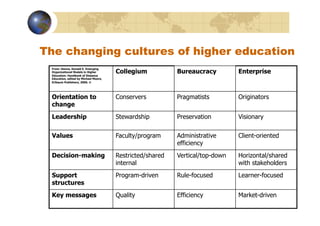
The changing cultures of higher education
 From: Hanna, Donald E. Emerging
 Organizational Models in Higher
 Education: Handbook of Distance
                                       Collegium           Bureaucracy         Enterprise
 Education, edited by Michael Moore,
 Erlbaum Publishers, 2006. ©


 Orientation to                        Conservers          Pragmatists         Originators
 change
 Leadership                            Stewardship         Preservation        Visionary

 Values                                Faculty/program     Administrative      Client-oriented
                                                           efficiency
 Decision-making                       Restricted/shared   Vertical/top-down   Horizontal/shared
                                       internal                                with stakeholders
 Support                               Program-driven      Rule-focused        Learner-focused
 structures
 Key messages                          Quality             Efficiency          Market-driven
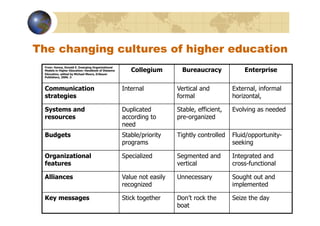
The changing cultures of higher education
 From: Hanna, Donald E. Emerging Organizational
 Models in Higher Education: Handbook of Distance      Collegium         Bureaucracy            Enterprise
 Education, edited by Michael Moore, Erlbaum
 Publishers, 2006. ©


 Communication                                      Internal           Vertical and         External, informal
 strategies                                                            formal               horizontal,

 Systems and                                        Duplicated         Stable, efficient,   Evolving as needed
 resources                                          according to       pre-organized
                                                    need
 Budgets                                            Stable/priority    Tightly controlled   Fluid/opportunity-
                                                    programs                                seeking

 Organizational                                     Specialized        Segmented and        Integrated and
 features                                                              vertical             cross-functional

 Alliances                                          Value not easily   Unnecessary          Sought out and
                                                    recognized                              implemented

 Key messages                                       Stick together     Don’t rock the       Seize the day
                                                                       boat
The changing cultures of higher education
  From: Hanna, Donald E. Emerging
  Organizational Models in Higher           Collegium          Bureaucracy           Enterprise
  Education: Handbook of Distance
  Education, edited by Michael Moore,
  Erlbaum Publishers, 2006. ©


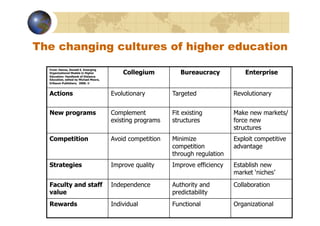
  Actions                               Evolutionary        Targeted             Revolutionary


  New programs                          Complement          Fit existing         Make new markets/
                                        existing programs   structures           force new
                                                                                 structures
  Competition                           Avoid competition   Minimize             Exploit competitive
                                                            competition          advantage
                                                            through regulation
  Strategies                            Improve quality     Improve efficiency   Establish new
                                                                                 market ‘niches’
  Faculty and staff                     Independence        Authority and        Collaboration
  value                                                     predictability
  Rewards                               Individual          Functional           Organizational
Changing conversations


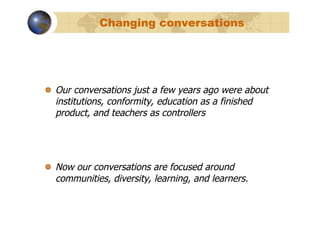
!   Our conversations just a few years ago were about
    institutions, conformity, education as a finished
    product, and teachers as controllers


!   Now our conversations are focused around
    communities, diversity, learning, and learners.
Changes in learners

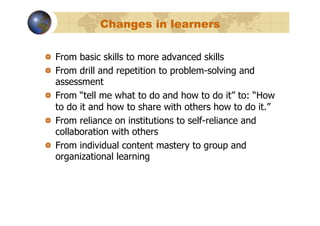
!   From basic skills to more advanced skills
!   From drill and repetition to problem-solving and
    assessment
!   From “tell me what to do and how to do it” to: “How
    to do it and how to share with others how to do it.”
!   From reliance on institutions to self-reliance and
    collaboration with others
!   From individual content mastery to group and
    organizational learning
Changes in teaching and learning


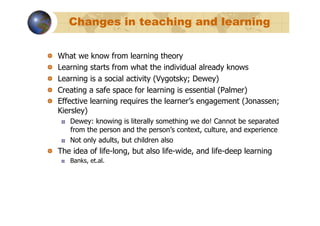
!       What we know from learning theory
!       Learning starts from what the individual already knows
!       Learning is a social activity (Vygotsky; Dewey)
!       Creating a safe space for learning is essential (Palmer)
!       Effective learning requires the learner’s engagement (Jonassen;
        Kiersley)
         !    Dewey: knowing is literally something we do! Cannot be separated
              from the person and the person’s context, culture, and experience
         !    Not only adults, but children also
!   The idea of life-long, but also life-wide, and life-deep learning
         !    Banks, et.al.
How do children learn?


!       Constantly interact with their environment
!       Seek out new information
!       Learn immediately from their experiences
!       Ask a lot of questions
!       Look for every opportunity to interact with other people
!       Make lots of ‘mistakes’
!       Use their ‘mistakes’ to learn (no fear)


Why can’t we create this in adult settings?
Ideal learning environments


!   Learner and problem-centered
!   Highly social and interactive
!   Very often collaborative
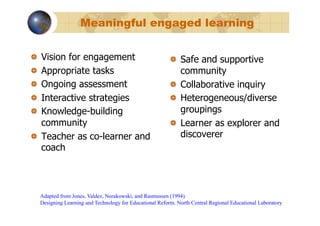
Meaningful engaged learning


!   Vision for engagement
                                                               !   Safe and supportive
!   Appropriate tasks
                                                                   community
!   Ongoing assessment
                                                               !   Collaborative inquiry
!   Interactive strategies
                                                               !   Heterogeneous/diverse
!   Knowledge-building
                                                                   groupings
    community                                                  !   Learner as explorer and
!   Teacher as co-learner and                                      discoverer
    coach


        Adapted from Jones, Valdez, Norakowski, and Rasmussen (1994).
        Designing Learning and Technology for Educational Reform. North Central Regional Educational Laboratory.
Changes in learner services


!   Services must be customized and responsive to the
    learner’s needs
!   Learner services are emotional, not mechanical
!   The importance of learner services as a valuable
    element of quality learning environments
   !    Herzberg’s Hygiene Factor Theory
Strategies for Excellence
Strategies for online educators


!   Educate leaders about the changing needs of learners
!   Develop rewards for the ‘scholarship of teaching’,
    (Boyer, 1990)
!   Build opportunities for teachers and learners to
    collaborate
!   Support development of citizen, professional and
    personal learning in social situations
!   Encourage teachers who provide opportunities for
    learners to teach in low-risk situations
Strategies for online educators


!   Focus on building an entrepreneurial, ethical, and
    collaborative culture
!   Establish partnerships and alliances across
    organizational boundaries
!   Build wherever possible external and internal problem-
    solving strategies that involve key stakeholders
!   Expand outreach to important communities
!   Develop linkage strategies that enable new innovations
    to enter our organizations
!   Facilitate the diffusion of innovation
!   Increase paths of access to learning
Strategies for online educators


!   Integrate team-building, problem-solving, and critical
    thinking systematically throughout the curriculum
!   Develop strategies for engaging learners in teaching
    what they are learning
!   Connect learners with each other
!   Connect learning with the learner’s previous
    experiences in every way possible
!   Invest in developing teaching skills in the creative use
    of technology
Strategies for online educators


!   Conduct research regarding effective administrative
    and academic support functions
   !    responsiveness to diverse and individual students needs as a primary
        measure of overall quality of programs

!   Build remotely accessible 24 hour, 7 days per week
    services in every way possible:
   !    computing support, library support, registration and records access,
        institutional information; handbooks and governance processes, etc.

!   Develop personalized learning services accessible to all
!   Create points of access and advocacy for learners
Strategies for online educators


!   Consider “appreciative inquiry” as an overall strategy for
    organizational change (Coopenrider; Watkins; Mohr)
   !    Discover
   !    Dream
   !    Design
   !    Deliver
!   Appreciative inquiry is based on a deceptively simple
    premise: that organizations grow in the direction of what
    they repeatedly ask questions about and focus their
    attention on.
The future


!   Emerging Trends
   !    Benchmarking, Collaboration, Modular Degrees, Need-based
        Planning
!   Indicators of Excellence
   !    Alignment, Leadership, Assessment, Curriculum, Support
!   Indicators of Problems
   !    Poor Planning, Disconnection with Mission, Lack of
        Communication, Poor Financial Model, Poor Learning Model,
        Teachers and Students “on their own”
Final thoughts


!   Multiple levels of planning for quality
   !    Ie course, programme, institution
!   Multiple perspectives of assessment
   !    Ie learners, faculty, employers, administration, society
!   Assessment outcomes built into programme decision-
    making
!   Broad-based planning and communication
!   Continuous improvement built into the culture at
    every level
knowing is literally something
            we do.
            John Dewey

Uoc presentation bsc_04_22_2011

  • 1.
    © Donald E. Hanna University of Wisconsin dehanna@wisc.edu Open University of Catalunya April 14, 2011
  • 2.
    My research frameworkand interests !   Organizational models and frameworks that support innovation and change !   The importance of organizational leadership and vision !   The importance of social and group interaction in learning !   Organizational adaptation toward change !   Building quality into learning frameworks
  • 3.
    My work atUOC !   Publication/scholarship !  Chapter on emerging technologies and organisational models for universities—Michael Moore, Handbook of Distance Education !  Chapter on organising learning in online environments— Diane Salter book entitled: Lessons from Award Winning Teachers: Implications for Staff Development and Institutional Change !  Atlantis Proposal—Benchmarking eLearning in the European Union and the USA; funding proposal submitted to EU and USA FIPSE program !  Also looking at educational model of UOC as a case study for comparison—this has taken more time than I thought it would
  • 4.
    Thank you all !  Albert and Enric !   Cris and Yolanda !   All of you as colleagues and friends
  • 5.
    Today’s conversation !  Fostering a Learning Culture: Strategies Toward Excellence !  Changing times and contexts !  Changing learners !  Changing teaching and learning !  Changing organisational structures !  Changing services to learners
  • 6.
    University of Wisconsin Madison, Wisconsin
  • 7.
  • 8.
  • 9.
  • 10.
    Changing times !  “Througheducation, a person and his or her world come to terms and he or she becomes what he or she is within it.” Russell Kleis !  “Good teachers possess a capacity for connectedness. To teach is to create a safe place for learning.” Parker Palmer !  “The mind is not a vessel to be filled but a fire to be kindled. Plutarch !  What we have to learn to do, we learn by doing.” Aristotle !  “Life moves pretty fast sometimes. If you don't stop and look around once in a while, you could miss it.” Ferris Bueller
  • 11.
  • 12.
    In the UnitedStates !   Currently approximately 38% of adults of working age— 25-64 years old—have a 4 year college degree !   By 2020, it is estimated that 62% of all jobs will require advanced education currently certified by at least a 4 year degree !   Meeting this challenge will require a dramatic expansion of places in universities, greater efficiency, and new educational models
  • 13.
    Changes in context !  The new context and need for learning !   The importance of education in building democratic societies !   The knowledge economy !   From standardization to customization !   From isolation of knowledge to connection of knowledge !  across disciplines !  across organizational boundaries !  across cultures !  across people
  • 14.
    The changing culturalcontext And our changed conversations
  • 15.
    Changes in universities D.E.  Hanna,  2011   Time Frame: Pre-Gutenberg 1439- 1960- 2000- Purposes Community Place Technology Network Distributed ICT Knowledge Isolated Laboratory Formation and Dynamic Creation Communities Distribution Constraints Limited Expertise Isolated Access Obsolescence Library Alexandria Storage Irish Monks Library Computer Cloud Center Constraints Preservation Access Competency Control Classroom Sharing/ Word of Mouth Classroom Internet Electronic Exchange Worldwide Web Constraints Reach Location Interaction Focus Society/ Application Religious Society International Global Constraints Narrow Connections Culture Language Designated Conferred Conferred Competency Certification Master Degree Degree Assessment? Constraints Application Limited Standards Recognition
  • 16.
    The changing culturesof higher education From: Hanna, Donald E. Emerging Organizational Models in Higher Education: Handbook of Distance Collegium Bureaucracy Enterprise Education, edited by Michael Moore, Erlbaum Publishers, 2006. © Orientation to Conservers Pragmatists Originators change Leadership Stewardship Preservation Visionary Values Faculty/program Administrative Client-oriented efficiency Decision-making Restricted/shared Vertical/top-down Horizontal/shared internal with stakeholders Support Program-driven Rule-focused Learner-focused structures Key messages Quality Efficiency Market-driven
  • 17.
    The changing culturesof higher education From: Hanna, Donald E. Emerging Organizational Models in Higher Education: Handbook of Distance Collegium Bureaucracy Enterprise Education, edited by Michael Moore, Erlbaum Publishers, 2006. © Communication Internal Vertical and External, informal strategies formal horizontal, Systems and Duplicated Stable, efficient, Evolving as needed resources according to pre-organized need Budgets Stable/priority Tightly controlled Fluid/opportunity- programs seeking Organizational Specialized Segmented and Integrated and features vertical cross-functional Alliances Value not easily Unnecessary Sought out and recognized implemented Key messages Stick together Don’t rock the Seize the day boat
  • 18.
    The changing culturesof higher education From: Hanna, Donald E. Emerging Organizational Models in Higher Collegium Bureaucracy Enterprise Education: Handbook of Distance Education, edited by Michael Moore, Erlbaum Publishers, 2006. © Actions Evolutionary Targeted Revolutionary New programs Complement Fit existing Make new markets/ existing programs structures force new structures Competition Avoid competition Minimize Exploit competitive competition advantage through regulation Strategies Improve quality Improve efficiency Establish new market ‘niches’ Faculty and staff Independence Authority and Collaboration value predictability Rewards Individual Functional Organizational
  • 19.
    Changing conversations !  Our conversations just a few years ago were about institutions, conformity, education as a finished product, and teachers as controllers !   Now our conversations are focused around communities, diversity, learning, and learners.
  • 20.
    Changes in learners !  From basic skills to more advanced skills !   From drill and repetition to problem-solving and assessment !   From “tell me what to do and how to do it” to: “How to do it and how to share with others how to do it.” !   From reliance on institutions to self-reliance and collaboration with others !   From individual content mastery to group and organizational learning
  • 21.
    Changes in teachingand learning !   What we know from learning theory !   Learning starts from what the individual already knows !   Learning is a social activity (Vygotsky; Dewey) !   Creating a safe space for learning is essential (Palmer) !   Effective learning requires the learner’s engagement (Jonassen; Kiersley) !  Dewey: knowing is literally something we do! Cannot be separated from the person and the person’s context, culture, and experience !  Not only adults, but children also !   The idea of life-long, but also life-wide, and life-deep learning !  Banks, et.al.
  • 22.
    How do childrenlearn? !   Constantly interact with their environment !   Seek out new information !   Learn immediately from their experiences !   Ask a lot of questions !   Look for every opportunity to interact with other people !   Make lots of ‘mistakes’ !   Use their ‘mistakes’ to learn (no fear) Why can’t we create this in adult settings?
  • 23.
    Ideal learning environments !  Learner and problem-centered !   Highly social and interactive !   Very often collaborative
  • 24.
    Meaningful engaged learning ! Vision for engagement   !   Safe and supportive ! Appropriate tasks   community ! Ongoing assessment   !   Collaborative inquiry ! Interactive strategies   !   Heterogeneous/diverse ! Knowledge-building   groupings community !   Learner as explorer and !   Teacher as co-learner and discoverer coach Adapted from Jones, Valdez, Norakowski, and Rasmussen (1994). Designing Learning and Technology for Educational Reform. North Central Regional Educational Laboratory.
  • 25.
    Changes in learnerservices !   Services must be customized and responsive to the learner’s needs !   Learner services are emotional, not mechanical !   The importance of learner services as a valuable element of quality learning environments !  Herzberg’s Hygiene Factor Theory
  • 26.
  • 27.
    Strategies for onlineeducators !   Educate leaders about the changing needs of learners !   Develop rewards for the ‘scholarship of teaching’, (Boyer, 1990) !   Build opportunities for teachers and learners to collaborate !   Support development of citizen, professional and personal learning in social situations !   Encourage teachers who provide opportunities for learners to teach in low-risk situations
  • 28.
    Strategies for onlineeducators !   Focus on building an entrepreneurial, ethical, and collaborative culture !   Establish partnerships and alliances across organizational boundaries !   Build wherever possible external and internal problem- solving strategies that involve key stakeholders !   Expand outreach to important communities !   Develop linkage strategies that enable new innovations to enter our organizations !   Facilitate the diffusion of innovation !   Increase paths of access to learning
  • 29.
    Strategies for onlineeducators !   Integrate team-building, problem-solving, and critical thinking systematically throughout the curriculum !   Develop strategies for engaging learners in teaching what they are learning !   Connect learners with each other !   Connect learning with the learner’s previous experiences in every way possible !   Invest in developing teaching skills in the creative use of technology
  • 30.
    Strategies for onlineeducators !   Conduct research regarding effective administrative and academic support functions !  responsiveness to diverse and individual students needs as a primary measure of overall quality of programs !   Build remotely accessible 24 hour, 7 days per week services in every way possible: !  computing support, library support, registration and records access, institutional information; handbooks and governance processes, etc. !   Develop personalized learning services accessible to all !   Create points of access and advocacy for learners
  • 31.
    Strategies for onlineeducators !   Consider “appreciative inquiry” as an overall strategy for organizational change (Coopenrider; Watkins; Mohr) !  Discover !  Dream !  Design !  Deliver !   Appreciative inquiry is based on a deceptively simple premise: that organizations grow in the direction of what they repeatedly ask questions about and focus their attention on.
  • 32.
    The future !  Emerging Trends !  Benchmarking, Collaboration, Modular Degrees, Need-based Planning !   Indicators of Excellence !  Alignment, Leadership, Assessment, Curriculum, Support !   Indicators of Problems !  Poor Planning, Disconnection with Mission, Lack of Communication, Poor Financial Model, Poor Learning Model, Teachers and Students “on their own”
  • 33.
    Final thoughts !  Multiple levels of planning for quality !  Ie course, programme, institution !   Multiple perspectives of assessment !  Ie learners, faculty, employers, administration, society !   Assessment outcomes built into programme decision- making !   Broad-based planning and communication !   Continuous improvement built into the culture at every level
  • 37.
    knowing is literallysomething we do. John Dewey