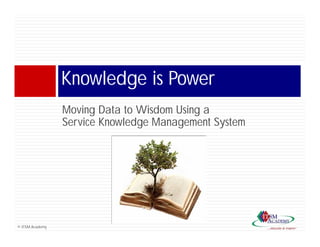
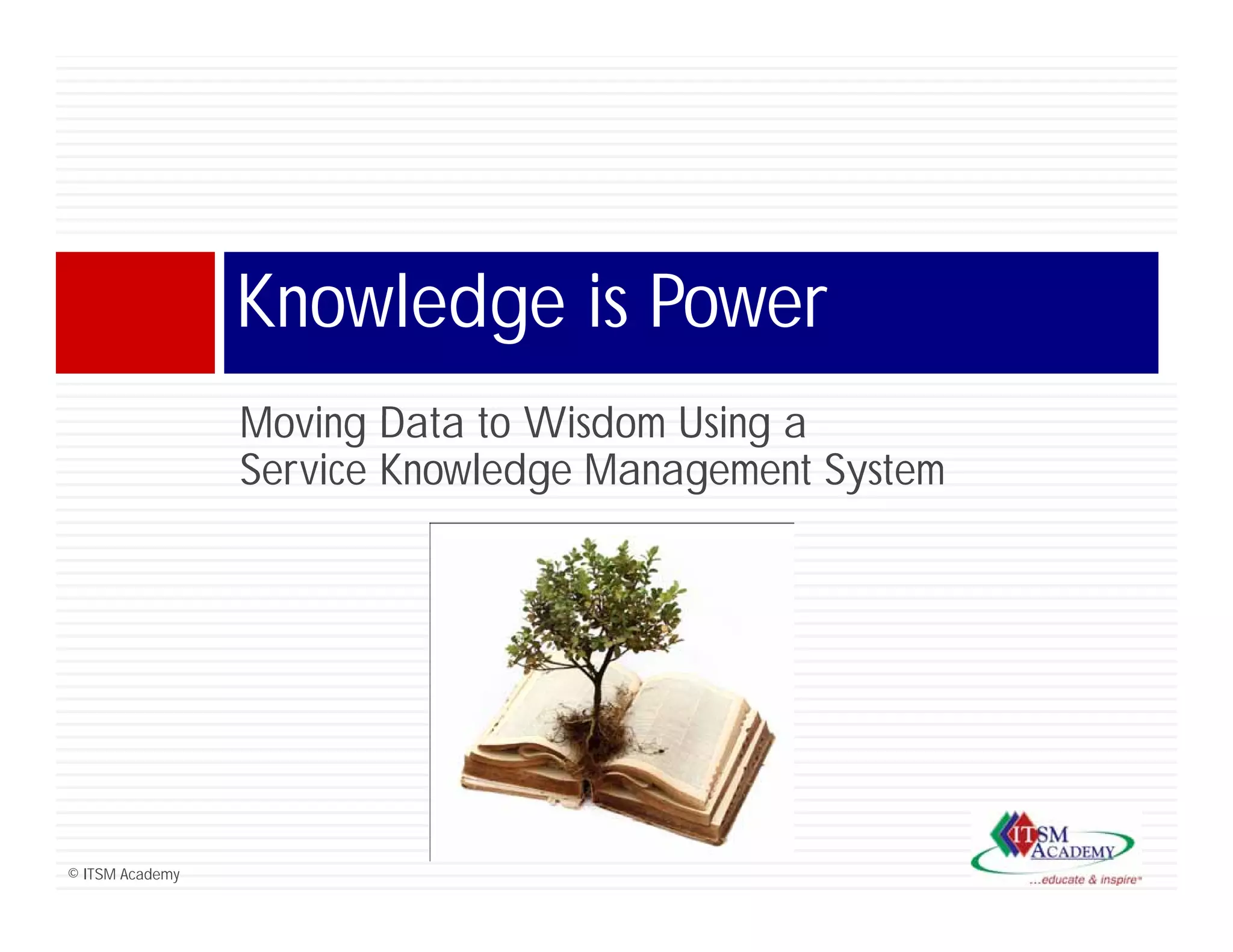
Knowledge is Power
                 Moving D t t Wi d Using
                 M i Data to Wisdom U i a
                 Service Knowledge Management System


© ITSM Academy
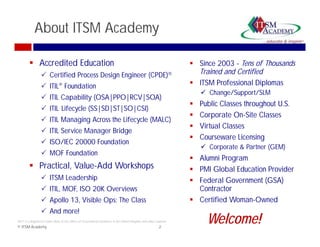
About ITSM Academy

         Accredited Education                                                                                     Since 2003 - Tens of Thousands
                  Certified Process Design Engineer (CPDE)                                                        Trained and Certified
                  ITIL® Foundation                                                                                ITSM Professional Diplomas
                                                                                                                       Change/Support/SLM
                  ITIL Capability (OSA|PPO|RCV|SOA)
                                                                                                                     Public Classes throughout U.S.
                  ITIL Lifec cle (SS|SD|ST|SO|CSI)
                        Lifecycle
                                                                                                                     Corporate On-Site Classes
                  ITIL Managing Across the Lifecycle (MALC)
                                                                                                                     Virtual Classes
                  ITIL Service Manager Bridge
                                                                                                                     Courseware Licensing
                  ISO/IEC 20000 Foundation
                      /
                                                                                                                       Corporate & Partner (GEM)
                  MOF Foundation
                                                                                                                   Alumni Program
         Practical, Value-Add Workshops
                                      p                                                                            PMI Global Education Provider
                  ITSM Leadership                                                                                 Federal Government (GSA)
                  ITIL, MOF, ISO 20K Overviews                                                                     Contractor
                  Apollo 13, Visible Ops: The Class
                          13                                                                                       Certified Woman-Owned
                                                                                                                              Woman Owned
                  And more!
ITIL® is a Registered Trade Mark of the Office of Government Commerce in the United Kingdom and other countries
© ITSM Academy                                                                                           2
                                                                                                                        Welcome!
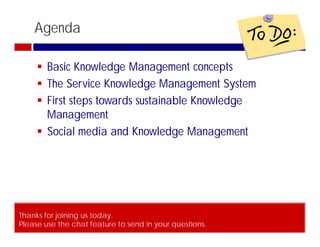
Agenda

      Basic Knowledge Management concepts
      The Service Knowledge Management System
      First steps towards sustainable Knowledge
       Management
      Social media and Knowledge Management


Thanks for joining us today.
Please use the chat feature to send in your questions.
© ITSM Academy                          3
The Basics of Knowledge
                 Management


© ITSM Academy
What is Knowledge Management?

            Knowledge Management (KM) ensures the right information is
            delivered to the right place or person at the right time to enable
                                   an informed decision

           Well-managed knowledge can
            W ll       dk    l d
                 Increase a service provider’s efficiency
                 Improve service quality and customer satisfaction
                 I            i      li     d             if i
                 Reduce the cost of service provision


© ITSM Academy                            5
Why is Knowledge So Hard to Manage?

         knowl·edge:      acquaintance or familiarity gained by sight,
         experience,
         experience or report ~ source: dictionary com
                                        dictionary.com


                    We have lots of data but less information or knowledge
                    We are not sure which knowledge is valuable
                    “Tribal knowledge” and experience is difficult to document
                    Pockets of data reside in many sources and tools
                    Databases can be too linear for meaningful queries
                    Controlling accuracy and currency is challenging
                    Proprietary knowledge = job security?


© ITSM Academy                                6
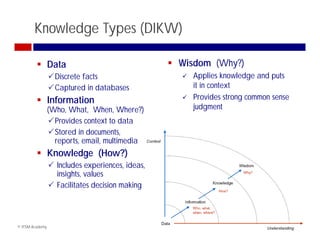
Knowledge Types (DIKW)

          Data                                        Wisdom (Why?)
                 Discrete facts                           Applies knowledge and puts
                 Captured in databases                     it in context
          Information                                     Provides strong common sense
                 (Who, Wh
                 (Wh What, Wh Wh ?)
                              When, Where?)                 judgment
                 Provides context to data
                 Stored in documents,
                   reports, email, multimedia
                               il    l i di
          Knowledge (How?)
                  Includes experiences, ideas,
                   insights, values
                  Facilitates decision making


© ITSM Academy                                    7
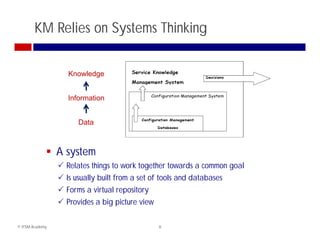
KM Relies on Systems Thinking

                    Knowledge
                           g


                    Information


                       Data


              A system
                  Relates things to work together towards a common goal
                  Is usually built from a set of tools and databases
                  Forms a virtual repository
                  Provides a big picture view

© ITSM Academy                                   8
What is a Service Knowledge Management
        System (SKMS)?


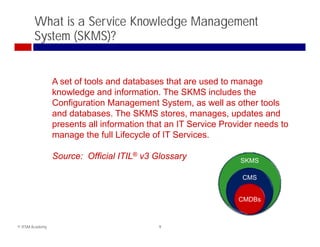
                 A set of tools and databases that are used to manage
                 knowledge and information. The SKMS includes the
                 Configuration Management System, as well as other tools
                 and databases. The SKMS stores, manages, updates and
                                                                   CMDBs
                 presents all information that an IT Service Provider needs to
                 manage the full Lifecycle of IT Services.
                       g               y

                 Source: Official ITIL® v3 Glossary              SKMS

                                                                  CMS


                                                                 CMDBs


© ITSM Academy                              9
Related Elements Within a SKMS

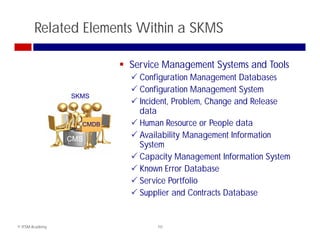
                           Service Management Systems and Tools
                             Configuration Management Databases
                             Configuration Management System
                 SKMS
                             Incident, Problem, Change and Release
                              data
                   CMDB      Human Resource or People data
                 CMS         Availability Management Information
                                         y      g
                              System
                             Capacity Management Information System
                             Known Error Database
                             Service Portfolio
                             Supplier and Contracts Database


© ITSM Academy                    10
Service Knowledge Management System
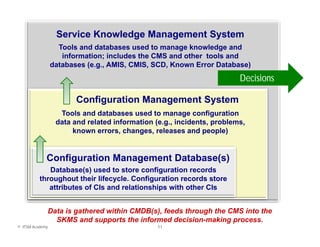
                   T l and databases used to manage knowledge and
                   Tools d d t b            dt         k     l d     d
                    information; includes the CMS and other tools and
                 databases (e.g., AMIS, CMIS, SCD, Known Error Database)
                                                                         Decisions
                                                                         D ii

                         Configuration Management System
                    Tools and databases used to manage configuration
                   data and related information (e.g., incidents, problems,
                        known errors, changes, releases and people)


             Configuration Management Database(s)
             Database(s) used to store configuration records
          throughout their lifecycle. Configuration records store
             attributes of CIs and relationships with other CIs


                 Data is gathered within CMDB(s), feeds through the CMS into the
                   SKMS and supports the informed decision-making process.
© ITSM Academy                                   11
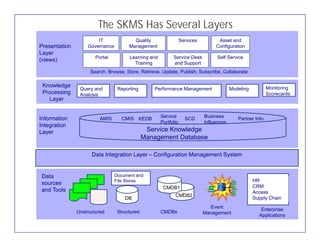
The SKMS Has Several Layers
                                 IT               Quality                  Services         Asset and
          Presentation       Governance         Management                                 Configuration
          Layer
                                 Portal         Learning and         Service Desk           Self Service
          (views)
                                                  Training           and Support
                              Search, Browse, Store, Retrieve, Update, Publish, Subscribe, Collaborate

           Knowledge                                                                                                 Monitoring
                          Query and        Reporting        Performance Management                 Modeling
           Processing     Analysis                                                                                   Scorecards
             Layer


                                                               Service                Business
          Information              AMIS      CMIS KEDB                       SCD                      Partner Info
                                                               Portfolio              Influences
          Integration
          Layer                                          Service Knowledge
                                                        Management Database

                               Data Integration Layer – Configuration Management System


           Data                           Document and
                                          File Stores                                                         HR
           sources
                                                                  CMDB1                                       CRM
           and Tools                                                                                          Access
                                                                      CMDB2
                                              DB                                                              Supply Chain
                                                                                        Event
                         Unstructured      Structured          CMDBs                                             Enterprise
                                                                                      Management                Applications

© ITSM Academy                                               12
First St
                 Fi t Steps


© ITSM Academy
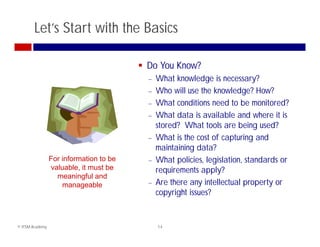
Let’s Start with the Basics

                                          Do You Know?
                                              What k
                                               Wh knowledge is necessary?
                                                           l d i              ?
                                              Who will use the knowledge? How?
                                              What conditions need to be monitored?
                                              What data is available and where it is
                                               stored? What tools are being used?
                                              What is the cost of capturing and
                                               maintaining data?
                 For information to be        What policies, legislation, standards or
                 valuable, it must be
                          ,                    requirements apply?
                   meaningful and
                     manageable               Are there any intellectual property or
                                               copyright issues?


© ITSM Academy                                 14
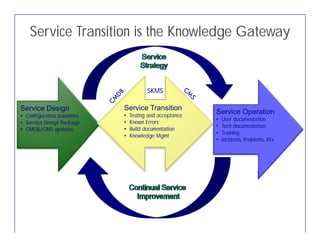
Service Transition is the Knowledge Gateway


                                        SKMS

 Service Design              Service Transition
 • Configuration baselines   •   Testing and acceptance
                                                          Service Operation
                                                          •   User documentation
 • Service Design Package    •   Known Errors
                                                          •   Tech documentation
 • CMDB/CMS updates          •   Build documentation
                                                          •   Training
                             •   Knowledge Mgmt
                                                          •   Incidents, P bl
                                                              I id t Problems, KEKEs


© ITSM Academy                              15
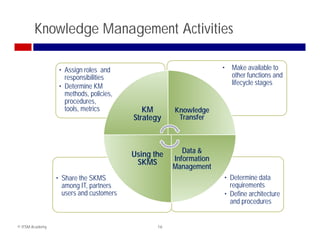
Knowledge Management Activities

                  • Assign roles and                               •   Make available to
                    responsibilities                                   other functions and
                  • Determine KM                                       lifecycle stages
                    methods, policies,
                    procedures,
                    tools,
                    tools metrics           KM       Knowledge
                                                     K     l d
                                         Strategy      Transfer


                                         Using the      Data &
                                          SKMS       Information
                                                     Management
                                                          g
                 • Share the SKMS                                  • Determine data
                   among IT, partners                                requirements
                   users and customers                             • Define architecture
                                                                     and procedures


© ITSM Academy                                  16
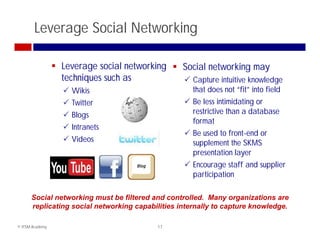
Leverage Social Networking

                  Leverage social networking  Social networking may
                   techniques such as
                   t h i         h               Capture intuitive knowledge
                     Wikis                          that does not “fit” into field
                     Twitter                       Be less intimidating or
                     Blogs                          restrictive than a database
                                                     format
                     Intranets
                                                    Be used to front-end or
                     Videos                         supplement the SKMS
                                                     presentation layer
                                                    Encourage staff and supplier
                                                     participation

      Social networking must be filtered and controlled. Many organizations are
                       g                                        y g
      replicating social networking capabilities internally to capture knowledge.

© ITSM Academy                              17
Tips for Getting Started

                  Pilot with a project for a new or changed service
                  Build from the top (presentation layer) down
                  Avoid terms that are too technical or difficult to understand
                  A i clear roles and responsibilities
                   Assign l    l     d        ibiliti
                  Have controls for contributing and verifying knowledge
                  Interview staff, users and partners for “tribal knowledge
                                                            tribal knowledge”
                  Build a friendly front-end (portal, wiki, query tool)
                  You do not have to consolidate tools unless it makes sense


                      Knowledge is only valuable if it is easy to retrieve


© ITSM Academy                                   18
Want t Learn More?
                 W t to L     M ?


© ITSM Academy
ITSM Academy Affiliates


© ITSM Academy               20
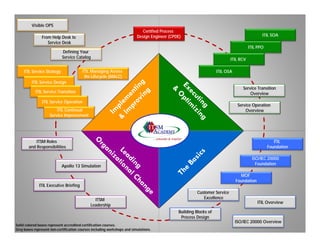
Visible OPS
                                                                             Certified Process
                From Help Desk to                                         Design Engineer (CPDE)                                             ITIL SOA
                   Service Desk
                                                                                                                                      ITIL PPO
                             Defining Your
                             Service Catalog                                                                               ITIL RCV

     ITIL Service Strategy               ITIL Managing Across                                                      ITIL OSA
                                          the Lifecycle (MALC)
         ITIL Service Design
                                                                                                                                 Service Transition
            ITIL Service Transition                                                                                                  Overview
                ITIL Service Operation
                                                                                                                               Service Operation
                        ITIL Continual                                                                                             Overview
                    Service Improvement


           ITSM Roles                                                                                                                               ITIL
       and Responsibilities                                                                                                                      Foundation

                                                                                                                                        ISO/IEC 20000
                             Apollo 13 Simulation                                                                                         Foundation

                                                                                                                                MOF
                                                                                                                              Foundation
              ITIL Executive Briefing
                                                                                                        Customer Service
                                               ITSM                                                        Excellence
                                                                                                                                           ITIL O
                                                                                                                                                Overview
                                                                                                                                                     i
                                             Leadership
                                                                                              Building Blocks of
                                                                                               Process Design
                                                                                                                              ISO/IEC 20000 Overview
Solid colored boxes represent accredited certification courses.
Grey boxes represent non-certification courses including workshops and simulations.
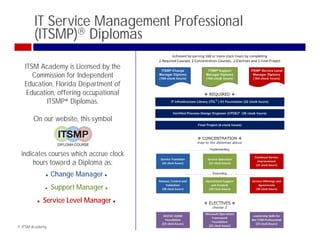
IT Service Management Professional
        (ITSMP) Diplomas

   ITSM Academy is Licensed by the
      Commission for Independent
   Education, Florida Department of
    Education, offering occupational
           ITSMP® Diplomas.

       On our website, this symbol


 indicates courses which accrue clock
     hours toward a Diploma as:
                Change Manager 
                Support Manager 
            Service Level Manager 


© ITSM Academy                          22
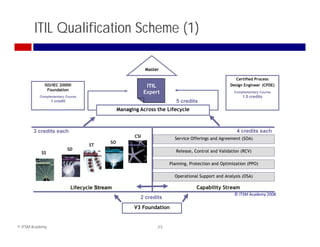
ITIL Qualification Scheme (1)

                                                             Master

                                                                                                       Certified Process
             ISO/IEC 20000                                    ITIL                                  Design Engineer (CPDE)
               Foundation
                                                             Expert                                   Complementary Course
          Complementary Course                                                                            1.5 credits
                 1 credit                                                 5 credits
                                                 Managing A
                                                 M    i Across th Lif
                                                               the Lifecycle
                                                                          l


       3 credits each                                                                                  4 credits each
                                                       CSI               Service Offerings and Agreement (SOA)
                                            SO
                                    ST
                            SD                                            Release, Control and Validation (RCV)
           SS

                                                                       Planning, Protection and Optimization (PPO)

                                                                         Operational Support and Analysis (OSA)

                             Lifecycle Stream                                       Capability Stream
                                                                                                      © ITSM Academy 2008
                                                         2 credits
                                                       V3 Foundation


© ITSM Academy                                                    23
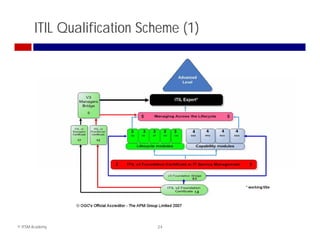
ITIL Qualification Scheme (1)


© ITSM Academy               24

Knowledge is Power

  • 1.
    Knowledge is Power Moving D t t Wi d Using M i Data to Wisdom U i a Service Knowledge Management System © ITSM Academy
  • 2.
    About ITSM Academy  Accredited Education  Since 2003 - Tens of Thousands  Certified Process Design Engineer (CPDE) Trained and Certified  ITIL® Foundation  ITSM Professional Diplomas  Change/Support/SLM  ITIL Capability (OSA|PPO|RCV|SOA)  Public Classes throughout U.S.  ITIL Lifec cle (SS|SD|ST|SO|CSI) Lifecycle  Corporate On-Site Classes  ITIL Managing Across the Lifecycle (MALC)  Virtual Classes  ITIL Service Manager Bridge  Courseware Licensing  ISO/IEC 20000 Foundation /  Corporate & Partner (GEM)  MOF Foundation  Alumni Program  Practical, Value-Add Workshops p  PMI Global Education Provider  ITSM Leadership  Federal Government (GSA)  ITIL, MOF, ISO 20K Overviews Contractor  Apollo 13, Visible Ops: The Class 13  Certified Woman-Owned Woman Owned  And more! ITIL® is a Registered Trade Mark of the Office of Government Commerce in the United Kingdom and other countries © ITSM Academy 2 Welcome!
  • 3.
    Agenda  Basic Knowledge Management concepts  The Service Knowledge Management System  First steps towards sustainable Knowledge Management  Social media and Knowledge Management Thanks for joining us today. Please use the chat feature to send in your questions. © ITSM Academy 3
  • 4.
    The Basics ofKnowledge Management © ITSM Academy
  • 5.
    What is KnowledgeManagement? Knowledge Management (KM) ensures the right information is delivered to the right place or person at the right time to enable an informed decision  Well-managed knowledge can W ll dk l d Increase a service provider’s efficiency Improve service quality and customer satisfaction I i li d if i Reduce the cost of service provision © ITSM Academy 5
  • 6.
    Why is KnowledgeSo Hard to Manage? knowl·edge: acquaintance or familiarity gained by sight, experience, experience or report ~ source: dictionary com dictionary.com  We have lots of data but less information or knowledge  We are not sure which knowledge is valuable  “Tribal knowledge” and experience is difficult to document  Pockets of data reside in many sources and tools  Databases can be too linear for meaningful queries  Controlling accuracy and currency is challenging  Proprietary knowledge = job security? © ITSM Academy 6
  • 7.
    Knowledge Types (DIKW)  Data  Wisdom (Why?) Discrete facts  Applies knowledge and puts Captured in databases it in context  Information  Provides strong common sense (Who, Wh (Wh What, Wh Wh ?) When, Where?) judgment Provides context to data Stored in documents, reports, email, multimedia il l i di  Knowledge (How?)  Includes experiences, ideas, insights, values  Facilitates decision making © ITSM Academy 7
  • 8.
    KM Relies onSystems Thinking Knowledge g Information Data  A system  Relates things to work together towards a common goal  Is usually built from a set of tools and databases  Forms a virtual repository  Provides a big picture view © ITSM Academy 8
  • 9.
    What is aService Knowledge Management System (SKMS)? A set of tools and databases that are used to manage knowledge and information. The SKMS includes the Configuration Management System, as well as other tools and databases. The SKMS stores, manages, updates and CMDBs presents all information that an IT Service Provider needs to manage the full Lifecycle of IT Services. g y Source: Official ITIL® v3 Glossary SKMS CMS CMDBs © ITSM Academy 9
  • 10.
    Related Elements Withina SKMS  Service Management Systems and Tools  Configuration Management Databases  Configuration Management System SKMS  Incident, Problem, Change and Release data CMDB  Human Resource or People data CMS  Availability Management Information y g System  Capacity Management Information System  Known Error Database  Service Portfolio  Supplier and Contracts Database © ITSM Academy 10
  • 11.
    Service Knowledge ManagementSystem T l and databases used to manage knowledge and Tools d d t b dt k l d d information; includes the CMS and other tools and databases (e.g., AMIS, CMIS, SCD, Known Error Database) Decisions D ii Configuration Management System Tools and databases used to manage configuration data and related information (e.g., incidents, problems, known errors, changes, releases and people) Configuration Management Database(s) Database(s) used to store configuration records throughout their lifecycle. Configuration records store attributes of CIs and relationships with other CIs Data is gathered within CMDB(s), feeds through the CMS into the SKMS and supports the informed decision-making process. © ITSM Academy 11
  • 12.
    The SKMS HasSeveral Layers IT Quality Services Asset and Presentation Governance Management Configuration Layer Portal Learning and Service Desk Self Service (views) Training and Support Search, Browse, Store, Retrieve, Update, Publish, Subscribe, Collaborate Knowledge Monitoring Query and Reporting Performance Management Modeling Processing Analysis Scorecards Layer Service Business Information AMIS CMIS KEDB SCD Partner Info Portfolio Influences Integration Layer Service Knowledge Management Database Data Integration Layer – Configuration Management System Data Document and File Stores HR sources CMDB1 CRM and Tools Access CMDB2 DB Supply Chain Event Unstructured Structured CMDBs Enterprise Management Applications © ITSM Academy 12
  • 13.
    First St Fi t Steps © ITSM Academy
  • 14.
    Let’s Start withthe Basics  Do You Know?  What k Wh knowledge is necessary? l d i ?  Who will use the knowledge? How?  What conditions need to be monitored?  What data is available and where it is stored? What tools are being used?  What is the cost of capturing and maintaining data? For information to be  What policies, legislation, standards or valuable, it must be , requirements apply? meaningful and manageable  Are there any intellectual property or copyright issues? © ITSM Academy 14
  • 15.
    Service Transition isthe Knowledge Gateway SKMS Service Design Service Transition • Configuration baselines • Testing and acceptance Service Operation • User documentation • Service Design Package • Known Errors • Tech documentation • CMDB/CMS updates • Build documentation • Training • Knowledge Mgmt • Incidents, P bl I id t Problems, KEKEs © ITSM Academy 15
  • 16.
    Knowledge Management Activities • Assign roles and • Make available to responsibilities other functions and • Determine KM lifecycle stages methods, policies, procedures, tools, tools metrics KM Knowledge K l d Strategy Transfer Using the Data & SKMS Information Management g • Share the SKMS • Determine data among IT, partners requirements users and customers • Define architecture and procedures © ITSM Academy 16
  • 17.
    Leverage Social Networking  Leverage social networking  Social networking may techniques such as t h i h  Capture intuitive knowledge  Wikis that does not “fit” into field  Twitter  Be less intimidating or  Blogs restrictive than a database format  Intranets  Be used to front-end or  Videos supplement the SKMS presentation layer  Encourage staff and supplier participation Social networking must be filtered and controlled. Many organizations are g y g replicating social networking capabilities internally to capture knowledge. © ITSM Academy 17
  • 18.
    Tips for GettingStarted  Pilot with a project for a new or changed service  Build from the top (presentation layer) down  Avoid terms that are too technical or difficult to understand  A i clear roles and responsibilities Assign l l d ibiliti  Have controls for contributing and verifying knowledge  Interview staff, users and partners for “tribal knowledge tribal knowledge”  Build a friendly front-end (portal, wiki, query tool)  You do not have to consolidate tools unless it makes sense Knowledge is only valuable if it is easy to retrieve © ITSM Academy 18
  • 19.
    Want t LearnMore? W t to L M ? © ITSM Academy
  • 20.
  • 21.
    Visible OPS Certified Process From Help Desk to Design Engineer (CPDE) ITIL SOA Service Desk ITIL PPO Defining Your Service Catalog ITIL RCV ITIL Service Strategy ITIL Managing Across ITIL OSA the Lifecycle (MALC) ITIL Service Design Service Transition ITIL Service Transition Overview ITIL Service Operation Service Operation ITIL Continual Overview Service Improvement ITSM Roles ITIL and Responsibilities Foundation ISO/IEC 20000 Apollo 13 Simulation Foundation MOF Foundation ITIL Executive Briefing Customer Service ITSM Excellence ITIL O Overview i Leadership Building Blocks of Process Design ISO/IEC 20000 Overview Solid colored boxes represent accredited certification courses. Grey boxes represent non-certification courses including workshops and simulations.
  • 22.
    IT Service ManagementProfessional (ITSMP) Diplomas ITSM Academy is Licensed by the Commission for Independent Education, Florida Department of Education, offering occupational ITSMP® Diplomas. On our website, this symbol indicates courses which accrue clock hours toward a Diploma as:  Change Manager   Support Manager   Service Level Manager  © ITSM Academy 22
  • 23.
    ITIL Qualification Scheme(1) Master Certified Process ISO/IEC 20000 ITIL Design Engineer (CPDE) Foundation Expert Complementary Course Complementary Course 1.5 credits 1 credit 5 credits Managing A M i Across th Lif the Lifecycle l 3 credits each 4 credits each CSI Service Offerings and Agreement (SOA) SO ST SD Release, Control and Validation (RCV) SS Planning, Protection and Optimization (PPO) Operational Support and Analysis (OSA) Lifecycle Stream Capability Stream © ITSM Academy 2008 2 credits V3 Foundation © ITSM Academy 23
  • 24.
    ITIL Qualification Scheme(1) © ITSM Academy 24