
2013: The Beginning
                     of the End
                 of the University?


Ken Ronkowitz
It’s the End of the University As We Know It
               Are you surprised?
Who Sets the Curriculum?
What do we do with Big
 Data?
What is the value of a
 traditional degree?
MOOCs?
Where is the funding?
Or will it all be open & free?
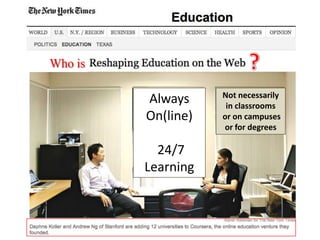
Who is

                    Not necessarily
         Always      in classrooms
         On(line)   or on campuses
                    or for degrees

           24/7
         Learning
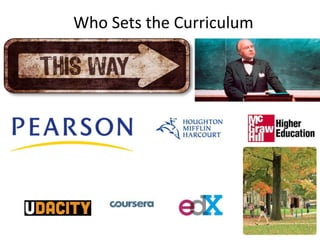
Who Sets the Curriculum
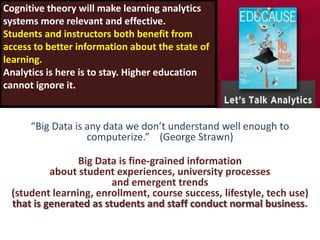
Cognitive theory will make learning analytics
systems more relevant and effective.
Students and instructors both benefit from
access to better information about the state of
learning.
Analytics is here is to stay. Higher education
cannot ignore it.


      “Big Data is any data we don’t understand well enough to
                   computerize.” (George Strawn)

                Big Data is fine-grained information
          about student experiences, university processes
                        and emergent trends
 (student learning, enrollment, course success, lifestyle, tech use)
 that is generated as students and staff conduct normal business.
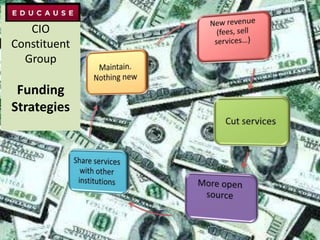
CIO
Constituent
  Group

 Funding
Strategies
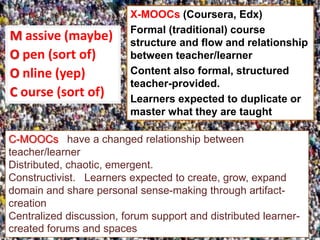
X-MOOCs (Coursera, Edx)
                         Formal (traditional) course
M assive (maybe)         structure and flow and relationship
O pen (sort of)          between teacher/learner
O nline (yep)            Content also formal, structured
                         teacher-provided.
C ourse (sort of)        Learners expected to duplicate or
                         master what they are taught

C-MOOCs have a changed relationship between
teacher/learner
Distributed, chaotic, emergent.
Constructivist. Learners expected to create, grow, expand
domain and share personal sense-making through artifact-
creation
Centralized discussion, forum support and distributed learner-
created forums and spaces
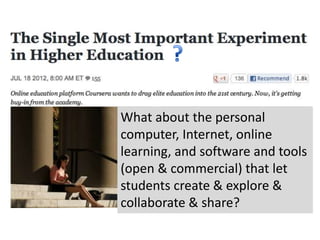
What about the personal
computer, Internet, online
learning, and software and tools
(open & commercial) that let
students create & explore &
collaborate & share?
Massive Open Online Courses (MOOC)

• Just last FALL 2011 Two Stanford computer science
  faculty members started Coursera to offer classes
  with the help of universities
• APRIL 2012 four universities signed on: Princeton,
  University of Michigan, Stanford and Penn State
• JULY 2012 12 more universities signed agreements
  with Coursera to provide courses California Institute
  of Technology, Duke University, Ecole Polytechnique
  Federale de Lausanne, Georgia Institute of Technology,
  Johns Hopkins University, Rice University, UC San Francisco,
  University of Edinburgh, University of Illinois at Urbana-
  Champaign, University of Toronto, University of Virginia
  and University of Washington…
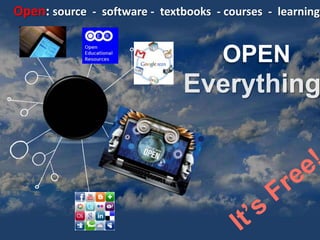
Open: source - software - textbooks - courses - learning


                                      OPEN
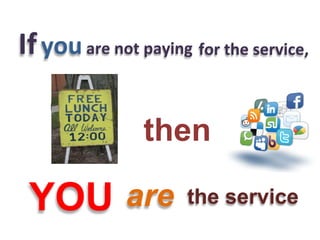
If you are not paying for the service,
     It’s free!

                   then

 YOU              are   the service
The end of
           replaced by ?
certificates, badges, corporate endorsements,
      “just” a desire to simply learn,
     competency-based degrees 
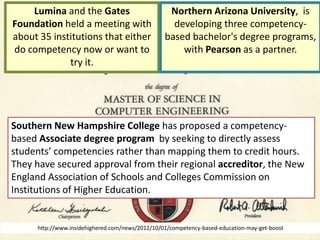
Lumina and the Gates                          Northern Arizona University, is
Foundation held a meeting with                     developing three competency-
about 35 institutions that either                based bachelor's degree programs,
do competency now or want to                         with Pearson as a partner.
   Competency-Based Degrees
             try it.


Southern New Hampshire College has proposed a competency-
based Associate degree program by seeking to directly assess
students’ competencies rather than mapping them to credit hours.
They have secured approval from their regional accreditor, the New
England Association of Schools and Colleges Commission on
Institutions of Higher Education.


     http://www.insidehighered.com/news/2012/10/01/competency-based-education-may-get-boost
Goddard’s low-residency semester format
comprises an intensive 8-day residency on campus,
& 16 weeks of independent work and self-reflection
    in close collaboration with a faculty advisor.

 Goddard College invented the low-residency model
     in 1963 to meet the needs of adult students
with professional, family, and other obligations seeking
         learning experiences with relevance
             in real-world circumstances.
“During the next fifteen years, the way
                             we educate our children, and how we
                             think of education itself, will change in
                             fundamental ways.”         ~ Tim Brady, co-founder
                             of Imagine K12, an incubator for tech companies focused on the K-12
                             market.


Big Ideas for K-12 Schools include reconsidering some
current fundamental assumptions:
o giving students grades
o partitioning them according to age
o proving competency
o high schools, and maybe even middle schools, will begin
   to operate less like factories and more like colleges
o the ubiquity of high-technology will blur the distinction
   between being in and out of school
bigthink.com/ideafeed/the-tech-ed-revolution-no-more-grades-or-division-by-age
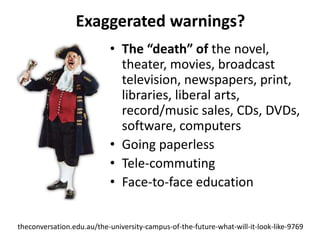
Exaggerated warnings?
                           • The “death” of the novel,
                             theater, movies, broadcast
                             television, newspapers, print,
                             libraries, liberal arts,
                             record/music sales, CDs, DVDs,
                             software, computers
                           • Going paperless
                           • Tele-commuting
                           • Face-to-face education


theconversation.edu.au/the-university-campus-of-the-future-what-will-it-look-like-9769
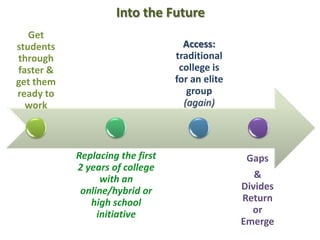
Into the Future
   Get
students                           Access:
through                          traditional
faster &                          college is
get them                         for an elite
ready to                            group
  work                             (again)


           Replacing the first                   Gaps
           2 years of college
                 with an                           &
            online/hybrid or                    Divides
              high school                       Return
                initiative                        or
                                                Emerge
Ken Ronkowitz
kenneth.ronkowitz@njit.edu
       @ronkowitz
    serendipity35.net
      ronkowitz.com

2013: The Beginning of the End of the University

  • 1.
    2013: The Beginning of the End of the University? Ken Ronkowitz
  • 2.
    It’s the Endof the University As We Know It Are you surprised? Who Sets the Curriculum? What do we do with Big Data? What is the value of a traditional degree? MOOCs? Where is the funding? Or will it all be open & free?
  • 3.
    Who is Not necessarily Always in classrooms On(line) or on campuses or for degrees 24/7 Learning
  • 4.
    Who Sets theCurriculum
  • 5.
    Cognitive theory willmake learning analytics systems more relevant and effective. Students and instructors both benefit from access to better information about the state of learning. Analytics is here is to stay. Higher education cannot ignore it. “Big Data is any data we don’t understand well enough to computerize.” (George Strawn) Big Data is fine-grained information about student experiences, university processes and emergent trends (student learning, enrollment, course success, lifestyle, tech use) that is generated as students and staff conduct normal business.
  • 6.
    CIO Constituent Group Funding Strategies
  • 7.
    X-MOOCs (Coursera, Edx) Formal (traditional) course M assive (maybe) structure and flow and relationship O pen (sort of) between teacher/learner O nline (yep) Content also formal, structured teacher-provided. C ourse (sort of) Learners expected to duplicate or master what they are taught C-MOOCs have a changed relationship between teacher/learner Distributed, chaotic, emergent. Constructivist. Learners expected to create, grow, expand domain and share personal sense-making through artifact- creation Centralized discussion, forum support and distributed learner- created forums and spaces
  • 8.
    What about thepersonal computer, Internet, online learning, and software and tools (open & commercial) that let students create & explore & collaborate & share?
  • 9.
    Massive Open OnlineCourses (MOOC) • Just last FALL 2011 Two Stanford computer science faculty members started Coursera to offer classes with the help of universities • APRIL 2012 four universities signed on: Princeton, University of Michigan, Stanford and Penn State • JULY 2012 12 more universities signed agreements with Coursera to provide courses California Institute of Technology, Duke University, Ecole Polytechnique Federale de Lausanne, Georgia Institute of Technology, Johns Hopkins University, Rice University, UC San Francisco, University of Edinburgh, University of Illinois at Urbana- Champaign, University of Toronto, University of Virginia and University of Washington…
  • 10.
    Open: source -software - textbooks - courses - learning OPEN
  • 11.
    If you arenot paying for the service, It’s free! then YOU are the service
  • 12.
    The end of replaced by ? certificates, badges, corporate endorsements, “just” a desire to simply learn, competency-based degrees 
  • 13.
    Lumina and theGates Northern Arizona University, is Foundation held a meeting with developing three competency- about 35 institutions that either based bachelor's degree programs, do competency now or want to with Pearson as a partner. Competency-Based Degrees try it. Southern New Hampshire College has proposed a competency- based Associate degree program by seeking to directly assess students’ competencies rather than mapping them to credit hours. They have secured approval from their regional accreditor, the New England Association of Schools and Colleges Commission on Institutions of Higher Education. http://www.insidehighered.com/news/2012/10/01/competency-based-education-may-get-boost
  • 14.
    Goddard’s low-residency semesterformat comprises an intensive 8-day residency on campus, & 16 weeks of independent work and self-reflection in close collaboration with a faculty advisor. Goddard College invented the low-residency model in 1963 to meet the needs of adult students with professional, family, and other obligations seeking learning experiences with relevance in real-world circumstances.
  • 15.
    “During the nextfifteen years, the way we educate our children, and how we think of education itself, will change in fundamental ways.” ~ Tim Brady, co-founder of Imagine K12, an incubator for tech companies focused on the K-12 market. Big Ideas for K-12 Schools include reconsidering some current fundamental assumptions: o giving students grades o partitioning them according to age o proving competency o high schools, and maybe even middle schools, will begin to operate less like factories and more like colleges o the ubiquity of high-technology will blur the distinction between being in and out of school bigthink.com/ideafeed/the-tech-ed-revolution-no-more-grades-or-division-by-age
  • 16.
    Exaggerated warnings? • The “death” of the novel, theater, movies, broadcast television, newspapers, print, libraries, liberal arts, record/music sales, CDs, DVDs, software, computers • Going paperless • Tele-commuting • Face-to-face education theconversation.edu.au/the-university-campus-of-the-future-what-will-it-look-like-9769
  • 17.
    Into the Future Get students Access: through traditional faster & college is get them for an elite ready to group work (again) Replacing the first Gaps 2 years of college with an & online/hybrid or Divides high school Return initiative or Emerge
  • 20.
    Ken Ronkowitz kenneth.ronkowitz@njit.edu @ronkowitz serendipity35.net ronkowitz.com

Editor's Notes

  • #4 http://www.nytimes.com/2012/07/17/education/consortium-of-colleges-takes-online-education-to-new-level.html?_r=2
  • #9 http://www.theatlantic.com/business/archive/2012/07/the-single-most-important-experiment-in-higher-education/259953/