Current issues and approaches in developing
digital literacies
Helen Beetham, Developing Digital Literacies programme consultant
with representatives of the SEEDPoD project (Plymouth University), Digitally Ready proje
(University of Reading), DIAL project (University of the Arts, London) and Digital Literacie
in Transition project (University of Greenwich)
Developing Digital Literacies Programme


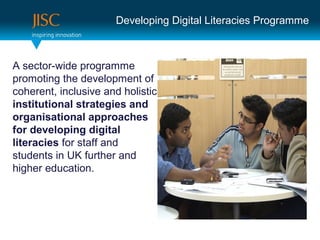
A sector-wide programme
promoting the development of
coherent, inclusive and holistic
institutional strategies and
organisational approaches
for developing digital
literacies for staff and
students in UK further and
higher education.
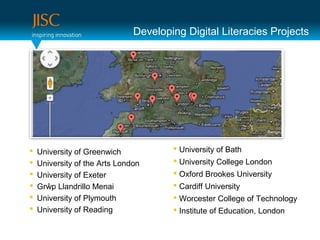
Developing Digital Literacies Projects


   University of Greenwich             University of Bath
   University of the Arts London       University College London
   University of Exeter                Oxford Brookes University
   Grŵp Llandrillo Menai               Cardiff University
   University of Plymouth              Worcester College of Technology
   University of Reading               Institute of Education, London
What do we mean by 'digital literacies'?

 The capabilities, aptitudes and attitudes learners need
   to thrive in a digital economy and society (JISC)

For example (from various institutional strategies):

[Ensure] students are prepared for study and employment
in the digital age, with a range of learning literacies
embedded into the curriculum.
Consider the potential of technology to promote knowledge
building and reflective, student-centred, creative and
collaborative learning.
[develop] self-regulating citizens in a globally connected
society, able to handle multiple, diverse information
sources and media.
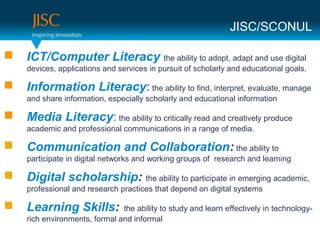
JISC/SCONUL

   ICT/Computer Literacy the ability to adopt, adapt and use digital
    devices, applications and services in pursuit of scholarly and educational goals.

   Information Literacy: the ability to find, interpret, evaluate, manage
    and share information, especially scholarly and educational information

   Media Literacy: the ability to critically read and creatively produce
    academic and professional communications in a range of media.

   Communication and Collaboration: the ability to
    participate in digital networks and working groups of research and learning

   Digital scholarship: the ability to participate in emerging academic,
    professional and research practices that depend on digital systems

   Learning Skills:           the ability to study and learn effectively in technology-
    rich environments, formal and informal
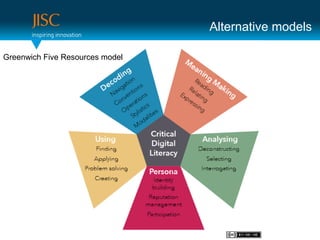
Alternative models

Greenwich Five Resources model
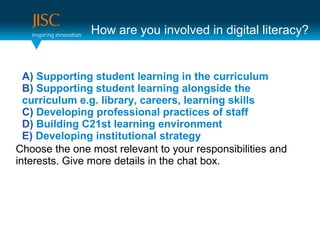
How are you involved in digital literacy?


  A) Supporting student learning in the curriculum
  B) Supporting student learning alongside the
  curriculum e.g. library, careers, learning skills
  C) Developing professional practices of staff
  D) Building C21st learning environment
  E) Developing institutional strategy
Choose the one most relevant to your responsibilities and
interests. Give more details in the chat box.
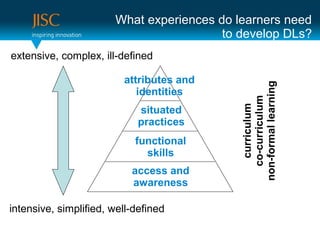
What experiences do learners need
                                         to develop DLs?
extensive, complex, ill-defined

                         attributes and


                                            non-formal learning
                            identities


                                              co-curriculum
                                                curriculum
                            situated
                            practices
                            functional
                              skills
                           access and
                           awareness

intensive, simplified, well-defined
Developing institutions to develop people


Features audited at baseline:
    
        institutional infrastructure and learning environment
    
        relevant strategies and policies
    
        Academic/learning cultures and attitudes
    
        roles/responsibilities of professional services
    
        practices in the curriculum
    
        the learning experience
What is being done?


       Professional development for teaching staff
           Partnerships with professional staff
       Mini-projects / case studies in departments
         Develop DL materials with/for students
  Students as pioneers/researchers/agents of change
            Change management approaches
Develop learning environment and ICT policies (BYOD)
 Institutional restructuring and major policy initiatives
          Qualitative and quantitative research
Four different institutional approaches

1. Plymouth University (SEEDPoD):
   'restructuring professional services'
2. University of Reading (Digitally Ready):
   'readiness across the board'
3. University of the Arts, London (DIAL):
   'transforming subject areas'
4. University of Greenwich (DL in transition):
   'engaging staff and students'
Embedding Digital Literacy


                                           Prof Neil Witt
                                     Dr Anne McDermott
                                            Rob Stillwell


www.technologyenhancedlearning.net                          12
What Is SEEDPoD?
•  Builds on 2011 BCUP project
•  Audit of systems, policies,
   infrastructure and data
• Views from academic and
   support staff on use of, and
   practice with, existing software
   and hardware systems.
• Recommending Institutional
   change on DL issues around:
  • Infrastructure
  • Support
  • Curriculum Design

www.technologyenhancedlearning.net                  13
The Digital Strategy
Opportunity 1 – inputting into Strategy

•Key theme 1 - Digital People
•Key theme 2 - Digital teaching, learning and research
•Key theme 3 - Digital services
•Key theme 4 - Digital Infrastructure and Capability


www.technologyenhancedlearning.net                       14
Performance Development Review

Opportunity 2 – using new processes


                                     Embed in PDR
                                     Embed in PDR

www.technologyenhancedlearning.net                  15
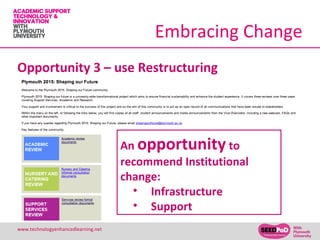
Embracing Change
Opportunity 3 – use Restructuring


                                     An opportunity to
                                     recommend Institutional
                                     change:
                                       • Infrastructure
                                       • Support
www.technologyenhancedlearning.net                             16
Being part of the solution

• Technology and Information Services
     – Strategy & Architecture
     – Solution Development
     – Service Management
     – Library and Digital Services
     – Academic Support, Technology & Innovation


• the annoying academic on the shoulder of the CIO

www.technologyenhancedlearning.net                            17
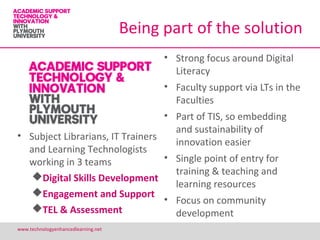
Being part of the solution
                                  • Strong focus around Digital
                                    Literacy
                                  • Faculty support via LTs in the
                                    Faculties
                                  • Part of TIS, so embedding
                                    and sustainability of
• Subject Librarians, IT Trainers
                                    innovation easier
  and Learning Technologists
  working in 3 teams              • Single point of entry for
                                    training & teaching and
   Digital Skills Development
                                    learning resources
   Engagement and Support
                                  • Focus on community
   TEL & Assessment                development
www.technologyenhancedlearning.net                               18
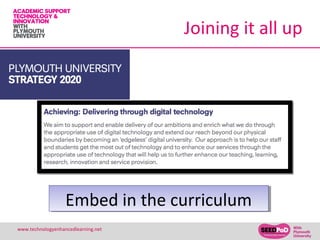
Joining it all up


                   Embed in the curriculum
                   Embed in the curriculum
www.technologyenhancedlearning.net                   19
A caveat
• "This range of approaches has also had a significant impact on
    the kind of evidence presented at the end of the projects with
    research-based projects offering some compelling evidence,
    but with impact on much smaller numbers of students, whilst
    impact on the whole institution is harder to measure and
    present as evidence, but has much more significance in terms
    of sustainability and embedding. Funders should continue to
    value this „softer‟ evidence. "


                                                                 Lou McGill
                                     Curriculum Delivery Programme Synthesis
www.technologyenhancedlearning.net                                        20
Any Questions?


www.technologyenhancedlearning.net              21
Digitally Ready


Readiness
across the
board
Nadja Guggi, Digitally Ready Project Officer

February 13, 2013   © University of Reading 2008   www.reading.ac.uk
Organisational challenges &
 issues
• No formal ‘digital’ University strategies, policies or
  plans
• Risk-averse, collegiate in structure and culture
• Silos
     – Pockets of good practice
     – Dependence on individual initiative
     – Lack of co-ordination between key professional services
• Varying levels of digital literacies
• Little knowledge of student expectations, attitudes
  and use of technology
• Little knowledge of employer expectations
• Major organisational change
Readiness across the board                                       23
Digitally Ready: bottom up
• Digital community-building & upskilling
     – Digital Heroes
     – Micro funding to support local initiatives
     – Work with existing structures: professional services,
       communities of practice, projects
     – Regular formal and informal events and training opportunities
     – Blog, newsletter, Yammer
• Research
     – Digital literacies for student employability
     – Student technology attitudes and use


Readiness across the board                                         24
Digitally Ready: top down
• Senior management engagement
     – Steering Group: heads of key professional services
       plus chaired by senior manager
     – University committee structure
     – Vice-Chancellor and Pro-Vice-Chancellor
       as champions for change (e.g. video, events)


Readiness across the board                                  25
Key gains & changes
• Genuine commitment from senior management to
  developing digital literacies at institutional level
     – Learning & Teaching Strategy 2013–18
     – TEL Strategy Group chaired by Pro-Vice-Chancelor
       (digital literacies/TEL; infrastructure provision;
       digital communication & marketing; digital governance;
       staff & student development)
     – Futurelearn membership
• Body of evidence to inform strategic decisions
• Better able to anticipate and meet student
  and employer expectations
• Emerging digital community
Readiness across the board                                      26
The DIAL Project
Aims: Cultural Change and Improved graduate
employability.

Approach: Support a number of self-identifying
and mutually supportive communities of staff and
students within the university (based on courses,
disciplines or other naturally occurring
communities) who identify goals for improving
their collective digital literacies.

Project blog: http://dial.myblog.arts.ac.uk/
Project resources: http://process.arts.ac.uk/content/dial-projects-and-activities
Embedding Digital Literacies at UAL?
•   Are we a project or a programme?
       Too big to be a project.
       A sustainable DL programme.
       Senior management support
       UAL Digital life programme and DL programme.
       Complicated landscape

•   Managing expectations, demand, scope and capacity.
       DIAL will do everything DL.
       Difficult to demonstrate benefits.
       Difficult to deliver tangible outputs
       Understanding digital literacies at UAL definitions and competencies

•   Meeting expectations, demand, scope and capacity.
       Expressions of interest with DIY built in evaluation
       Extra funding
       Two new DIAL coordinators (0.5)
       Visualise and present projects and activities
       Reduce DIAL brand
       Improve web environments, outgrown the project blog
Digital Literacies: integration with
           curriculum and services.
•   Project Groups; most groups are autonomous.
•   Collaborating with UAL services and departments.
•   Academic and curriculum integration
•   Project Groups supporting Academic and curriculum integration.
•   Natural cross sector collaboration/common interests (GSA)
•   Other general observations

• Project deliverables:
     Stories
     Online resources - OERs
     Case studies
     New communities of practice; face to face and virtual
     Workshops and training courses
     Commissioned and in-house research
     Sector collaboration
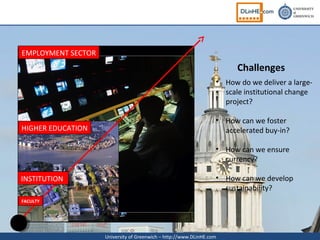
EMPLOYMENT SECTOR
                                                                        Challenges
                                                                  • How do we deliver a large-
                                                                    scale institutional change
                                                                    project?

                                                                  • How can we foster
HIGHER EDUCATION                                                    accelerated buy-in?

                                                                  • How can we ensure
                                                                    currency?

INSTITUTION                                                       • How can we develop
                                                                    sustainability?
FACULTY


                    University of Greenwich – http://www.DLinHE.com
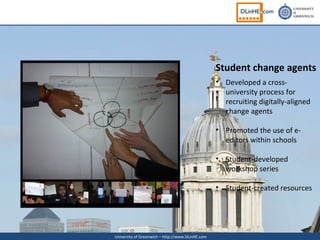
Student change agents
                                                  • Developed a cross-
                                                    university process for
                                                    recruiting digitally-aligned
                                                    change agents

                                                  • Promoted the use of e-
                                                    editors within schools

                                                  • Student-developed
                                                    workshop series

                                                  • Student-created resources


University of Greenwich – http://www.DLinHE.com
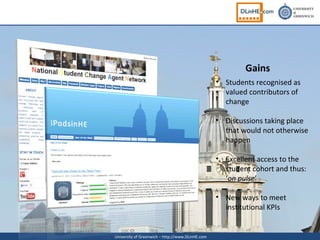
Gains
                                                  • Students recognised as
                                                    valued contributors of
                                                    change

                                                  • Discussions taking place
                                                    that would not otherwise
                                                    happen

                                                  • Excellent access to the
                                                    student cohort and thus:
                                                    ‘on pulse’

                                                  • New ways to meet
                                                    institutional KPIs


University of Greenwich – http://www.DLinHE.com
What will we offer?

 Self-assessment/self-development materials
 Briefings and OERs e.g. on social media, digital identity,
  digital research
 Support for curriculum design and examples of digital
  literacy development in different subject areas
 Organisational case studies and lessons learned
 Role descriptions and work with professional standards/
  benchmarks e.g. UK PSF, CMALT, SCONUL
 Conceptual frameworks
 Institutional audit materials and checklist for planning/
  evaluating digital literacy initiatives
                       bit.ly/JISCDDL

Current issues and approaches in developing digital literacy

  • 1.
    Current issues andapproaches in developing digital literacies Helen Beetham, Developing Digital Literacies programme consultant with representatives of the SEEDPoD project (Plymouth University), Digitally Ready proje (University of Reading), DIAL project (University of the Arts, London) and Digital Literacie in Transition project (University of Greenwich)
  • 2.
    Developing Digital LiteraciesProgramme A sector-wide programme promoting the development of coherent, inclusive and holistic institutional strategies and organisational approaches for developing digital literacies for staff and students in UK further and higher education.
  • 3.
    Developing Digital LiteraciesProjects  University of Greenwich  University of Bath  University of the Arts London  University College London  University of Exeter  Oxford Brookes University  Grŵp Llandrillo Menai  Cardiff University  University of Plymouth  Worcester College of Technology  University of Reading  Institute of Education, London
  • 4.
    What do wemean by 'digital literacies'? The capabilities, aptitudes and attitudes learners need to thrive in a digital economy and society (JISC) For example (from various institutional strategies): [Ensure] students are prepared for study and employment in the digital age, with a range of learning literacies embedded into the curriculum. Consider the potential of technology to promote knowledge building and reflective, student-centred, creative and collaborative learning. [develop] self-regulating citizens in a globally connected society, able to handle multiple, diverse information sources and media.
  • 5.
    JISC/SCONUL  ICT/Computer Literacy the ability to adopt, adapt and use digital devices, applications and services in pursuit of scholarly and educational goals.  Information Literacy: the ability to find, interpret, evaluate, manage and share information, especially scholarly and educational information  Media Literacy: the ability to critically read and creatively produce academic and professional communications in a range of media.  Communication and Collaboration: the ability to participate in digital networks and working groups of research and learning  Digital scholarship: the ability to participate in emerging academic, professional and research practices that depend on digital systems  Learning Skills: the ability to study and learn effectively in technology- rich environments, formal and informal
  • 6.
  • 7.
    How are youinvolved in digital literacy? A) Supporting student learning in the curriculum B) Supporting student learning alongside the curriculum e.g. library, careers, learning skills C) Developing professional practices of staff D) Building C21st learning environment E) Developing institutional strategy Choose the one most relevant to your responsibilities and interests. Give more details in the chat box.
  • 8.
    What experiences dolearners need to develop DLs? extensive, complex, ill-defined attributes and non-formal learning identities co-curriculum curriculum situated practices functional skills access and awareness intensive, simplified, well-defined
  • 9.
    Developing institutions todevelop people Features audited at baseline:  institutional infrastructure and learning environment  relevant strategies and policies  Academic/learning cultures and attitudes  roles/responsibilities of professional services  practices in the curriculum  the learning experience
  • 10.
    What is beingdone? Professional development for teaching staff Partnerships with professional staff Mini-projects / case studies in departments Develop DL materials with/for students Students as pioneers/researchers/agents of change Change management approaches Develop learning environment and ICT policies (BYOD) Institutional restructuring and major policy initiatives Qualitative and quantitative research
  • 11.
    Four different institutionalapproaches 1. Plymouth University (SEEDPoD): 'restructuring professional services' 2. University of Reading (Digitally Ready): 'readiness across the board' 3. University of the Arts, London (DIAL): 'transforming subject areas' 4. University of Greenwich (DL in transition): 'engaging staff and students'
  • 12.
    Embedding Digital Literacy Prof Neil Witt Dr Anne McDermott Rob Stillwell www.technologyenhancedlearning.net 12
  • 13.
    What Is SEEDPoD? • Builds on 2011 BCUP project • Audit of systems, policies, infrastructure and data • Views from academic and support staff on use of, and practice with, existing software and hardware systems. • Recommending Institutional change on DL issues around: • Infrastructure • Support • Curriculum Design www.technologyenhancedlearning.net 13
  • 14.
    The Digital Strategy Opportunity1 – inputting into Strategy •Key theme 1 - Digital People •Key theme 2 - Digital teaching, learning and research •Key theme 3 - Digital services •Key theme 4 - Digital Infrastructure and Capability www.technologyenhancedlearning.net 14
  • 15.
    Performance Development Review Opportunity2 – using new processes Embed in PDR Embed in PDR www.technologyenhancedlearning.net 15
  • 16.
    Embracing Change Opportunity 3– use Restructuring An opportunity to recommend Institutional change: • Infrastructure • Support www.technologyenhancedlearning.net 16
  • 17.
    Being part ofthe solution • Technology and Information Services – Strategy & Architecture – Solution Development – Service Management – Library and Digital Services – Academic Support, Technology & Innovation • the annoying academic on the shoulder of the CIO www.technologyenhancedlearning.net 17
  • 18.
    Being part ofthe solution • Strong focus around Digital Literacy • Faculty support via LTs in the Faculties • Part of TIS, so embedding and sustainability of • Subject Librarians, IT Trainers innovation easier and Learning Technologists working in 3 teams • Single point of entry for training & teaching and Digital Skills Development learning resources Engagement and Support • Focus on community TEL & Assessment development www.technologyenhancedlearning.net 18
  • 19.
    Joining it allup Embed in the curriculum Embed in the curriculum www.technologyenhancedlearning.net 19
  • 20.
    A caveat • "Thisrange of approaches has also had a significant impact on the kind of evidence presented at the end of the projects with research-based projects offering some compelling evidence, but with impact on much smaller numbers of students, whilst impact on the whole institution is harder to measure and present as evidence, but has much more significance in terms of sustainability and embedding. Funders should continue to value this „softer‟ evidence. " Lou McGill Curriculum Delivery Programme Synthesis www.technologyenhancedlearning.net 20
  • 21.
  • 22.
    Digitally Ready Readiness across the board NadjaGuggi, Digitally Ready Project Officer February 13, 2013 © University of Reading 2008 www.reading.ac.uk
  • 23.
    Organisational challenges & issues • No formal ‘digital’ University strategies, policies or plans • Risk-averse, collegiate in structure and culture • Silos – Pockets of good practice – Dependence on individual initiative – Lack of co-ordination between key professional services • Varying levels of digital literacies • Little knowledge of student expectations, attitudes and use of technology • Little knowledge of employer expectations • Major organisational change Readiness across the board 23
  • 24.
    Digitally Ready: bottomup • Digital community-building & upskilling – Digital Heroes – Micro funding to support local initiatives – Work with existing structures: professional services, communities of practice, projects – Regular formal and informal events and training opportunities – Blog, newsletter, Yammer • Research – Digital literacies for student employability – Student technology attitudes and use Readiness across the board 24
  • 25.
    Digitally Ready: topdown • Senior management engagement – Steering Group: heads of key professional services plus chaired by senior manager – University committee structure – Vice-Chancellor and Pro-Vice-Chancellor as champions for change (e.g. video, events) Readiness across the board 25
  • 26.
    Key gains &changes • Genuine commitment from senior management to developing digital literacies at institutional level – Learning & Teaching Strategy 2013–18 – TEL Strategy Group chaired by Pro-Vice-Chancelor (digital literacies/TEL; infrastructure provision; digital communication & marketing; digital governance; staff & student development) – Futurelearn membership • Body of evidence to inform strategic decisions • Better able to anticipate and meet student and employer expectations • Emerging digital community Readiness across the board 26
  • 27.
    The DIAL Project Aims:Cultural Change and Improved graduate employability. Approach: Support a number of self-identifying and mutually supportive communities of staff and students within the university (based on courses, disciplines or other naturally occurring communities) who identify goals for improving their collective digital literacies. Project blog: http://dial.myblog.arts.ac.uk/ Project resources: http://process.arts.ac.uk/content/dial-projects-and-activities
  • 28.
    Embedding Digital Literaciesat UAL? • Are we a project or a programme? Too big to be a project. A sustainable DL programme. Senior management support UAL Digital life programme and DL programme. Complicated landscape • Managing expectations, demand, scope and capacity. DIAL will do everything DL. Difficult to demonstrate benefits. Difficult to deliver tangible outputs Understanding digital literacies at UAL definitions and competencies • Meeting expectations, demand, scope and capacity. Expressions of interest with DIY built in evaluation Extra funding Two new DIAL coordinators (0.5) Visualise and present projects and activities Reduce DIAL brand Improve web environments, outgrown the project blog
  • 29.
    Digital Literacies: integrationwith curriculum and services. • Project Groups; most groups are autonomous. • Collaborating with UAL services and departments. • Academic and curriculum integration • Project Groups supporting Academic and curriculum integration. • Natural cross sector collaboration/common interests (GSA) • Other general observations • Project deliverables: Stories Online resources - OERs Case studies New communities of practice; face to face and virtual Workshops and training courses Commissioned and in-house research Sector collaboration
  • 30.
    EMPLOYMENT SECTOR Challenges • How do we deliver a large- scale institutional change project? • How can we foster HIGHER EDUCATION accelerated buy-in? • How can we ensure currency? INSTITUTION • How can we develop sustainability? FACULTY University of Greenwich – http://www.DLinHE.com
  • 31.
    Student change agents • Developed a cross- university process for recruiting digitally-aligned change agents • Promoted the use of e- editors within schools • Student-developed workshop series • Student-created resources University of Greenwich – http://www.DLinHE.com
  • 32.
    Gains • Students recognised as valued contributors of change • Discussions taking place that would not otherwise happen • Excellent access to the student cohort and thus: ‘on pulse’ • New ways to meet institutional KPIs University of Greenwich – http://www.DLinHE.com
  • 33.
    What will weoffer?  Self-assessment/self-development materials  Briefings and OERs e.g. on social media, digital identity, digital research  Support for curriculum design and examples of digital literacy development in different subject areas  Organisational case studies and lessons learned  Role descriptions and work with professional standards/ benchmarks e.g. UK PSF, CMALT, SCONUL  Conceptual frameworks  Institutional audit materials and checklist for planning/ evaluating digital literacy initiatives bit.ly/JISCDDL

Editor's Notes

  • #2 This morning we have created some ideal digital learners, with the skills and practices necessary for them to study in college or university, and go into the workplace (and life) with a set of attributes which enable them to be confident, advanced users of technology. How close are our learners to this ‘ideal’ digitally literate graduate? How far have they got to travel? What aspects of their development do we as their educators need to focus on? Well, we know some of this already – from learner experience research funded by JISC and others… But, there is likely to still be some things you don’t know, perhaps because your particular learners are different, or because learners are changing so fast that the research is quickly becoming out of date. So this next section of the workshop is about these two things…
  • #5 However, beyond these expectations of service provision, and despite using technology extensively in their social and leisure lives, most learners do not have clear ideas of how courses could be using technology in educational and innovative ways. In the main they still rely to a great extent on their institutions, course pedagogies and tutors for guidance and direction. Findings taken from http://www.jisc.ac.uk/media/documents/programmes/elearningpedagogy/lxp2finalsynthesis.pdf
  • #8 However, beyond these expectations of service provision, and despite using technology extensively in their social and leisure lives, most learners do not have clear ideas of how courses could be using technology in educational and innovative ways. In the main they still rely to a great extent on their institutions, course pedagogies and tutors for guidance and direction. Findings taken from http://www.jisc.ac.uk/media/documents/programmes/elearningpedagogy/lxp2finalsynthesis.pdf
  • #11 However, beyond these expectations of service provision, and despite using technology extensively in their social and leisure lives, most learners do not have clear ideas of how courses could be using technology in educational and innovative ways. In the main they still rely to a great extent on their institutions, course pedagogies and tutors for guidance and direction. Findings taken from http://www.jisc.ac.uk/media/documents/programmes/elearningpedagogy/lxp2finalsynthesis.pdf
  • #12 However, beyond these expectations of service provision, and despite using technology extensively in their social and leisure lives, most learners do not have clear ideas of how courses could be using technology in educational and innovative ways. In the main they still rely to a great extent on their institutions, course pedagogies and tutors for guidance and direction. Findings taken from http://www.jisc.ac.uk/media/documents/programmes/elearningpedagogy/lxp2finalsynthesis.pdf
  • #34 However, beyond these expectations of service provision, and despite using technology extensively in their social and leisure lives, most learners do not have clear ideas of how courses could be using technology in educational and innovative ways. In the main they still rely to a great extent on their institutions, course pedagogies and tutors for guidance and direction. Findings taken from http://www.jisc.ac.uk/media/documents/programmes/elearningpedagogy/lxp2finalsynthesis.pdf