Dr. George Veletsianos
Canada Research Chair in Innovative Learning & Technology
Associate Professor
School of Education and Technology
Royal Roads University, Victoria, BC
eLearn Center– Open University of Catalonia, September 30, 2013
The significant opportunities and
challenges that learners,
educators, researchers, and learning
institutions are facing in the
age of "open" and "connected"
Gràcies per la seva hospitalitat i per la
invitació a passar temps amb eLearn
Center
School of Education and Technology
http://tinyurl.com/RRUMALAT
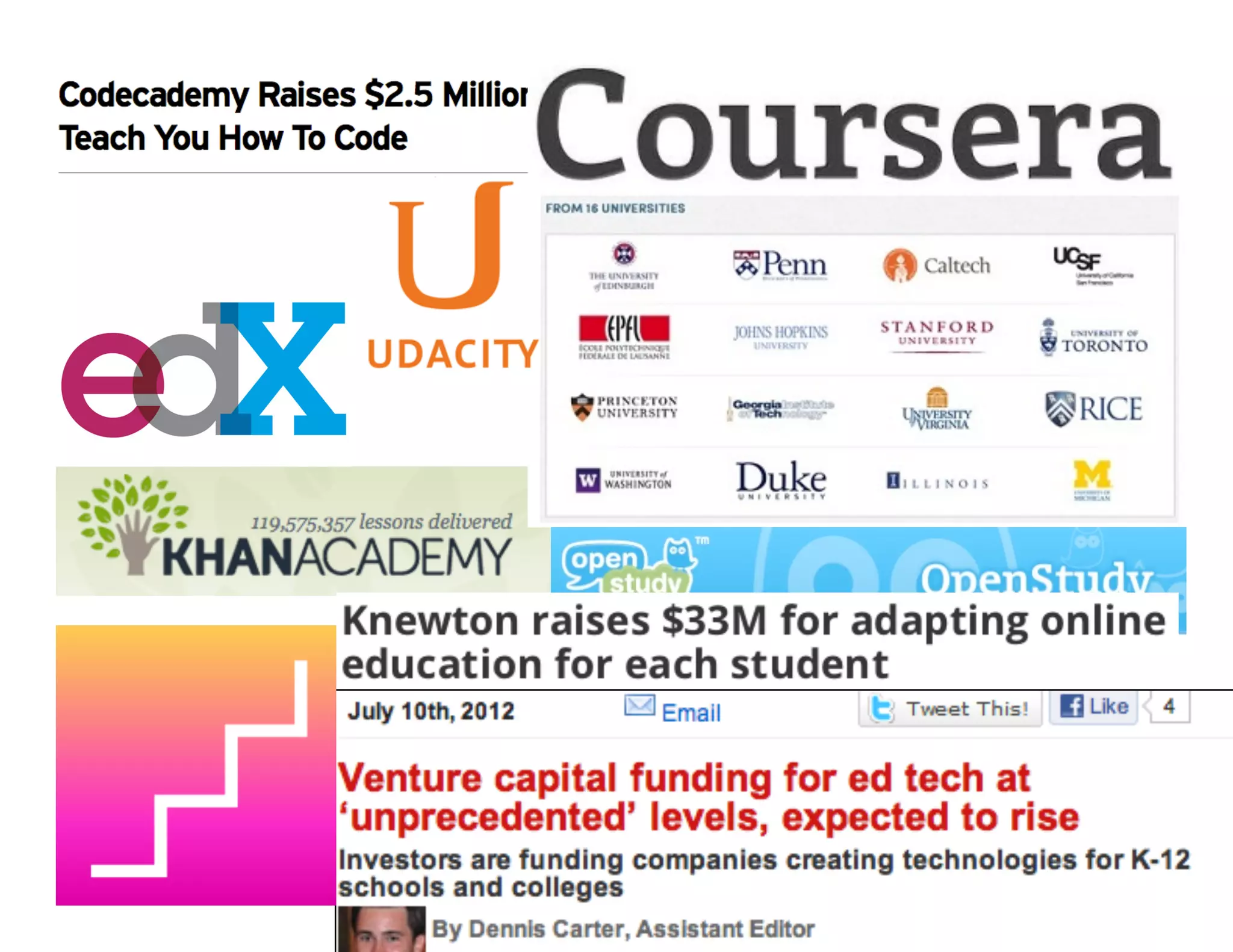
The MOOC phenomenon
•  MOOCs & rise of “edtech”
– A symptom or a solution?
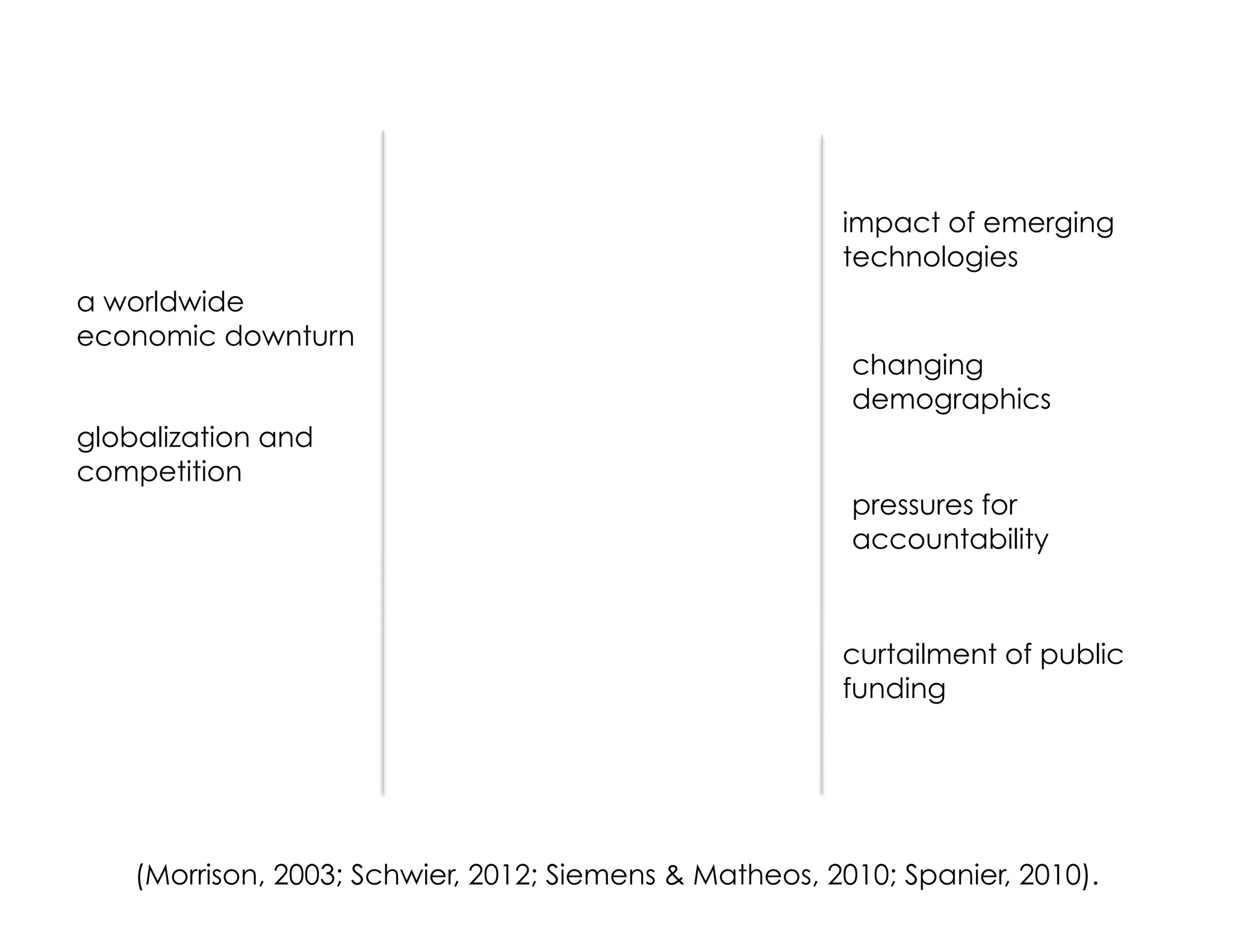
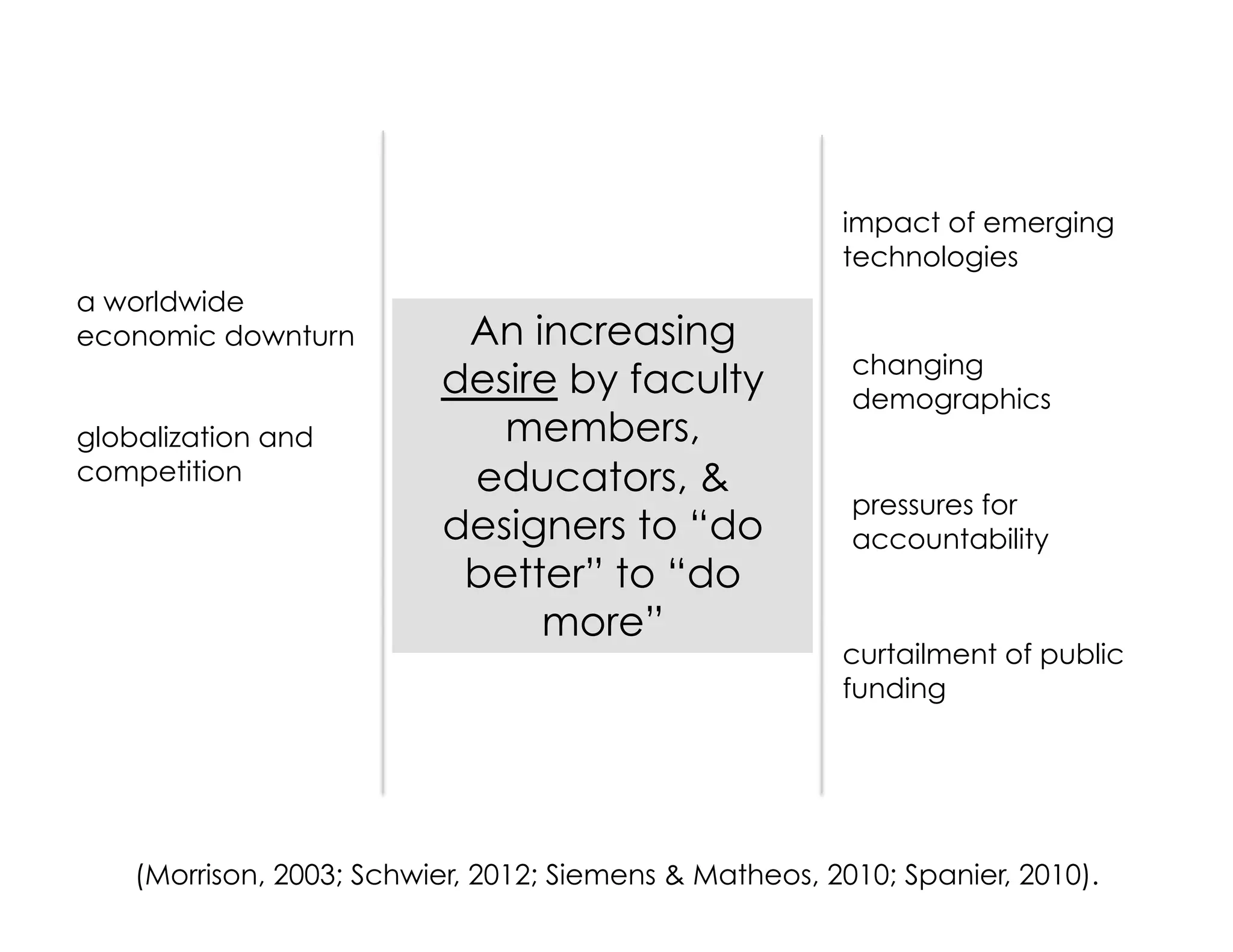
Contemporary universities are facing
numerous powerful forces that may
shape their future.
a worldwide
economic downturn
globalization and
competition
changing
demographics
curtailment of public
funding
pressures for
accountability
impact of emerging
technologies
(Morrison, 2003; Schwier, 2012; Siemens & Matheos, 2010; Spanier, 2010).
a worldwide
economic downturn
globalization and
competition
changing
demographics
curtailment of public
funding
pressures for
accountability
impact of emerging
technologies
(Morrison, 2003; Schwier, 2012; Siemens & Matheos, 2010; Spanier, 2010).
An increasing
desire by faculty
members,
educators, &
designers to “do
better” to “do
more”
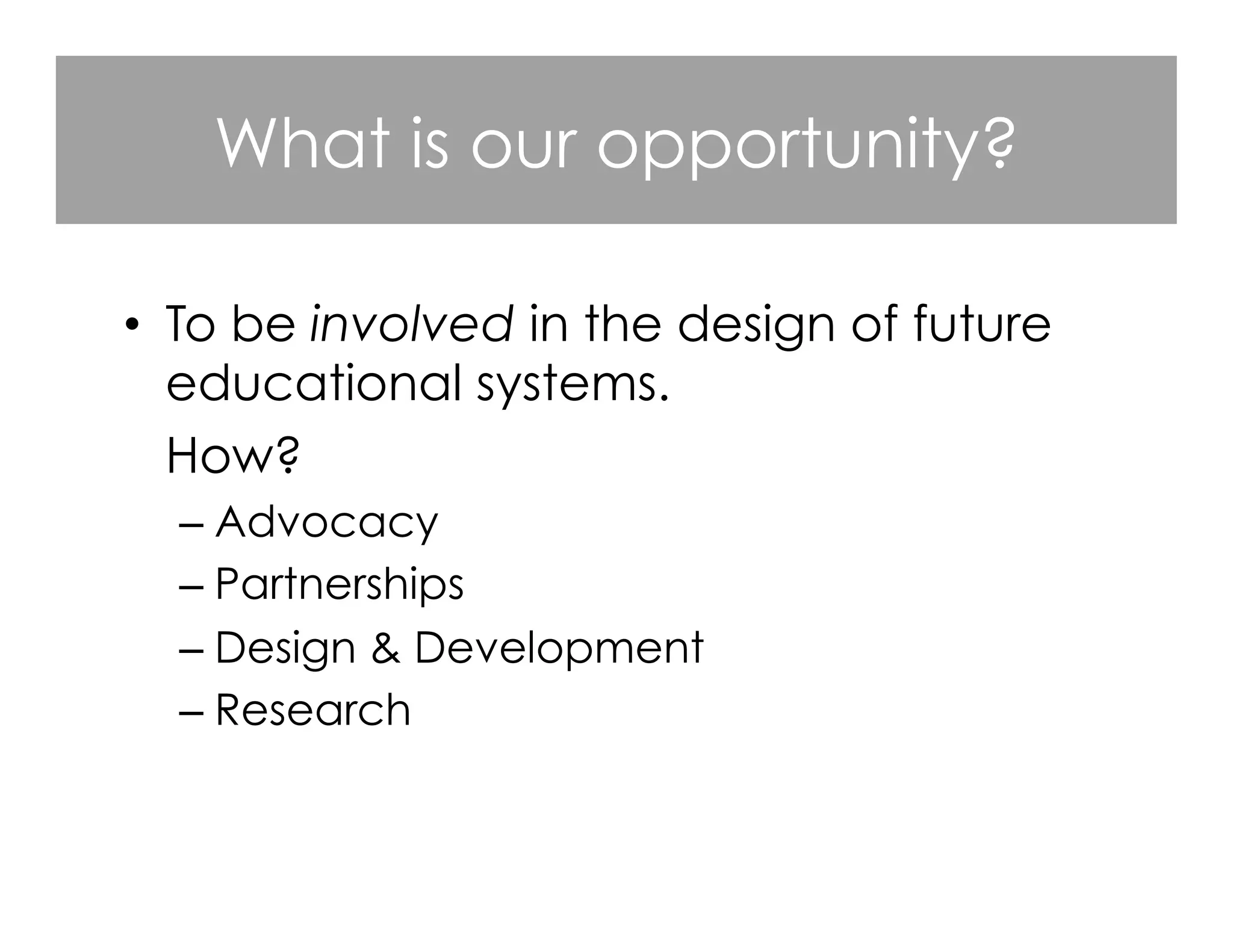
What is our opportunity?
•  To be involved in the design of future
educational systems.
How?
– Advocacy
– Partnerships
– Design & Development
– Research
Higher Education in 2012-2013:
Sense of urgency. And tension.
Techno-enthusiasm & techno-
determinism* dominate
e.g., Technology will ____________
Narratives of disruption & revolution
(*skeptics != naysayers)
Disaggregation & Unbundling
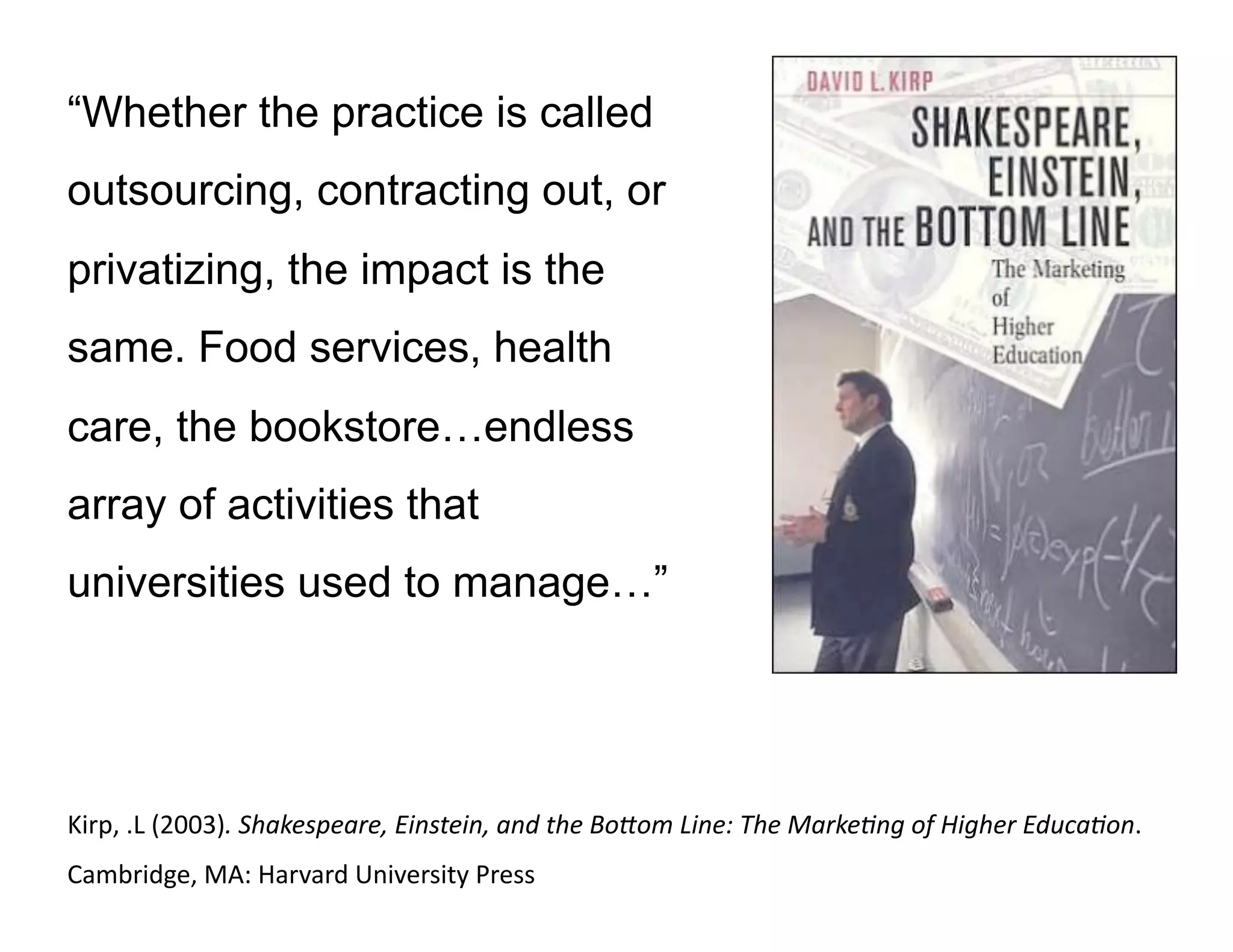
“Whether the practice is called
outsourcing, contracting out, or
privatizing, the impact is the
same. Food services, health
care, the bookstore…endless
array of activities that
universities used to manage…”
Kirp,	
  .L	
  (2003).	
  Shakespeare,	
  Einstein,	
  and	
  the	
  Bo3om	
  Line:	
  The	
  Marke9ng	
  of	
  Higher	
  Educa9on.	
  
Cambridge,	
  MA:	
  Harvard	
  University	
  Press	
  	
  
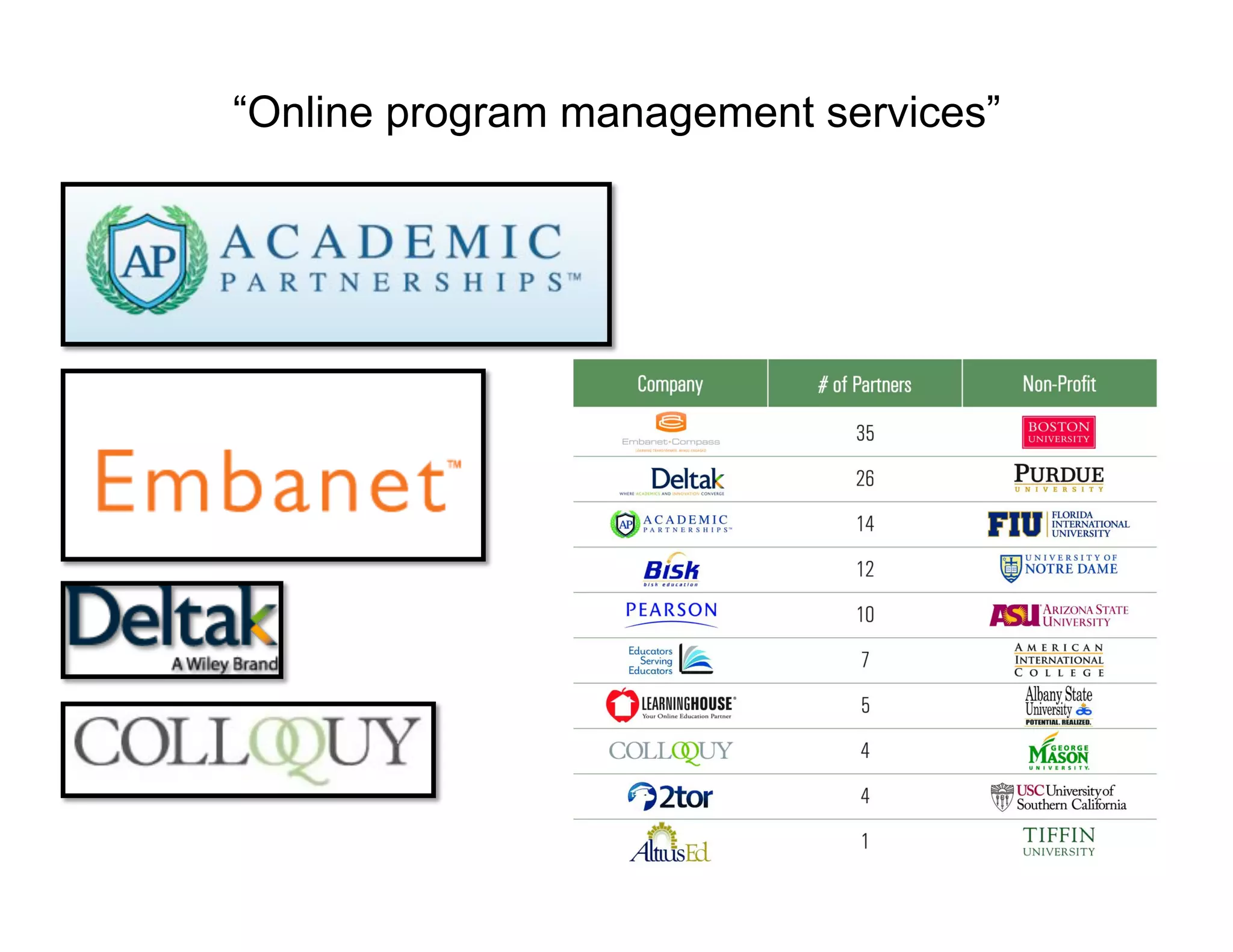
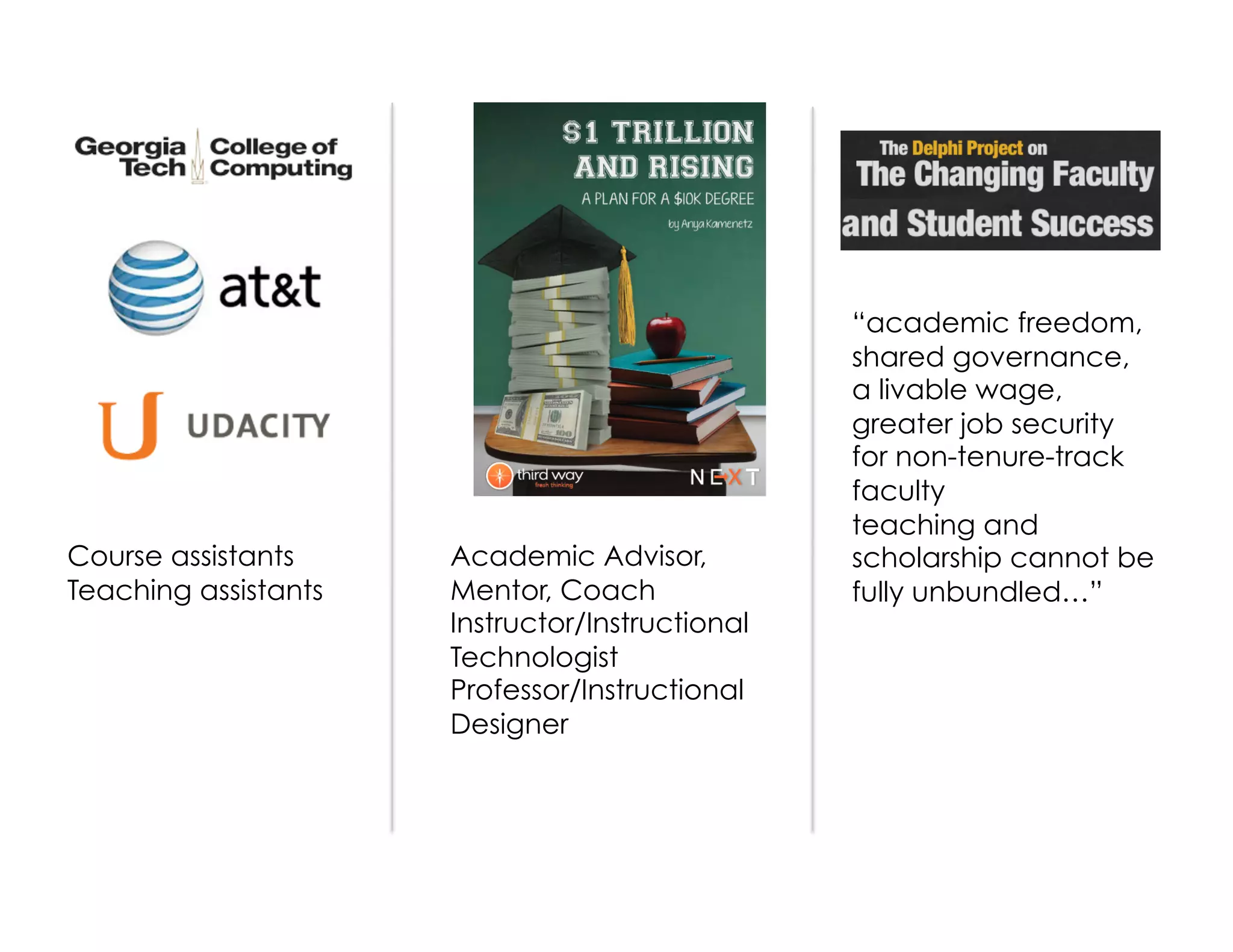
“Online program management services”
The role of the faculty member
The roles of instructional designers,
tutors, instructors
“academic freedom,
shared governance,
a livable wage,
greater job security
for non-tenure-track
faculty
teaching and
scholarship cannot be
fully unbundled…”
Academic Advisor,
Mentor, Coach
Instructor/Instructional
Technologist
Professor/Instructional
Designer
Course assistants
Teaching assistants
What is our opportunity?
•  To prepare learning designers for a
new era of educational technology
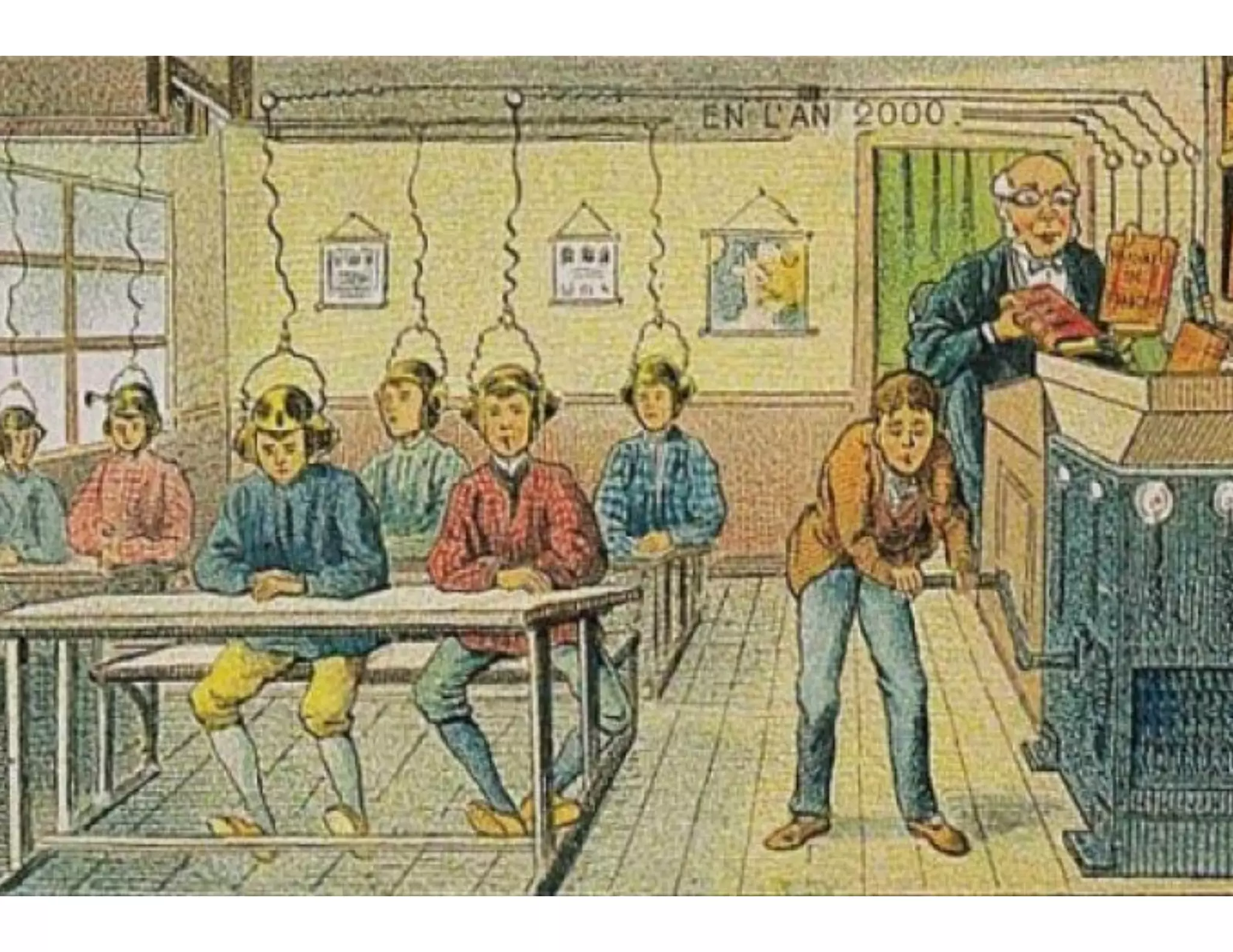
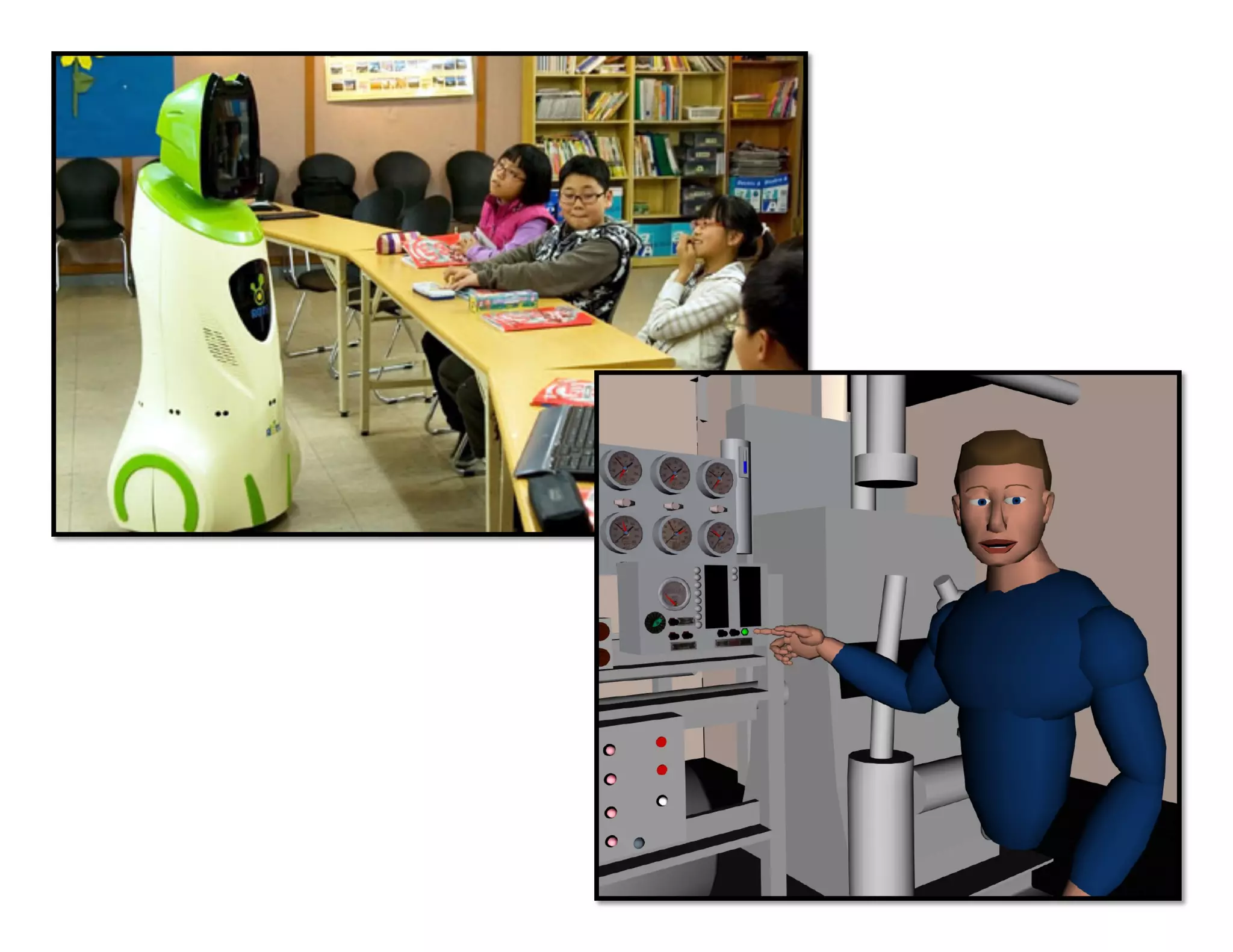
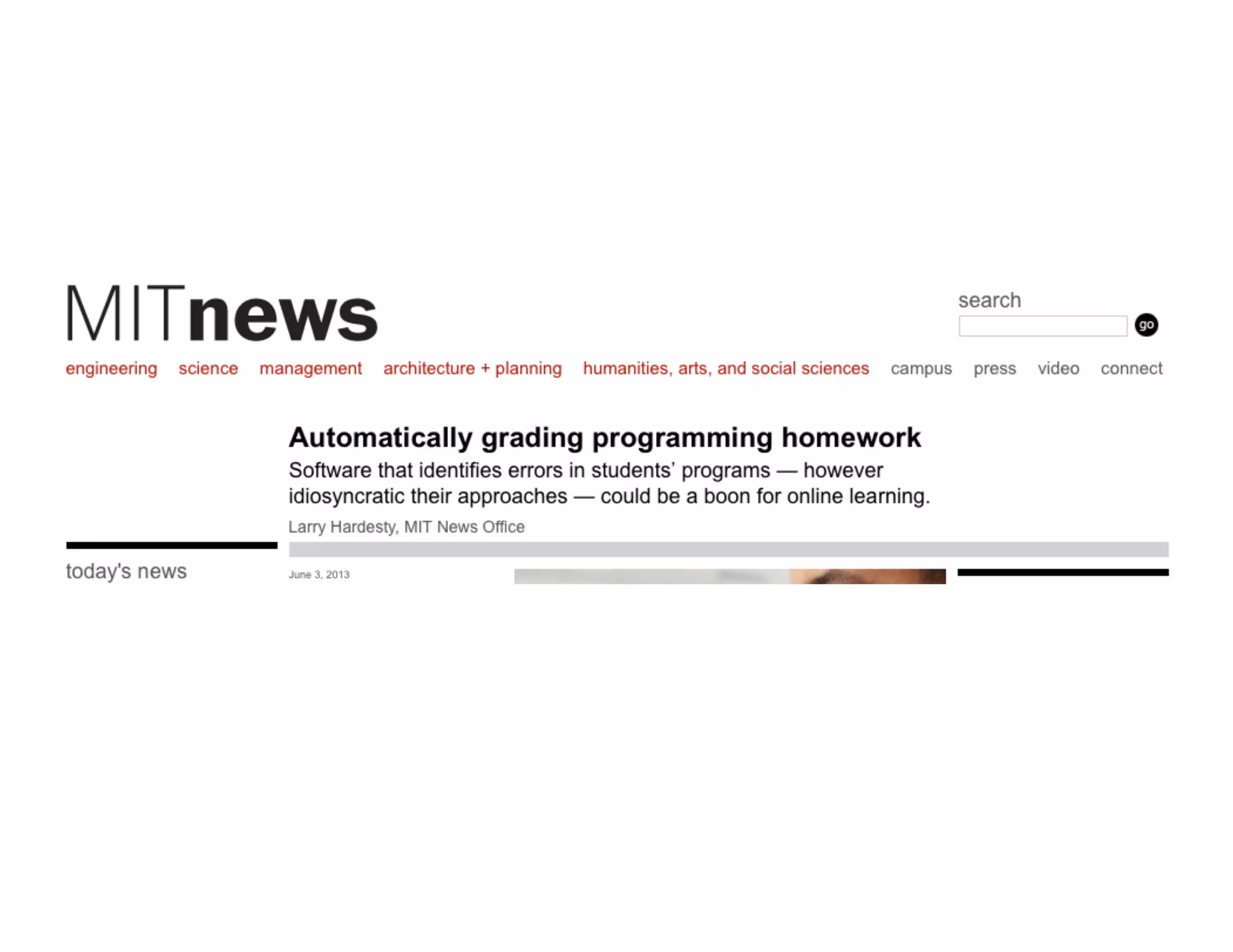
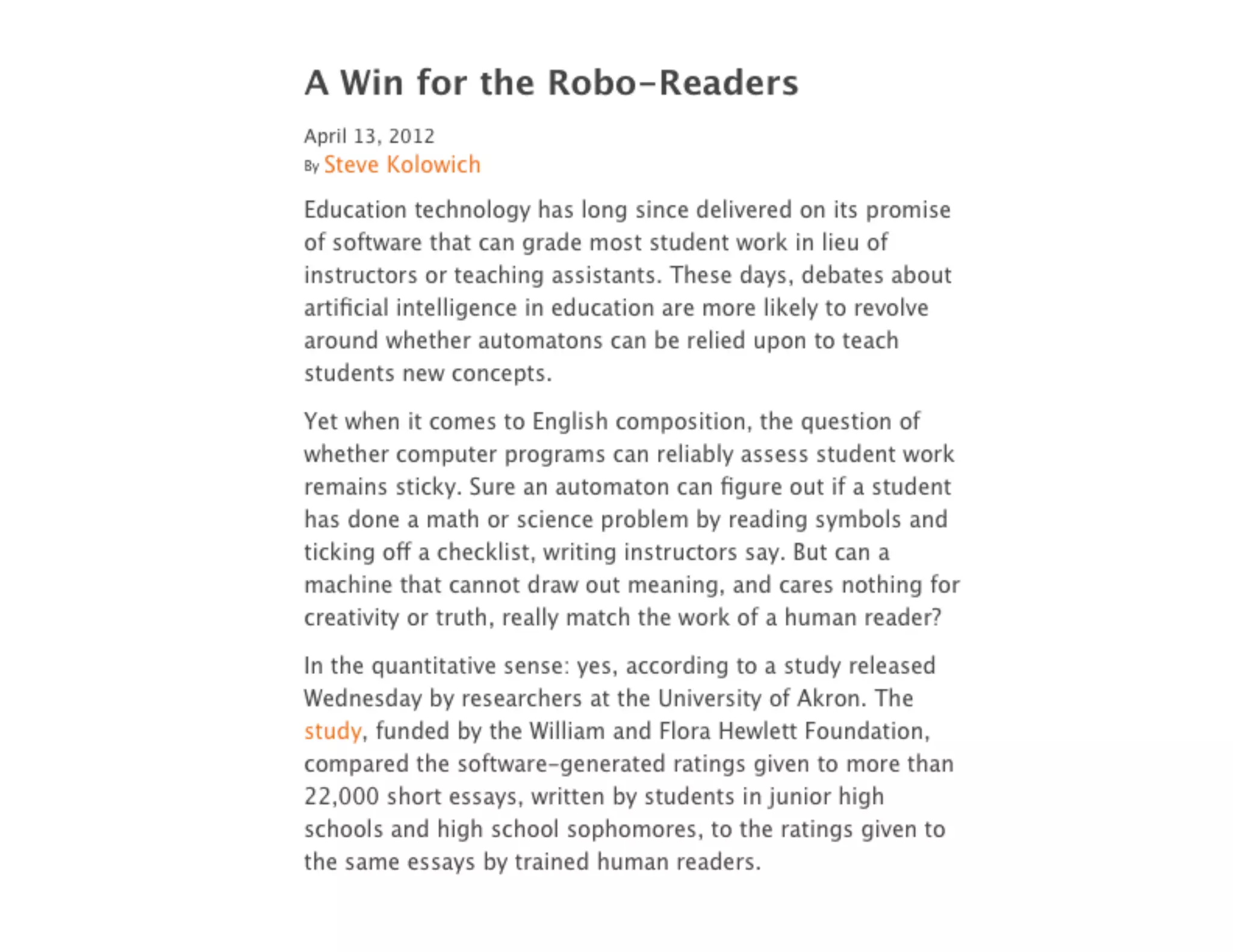
Efficiency. Automation. And robots.
Open Practices
Open Education  Open Scholarship
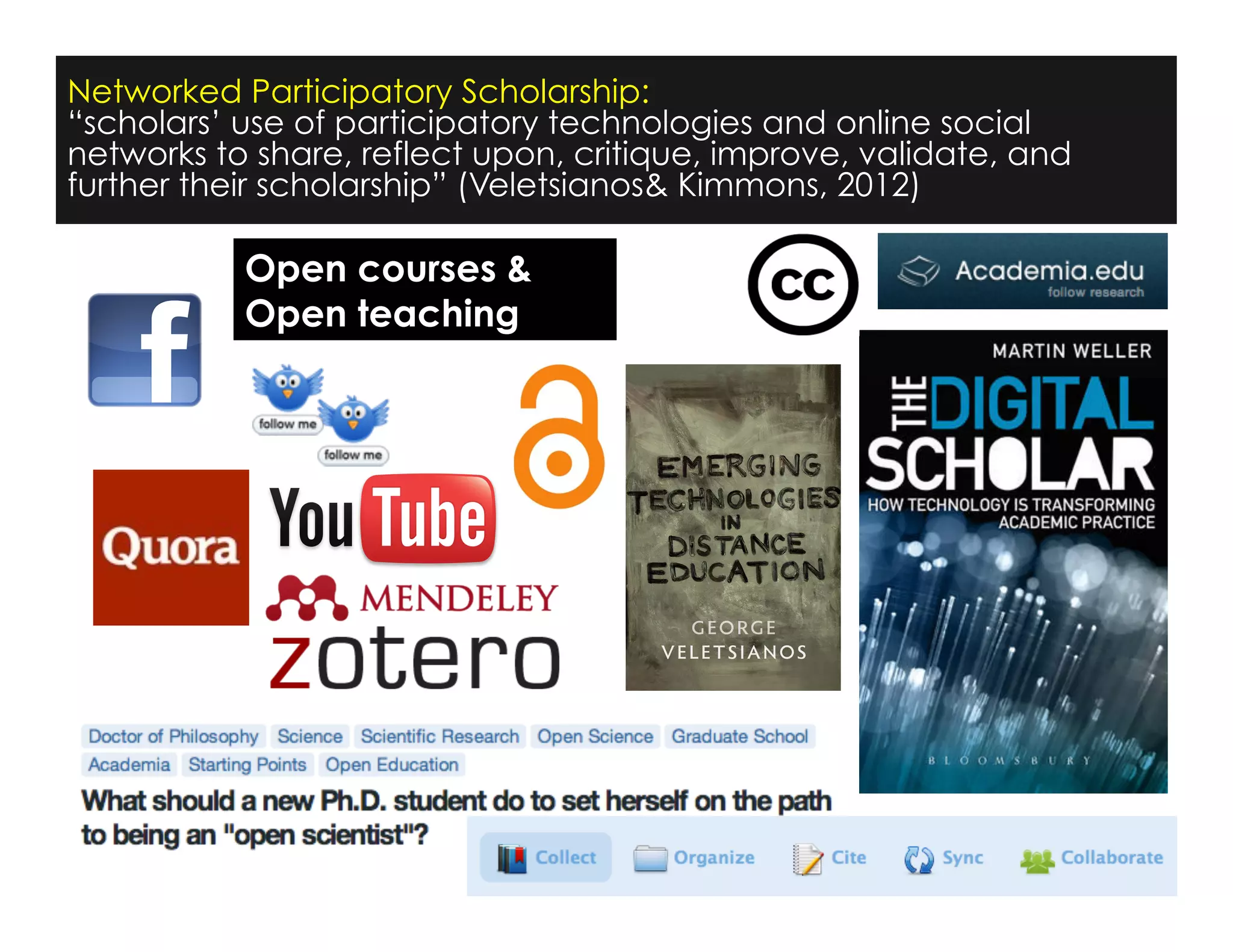
Networked Participatory Scholarship:
“scholars’ use of participatory technologies and online social
networks to share, reflect upon, critique, improve, validate, and
further their scholarship” (Veletsianos& Kimmons, 2012)
Open courses &
Open teaching
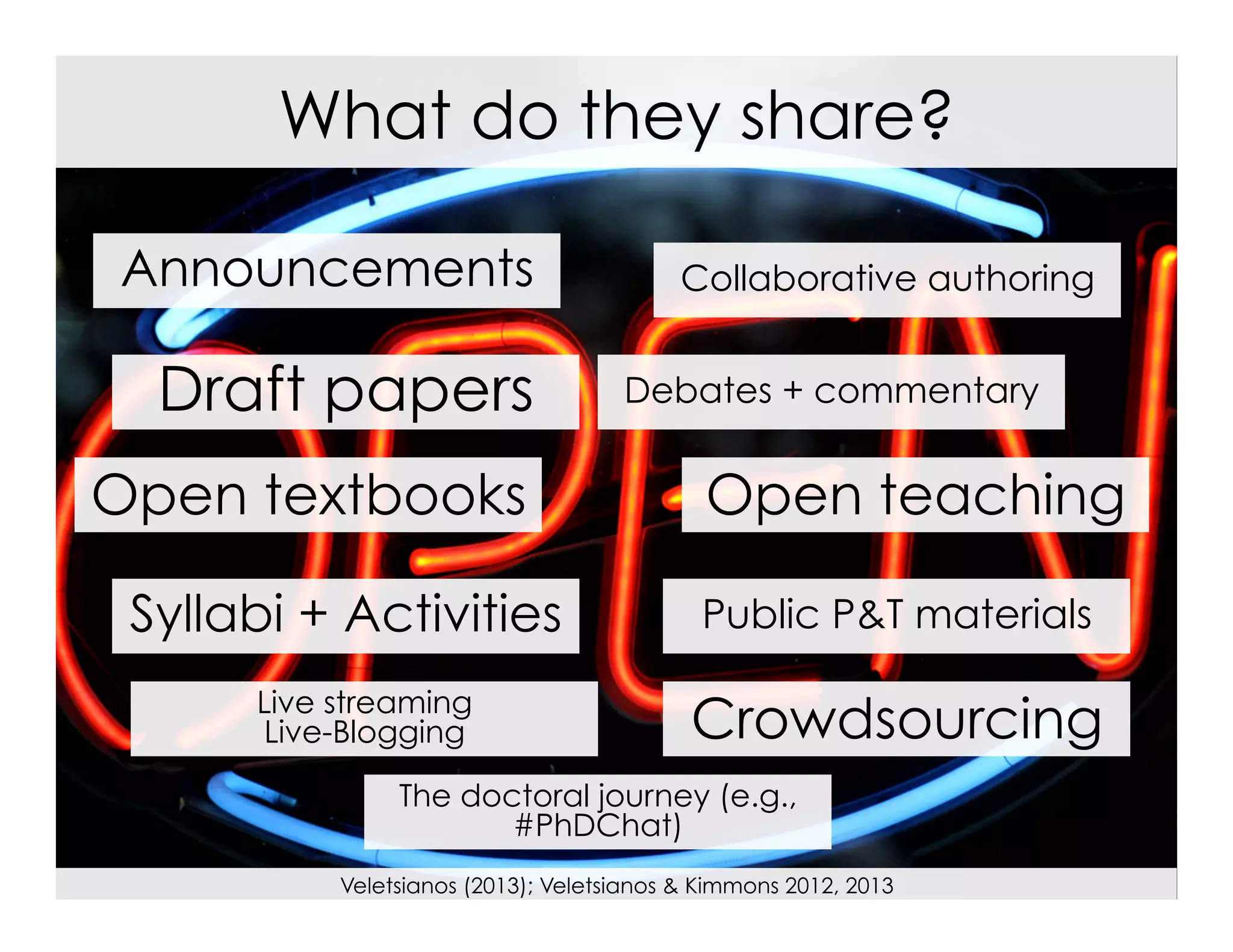
Veletsianos (2013); Veletsianos & Kimmons 2012, 2013
Announcements
Draft papers
Open textbooks
Syllabi + Activities
Live streaming
Live-Blogging
Collaborative authoring
Debates + commentary
Open teaching
Public P&T materials
The doctoral journey (e.g.,
#PhDChat)
Crowdsourcing
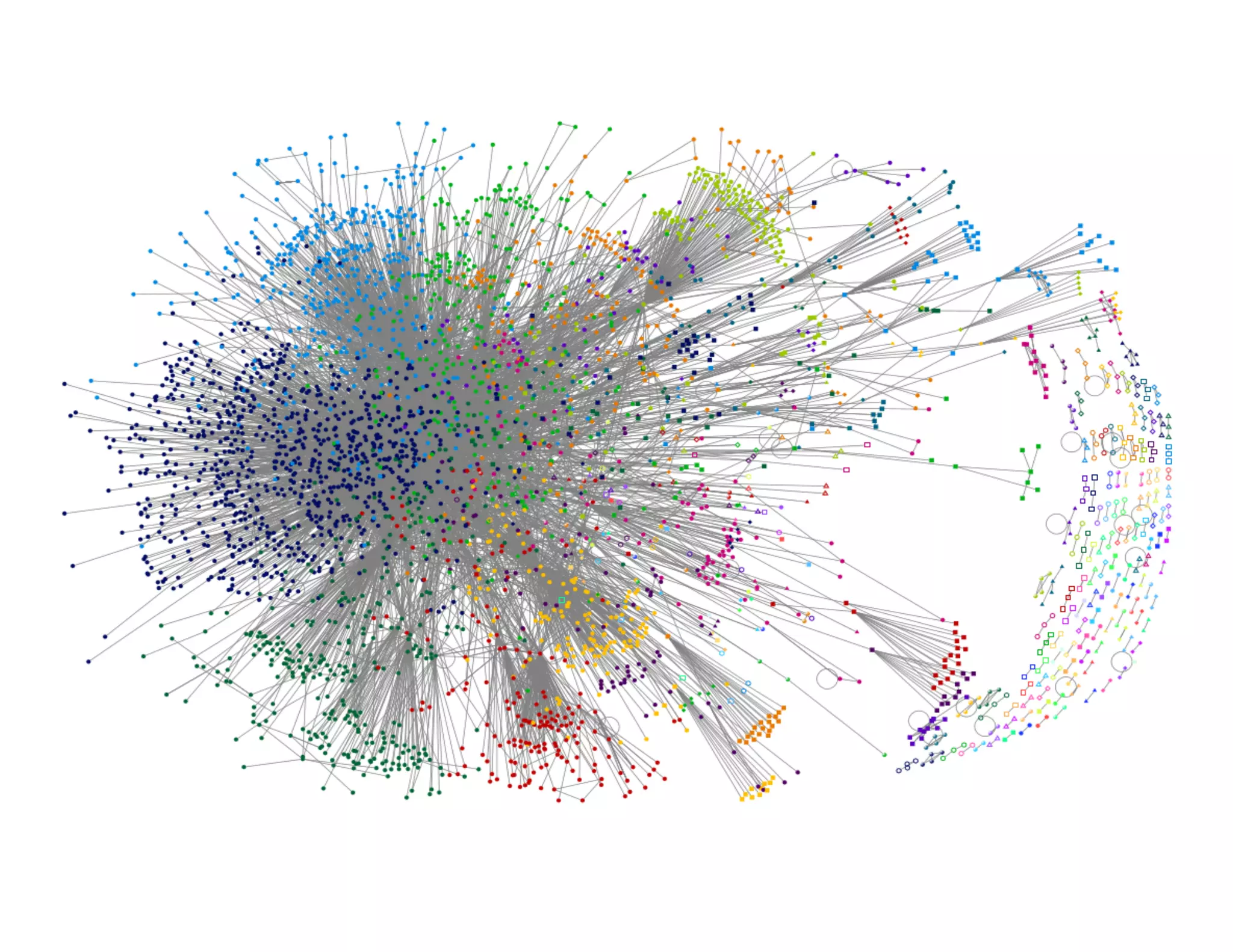
What do they share?
Why do they share?
•  Faculty use blogs to:
– Explore scholarly ideas (Kirkup, 2010)
– Re-envision their identities as public
intellectuals (Kirkup, 2010)
– Share knowledge (Kjellberg, 2010)
– Connect with other researchers (Kjellberg,
2010)
– Reach multiple audiences (Kjellberg, 2010;
Martindale & Wiley, 2005)
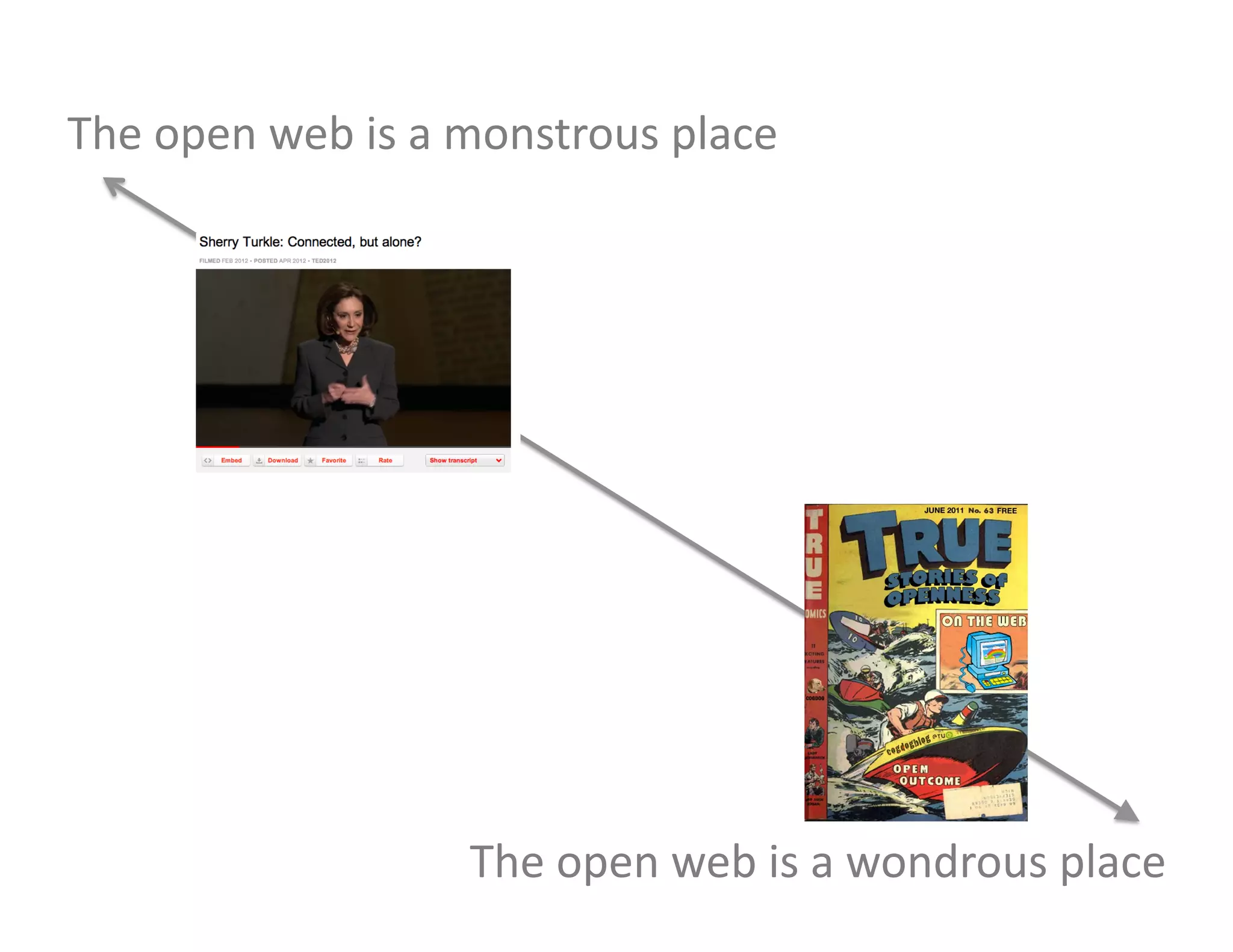
Open Sharing
The	
  open	
  web	
  is	
  a	
  monstrous	
  place	
  
The	
  open	
  web	
  is	
  a	
  wondrous	
  place	
  
Identity & Participation
“I made it [Facebook] this hybrid space ... and sometimes it's
really annoying. … I keep thinking I should be writing or
looking at data, and I'm doing this! … I created the
conundrum that I live in now.”
“My position [as a professor] is building a community of
teachers that I talk to ... where you can share, and so
[participation in these spaces] makes total sense.”
“All the [expletive] is not really worth it. … I think that it's okay
for students to not know everything about their professor. …
[These practices] add to the complexity of those who
struggle with the home-work balance and the ... technology
pull. … I don't have time for you. “
Veletsianos & Kimmons, 2013
Designing for Learner Experiences
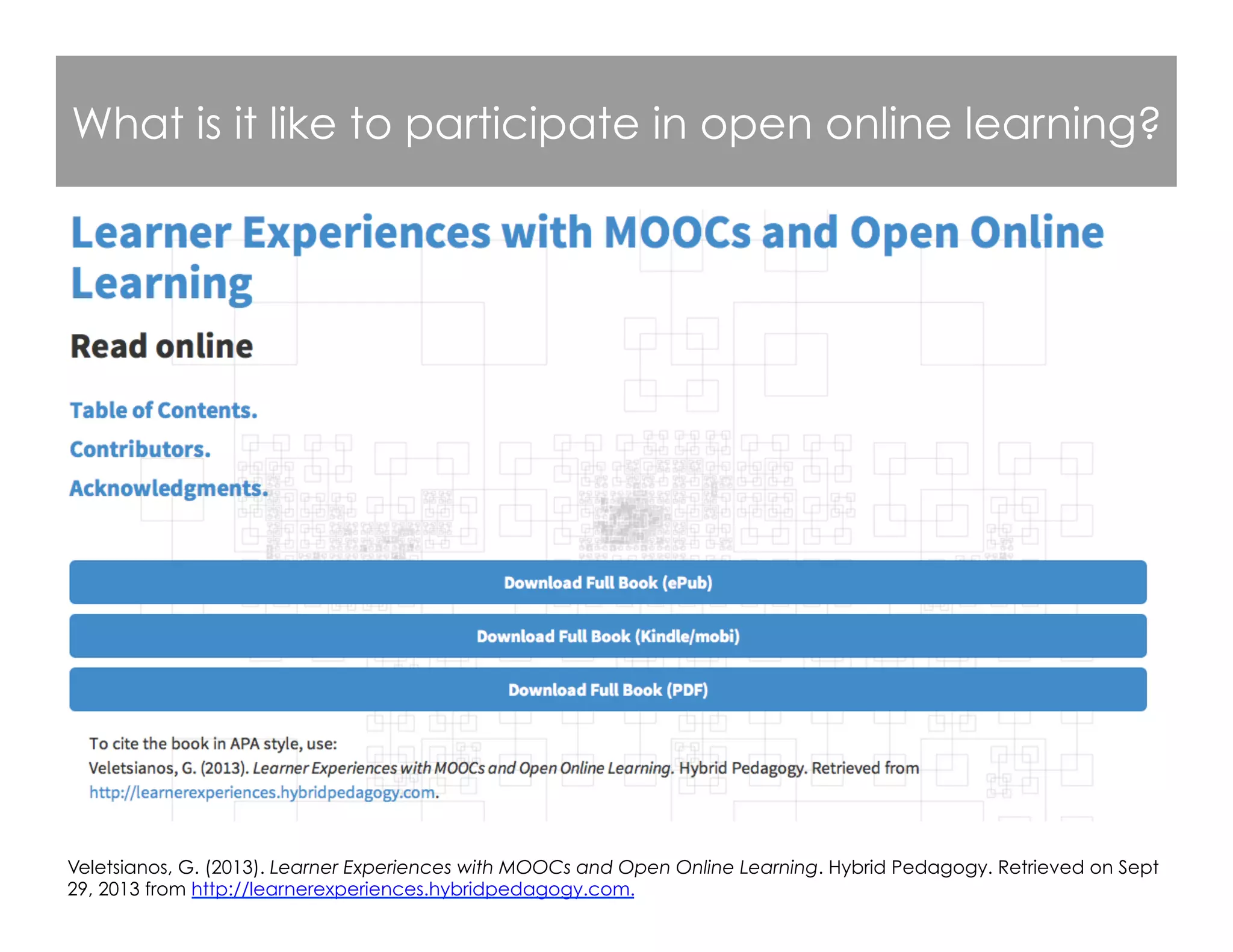
What is it like to participate in open online learning?
Veletsianos, G. (2013). Learner Experiences with MOOCs and Open Online Learning. Hybrid Pedagogy. Retrieved on Sept
29, 2013 from http://learnerexperiences.hybridpedagogy.com.
Key takeaways
• We should be asking students to do a discipline, not just
read about it.
• In the frenzy surrounding the rise of “edtech” and MOOCs,
it seems that student voices and experiences are rarely
considered.
• To gain a holistic understanding of learner experiences
researchers need to use multiple methodologies.
• Macro (Kizilcec, Piech, Schneider, 2013)
• Learners were: “Auditing, Completing. Disengaging,
Sampling”
• Micro
• “[I was] left with a partial sense of accomplishment
and feelings of hollowness and incompleteness.”
Key takeaways
The realities of open online learning are different from the
hopes of open online learning.
We only have small pieces of an incomplete mosaic of
students’ learning experiences with open online learning.
What do we want learner experiences
to look like?
Thank you!
www.veletsianos.com
@veletsianos on Twitter
veletsianos@gmail.com

Significant opportunities and challenges in the age of "open" and "connected". By George Veletsianos

  • 1.
    Dr. George Veletsianos CanadaResearch Chair in Innovative Learning & Technology Associate Professor School of Education and Technology Royal Roads University, Victoria, BC eLearn Center– Open University of Catalonia, September 30, 2013 The significant opportunities and challenges that learners, educators, researchers, and learning institutions are facing in the age of "open" and "connected"
  • 2.
    Gràcies per laseva hospitalitat i per la invitació a passar temps amb eLearn Center
  • 3.
    School of Educationand Technology http://tinyurl.com/RRUMALAT
  • 4.
    The MOOC phenomenon • MOOCs & rise of “edtech” – A symptom or a solution?
  • 5.
    Contemporary universities arefacing numerous powerful forces that may shape their future.
  • 6.
    a worldwide economic downturn globalizationand competition changing demographics curtailment of public funding pressures for accountability impact of emerging technologies (Morrison, 2003; Schwier, 2012; Siemens & Matheos, 2010; Spanier, 2010).
  • 7.
    a worldwide economic downturn globalizationand competition changing demographics curtailment of public funding pressures for accountability impact of emerging technologies (Morrison, 2003; Schwier, 2012; Siemens & Matheos, 2010; Spanier, 2010). An increasing desire by faculty members, educators, & designers to “do better” to “do more”
  • 8.
    What is ouropportunity? •  To be involved in the design of future educational systems. How? – Advocacy – Partnerships – Design & Development – Research
  • 9.
    Higher Education in2012-2013: Sense of urgency. And tension.
  • 11.
    Techno-enthusiasm & techno- determinism*dominate e.g., Technology will ____________ Narratives of disruption & revolution (*skeptics != naysayers)
  • 12.
  • 13.
    “Whether the practiceis called outsourcing, contracting out, or privatizing, the impact is the same. Food services, health care, the bookstore…endless array of activities that universities used to manage…” Kirp,  .L  (2003).  Shakespeare,  Einstein,  and  the  Bo3om  Line:  The  Marke9ng  of  Higher  Educa9on.   Cambridge,  MA:  Harvard  University  Press    
  • 15.
  • 16.
    The role ofthe faculty member The roles of instructional designers, tutors, instructors
  • 17.
    “academic freedom, shared governance, alivable wage, greater job security for non-tenure-track faculty teaching and scholarship cannot be fully unbundled…” Academic Advisor, Mentor, Coach Instructor/Instructional Technologist Professor/Instructional Designer Course assistants Teaching assistants
  • 18.
    What is ouropportunity? •  To prepare learning designers for a new era of educational technology
  • 19.
  • 24.
    Open Practices Open Education Open Scholarship
  • 25.
    Networked Participatory Scholarship: “scholars’use of participatory technologies and online social networks to share, reflect upon, critique, improve, validate, and further their scholarship” (Veletsianos& Kimmons, 2012) Open courses & Open teaching
  • 26.
    Veletsianos (2013); Veletsianos& Kimmons 2012, 2013 Announcements Draft papers Open textbooks Syllabi + Activities Live streaming Live-Blogging Collaborative authoring Debates + commentary Open teaching Public P&T materials The doctoral journey (e.g., #PhDChat) Crowdsourcing What do they share?
  • 27.
    Why do theyshare? •  Faculty use blogs to: – Explore scholarly ideas (Kirkup, 2010) – Re-envision their identities as public intellectuals (Kirkup, 2010) – Share knowledge (Kjellberg, 2010) – Connect with other researchers (Kjellberg, 2010) – Reach multiple audiences (Kjellberg, 2010; Martindale & Wiley, 2005)
  • 28.
  • 30.
    The  open  web  is  a  monstrous  place   The  open  web  is  a  wondrous  place  
  • 31.
    Identity & Participation “Imade it [Facebook] this hybrid space ... and sometimes it's really annoying. … I keep thinking I should be writing or looking at data, and I'm doing this! … I created the conundrum that I live in now.” “My position [as a professor] is building a community of teachers that I talk to ... where you can share, and so [participation in these spaces] makes total sense.” “All the [expletive] is not really worth it. … I think that it's okay for students to not know everything about their professor. … [These practices] add to the complexity of those who struggle with the home-work balance and the ... technology pull. … I don't have time for you. “ Veletsianos & Kimmons, 2013
  • 32.
  • 33.
    What is itlike to participate in open online learning? Veletsianos, G. (2013). Learner Experiences with MOOCs and Open Online Learning. Hybrid Pedagogy. Retrieved on Sept 29, 2013 from http://learnerexperiences.hybridpedagogy.com.
  • 34.
    Key takeaways • We shouldbe asking students to do a discipline, not just read about it. • In the frenzy surrounding the rise of “edtech” and MOOCs, it seems that student voices and experiences are rarely considered. • To gain a holistic understanding of learner experiences researchers need to use multiple methodologies. • Macro (Kizilcec, Piech, Schneider, 2013) • Learners were: “Auditing, Completing. Disengaging, Sampling” • Micro • “[I was] left with a partial sense of accomplishment and feelings of hollowness and incompleteness.”
  • 35.
    Key takeaways The realitiesof open online learning are different from the hopes of open online learning. We only have small pieces of an incomplete mosaic of students’ learning experiences with open online learning.
  • 36.
    What do wewant learner experiences to look like?
  • 37.