TAG: Ubiquitous Learning
Model to Assess the
Ubiquity Level in Higher
Education Institutions
(Thesis Proposal)
Roberto Aguas Núñez

1
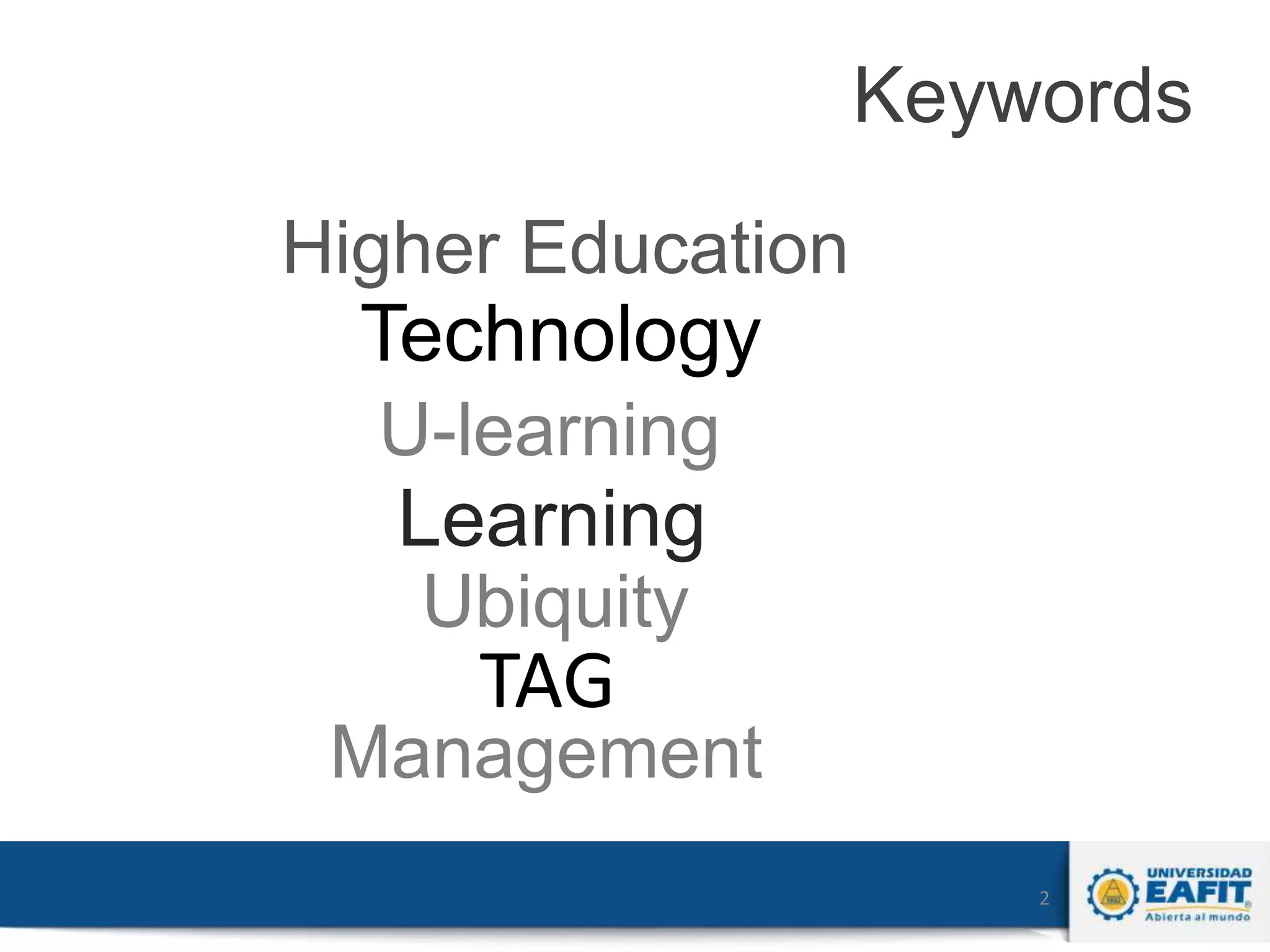
Keywords
Higher Education

Technology
U-learning

Learning
Ubiquity

TAG

Management
2
Introduction

3
Main referents

U-Learning
Concept

Trends and
changes in
H.E.

UT in
educational
contexts

Proposal - Educational Model for
Scenarios of Ubiquitous Learning
4
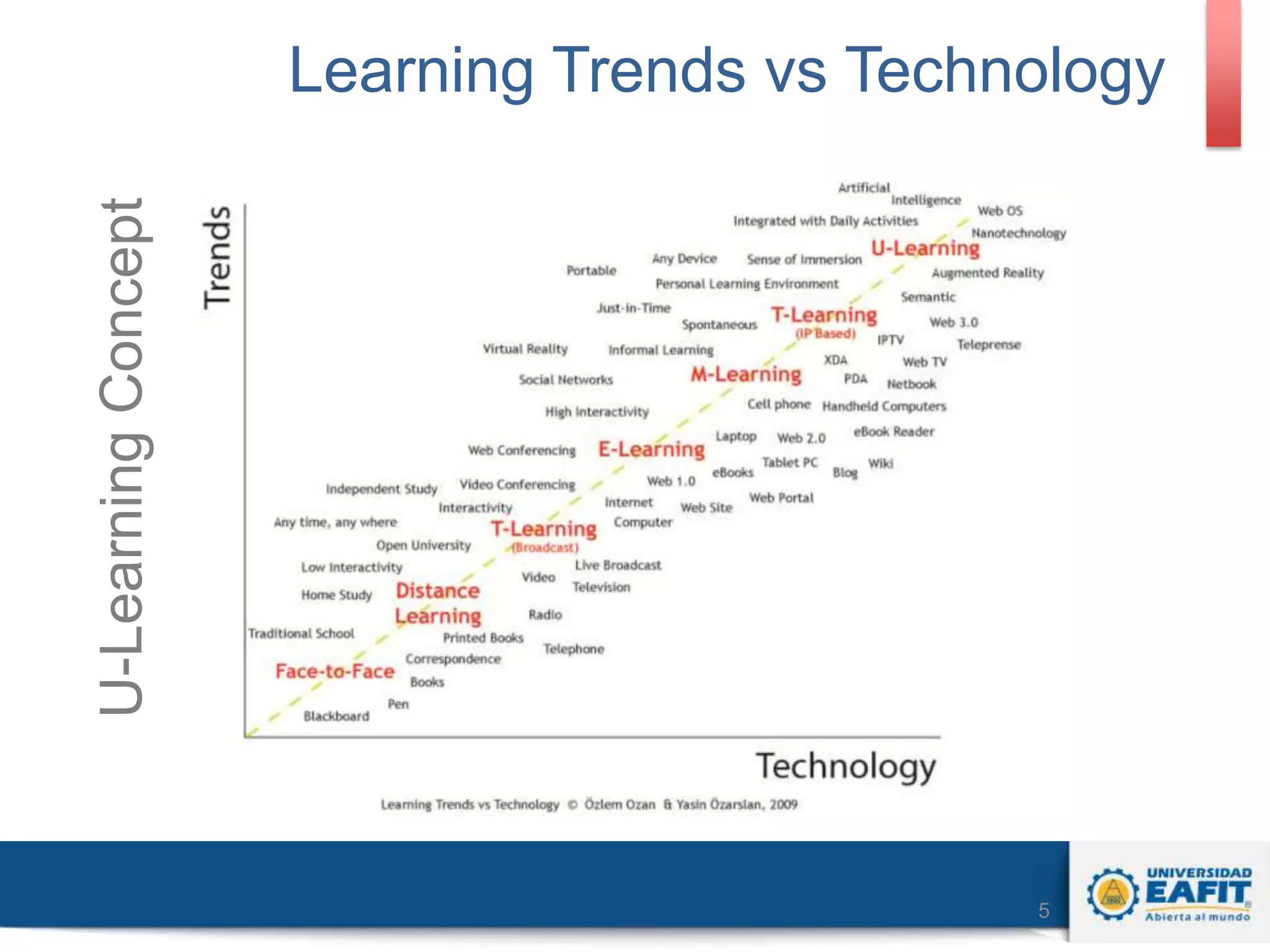
U-Learning Concept

Learning Trends vs Technology

5
U-Learning Concept

6
Trends and changes in H.E.
Neubauer (2003) focuses on the impact of economic rationalism and numerous other
macro forces affecting the H.E. sector. Analyzes the institutional challenges, particularly
for university leaders, after the wake of the macro changes imposed by globalization, lack
of affordability and computer mediated technologies.

Dator (1998) establishes 3 aspects that the XXI century universities need to learn -> The
change into culturally diverse curriculum, the development of the multidisciplinary environments and the contribution from the invention and creativity
to manage new paradigms in political economy and learning communities.
Inayatullah and Gidley (2003) -> 4 factors that motivate transformation in higher
education: Globalization, Multiculturalism, Internet and Politicization.
Wissema (2003), Scott (2006) -> Constant search of knowledge in all ways; The
expression of capabilities of the human condition: thought and creativity; Learning
languages ​and symbolic representations of knowledge; Learning skills; Active
participation in social, cultural and scientific changes, The formation of citizens
oriented to tolerance, scientific and humanistic thinking, critical thinking, esthetic
thinking, problem solving and the ability to undertake.

7
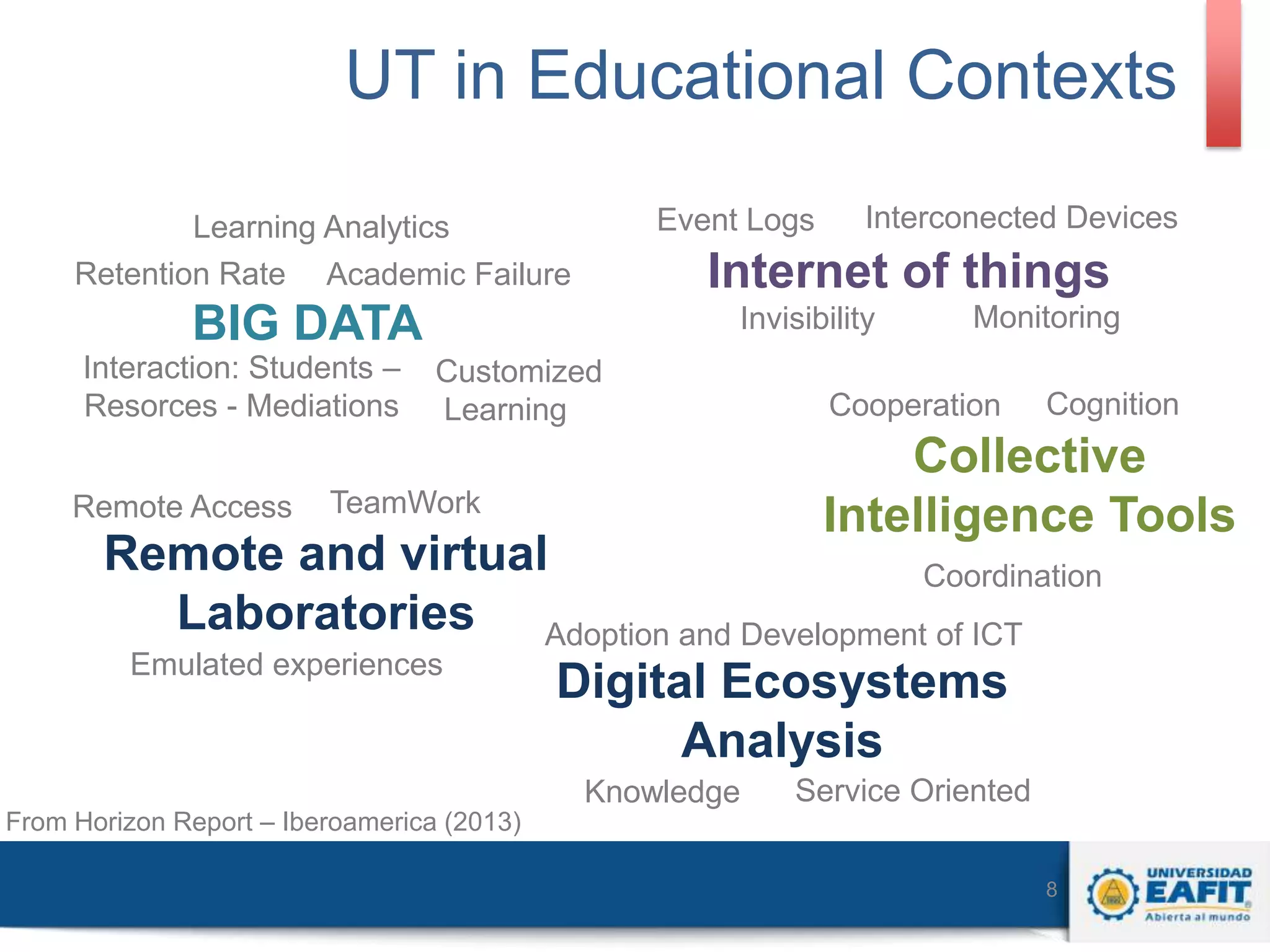
UT in Educational Contexts
Event Logs

Learning Analytics
Retention Rate Academic Failure

Internet of things

BIG DATA

Interaction: Students –
Resorces - Mediations
Remote Access

Interconected Devices

Invisibility
Customized
Learning

Monitoring

Cooperation

Cognition

Collective
Intelligence Tools

TeamWork

Remote and virtual
Coordination
Laboratories Adoption and Development of ICT
Emulated experiences
Digital Ecosystems
Analysis
From Horizon Report – Iberoamerica (2013)

Knowledge

Service Oriented
8
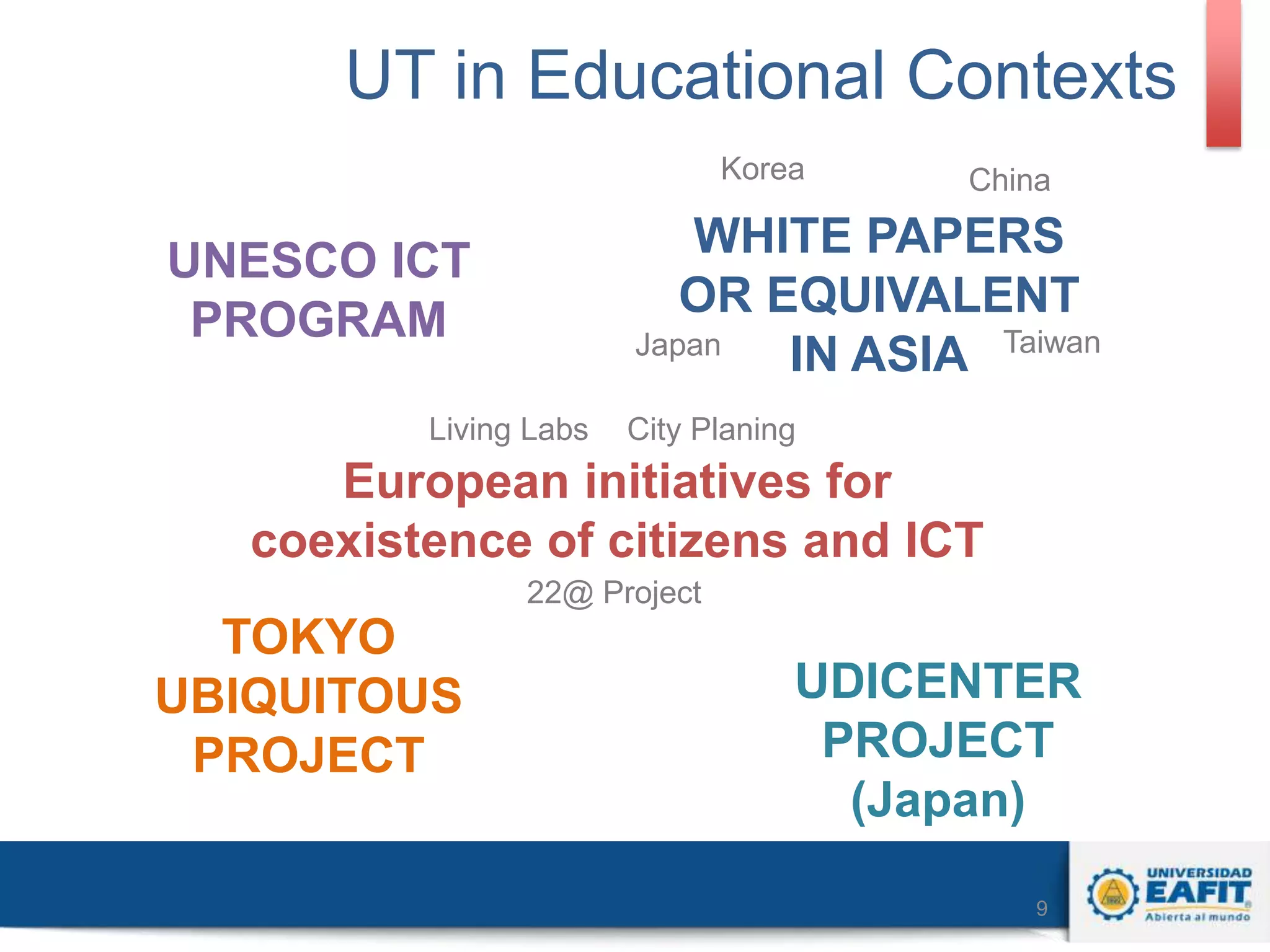
UT in Educational Contexts
Korea

China

WHITE PAPERS
OR EQUIVALENT
Japan
IN ASIA Taiwan

UNESCO ICT
PROGRAM
Living Labs

City Planing

European initiatives for
coexistence of citizens and ICT
22@ Project

TOKYO
UBIQUITOUS
PROJECT

UDICENTER
PROJECT
(Japan)
9
10
Three Dimensions
Zea et. al.(2005) Características de los procesos de gestión en los contextos
E-Learning => between the technical, institutional and pedagogical
aspects.

Zea et. al. (2000) Conexiones => pedagogical, didactical, technological
and managerial areas.
Williams(2003) Roles and Competencies for Distance Education Programs in
Higher Education Institutions => Communication and interaction,
Management, technology and, learning and instruction.
Duart and Lupiáñez (2004), Procesos institucionales de gestión de la calidad
del E-Learning en Instituciones educativas universitarias => They have
identified relevant dimensions to the conceptualization, design and
construction of technology-based learning environments.

11
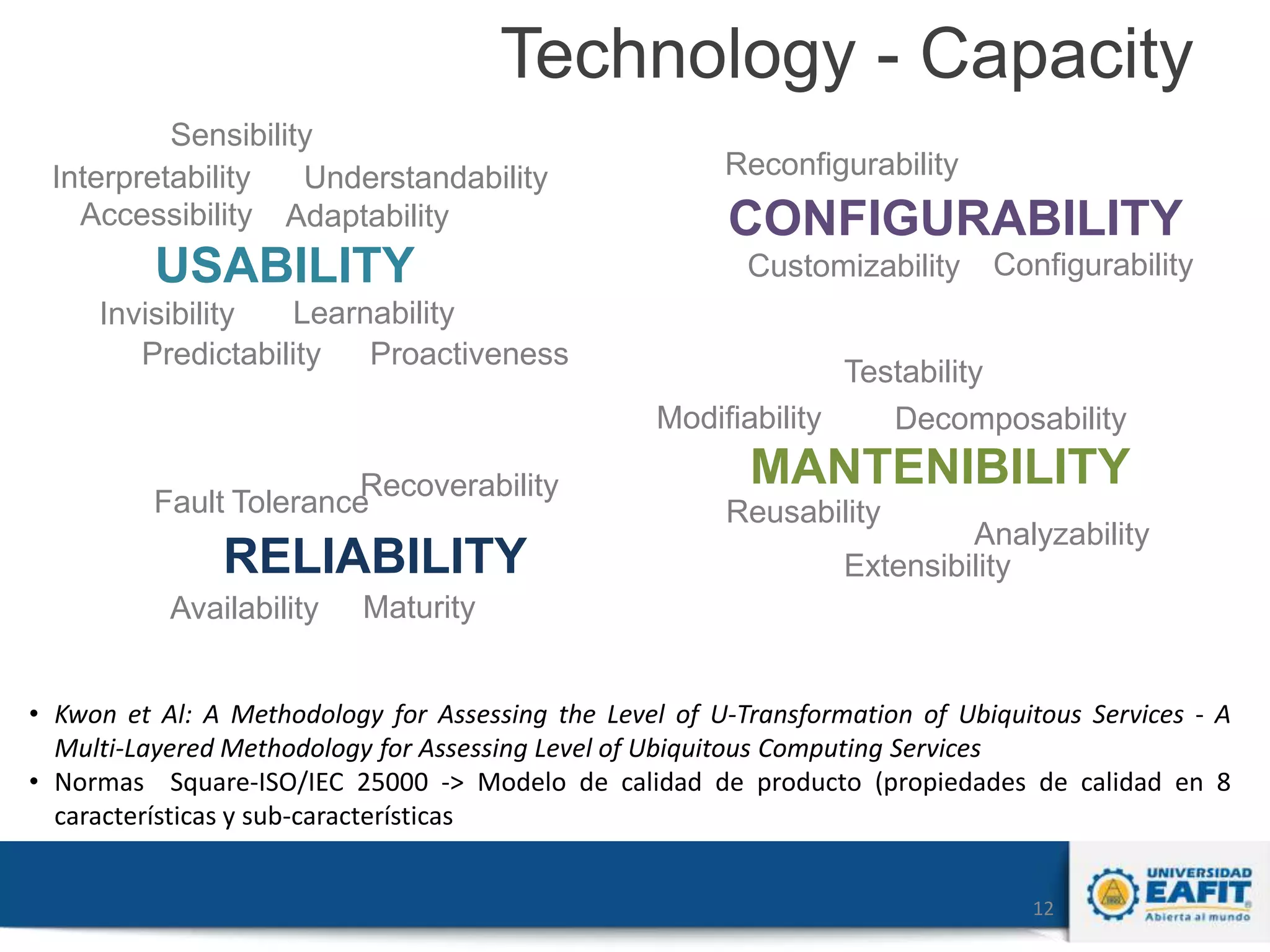
Technology - Capacity
Sensibility
Interpretability
Understandability
Accessibility Adaptability

USABILITY
Learnability
Invisibility
Predictability
Proactiveness

Recoverability
Fault Tolerance

RELIABILITY
Availability

Reconfigurability

CONFIGURABILITY
Customizability

Configurability

Testability
Modifiability
Decomposability

MANTENIBILITY
Reusability

Analyzability
Extensibility

Maturity

• Kwon et Al: A Methodology for Assessing the Level of U-Transformation of Ubiquitous Services - A
Multi-Layered Methodology for Assessing Level of Ubiquitous Computing Services
• Normas Square-ISO/IEC 25000 -> Modelo de calidad de producto (propiedades de calidad en 8
características y sub-características
12
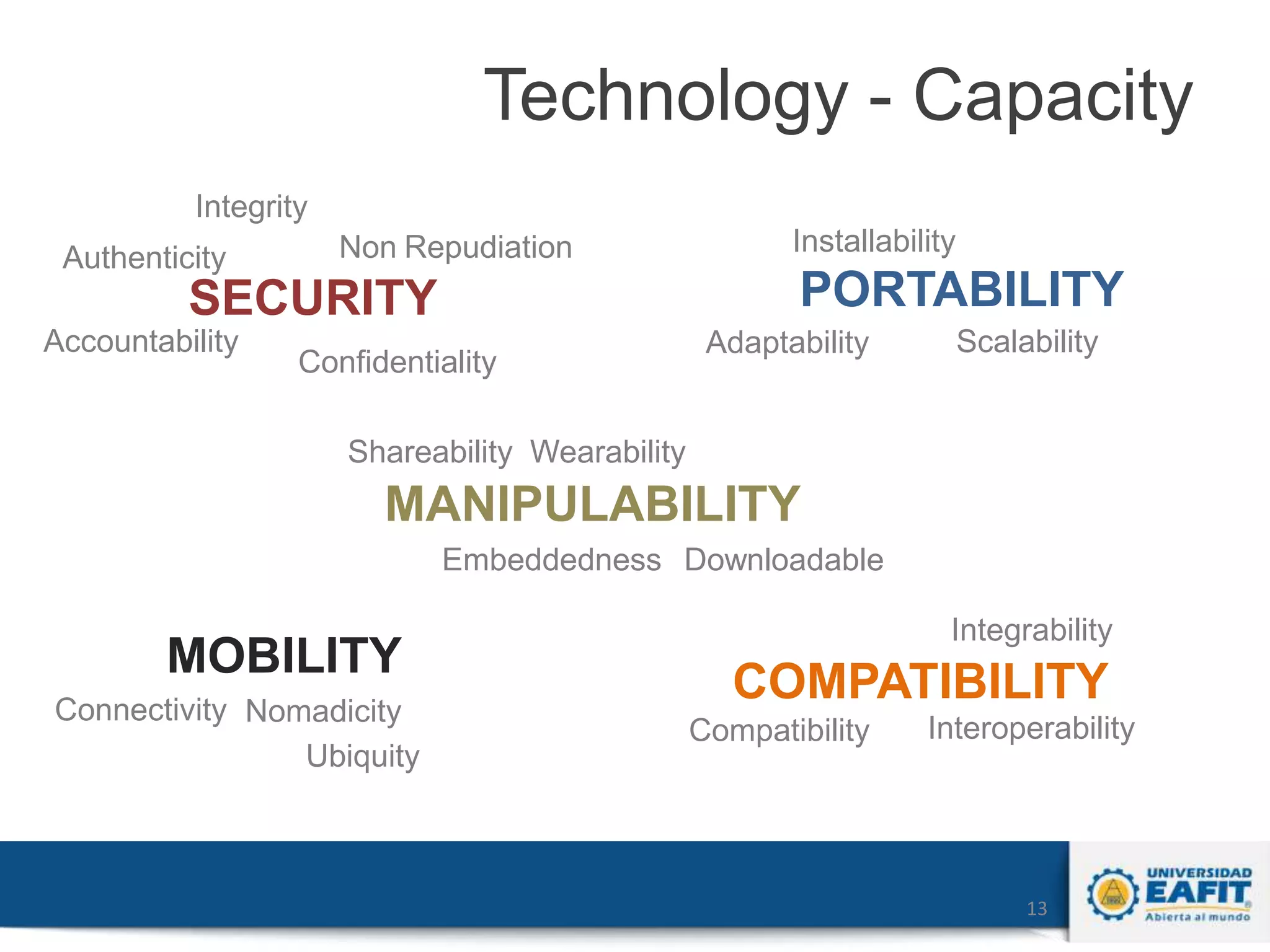
Technology - Capacity
Integrity

Authenticity

Non Repudiation

PORTABILITY

SECURITY
Accountability

Installability

Confidentiality

Adaptability

Scalability

Shareability Wearability

MANIPULABILITY
Embeddedness Downloadable

MOBILITY
Connectivity Nomadicity
Ubiquity

Integrability

COMPATIBILITY
Compatibility

Interoperability

13
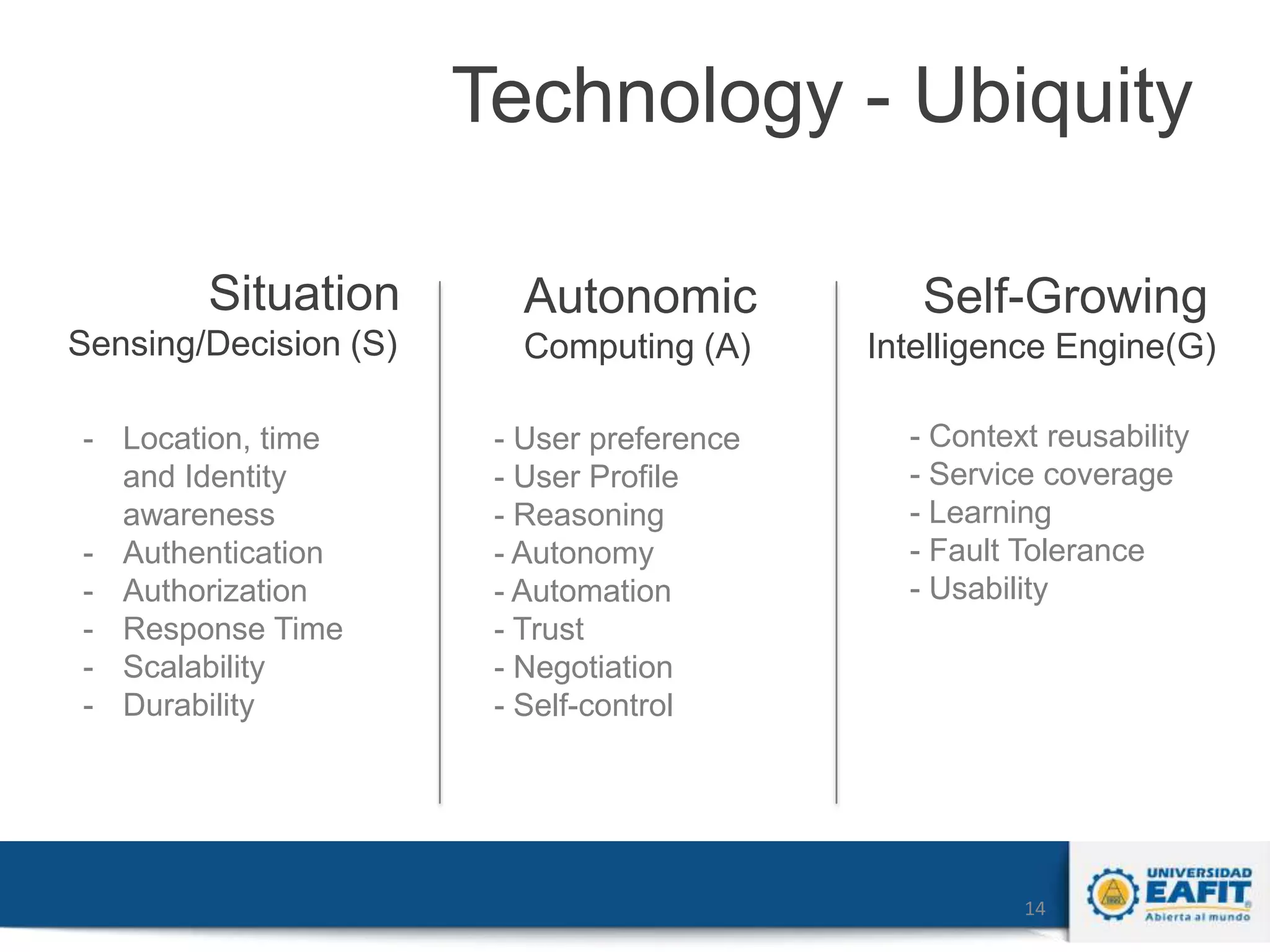
Technology - Ubiquity
Situation

Autonomic

Self-Growing

Sensing/Decision (S)

Computing (A)

Intelligence Engine(G)

- Location, time
and Identity
awareness
- Authentication
- Authorization
- Response Time
- Scalability
- Durability

- User preference
- User Profile
- Reasoning
- Autonomy
- Automation
- Trust
- Negotiation
- Self-control

- Context reusability
- Service coverage
- Learning
- Fault Tolerance
- Usability

14
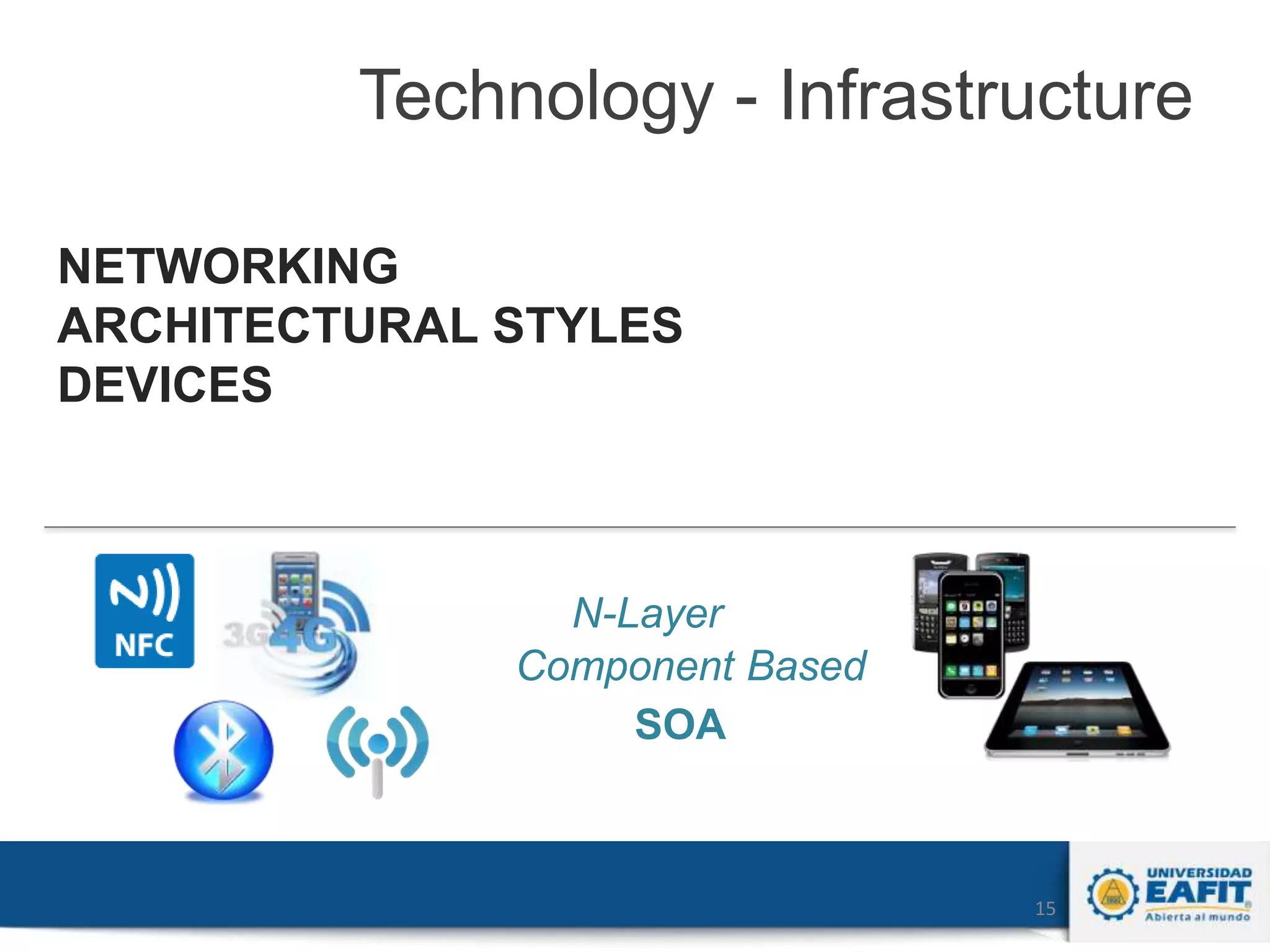
Technology - Infrastructure
NETWORKING
ARCHITECTURAL STYLES
DEVICES

N-Layer
Component Based
SOA

15
Technology

16
Technology

Taken www.masquelearning.com

17
Learning
Feldman and Schunk: Behavioral change, lasting change in time and the
acquisition of knowledge through some kind of experience. Implies acquisition,
processing, comprehension, modification and application of knowledge, strategies,
skills, beliefs and attitudes.

Types of
Learning

Learning
Methodologies

Technological
Mediation

- Repetitive Learning
- Receptive Learning
- Observational or
Modeled Learning
- Appreciative
Learning
- Meaningful Learning

- Problem-based
learning
- Project-based
learning
- Collaborative and
cooperative learning
- Learning by
discoveries
- Autonomous
learning.

-

E-Learning
M-Learning
Multimedia learning
Collaborative
mediated by ICT
- Social Networks
- Virtual communities
- Ubiquitous Learning

18
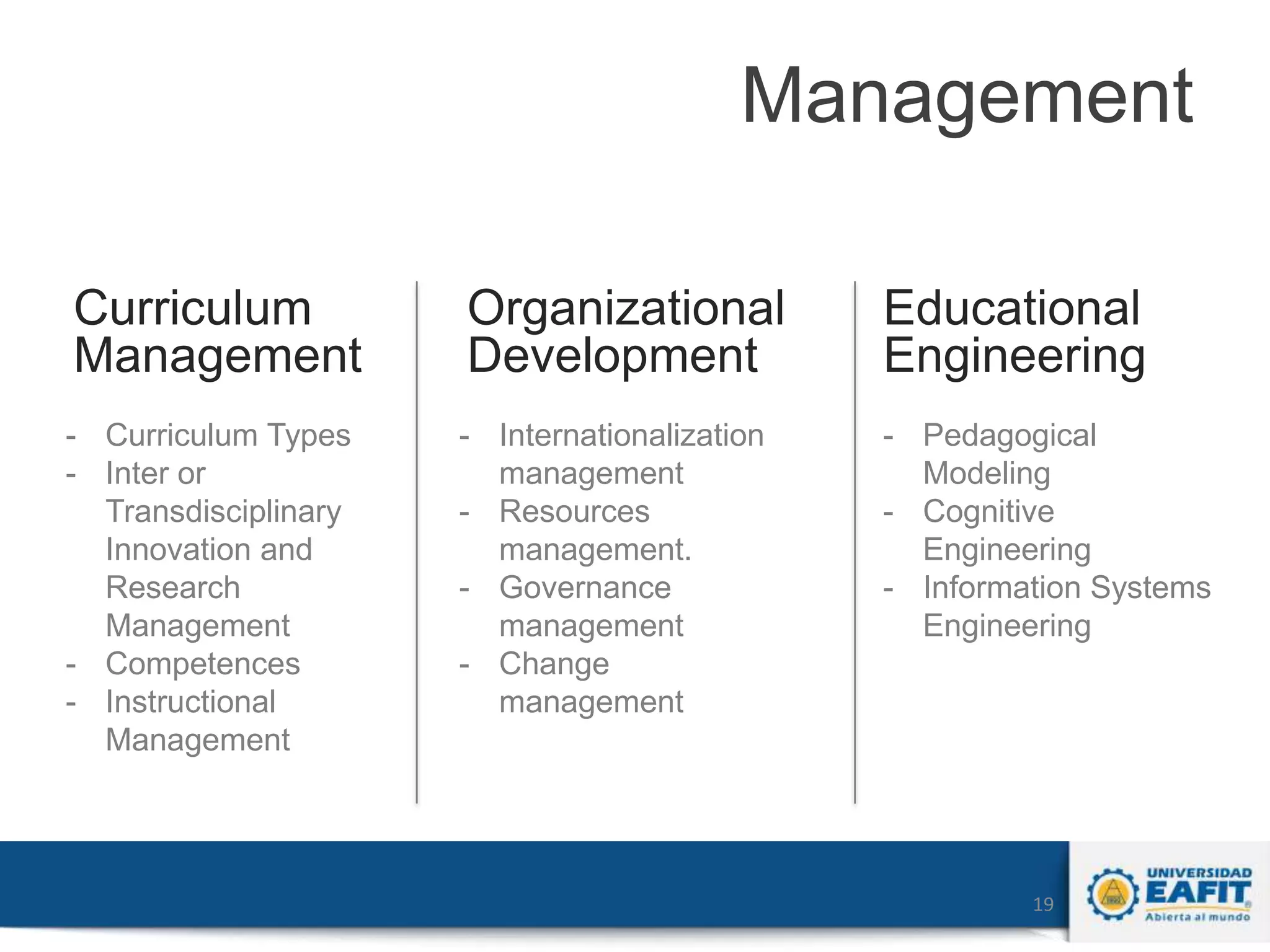
Management
Curriculum
Management

Organizational
Development

Educational
Engineering

- Curriculum Types
- Inter or
Transdisciplinary
Innovation and
Research
Management
- Competences
- Instructional
Management

- Internationalization
management
- Resources
management.
- Governance
management
- Change
management

- Pedagogical
Modeling
- Cognitive
Engineering
- Information Systems
Engineering

19
Management
Curriculum
Management

U-Multirank
Project
- Teaching and
learning
- Research
- Knowledge transfer
- International
orientation
- Regional
engagement

-

Curriculum Types
Inter or Transdisciplinary
Innovation and Research
Management
Competences
Instructional Management

-

Organizational
Development
-

Educational
Engineering
-

-

Internationalization
management
Resources management.
Governance
management
Change management

Pedagogical Modeling
Cognitive Engineering
Information Systems
Engineering

20
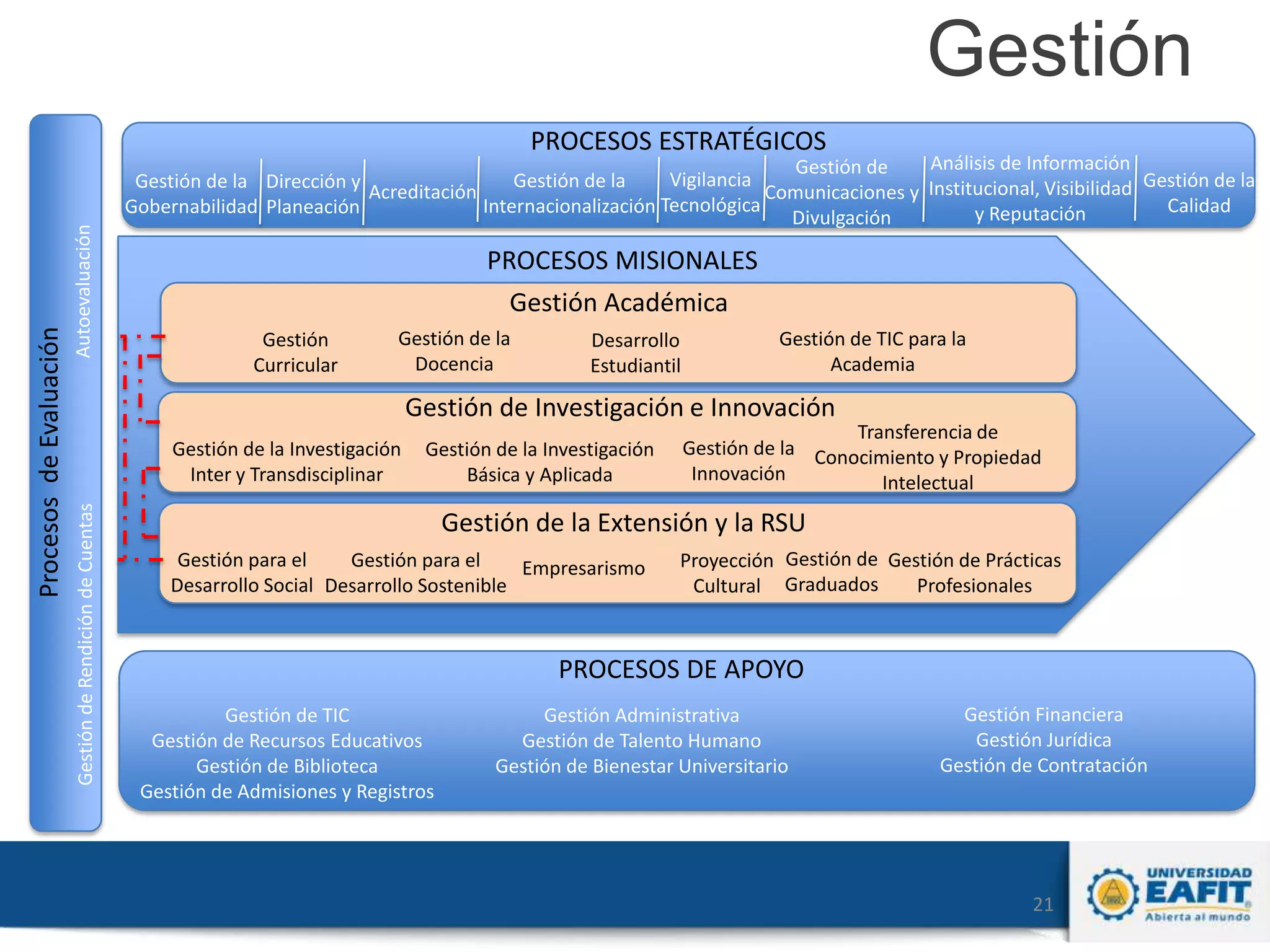
Gestión
Autoevaluación

Análisis de Información
Gestión de
Vigilancia
Gestión de la
Gestión de la Dirección y
Institucional, Visibilidad Gestión de la
Acreditación
Comunicaciones y
Calidad
Internacionalización Tecnológica
Gobernabilidad Planeación
y Reputación
Divulgación

PROCESOS MISIONALES
Gestión Académica
Gestión
Curricular

Gestión de la
Docencia

Desarrollo
Estudiantil

Gestión de TIC para la
Academia

Gestión de Investigación e Innovación
Gestión de la Investigación
Inter y Transdisciplinar
Gestión de Rendición de Cuentas

Procesos de Evaluación

PROCESOS ESTRATÉGICOS

Gestión de la Investigación
Básica y Aplicada

Transferencia de
Gestión de la Conocimiento y Propiedad
Innovación
Intelectual

Gestión de la Extensión y la RSU
Gestión para el
Gestión para el
Empresarismo
Desarrollo Social Desarrollo Sostenible

Proyección Gestión de Gestión de Prácticas
Profesionales
Cultural Graduados

PROCESOS DE APOYO
Gestión de TIC
Gestión de Recursos Educativos
Gestión de Biblioteca
Gestión de Admisiones y Registros

Gestión Administrativa
Gestión de Talento Humano
Gestión de Bienestar Universitario

Gestión Financiera
Gestión Jurídica
Gestión de Contratación

21
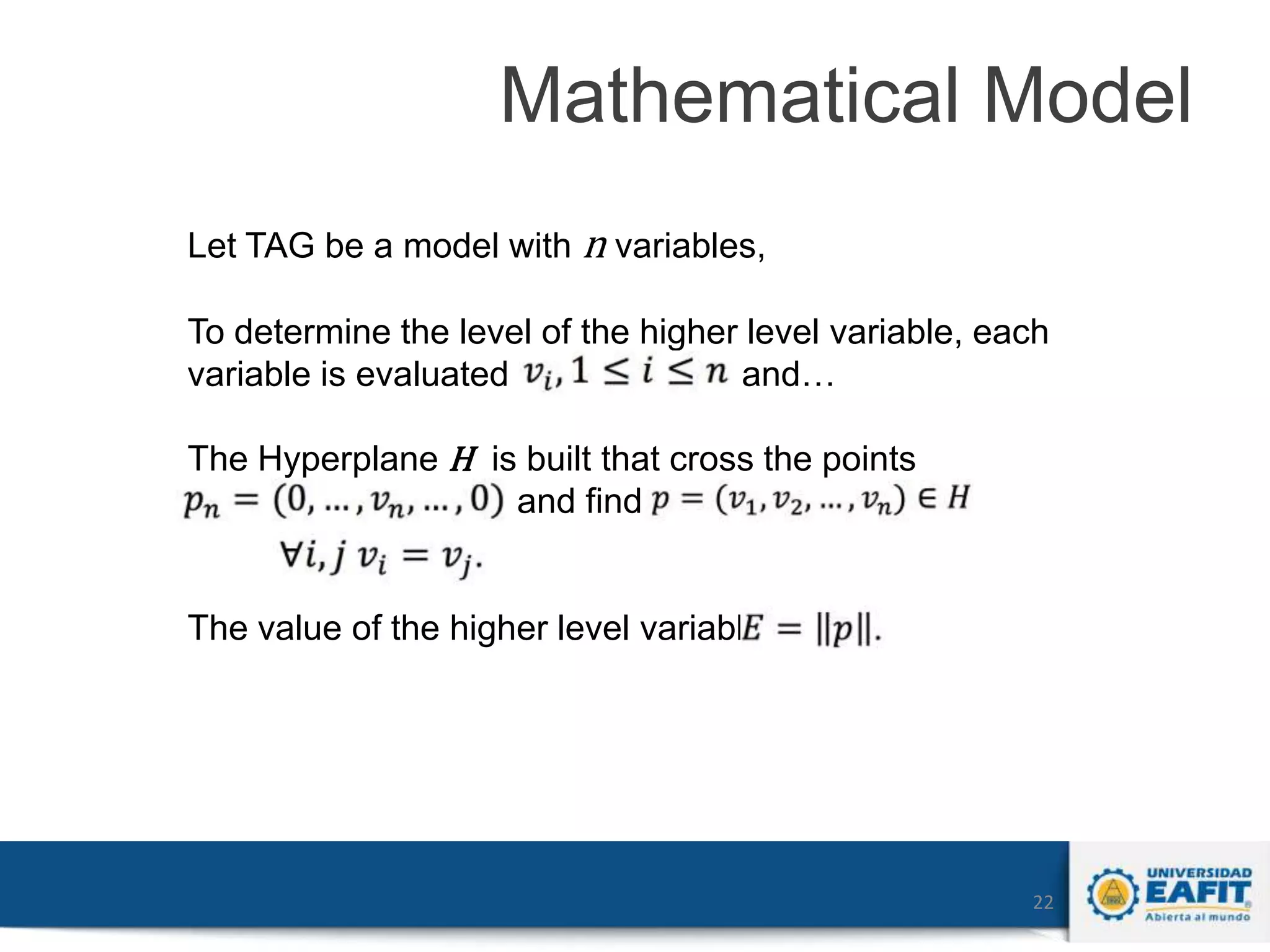
Mathematical Model
Let TAG be a model with n variables,
To determine the level of the higher level variable, each
variable is evaluated
and…
The Hyperplane H is built that cross the points
and find

t

The value of the higher level variable is

22
Mathematical Model
y=x

23
Mathematical Model
y=x
2y+3x-6=0

24
Mathematical Model
y=x

P

2y+3x-6=0
y=3-(3x/2)
Level (P)= ||(6/5, 6/5)||

25
Conclusions and Future Work
The technology dimension is not enough to analyze the learning
paradigms supported by IT. Several dimensions are required.
The model privileges the proportional development of the
variables.
The model is appliable to Higher Education Institutions with
development in the three dimensions (Technology, Learning and
Management).

Metrics and indicators associated to each dimension
Graphical representation for each dimension in a threedimensional space.
26
Gràcies per la
seva atenció !!
Taken from translate.google.com 

27

Modelo TAG: Referentes para valorar el nivel de ubicuidad en una institución de educación superior. A cargo de Roberto Aguas, EAFYT, Colombia

  • 1.
    TAG: Ubiquitous Learning Modelto Assess the Ubiquity Level in Higher Education Institutions (Thesis Proposal) Roberto Aguas Núñez 1
  • 2.
  • 3.
  • 4.
    Main referents U-Learning Concept Trends and changesin H.E. UT in educational contexts Proposal - Educational Model for Scenarios of Ubiquitous Learning 4
  • 5.
  • 6.
  • 7.
    Trends and changesin H.E. Neubauer (2003) focuses on the impact of economic rationalism and numerous other macro forces affecting the H.E. sector. Analyzes the institutional challenges, particularly for university leaders, after the wake of the macro changes imposed by globalization, lack of affordability and computer mediated technologies. Dator (1998) establishes 3 aspects that the XXI century universities need to learn -> The change into culturally diverse curriculum, the development of the multidisciplinary environments and the contribution from the invention and creativity to manage new paradigms in political economy and learning communities. Inayatullah and Gidley (2003) -> 4 factors that motivate transformation in higher education: Globalization, Multiculturalism, Internet and Politicization. Wissema (2003), Scott (2006) -> Constant search of knowledge in all ways; The expression of capabilities of the human condition: thought and creativity; Learning languages ​and symbolic representations of knowledge; Learning skills; Active participation in social, cultural and scientific changes, The formation of citizens oriented to tolerance, scientific and humanistic thinking, critical thinking, esthetic thinking, problem solving and the ability to undertake. 7
  • 8.
    UT in EducationalContexts Event Logs Learning Analytics Retention Rate Academic Failure Internet of things BIG DATA Interaction: Students – Resorces - Mediations Remote Access Interconected Devices Invisibility Customized Learning Monitoring Cooperation Cognition Collective Intelligence Tools TeamWork Remote and virtual Coordination Laboratories Adoption and Development of ICT Emulated experiences Digital Ecosystems Analysis From Horizon Report – Iberoamerica (2013) Knowledge Service Oriented 8
  • 9.
    UT in EducationalContexts Korea China WHITE PAPERS OR EQUIVALENT Japan IN ASIA Taiwan UNESCO ICT PROGRAM Living Labs City Planing European initiatives for coexistence of citizens and ICT 22@ Project TOKYO UBIQUITOUS PROJECT UDICENTER PROJECT (Japan) 9
  • 10.
  • 11.
    Three Dimensions Zea et.al.(2005) Características de los procesos de gestión en los contextos E-Learning => between the technical, institutional and pedagogical aspects. Zea et. al. (2000) Conexiones => pedagogical, didactical, technological and managerial areas. Williams(2003) Roles and Competencies for Distance Education Programs in Higher Education Institutions => Communication and interaction, Management, technology and, learning and instruction. Duart and Lupiáñez (2004), Procesos institucionales de gestión de la calidad del E-Learning en Instituciones educativas universitarias => They have identified relevant dimensions to the conceptualization, design and construction of technology-based learning environments. 11
  • 12.
    Technology - Capacity Sensibility Interpretability Understandability AccessibilityAdaptability USABILITY Learnability Invisibility Predictability Proactiveness Recoverability Fault Tolerance RELIABILITY Availability Reconfigurability CONFIGURABILITY Customizability Configurability Testability Modifiability Decomposability MANTENIBILITY Reusability Analyzability Extensibility Maturity • Kwon et Al: A Methodology for Assessing the Level of U-Transformation of Ubiquitous Services - A Multi-Layered Methodology for Assessing Level of Ubiquitous Computing Services • Normas Square-ISO/IEC 25000 -> Modelo de calidad de producto (propiedades de calidad en 8 características y sub-características 12
  • 13.
    Technology - Capacity Integrity Authenticity NonRepudiation PORTABILITY SECURITY Accountability Installability Confidentiality Adaptability Scalability Shareability Wearability MANIPULABILITY Embeddedness Downloadable MOBILITY Connectivity Nomadicity Ubiquity Integrability COMPATIBILITY Compatibility Interoperability 13
  • 14.
    Technology - Ubiquity Situation Autonomic Self-Growing Sensing/Decision(S) Computing (A) Intelligence Engine(G) - Location, time and Identity awareness - Authentication - Authorization - Response Time - Scalability - Durability - User preference - User Profile - Reasoning - Autonomy - Automation - Trust - Negotiation - Self-control - Context reusability - Service coverage - Learning - Fault Tolerance - Usability 14
  • 15.
    Technology - Infrastructure NETWORKING ARCHITECTURALSTYLES DEVICES N-Layer Component Based SOA 15
  • 16.
  • 17.
  • 18.
    Learning Feldman and Schunk:Behavioral change, lasting change in time and the acquisition of knowledge through some kind of experience. Implies acquisition, processing, comprehension, modification and application of knowledge, strategies, skills, beliefs and attitudes. Types of Learning Learning Methodologies Technological Mediation - Repetitive Learning - Receptive Learning - Observational or Modeled Learning - Appreciative Learning - Meaningful Learning - Problem-based learning - Project-based learning - Collaborative and cooperative learning - Learning by discoveries - Autonomous learning. - E-Learning M-Learning Multimedia learning Collaborative mediated by ICT - Social Networks - Virtual communities - Ubiquitous Learning 18
  • 19.
    Management Curriculum Management Organizational Development Educational Engineering - Curriculum Types -Inter or Transdisciplinary Innovation and Research Management - Competences - Instructional Management - Internationalization management - Resources management. - Governance management - Change management - Pedagogical Modeling - Cognitive Engineering - Information Systems Engineering 19
  • 20.
    Management Curriculum Management U-Multirank Project - Teaching and learning -Research - Knowledge transfer - International orientation - Regional engagement - Curriculum Types Inter or Transdisciplinary Innovation and Research Management Competences Instructional Management - Organizational Development - Educational Engineering - - Internationalization management Resources management. Governance management Change management Pedagogical Modeling Cognitive Engineering Information Systems Engineering 20
  • 21.
    Gestión Autoevaluación Análisis de Información Gestiónde Vigilancia Gestión de la Gestión de la Dirección y Institucional, Visibilidad Gestión de la Acreditación Comunicaciones y Calidad Internacionalización Tecnológica Gobernabilidad Planeación y Reputación Divulgación PROCESOS MISIONALES Gestión Académica Gestión Curricular Gestión de la Docencia Desarrollo Estudiantil Gestión de TIC para la Academia Gestión de Investigación e Innovación Gestión de la Investigación Inter y Transdisciplinar Gestión de Rendición de Cuentas Procesos de Evaluación PROCESOS ESTRATÉGICOS Gestión de la Investigación Básica y Aplicada Transferencia de Gestión de la Conocimiento y Propiedad Innovación Intelectual Gestión de la Extensión y la RSU Gestión para el Gestión para el Empresarismo Desarrollo Social Desarrollo Sostenible Proyección Gestión de Gestión de Prácticas Profesionales Cultural Graduados PROCESOS DE APOYO Gestión de TIC Gestión de Recursos Educativos Gestión de Biblioteca Gestión de Admisiones y Registros Gestión Administrativa Gestión de Talento Humano Gestión de Bienestar Universitario Gestión Financiera Gestión Jurídica Gestión de Contratación 21
  • 22.
    Mathematical Model Let TAGbe a model with n variables, To determine the level of the higher level variable, each variable is evaluated and… The Hyperplane H is built that cross the points and find t The value of the higher level variable is 22
  • 23.
  • 24.
  • 25.
  • 26.
    Conclusions and FutureWork The technology dimension is not enough to analyze the learning paradigms supported by IT. Several dimensions are required. The model privileges the proportional development of the variables. The model is appliable to Higher Education Institutions with development in the three dimensions (Technology, Learning and Management). Metrics and indicators associated to each dimension Graphical representation for each dimension in a threedimensional space. 26
  • 27.
    Gràcies per la sevaatenció !! Taken from translate.google.com  27