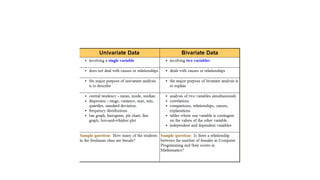
Univariate Analysis
Medical statistics Part IV
Univariate analysis :Watch one variable at
a time across sample
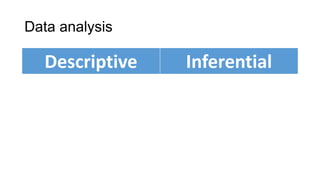
Data analysis
Descriptive Inferential
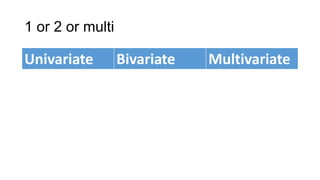
1 or 2 or multi
Univariate Bivariate Multivariate
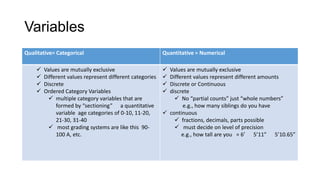
Variables
Qualitative= Categorical Quantitative = Numerical
 Values are mutually exclusive
 Different values represent different categories
 Discrete
 Ordered Category Variables
 multiple category variables that are
formed by “sectioning” a quantitative
variable age categories of 0-10, 11-20,
21-30, 31-40
 most grading systems are like this 90-
100 A, etc.
 Values are mutually exclusive
 Different values represent different amounts
 Discrete or Continuous
 discrete
 No “partial counts” just “whole numbers”
e.g., how many siblings do you have
 continuous
 fractions, decimals, parts possible
 must decide on level of precision
e.g., how tall are you = 6’ 5’11” 5’10.65”
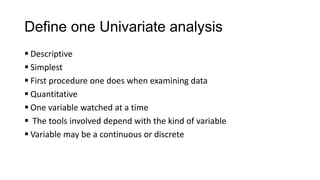
Define one Univariate analysis
 Descriptive
 Simplest
 First procedure one does when examining data
 Quantitative
 One variable watched at a time
 The tools involved depend with the kind of variable
 Variable may be a continuous or discrete
3 major tools used in Univariate analysis
 Distribution [of frequency]
 Central tendency[mean,median and mode]
 Dispersion
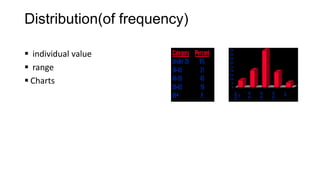
Distribution(of frequency)
 individual value
 range
 Charts
finding frequency is key measurement
Description of frequency
1) counts
2) percentages
3) percentile values
4) Central tendency
5) Dispersion[standard deviation
6) distribution: Skew=“direction of the distribution tail”
7) kurtosis
8) Standard Error of the Mean (SEM)
9) charts : bar charts and histograms
10) Box plot
Central Tendency
Mean :summing all the scores and dividing by the number of
students
Median: the score found at the exact middle of the set of values
Mode :the most frequently occurring value in the set of scores
Dispersion :Spread around the central
tendency
Range Standard deviation
Range=highest value minus
the lowest value
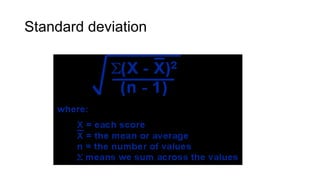
The Standard Deviation
shows the relation that set of
scores has to the mean of the
sample
More accurate
Standard deviation
The SPSS tools
• following procedures: "Frequencies", "Descriptives" and "Explore" all
located under the "Analyse" menu.
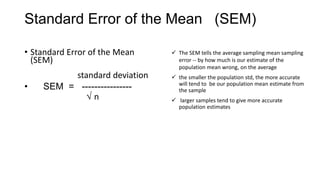
Standard Error of the Mean (SEM)
• Standard Error of the Mean
(SEM)
standard deviation
• SEM = ----------------
n
 The SEM tells the average sampling mean sampling
error -- by how much is our estimate of the
population mean wrong, on the average
 the smaller the population std, the more accurate
will tend to be our population mean estimate from
the sample
 larger samples tend to give more accurate
population estimates
Thanks

Univariate analysis:Medical statistics Part IV

  • 1.
  • 2.
    Univariate analysis :Watchone variable at a time across sample
  • 3.
  • 4.
    1 or 2or multi Univariate Bivariate Multivariate
  • 5.
    Variables Qualitative= Categorical Quantitative= Numerical  Values are mutually exclusive  Different values represent different categories  Discrete  Ordered Category Variables  multiple category variables that are formed by “sectioning” a quantitative variable age categories of 0-10, 11-20, 21-30, 31-40  most grading systems are like this 90- 100 A, etc.  Values are mutually exclusive  Different values represent different amounts  Discrete or Continuous  discrete  No “partial counts” just “whole numbers” e.g., how many siblings do you have  continuous  fractions, decimals, parts possible  must decide on level of precision e.g., how tall are you = 6’ 5’11” 5’10.65”
  • 7.
    Define one Univariateanalysis  Descriptive  Simplest  First procedure one does when examining data  Quantitative  One variable watched at a time  The tools involved depend with the kind of variable  Variable may be a continuous or discrete
  • 8.
    3 major toolsused in Univariate analysis  Distribution [of frequency]  Central tendency[mean,median and mode]  Dispersion
  • 9.
  • 10.
    finding frequency iskey measurement Description of frequency 1) counts 2) percentages 3) percentile values 4) Central tendency 5) Dispersion[standard deviation 6) distribution: Skew=“direction of the distribution tail” 7) kurtosis 8) Standard Error of the Mean (SEM) 9) charts : bar charts and histograms 10) Box plot
  • 11.
    Central Tendency Mean :summingall the scores and dividing by the number of students Median: the score found at the exact middle of the set of values Mode :the most frequently occurring value in the set of scores
  • 12.
    Dispersion :Spread aroundthe central tendency Range Standard deviation Range=highest value minus the lowest value The Standard Deviation shows the relation that set of scores has to the mean of the sample More accurate
  • 13.
  • 14.
    The SPSS tools •following procedures: "Frequencies", "Descriptives" and "Explore" all located under the "Analyse" menu.
  • 15.
    Standard Error ofthe Mean (SEM) • Standard Error of the Mean (SEM) standard deviation • SEM = ---------------- n  The SEM tells the average sampling mean sampling error -- by how much is our estimate of the population mean wrong, on the average  the smaller the population std, the more accurate will tend to be our population mean estimate from the sample  larger samples tend to give more accurate population estimates
  • 16.