

STEP
 Student Training for Entrepreneurial Promotion


   The Effect of Self-Regulatory
Mechanisms on Business Success In
   a Randomized Control Group
           Experiment
                            Kim Marie Bischoff
                            Dr. Michael Gielnik
                          Prof. Dr. Michael Frese

                    Leuphana University of Lüneburg
The effect of self-regulatory mechanisms on
business success in a randomized control group
experiment

 What is this study about?

 We study the effect of self-regulatory factors in the
 relationship between an action-oriented
 entrepreneurship training and entrepreneurial action
 / entrepreneurial success.


 The effects of self-regulatory mechanisms on business success in a randomized control group experiment
                                                                                                          2
 Kim Marie Bischoff, Dr. Michael Gielnik, Prof. Dr. Michael Frese
Action Training and Entrepreneurship

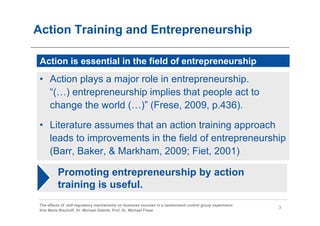
 Action is essential in the field of entrepreneurship
 • Action plays a major role in entrepreneurship.
   “(…) entrepreneurship implies that people act to
   change the world (…)” (Frese, 2009, p.436).

 • Literature assumes that an action training approach
   leads to improvements in the field of entrepreneurship
   (Barr, Baker, & Markham, 2009; Fiet, 2001)

          Promoting entrepreneurship by action
          training is useful.
 The effects of self-regulatory mechanisms on business success in a randomized control group experiment
                                                                                                          3
 Kim Marie Bischoff, Dr. Michael Gielnik, Prof. Dr. Michael Frese
Self-regulation and Entrepreneurship

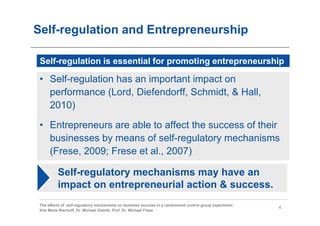
 Self-regulation is essential for promoting entrepreneurship

 • Self-regulation has an important impact on
   performance (Lord, Diefendorff, Schmidt, & Hall,
   2010)

 • Entrepreneurs are able to affect the success of their
   businesses by means of self-regulatory mechanisms
   (Frese, 2009; Frese et al., 2007)

          Self-regulatory mechanisms may have an
          impact on entrepreneurial action & success.
 The effects of self-regulatory mechanisms on business success in a randomized control group experiment
                                                                                                          4
 Kim Marie Bischoff, Dr. Michael Gielnik, Prof. Dr. Michael Frese
Promoting entrepreneurship by action training
and self-regulatory mechanisms


• We base our theoretical model on

                     action regulation theory (Frese, 2009;
                     Frese & Zapf, 1994; Karoly, 1993)
                     theory of planned behavior (Ajzen, 1991)


 The effects of self-regulatory mechanisms on business success in a randomized control group experiment
                                                                                                          5
 Kim Marie Bischoff, Dr. Michael Gielnik, Prof. Dr. Michael Frese
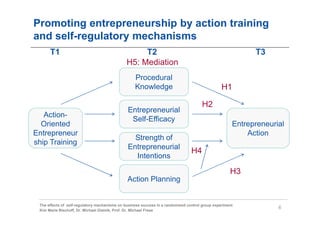
Promoting entrepreneurship by action training
and self-regulatory mechanisms
      T1                                            T2                                                      T3
                                               H5: Mediation
                                                   Procedural
                                                   Knowledge                                     H1

                                                                                      H2
                                               Entrepreneurial
   Action-
                                                Self-Efficacy
  Oriented                                                                                            Entrepreneurial
Entrepreneur                                                                                              Action
                                                 Strength of
ship Training
                                               Entrepreneurial
                                                                                 H4
                                                 Intentions

                                                                                                     H3
                                               Action Planning


 The effects of self-regulatory mechanisms on business success in a randomized control group experiment
                                                                                                                   6
 Kim Marie Bischoff, Dr. Michael Gielnik, Prof. Dr. Michael Frese
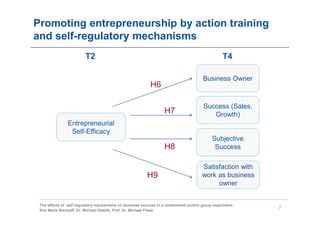
Promoting entrepreneurship by action training
and self-regulatory mechanisms
                         T2                                                                      T4

                                                                                       Business Owner
                                                           H6

                                                                                       Success (Sales,
                                                                  H7                      Growth)
               Entrepreneurial
                Self-Efficacy
                                                                                            Subjective
                                                                  H8                         Success

                                                                                      Satisfaction with
                                                         H9                           work as business
                                                                                           owner


 The effects of self-regulatory mechanisms on business success in a randomized control group experiment
                                                                                                          7
 Kim Marie Bischoff, Dr. Michael Gielnik, Prof. Dr. Michael Frese
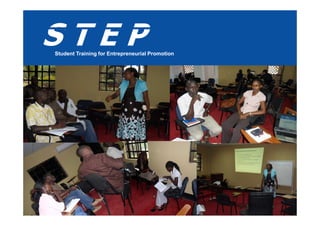
STEP
Student Training for Entrepreneurial Promotion
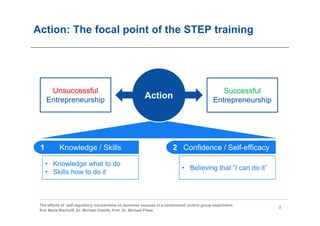
Action: The focal point of the STEP training


      Unsuccessful                                                                             Successful
     Entrepreneurship
                                                        Action                              Entrepreneurship


 1         Knowledge / Skills                                          2 Confidence / Self-efficacy

     • Knowledge what to do
                                                                            • Believing that “I can do it”
     • Skills how to do it


 The effects of self-regulatory mechanisms on business success in a randomized control group experiment
                                                                                                               9
 Kim Marie Bischoff, Dr. Michael Gielnik, Prof. Dr. Michael Frese
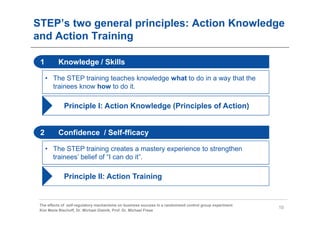
STEP’s two general principles: Action Knowledge
and Action Training

 1        Knowledge / Skills

     • The STEP training teaches knowledge what to do in a way that the
       trainees know how to do it.

     •       Principle I: Action Knowledge (Principles of Action)


 2        Confidence / Self-fficacy

     • The STEP training creates a mastery experience to strengthen
       trainees’ belief of “I can do it”.

     •       Principle II: Action Training


 The effects of self-regulatory mechanisms on business success in a randomized control group experiment
                                                                                                          10
 Kim Marie Bischoff, Dr. Michael Gielnik, Prof. Dr. Michael Frese
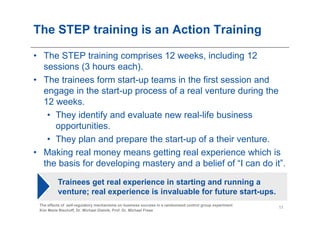
The STEP training is an Action Training

• The STEP training comprises 12 weeks, including 12
  sessions (3 hours each).
• The trainees form start-up teams in the first session and
  engage in the start-up process of a real venture during the
  12 weeks.
   • They identify and evaluate new real-life business
     opportunities.
   • They plan and prepare the start-up of a their venture.
• Making real money means getting real experience which is
  the basis for developing mastery and a belief of “I can do it”.

          Trainees get real experience in starting and running a
          venture; real experience is invaluable for future start-ups.
 The effects of self-regulatory mechanisms on business success in a randomized control group experiment
                                                                                                          11
 Kim Marie Bischoff, Dr. Michael Gielnik, Prof. Dr. Michael Frese
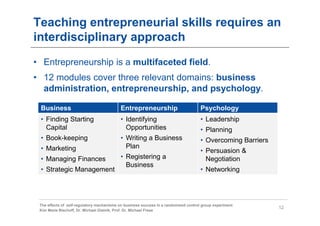
Teaching entrepreneurial skills requires an
interdisciplinary approach
• Entrepreneurship is a multifaceted field.
• 12 modules cover three relevant domains: business
  administration, entrepreneurship, and psychology.

 Business                                  Entrepreneurship                           Psychology
 • Finding Starting                        • Identifying                              • Leadership
   Capital                                   Opportunities                            • Planning
 • Book-keeping                            • Writing a Business                       • Overcoming Barriers
 • Marketing                                 Plan
                                                                                      • Persuasion &
 • Managing Finances                       • Registering a                              Negotiation
                                             Business
 • Strategic Management                                                               • Networking


 The effects of self-regulatory mechanisms on business success in a randomized control group experiment
                                                                                                              12
 Kim Marie Bischoff, Dr. Michael Gielnik, Prof. Dr. Michael Frese
Method: Data Collection

       T1                 Training                   T2                          T3                             T4
    Feb 2009            Feb-May 2009              Jun 2009                 Jan – Mar 2010                 Aug – Nov 2011


 395 students                                  352 students                 319 students                   227 students
 Interview T1                                  Interview T2                 Interview T3                   Interview T4


• Procedure: face-to-face interviews & questionnaires


 The effects of self-regulatory mechanisms on business success in a randomized control group experiment
                                                                                                                           13
 Kim Marie Bischoff, Dr. Michael Gielnik, Prof. Dr. Michael Frese
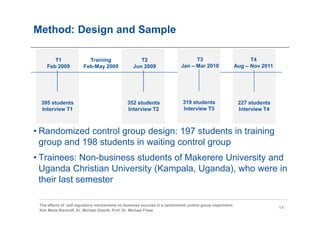
Method: Design and Sample

       T1                 Training                   T2                          T3                             T4
    Feb 2009            Feb-May 2009              Jun 2009                 Jan – Mar 2010                 Aug – Nov 2011


 395 students                                  352 students                 319 students                   227 students
 Interview T1                                  Interview T2                 Interview T3                   Interview T4


• Randomized control group design: 197 students in training
  group and 198 students in waiting control group
• Trainees: Non-business students of Makerere University and
  Uganda Christian University (Kampala, Uganda), who were in
  their last semester

 The effects of self-regulatory mechanisms on business success in a randomized control group experiment
                                                                                                                           14
 Kim Marie Bischoff, Dr. Michael Gielnik, Prof. Dr. Michael Frese
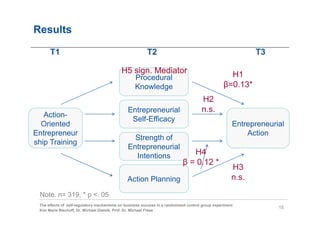
Results

      T1                                                 T2                                                  T3

                                            H5 sign. Mediator                                       H1
                                                   Procedural
                                                   Knowledge                                      β=0.13*
                                                                                      H2
                                               Entrepreneurial                        n.s.
   Action-
                                                Self-Efficacy
  Oriented                                                                                            Entrepreneurial
Entrepreneur                                                                                              Action
                                                 Strength of
ship Training
                                               Entrepreneurial
                                                 Intentions                    H4
                                                                            β = 0.12 *
                                                                                                      H3
                                               Action Planning                                        n.s.

 Note. n= 319, * p <. 05
 The effects of self-regulatory mechanisms on business success in a randomized control group experiment
                                                                                                                   15
 Kim Marie Bischoff, Dr. Michael Gielnik, Prof. Dr. Michael Frese
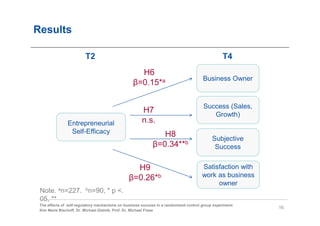
Results

                         T2                                                                      T4
                                                    H6
                                                                                       Business Owner
                                                  β=0.15*a

                                                                                       Success (Sales,
                                                       H7                                 Growth)
               Entrepreneurial                         n.s.
                Self-Efficacy                                  H8                           Subjective
                                                            β=0.34**b                        Success


                                                  H9                                  Satisfaction with
                                                β=0.26*b                              work as business
                                                                                           owner
 Note. an=227. bn=90, * p <.
 05, **
 The effects of self-regulatory mechanisms on business success in a randomized control group experiment
                                                                                                          16
 Kim Marie Bischoff, Dr. Michael Gielnik, Prof. Dr. Michael Frese
Conclusions
Action-oriented training in entrepreneurship affects self-
regulation and enhances entrepreneurial action.
• Procedural knowledge geared towards action,
  mediates the relationship between the action oriented
  entrepreneurship training and entrepreneurial action.
  Thus, learning what to do and how to do it is essential
  for undertaking entrepreneurial actions.

• The interaction of strength of entrepreneurial
  intentions and action planning predict entrepreneurial
  action. Only in combination with action planning can
  entrepreneurial intentions lead to entrepreneurial
  action.
The effects of self-regulatory mechanisms on business success in a randomized control group experiment
                                                                                                         17
Kim Marie Bischoff, Dr. Michael Gielnik, Prof. Dr. Michael Frese
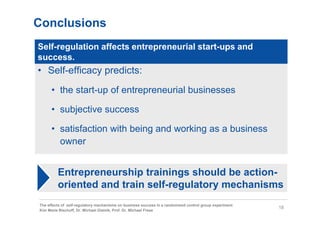
Conclusions
Self-regulation affects entrepreneurial start-ups and
success.
• Self-efficacy predicts:
      • the start-up of entrepreneurial businesses

      • subjective success

      • satisfaction with being and working as a business
        owner


         Entrepreneurship trainings should be action-
         oriented and train self-regulatory mechanisms
The effects of self-regulatory mechanisms on business success in a randomized control group experiment
                                                                                                         18
Kim Marie Bischoff, Dr. Michael Gielnik, Prof. Dr. Michael Frese
Acknowledgements

• Thanks to my colleagues at the Leuphana
  University of Lüneburg and National University of
  Singapore Business School
    • Prof. Dr. Michael Frese
    • Dr. Michael Gielnik
• to the students, who supported us in data collection
  and rating:
    • Melanie von der Lahr, Thorsten Dlugosch, Marie-Luise Lackhoff,
      Kristina Zyla, Eike Hedder, Andreas Heese, Diana Breé, Svenja
      Haskamp, Mona Mensmann
• and to our cooperation partners at the Makerere
  University Business School (MUBS), Kampala, Uganda
 The effects of self-regulatory mechanisms on business success in a randomized control group experiment
                                                                                                          19
 Kim Marie Bischoff, Dr. Michael Gielnik, Prof. Dr. Michael Frese
STEP
Student Training for Entrepreneurial Promotion


     Thank you very much for your
              attention

The effects of self-regulatory mechanisms on business success in a randomized control group experiment

  • 1.
    STEP Student Trainingfor Entrepreneurial Promotion The Effect of Self-Regulatory Mechanisms on Business Success In a Randomized Control Group Experiment Kim Marie Bischoff Dr. Michael Gielnik Prof. Dr. Michael Frese Leuphana University of Lüneburg
  • 2.
    The effect ofself-regulatory mechanisms on business success in a randomized control group experiment What is this study about? We study the effect of self-regulatory factors in the relationship between an action-oriented entrepreneurship training and entrepreneurial action / entrepreneurial success. The effects of self-regulatory mechanisms on business success in a randomized control group experiment 2 Kim Marie Bischoff, Dr. Michael Gielnik, Prof. Dr. Michael Frese
  • 3.
    Action Training andEntrepreneurship Action is essential in the field of entrepreneurship • Action plays a major role in entrepreneurship. “(…) entrepreneurship implies that people act to change the world (…)” (Frese, 2009, p.436). • Literature assumes that an action training approach leads to improvements in the field of entrepreneurship (Barr, Baker, & Markham, 2009; Fiet, 2001) Promoting entrepreneurship by action training is useful. The effects of self-regulatory mechanisms on business success in a randomized control group experiment 3 Kim Marie Bischoff, Dr. Michael Gielnik, Prof. Dr. Michael Frese
  • 4.
    Self-regulation and Entrepreneurship Self-regulation is essential for promoting entrepreneurship • Self-regulation has an important impact on performance (Lord, Diefendorff, Schmidt, & Hall, 2010) • Entrepreneurs are able to affect the success of their businesses by means of self-regulatory mechanisms (Frese, 2009; Frese et al., 2007) Self-regulatory mechanisms may have an impact on entrepreneurial action & success. The effects of self-regulatory mechanisms on business success in a randomized control group experiment 4 Kim Marie Bischoff, Dr. Michael Gielnik, Prof. Dr. Michael Frese
  • 5.
    Promoting entrepreneurship byaction training and self-regulatory mechanisms • We base our theoretical model on action regulation theory (Frese, 2009; Frese & Zapf, 1994; Karoly, 1993) theory of planned behavior (Ajzen, 1991) The effects of self-regulatory mechanisms on business success in a randomized control group experiment 5 Kim Marie Bischoff, Dr. Michael Gielnik, Prof. Dr. Michael Frese
  • 6.
    Promoting entrepreneurship byaction training and self-regulatory mechanisms T1 T2 T3 H5: Mediation Procedural Knowledge H1 H2 Entrepreneurial Action- Self-Efficacy Oriented Entrepreneurial Entrepreneur Action Strength of ship Training Entrepreneurial H4 Intentions H3 Action Planning The effects of self-regulatory mechanisms on business success in a randomized control group experiment 6 Kim Marie Bischoff, Dr. Michael Gielnik, Prof. Dr. Michael Frese
  • 7.
    Promoting entrepreneurship byaction training and self-regulatory mechanisms T2 T4 Business Owner H6 Success (Sales, H7 Growth) Entrepreneurial Self-Efficacy Subjective H8 Success Satisfaction with H9 work as business owner The effects of self-regulatory mechanisms on business success in a randomized control group experiment 7 Kim Marie Bischoff, Dr. Michael Gielnik, Prof. Dr. Michael Frese
  • 8.
    STEP Student Training forEntrepreneurial Promotion
  • 9.
    Action: The focalpoint of the STEP training Unsuccessful Successful Entrepreneurship Action Entrepreneurship 1 Knowledge / Skills 2 Confidence / Self-efficacy • Knowledge what to do • Believing that “I can do it” • Skills how to do it The effects of self-regulatory mechanisms on business success in a randomized control group experiment 9 Kim Marie Bischoff, Dr. Michael Gielnik, Prof. Dr. Michael Frese
  • 10.
    STEP’s two generalprinciples: Action Knowledge and Action Training 1 Knowledge / Skills • The STEP training teaches knowledge what to do in a way that the trainees know how to do it. • Principle I: Action Knowledge (Principles of Action) 2 Confidence / Self-fficacy • The STEP training creates a mastery experience to strengthen trainees’ belief of “I can do it”. • Principle II: Action Training The effects of self-regulatory mechanisms on business success in a randomized control group experiment 10 Kim Marie Bischoff, Dr. Michael Gielnik, Prof. Dr. Michael Frese
  • 11.
    The STEP trainingis an Action Training • The STEP training comprises 12 weeks, including 12 sessions (3 hours each). • The trainees form start-up teams in the first session and engage in the start-up process of a real venture during the 12 weeks. • They identify and evaluate new real-life business opportunities. • They plan and prepare the start-up of a their venture. • Making real money means getting real experience which is the basis for developing mastery and a belief of “I can do it”. Trainees get real experience in starting and running a venture; real experience is invaluable for future start-ups. The effects of self-regulatory mechanisms on business success in a randomized control group experiment 11 Kim Marie Bischoff, Dr. Michael Gielnik, Prof. Dr. Michael Frese
  • 12.
    Teaching entrepreneurial skillsrequires an interdisciplinary approach • Entrepreneurship is a multifaceted field. • 12 modules cover three relevant domains: business administration, entrepreneurship, and psychology. Business Entrepreneurship Psychology • Finding Starting • Identifying • Leadership Capital Opportunities • Planning • Book-keeping • Writing a Business • Overcoming Barriers • Marketing Plan • Persuasion & • Managing Finances • Registering a Negotiation Business • Strategic Management • Networking The effects of self-regulatory mechanisms on business success in a randomized control group experiment 12 Kim Marie Bischoff, Dr. Michael Gielnik, Prof. Dr. Michael Frese
  • 13.
    Method: Data Collection T1 Training T2 T3 T4 Feb 2009 Feb-May 2009 Jun 2009 Jan – Mar 2010 Aug – Nov 2011 395 students 352 students 319 students 227 students Interview T1 Interview T2 Interview T3 Interview T4 • Procedure: face-to-face interviews & questionnaires The effects of self-regulatory mechanisms on business success in a randomized control group experiment 13 Kim Marie Bischoff, Dr. Michael Gielnik, Prof. Dr. Michael Frese
  • 14.
    Method: Design andSample T1 Training T2 T3 T4 Feb 2009 Feb-May 2009 Jun 2009 Jan – Mar 2010 Aug – Nov 2011 395 students 352 students 319 students 227 students Interview T1 Interview T2 Interview T3 Interview T4 • Randomized control group design: 197 students in training group and 198 students in waiting control group • Trainees: Non-business students of Makerere University and Uganda Christian University (Kampala, Uganda), who were in their last semester The effects of self-regulatory mechanisms on business success in a randomized control group experiment 14 Kim Marie Bischoff, Dr. Michael Gielnik, Prof. Dr. Michael Frese
  • 15.
    Results T1 T2 T3 H5 sign. Mediator H1 Procedural Knowledge β=0.13* H2 Entrepreneurial n.s. Action- Self-Efficacy Oriented Entrepreneurial Entrepreneur Action Strength of ship Training Entrepreneurial Intentions H4 β = 0.12 * H3 Action Planning n.s. Note. n= 319, * p <. 05 The effects of self-regulatory mechanisms on business success in a randomized control group experiment 15 Kim Marie Bischoff, Dr. Michael Gielnik, Prof. Dr. Michael Frese
  • 16.
    Results T2 T4 H6 Business Owner β=0.15*a Success (Sales, H7 Growth) Entrepreneurial n.s. Self-Efficacy H8 Subjective β=0.34**b Success H9 Satisfaction with β=0.26*b work as business owner Note. an=227. bn=90, * p <. 05, ** The effects of self-regulatory mechanisms on business success in a randomized control group experiment 16 Kim Marie Bischoff, Dr. Michael Gielnik, Prof. Dr. Michael Frese
  • 17.
    Conclusions Action-oriented training inentrepreneurship affects self- regulation and enhances entrepreneurial action. • Procedural knowledge geared towards action, mediates the relationship between the action oriented entrepreneurship training and entrepreneurial action. Thus, learning what to do and how to do it is essential for undertaking entrepreneurial actions. • The interaction of strength of entrepreneurial intentions and action planning predict entrepreneurial action. Only in combination with action planning can entrepreneurial intentions lead to entrepreneurial action. The effects of self-regulatory mechanisms on business success in a randomized control group experiment 17 Kim Marie Bischoff, Dr. Michael Gielnik, Prof. Dr. Michael Frese
  • 18.
    Conclusions Self-regulation affects entrepreneurialstart-ups and success. • Self-efficacy predicts: • the start-up of entrepreneurial businesses • subjective success • satisfaction with being and working as a business owner Entrepreneurship trainings should be action- oriented and train self-regulatory mechanisms The effects of self-regulatory mechanisms on business success in a randomized control group experiment 18 Kim Marie Bischoff, Dr. Michael Gielnik, Prof. Dr. Michael Frese
  • 19.
    Acknowledgements • Thanks tomy colleagues at the Leuphana University of Lüneburg and National University of Singapore Business School • Prof. Dr. Michael Frese • Dr. Michael Gielnik • to the students, who supported us in data collection and rating: • Melanie von der Lahr, Thorsten Dlugosch, Marie-Luise Lackhoff, Kristina Zyla, Eike Hedder, Andreas Heese, Diana Breé, Svenja Haskamp, Mona Mensmann • and to our cooperation partners at the Makerere University Business School (MUBS), Kampala, Uganda The effects of self-regulatory mechanisms on business success in a randomized control group experiment 19 Kim Marie Bischoff, Dr. Michael Gielnik, Prof. Dr. Michael Frese
  • 20.
    STEP Student Training forEntrepreneurial Promotion Thank you very much for your attention