1r
Supply Chain Management
Introduction
2r
Outline
What is supply chain management?
A supply chain strategy framework
Components of a SCM
Major obstacles and common problems
Seven Eleven Japan
3r
Traditional View: Supply Chains in
the Economy (1990, 1996)
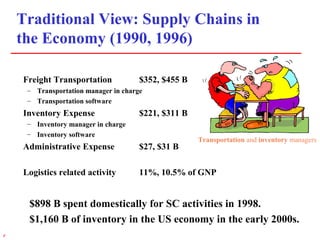
Freight Transportation $352, $455 B
– Transportation manager in charge
– Transportation software
Inventory Expense $221, $311 B
– Inventory manager in charge
– Inventory software
Administrative Expense $27, $31 B
Logistics related activity 11%, 10.5% of GNP
$898 B spent domestically for SC activities in 1998.
$1,160 B of inventory in the US economy in the early 2000s.
Transportation and inventory managers
4r
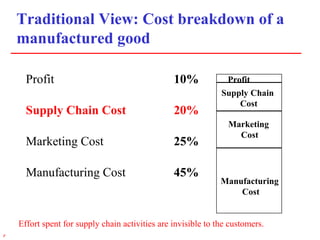
Traditional View: Cost breakdown of a
manufactured good
Profit 10%
Supply Chain Cost 20%
Marketing Cost 25%
Manufacturing Cost 45%
Profit
Supply Chain
Cost
Marketing
Cost
Manufacturing
Cost
Effort spent for supply chain activities are invisible to the customers.
5r
What can Supply Chain Management do?
Estimated that the grocery industry could save $30 billion (10% of operating
cost) by using effective logistics and supply chain strategies
– A typical box of cereal spends 104 days from factory to sale
– A typical car spends 15 days from factory to dealership
– Faster turnaround of the goods is better?
Laura Ashley (retailer of women and children clothes) turns its inventory 10
times a year five times faster than 3 years ago
– inventory is emptied 10 times a year, or an item spends about 12/10 months in the
inventory.
– To be responsive, it relocated its main warehouse next to FedEx hub in Memphis, TE.
National Semiconductor used air transportation and closed 6 warehouses, 34%
increase in sales and 47% decrease in delivery lead time.
6r
A picture is better than 1000 words!
How many words would be better than 3 pictures?
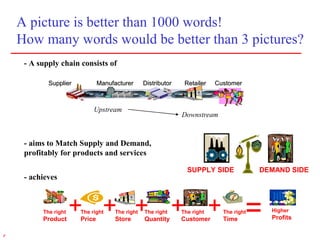
- A supply chain consists of
- aims to Match Supply and Demand,
profitably for products and services
SUPPLY SIDE DEMAND SIDE
The right
Product
Higher
Profits
The right
Time
The right
Customer
The right
Quantity
The right
Store
The right
Price
=++ ++ +
- achieves
SupplierSupplier ManufacturerManufacturer DistributorDistributor RetailerRetailer CustomerCustomer
Upstream
Downstream
7r
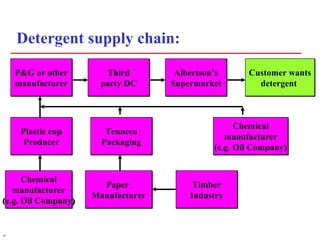
Detergent supply chain:
Customer wants
detergent
Customer wants
detergent
Albertson’s
Supermarket
Albertson’s
Supermarket
Third
party DC
Third
party DC
P&G or other
manufacturer
P&G or other
manufacturer
Plastic cup
Producer
Plastic cup
Producer
Chemical
manufacturer
(e.g. Oil Company)
Chemical
manufacturer
(e.g. Oil Company)
Tenneco
Packaging
Tenneco
Packaging
Paper
Manufacturer
Paper
Manufacturer
Timber
Industry
Timber
Industry
Chemical
manufacturer
(e.g. Oil Company)
Chemical
manufacturer
(e.g. Oil Company)
8r
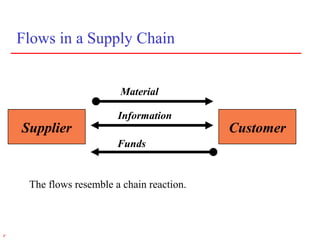
Flows in a Supply Chain
Customer
Material
Information
Funds
The flows resemble a chain reaction.
Supplier
9r
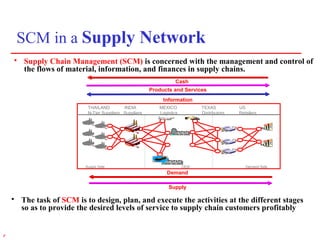
SCM in a Supply Network
 Supply Chain Management (SCM) is concerned with the management and control of
the flows of material, information, and finances in supply chains.
Supply
Demand
Products and Services
Cash
Supply Side OEM Demand Side
THAILAND INDIA MEXICO TEXAS US
N-Tier Suppliers Suppliers Logistics Distributors Retailers
Information
 The task of SCM is to design, plan, and execute the activities at the different stages
so as to provide the desired levels of service to supply chain customers profitably
10r
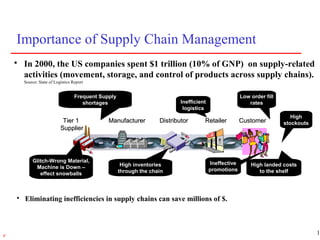
Importance of Supply Chain Management
 In 2000, the US companies spent $1 trillion (10% of GNP) on supply-related
activities (movement, storage, and control of products across supply chains).
Source: State of Logistics Report
 Eliminating inefficiencies in supply chains can save millions of $.
Tier 1Tier 1
SupplierSupplier
ManufacturerManufacturer DistributorDistributor RetailerRetailer CustomerCustomer
Inefficient
logistics
High
stockouts
Ineffective
promotions
Frequent Supply
shortages
High landed costs
to the shelf
High inventories
through the chain
Low order fill
rates
Glitch-Wrong Material,
Machine is Down –
effect snowballs
11r
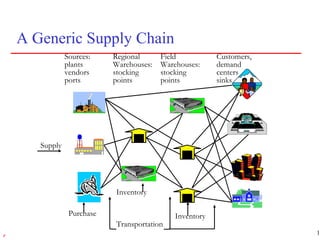
Supply
Sources:
plants
vendors
ports
Regional
Warehouses:
stocking
points
Field
Warehouses:
stocking
points
Customers,
demand
centers
sinks
Purchase
Inventory
Transportation
Inventory
A Generic Supply Chain
12r
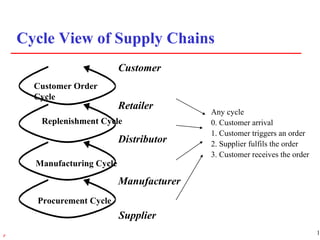
Cycle View of Supply Chains
Customer Order
Cycle
Replenishment Cycle
Manufacturing Cycle
Procurement Cycle
Customer
Retailer
Distributor
Manufacturer
Supplier
Any cycle
0. Customer arrival
1. Customer triggers an order
2. Supplier fulfils the order
3. Customer receives the order
13r
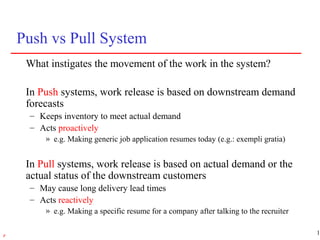
Push vs Pull System
What instigates the movement of the work in the system?
In Push systems, work release is based on downstream demand
forecasts
– Keeps inventory to meet actual demand
– Acts proactively
» e.g. Making generic job application resumes today (e.g.: exempli gratia)
In Pull systems, work release is based on actual demand or the
actual status of the downstream customers
– May cause long delivery lead times
– Acts reactively
» e.g. Making a specific resume for a company after talking to the recruiter
14r
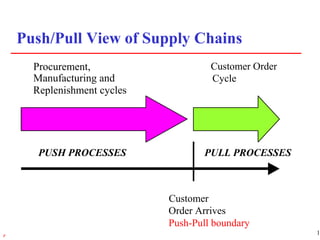
Push/Pull View of Supply Chains
Procurement,
Manufacturing and
Replenishment cycles
Customer Order
Cycle
Customer
Order Arrives
Push-Pull boundary
PUSH PROCESSES PULL PROCESSES
15r
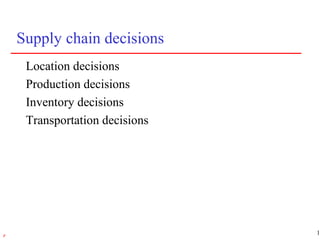
Supply chain decisions
Location decisions
Production decisions
Inventory decisions
Transportation decisions
16r
SCM Strategy
17r
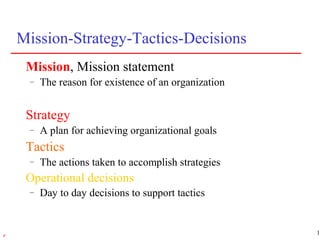
Mission-Strategy-Tactics-Decisions
Mission, Mission statement
– The reason for existence of an organization
Strategy
– A plan for achieving organizational goals
Tactics
– The actions taken to accomplish strategies
Operational decisions
– Day to day decisions to support tactics
18r
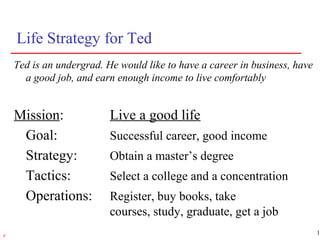
Life Strategy for Ted
Ted is an undergrad. He would like to have a career in business, have
a good job, and earn enough income to live comfortably
Mission: Live a good life
Goal: Successful career, good income
Strategy: Obtain a master’s degree
Tactics: Select a college and a concentration
Operations: Register, buy books, take
courses, study, graduate, get a job
19r
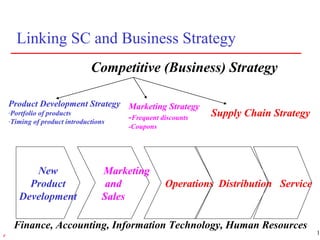
Linking SC and Business Strategy
New
Product
Development
Marketing
and
Sales
Operations Distribution Service
Finance, Accounting, Information Technology, Human Resources
Competitive (Business) Strategy
Product Development Strategy
-Portfolio of products
-Timing of product introductions
Marketing Strategy
-Frequent discounts
-Coupons
Supply Chain Strategy
20r
Strategies:
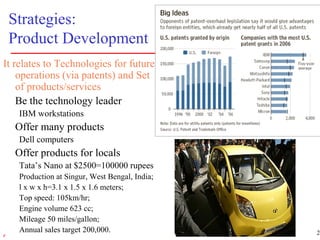
Product Development
It relates to Technologies for future
operations (via patents) and Set
of products/services
Be the technology leader
IBM workstations
Offer many products
Dell computers
Offer products for locals
Tata’s Nano at $2500=100000 rupees
Production at Singur, West Bengal, India;
l x w x h=3.1 x 1.5 x 1.6 meters;
Top speed: 105km/hr;
Engine volume 623 cc;
Mileage 50 miles/gallon;
Annual sales target 200,000.
21r
Strategies
Marketing and sales strategy relates to positioning, pricing and
promotion of products/services
– e.g. Never offer more than 40% discount
– e.g. EDLP = every day low price
» At Wal-Mart
– e.g. Demand smoothing via coupons
» BestBuy
Supply chain management strategy relates to procurement,
transportation, storage and delivery
– e.g. Never use more than 1 supplier for every input
– e.g. Never expedite orders just because they are late
– e.g. Always use domestic suppliers within the sales season not in advance.
22r
Fitting the SC to the customer or vice versa?
Understand the customer Wishes
Understand the Capabilities of your SC
Match the Wishes with the Capabilities
Challenge: How to meet extensive Wishes
with limited Capabilities?
23r
Achieving Strategic Fit: Consistent SCM
and Competitive strategies
Fit SC to the customer
Understanding the Customer
– Range of demand, pizza hut stable
– Production lot size, seasonal products
– Response time, organ transplantation
– Service level, product availability
– Product variety
– Innovation
– Accommodating
poor quality
Implied (Demand)
Uncertainty for SC
Implied trouble
for SC
24r
Contributors to Implied Demand Uncertainty
Low High
Price ResponsivenessCustomer Need
Implied Demand Uncertainty
Commodities
Detergent
Long lead time
steel
Customized products
High Fashion Clothing
Emergency steel,
for maintenance/replacement
Short lead times, product variety,
distribution channel variety, high rate of innovation and
high customer service levels all increase
the Implied Demand Uncertainty
25r
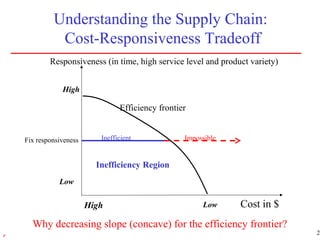
Understanding the Supply Chain:
Cost-Responsiveness Tradeoff
High Low
Low
High
Responsiveness (in time, high service level and product variety)
Cost in $
Efficiency frontier
InefficientFix responsiveness Impossible
Inefficiency Region
Why decreasing slope (concave) for the efficiency frontier?
26r
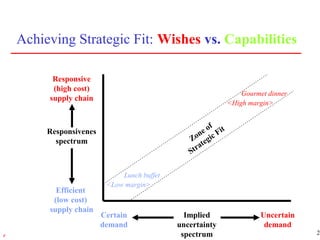
Achieving Strategic Fit: Wishes vs. Capabilities
Implied
uncertainty
spectrum
Responsive
(high cost)
supply chain
Efficient
(low cost)
supply chain
Certain
demand
Uncertain
demand
Responsivenes
spectrum Zone of
Strategic Fit
Lunch buffet
<Low margin>
Gourmet dinner
<High margin>
27r
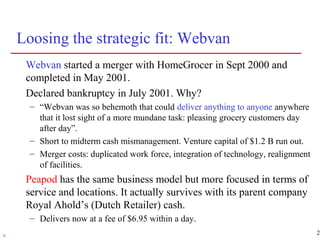
Loosing the strategic fit: Webvan
Webvan started a merger with HomeGrocer in Sept 2000 and
completed in May 2001.
Declared bankruptcy in July 2001. Why?
– “Webvan was so behemoth that could deliver anything to anyone anywhere
that it lost sight of a more mundane task: pleasing grocery customers day
after day”.
– Short to midterm cash mismanagement. Venture capital of $1.2 B run out.
– Merger costs: duplicated work force, integration of technology, realignment
of facilities.
Peapod has the same business model but more focused in terms of
service and locations. It actually survives with its parent company
Royal Ahold’s (Dutch Retailer) cash.
– Delivers now at a fee of $6.95 within a day.
28r
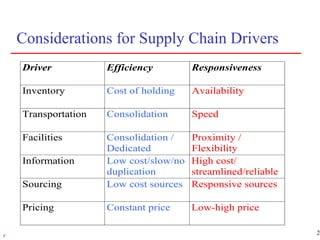
Considerations for Supply Chain Drivers
Driver Efficiency Responsiveness
Inventory Cost of holding Availability
Transportation Consolidation Speed
Facilities Consolidation /
Dedicated
Proximity /
Flexibility
Information Low cost/slow/no
duplication
High cost/
streamlined/reliable
Sourcing Low cost sources Responsive sources
Pricing Constant price Low-high price

Supply chain management

  • 1.
  • 2.
    2r Outline What is supplychain management? A supply chain strategy framework Components of a SCM Major obstacles and common problems Seven Eleven Japan
  • 3.
    3r Traditional View: SupplyChains in the Economy (1990, 1996) Freight Transportation $352, $455 B – Transportation manager in charge – Transportation software Inventory Expense $221, $311 B – Inventory manager in charge – Inventory software Administrative Expense $27, $31 B Logistics related activity 11%, 10.5% of GNP $898 B spent domestically for SC activities in 1998. $1,160 B of inventory in the US economy in the early 2000s. Transportation and inventory managers
  • 4.
    4r Traditional View: Costbreakdown of a manufactured good Profit 10% Supply Chain Cost 20% Marketing Cost 25% Manufacturing Cost 45% Profit Supply Chain Cost Marketing Cost Manufacturing Cost Effort spent for supply chain activities are invisible to the customers.
  • 5.
    5r What can SupplyChain Management do? Estimated that the grocery industry could save $30 billion (10% of operating cost) by using effective logistics and supply chain strategies – A typical box of cereal spends 104 days from factory to sale – A typical car spends 15 days from factory to dealership – Faster turnaround of the goods is better? Laura Ashley (retailer of women and children clothes) turns its inventory 10 times a year five times faster than 3 years ago – inventory is emptied 10 times a year, or an item spends about 12/10 months in the inventory. – To be responsive, it relocated its main warehouse next to FedEx hub in Memphis, TE. National Semiconductor used air transportation and closed 6 warehouses, 34% increase in sales and 47% decrease in delivery lead time.
  • 6.
    6r A picture isbetter than 1000 words! How many words would be better than 3 pictures? - A supply chain consists of - aims to Match Supply and Demand, profitably for products and services SUPPLY SIDE DEMAND SIDE The right Product Higher Profits The right Time The right Customer The right Quantity The right Store The right Price =++ ++ + - achieves SupplierSupplier ManufacturerManufacturer DistributorDistributor RetailerRetailer CustomerCustomer Upstream Downstream
  • 7.
    7r Detergent supply chain: Customerwants detergent Customer wants detergent Albertson’s Supermarket Albertson’s Supermarket Third party DC Third party DC P&G or other manufacturer P&G or other manufacturer Plastic cup Producer Plastic cup Producer Chemical manufacturer (e.g. Oil Company) Chemical manufacturer (e.g. Oil Company) Tenneco Packaging Tenneco Packaging Paper Manufacturer Paper Manufacturer Timber Industry Timber Industry Chemical manufacturer (e.g. Oil Company) Chemical manufacturer (e.g. Oil Company)
  • 8.
    8r Flows in aSupply Chain Customer Material Information Funds The flows resemble a chain reaction. Supplier
  • 9.
    9r SCM in aSupply Network  Supply Chain Management (SCM) is concerned with the management and control of the flows of material, information, and finances in supply chains. Supply Demand Products and Services Cash Supply Side OEM Demand Side THAILAND INDIA MEXICO TEXAS US N-Tier Suppliers Suppliers Logistics Distributors Retailers Information  The task of SCM is to design, plan, and execute the activities at the different stages so as to provide the desired levels of service to supply chain customers profitably
  • 10.
    10r Importance of SupplyChain Management  In 2000, the US companies spent $1 trillion (10% of GNP) on supply-related activities (movement, storage, and control of products across supply chains). Source: State of Logistics Report  Eliminating inefficiencies in supply chains can save millions of $. Tier 1Tier 1 SupplierSupplier ManufacturerManufacturer DistributorDistributor RetailerRetailer CustomerCustomer Inefficient logistics High stockouts Ineffective promotions Frequent Supply shortages High landed costs to the shelf High inventories through the chain Low order fill rates Glitch-Wrong Material, Machine is Down – effect snowballs
  • 11.
  • 12.
    12r Cycle View ofSupply Chains Customer Order Cycle Replenishment Cycle Manufacturing Cycle Procurement Cycle Customer Retailer Distributor Manufacturer Supplier Any cycle 0. Customer arrival 1. Customer triggers an order 2. Supplier fulfils the order 3. Customer receives the order
  • 13.
    13r Push vs PullSystem What instigates the movement of the work in the system? In Push systems, work release is based on downstream demand forecasts – Keeps inventory to meet actual demand – Acts proactively » e.g. Making generic job application resumes today (e.g.: exempli gratia) In Pull systems, work release is based on actual demand or the actual status of the downstream customers – May cause long delivery lead times – Acts reactively » e.g. Making a specific resume for a company after talking to the recruiter
  • 14.
    14r Push/Pull View ofSupply Chains Procurement, Manufacturing and Replenishment cycles Customer Order Cycle Customer Order Arrives Push-Pull boundary PUSH PROCESSES PULL PROCESSES
  • 15.
    15r Supply chain decisions Locationdecisions Production decisions Inventory decisions Transportation decisions
  • 16.
  • 17.
    17r Mission-Strategy-Tactics-Decisions Mission, Mission statement –The reason for existence of an organization Strategy – A plan for achieving organizational goals Tactics – The actions taken to accomplish strategies Operational decisions – Day to day decisions to support tactics
  • 18.
    18r Life Strategy forTed Ted is an undergrad. He would like to have a career in business, have a good job, and earn enough income to live comfortably Mission: Live a good life Goal: Successful career, good income Strategy: Obtain a master’s degree Tactics: Select a college and a concentration Operations: Register, buy books, take courses, study, graduate, get a job
  • 19.
    19r Linking SC andBusiness Strategy New Product Development Marketing and Sales Operations Distribution Service Finance, Accounting, Information Technology, Human Resources Competitive (Business) Strategy Product Development Strategy -Portfolio of products -Timing of product introductions Marketing Strategy -Frequent discounts -Coupons Supply Chain Strategy
  • 20.
    20r Strategies: Product Development It relatesto Technologies for future operations (via patents) and Set of products/services Be the technology leader IBM workstations Offer many products Dell computers Offer products for locals Tata’s Nano at $2500=100000 rupees Production at Singur, West Bengal, India; l x w x h=3.1 x 1.5 x 1.6 meters; Top speed: 105km/hr; Engine volume 623 cc; Mileage 50 miles/gallon; Annual sales target 200,000.
  • 21.
    21r Strategies Marketing and salesstrategy relates to positioning, pricing and promotion of products/services – e.g. Never offer more than 40% discount – e.g. EDLP = every day low price » At Wal-Mart – e.g. Demand smoothing via coupons » BestBuy Supply chain management strategy relates to procurement, transportation, storage and delivery – e.g. Never use more than 1 supplier for every input – e.g. Never expedite orders just because they are late – e.g. Always use domestic suppliers within the sales season not in advance.
  • 22.
    22r Fitting the SCto the customer or vice versa? Understand the customer Wishes Understand the Capabilities of your SC Match the Wishes with the Capabilities Challenge: How to meet extensive Wishes with limited Capabilities?
  • 23.
    23r Achieving Strategic Fit:Consistent SCM and Competitive strategies Fit SC to the customer Understanding the Customer – Range of demand, pizza hut stable – Production lot size, seasonal products – Response time, organ transplantation – Service level, product availability – Product variety – Innovation – Accommodating poor quality Implied (Demand) Uncertainty for SC Implied trouble for SC
  • 24.
    24r Contributors to ImpliedDemand Uncertainty Low High Price ResponsivenessCustomer Need Implied Demand Uncertainty Commodities Detergent Long lead time steel Customized products High Fashion Clothing Emergency steel, for maintenance/replacement Short lead times, product variety, distribution channel variety, high rate of innovation and high customer service levels all increase the Implied Demand Uncertainty
  • 25.
    25r Understanding the SupplyChain: Cost-Responsiveness Tradeoff High Low Low High Responsiveness (in time, high service level and product variety) Cost in $ Efficiency frontier InefficientFix responsiveness Impossible Inefficiency Region Why decreasing slope (concave) for the efficiency frontier?
  • 26.
    26r Achieving Strategic Fit:Wishes vs. Capabilities Implied uncertainty spectrum Responsive (high cost) supply chain Efficient (low cost) supply chain Certain demand Uncertain demand Responsivenes spectrum Zone of Strategic Fit Lunch buffet <Low margin> Gourmet dinner <High margin>
  • 27.
    27r Loosing the strategicfit: Webvan Webvan started a merger with HomeGrocer in Sept 2000 and completed in May 2001. Declared bankruptcy in July 2001. Why? – “Webvan was so behemoth that could deliver anything to anyone anywhere that it lost sight of a more mundane task: pleasing grocery customers day after day”. – Short to midterm cash mismanagement. Venture capital of $1.2 B run out. – Merger costs: duplicated work force, integration of technology, realignment of facilities. Peapod has the same business model but more focused in terms of service and locations. It actually survives with its parent company Royal Ahold’s (Dutch Retailer) cash. – Delivers now at a fee of $6.95 within a day.
  • 28.
    28r Considerations for SupplyChain Drivers Driver Efficiency Responsiveness Inventory Cost of holding Availability Transportation Consolidation Speed Facilities Consolidation / Dedicated Proximity / Flexibility Information Low cost/slow/no duplication High cost/ streamlined/reliable Sourcing Low cost sources Responsive sources Pricing Constant price Low-high price

Editor's Notes

  • #3 Notes:
  • #4 Notes: Traditionally logistics and supply chain management have been measured in terms of transportation and inventory costs and the administration required to manage both. Traditionally firms would have an inventory manager and a transportation manager. This view is very narrow and causes significant problems in the proper functioning of the supply chain.
  • #5 Notes: Key message here is that logistics costs are a significant fraction of the total value of a product. The problem here is that this a purely cost based view of the supply chain and drives a firm to simply reducing logistics costs. This is an incomplete picture.
  • #8 Notes: Supply chain involves everybody, from the customer all the way to the last supplier. Key flows in the supply chain are - information, product, and cash. It is through these flows that a supply chain fills a customer order. The management of these flows is key to the success or failure of a firm. Give Dell &amp; Compaq example, Amazon &amp; Borders example to bring out the fact that all supply chain interaction is through these flows.
  • #12 A customer is a supplier for some other company. A supplier is a customer for some other company. Not all pieces of a supply chain belongs to the same company.
  • #13 The supply chain is a concatenation of cycles with each cycle at the interface of two successive stages in the supply chain. Each cycle involves the customer stage placing an order and receiving it after it has been supplied by the supplier stage. One difference is in size of order. Second difference is in predictability of orders - orders in the procurement cycle are predictable once manufacturing planning has been done. This is the predominant view for ERP systems. It is a transaction level view and clearly defines each process and its owner.
  • #15 In this view processes are divided based on their timing relative to the timing of a customer order. Define push and pull processes. They key difference is the uncertainty during the two phases. Give examples at Amazon and Borders to illustrate the two views
  • #20 Competitive strategy: a set of customer needs that a company emphasizes and concentrates on while producing / servicing. Compare Wal-Mart, 7 eleven, Sam’s club.