Strategic Partnering:
Types of SP
• Quick Response:
– Vendors receive POS data from retailers, and
use this information to synchronize production
and inventory activities at the supplier.
– The retailer still prepares individual orders, but
the POS data is used by the supplier to
improve forecasting and scheduling.
– Example: Milliken and Company: The lead time
from order receipt at Milliken’s textile plants to
final clothing receipt at several of the
department stores involved was reduced from
eighteen weeks down to three weeks.
Strategic Partnering:
Types of SP
• Continuous Replenishment: Vendors
receive POS data and use it to prepare
shipments at previously agreed upon
intervals to maintain agreed to levels of
inventory.
– Wal-Mart, Kmart

• Advanced Continuous Replenishment:
Suppliers may gradually decrease
inventory levels at the retailer’s store or
distribution center as long as service levels
are met. Inventory levels are thus
continuously improved in a structured
way.
Strategic Partnering:
Types of SP
• Vendor Managed Inventory
(VMI):JITD
– VMI Projects at Dillard Department
Stores, J.C. Penney, and Wal-Mart have
shown sales increases of 20 to 25
percent, and 30 percent inventory
turnover improvements.
Advantages of SP
• Decrease required inventory
levels
• Improve service levels
• Decrease work duplication
• Improve forecasts
Advantages of SP
• Fully utilize system knowledge
– Consider the partnership between
White-Hall Robbins (W-R), who makes
over-the-counter drugs such as Advil,
and Kmart. W-R initially disagreed with
Kmart about forecasts, and in this case,
it turned out that W-R forecasts were
more accurate because they have a
much more extensive knowledge of their
products than Kmart does.
Disadvantages of SP
• Expensive advanced technology
is required.
• Supplier/retailer trust must be
developed.
• Supplier responsibility increases.
• Expenses at the supplier
often increase.
–Why? How can this be
addressed?
Conceptual Evolution of
Inventory Management
Owner Managed
Inventory

Continuous
Replenishment

VMI

Consignment
Selling

Direct Selling
Vendor Managed Inventory
(VMI)
VMI is essentially an integrated
approach whereby the inventory
at the distributor/retailer
(downstream) is monitored and
managed by the
manufacturer/vendor (upstream)
VMI rationale ….
By pushing the decision making
responsibility further up the supply
chain, the manufacturer/vendor will be
in a better position to support the
objectives of the entire integrated
supply chain resulting in sustainable
competitive advantage
VMI includes …
• Determining appropriate order
quantities
• Managing proper product mixes
• Configuring appropriate safety stock
Typical Benefits to
Manufacturers
• Lower inventory investments (raw
and finished)
• Better scheduling and planning
• Better market information
• Closer customer ties and preferred
status
Typical Benefits to Retailers
• Fewer stock-out with higher
inventory turnover
• Better market information
• More optimal product mix
• Less inventory in channels (transfer
costs)
• Lower administrative replenishment
costs
VMI Success Factors
• Top management commitment
• Focus on effort
• Trust and partnership between
supply chain stakeholders
• Highly effective
computer/information systems (EDI,
Bar coding, Scanning)
• Competent manufacturers and the
ability to forecast
• Willing stakeholders partners and
patience
Electronic Data
Interchange EDI
computer to computer
exchange of business
transaction in a standard
format
EDI Benefits …
• Quick access to information
• Reduced labor and material costs
associated with handling paper-based
business transaction
• Better communication
• Increases productivity
• Improved tracing and expediting
• Improved billing
• Better customer service
Ownership of inventory
• Initially, ownership transferred to retailer
upon receipt of goods
• Now, VMI is based on consignment
relationship in which manufacturer owns
goods until sold
• Retailer benefit: lower inventory cost
• Manufacturers benefits: better control
• Supply chain benefit: system-wide cost
reduction
Requirements for Effective SP
• Advanced information systems
• Top management commitment
– Information must be shared
– Power and responsibility within an organization
might change (for example, contact with
customers switches from sales and marketing
to logistics)

• Mutual trust
– Information sharing
– Management of the entire supply chain
– Initial loss of revenues
Important SP Issues
• Inventory ownership:
– Retailer owns inventory
– Supplier owns the goods until they are
sold (consignment)
• Why would a firm do this?

• Performance measures: Fill rate,
inventory level, inventory turns
Important SP Issues
• Confidentiality
• Communication and cooperation
– When First Brands started partnering
with Kmart, Kmart often claimed that its
supplier was not living up to its
agreement to keep two weeks of
inventory at all times. It turned out that
this was due to the fact that the two
companies employed different
forecasting methods.
Steps in SP Implementation
• Contractual negotiations
–
–
–
–

Ownership
Credit terms
Ordering decisions
Performance measures

• Develop or integrate information systems
• Develop effective forecasting techniques
• Develop a tactical decision support tool to
assist in coordinating inventory
management and transportation policies
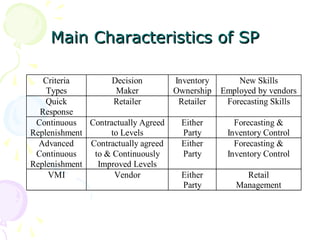
Main Characteristics of SP
Criteria
Decision
Inventory
Types
Maker
Ownership
Quick
Retailer
Retailer
Response
Continuous
Contractually Agreed
Either
Replenishment
to Levels
Party
Advanced
Contractually agreed
Either
Continuous
to & Continuously
Party
Replenishment
Improved Levels
VMI
Vendor
Either
Party

New Skills
Employed by vendors
Forecasting Skills
Forecasting &
Inventory Control
Forecasting &
Inventory Control
Retail
Management
Examples of SP Successes
and Failures
• Western Publishing-Golden Books:
– Western Publishing is using VMI for its Golden Books line
of children’s books at several retailers.
– POS data automatically triggers re-orders when
inventory falls below a reorder point.
– This inventory is delivered either to a distribution center,
or in many cases, directly to the store.
– Ownership of the books shifts to the retailer once
deliveries have been made.
– In the case of Toys R Us, the company has even
managed the entire book section for the retailer,
including inventory from suppliers other than Western
Publishing.
– Extra sales, increased costs to Western
Examples of SP Successes
and Failures
• VF Corporation’s Market Response
System:
– The VF Corporation, which has many well
known brand names (including Wrangler, Lee,
Girbaud, and many others), began its VMI
program in 1989.
– Currently, about 40 percent of its production is
handled using some type of automatic
replenishment scheme.
– This is particularly notable because the
program encompasses 350 different retailers,
40,000 store locations, and more than 15
million replenishment levels.
– VF’s program is considered one of the most
Examples of SP Successes
and Failures
• Spartan Stores
– Spartan Stores, a grocery chain, shut
down its VMI effort about one year after
its inception.
– One problem was that buyers were not
spending any less time on reorders than
they did before
– This was because they didn’t trust the
suppliers enough to be able to stop
carefully monitoring the inventories and
deliveries of the VMI items, and
intervening at the slightest hint of
Examples of SP Successes
and Failures
• Spartan Stores (continued)
– Suppliers didn’t do much to allay these
fears. The problems were not with the
suppliers’ forecasts; instead, they were
due to the suppliers’ inability to deal
with promotions, which are a key part of
the grocery business.
– Since they were unable to appropriately
account for promotions, delivery levels
were often unacceptably low during
these periods of peak demand.
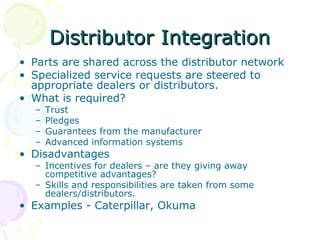
Distributor Integration
• Parts are shared across the distributor network
• Specialized service requests are steered to
appropriate dealers or distributors.
• What is required?
–
–
–
–

Trust
Pledges
Guarantees from the manufacturer
Advanced information systems

• Disadvantages

– Incentives for dealers – are they giving away
competitive advantages?
– Skills and responsibilities are taken from some
dealers/distributors.

• Examples - Caterpillar, Okuma

Vendor managed inventory ppt

  • 1.
    Strategic Partnering: Types ofSP • Quick Response: – Vendors receive POS data from retailers, and use this information to synchronize production and inventory activities at the supplier. – The retailer still prepares individual orders, but the POS data is used by the supplier to improve forecasting and scheduling. – Example: Milliken and Company: The lead time from order receipt at Milliken’s textile plants to final clothing receipt at several of the department stores involved was reduced from eighteen weeks down to three weeks.
  • 2.
    Strategic Partnering: Types ofSP • Continuous Replenishment: Vendors receive POS data and use it to prepare shipments at previously agreed upon intervals to maintain agreed to levels of inventory. – Wal-Mart, Kmart • Advanced Continuous Replenishment: Suppliers may gradually decrease inventory levels at the retailer’s store or distribution center as long as service levels are met. Inventory levels are thus continuously improved in a structured way.
  • 3.
    Strategic Partnering: Types ofSP • Vendor Managed Inventory (VMI):JITD – VMI Projects at Dillard Department Stores, J.C. Penney, and Wal-Mart have shown sales increases of 20 to 25 percent, and 30 percent inventory turnover improvements.
  • 4.
    Advantages of SP •Decrease required inventory levels • Improve service levels • Decrease work duplication • Improve forecasts
  • 5.
    Advantages of SP •Fully utilize system knowledge – Consider the partnership between White-Hall Robbins (W-R), who makes over-the-counter drugs such as Advil, and Kmart. W-R initially disagreed with Kmart about forecasts, and in this case, it turned out that W-R forecasts were more accurate because they have a much more extensive knowledge of their products than Kmart does.
  • 6.
    Disadvantages of SP •Expensive advanced technology is required. • Supplier/retailer trust must be developed. • Supplier responsibility increases. • Expenses at the supplier often increase. –Why? How can this be addressed?
  • 7.
    Conceptual Evolution of InventoryManagement Owner Managed Inventory Continuous Replenishment VMI Consignment Selling Direct Selling
  • 8.
    Vendor Managed Inventory (VMI) VMIis essentially an integrated approach whereby the inventory at the distributor/retailer (downstream) is monitored and managed by the manufacturer/vendor (upstream)
  • 9.
    VMI rationale …. Bypushing the decision making responsibility further up the supply chain, the manufacturer/vendor will be in a better position to support the objectives of the entire integrated supply chain resulting in sustainable competitive advantage
  • 10.
    VMI includes … •Determining appropriate order quantities • Managing proper product mixes • Configuring appropriate safety stock
  • 11.
    Typical Benefits to Manufacturers •Lower inventory investments (raw and finished) • Better scheduling and planning • Better market information • Closer customer ties and preferred status
  • 12.
    Typical Benefits toRetailers • Fewer stock-out with higher inventory turnover • Better market information • More optimal product mix • Less inventory in channels (transfer costs) • Lower administrative replenishment costs
  • 13.
    VMI Success Factors •Top management commitment • Focus on effort • Trust and partnership between supply chain stakeholders • Highly effective computer/information systems (EDI, Bar coding, Scanning) • Competent manufacturers and the ability to forecast • Willing stakeholders partners and patience
  • 14.
    Electronic Data Interchange EDI computerto computer exchange of business transaction in a standard format
  • 15.
    EDI Benefits … •Quick access to information • Reduced labor and material costs associated with handling paper-based business transaction • Better communication • Increases productivity • Improved tracing and expediting • Improved billing • Better customer service
  • 16.
    Ownership of inventory •Initially, ownership transferred to retailer upon receipt of goods • Now, VMI is based on consignment relationship in which manufacturer owns goods until sold • Retailer benefit: lower inventory cost • Manufacturers benefits: better control • Supply chain benefit: system-wide cost reduction
  • 17.
    Requirements for EffectiveSP • Advanced information systems • Top management commitment – Information must be shared – Power and responsibility within an organization might change (for example, contact with customers switches from sales and marketing to logistics) • Mutual trust – Information sharing – Management of the entire supply chain – Initial loss of revenues
  • 18.
    Important SP Issues •Inventory ownership: – Retailer owns inventory – Supplier owns the goods until they are sold (consignment) • Why would a firm do this? • Performance measures: Fill rate, inventory level, inventory turns
  • 19.
    Important SP Issues •Confidentiality • Communication and cooperation – When First Brands started partnering with Kmart, Kmart often claimed that its supplier was not living up to its agreement to keep two weeks of inventory at all times. It turned out that this was due to the fact that the two companies employed different forecasting methods.
  • 20.
    Steps in SPImplementation • Contractual negotiations – – – – Ownership Credit terms Ordering decisions Performance measures • Develop or integrate information systems • Develop effective forecasting techniques • Develop a tactical decision support tool to assist in coordinating inventory management and transportation policies
  • 21.
    Main Characteristics ofSP Criteria Decision Inventory Types Maker Ownership Quick Retailer Retailer Response Continuous Contractually Agreed Either Replenishment to Levels Party Advanced Contractually agreed Either Continuous to & Continuously Party Replenishment Improved Levels VMI Vendor Either Party New Skills Employed by vendors Forecasting Skills Forecasting & Inventory Control Forecasting & Inventory Control Retail Management
  • 22.
    Examples of SPSuccesses and Failures • Western Publishing-Golden Books: – Western Publishing is using VMI for its Golden Books line of children’s books at several retailers. – POS data automatically triggers re-orders when inventory falls below a reorder point. – This inventory is delivered either to a distribution center, or in many cases, directly to the store. – Ownership of the books shifts to the retailer once deliveries have been made. – In the case of Toys R Us, the company has even managed the entire book section for the retailer, including inventory from suppliers other than Western Publishing. – Extra sales, increased costs to Western
  • 23.
    Examples of SPSuccesses and Failures • VF Corporation’s Market Response System: – The VF Corporation, which has many well known brand names (including Wrangler, Lee, Girbaud, and many others), began its VMI program in 1989. – Currently, about 40 percent of its production is handled using some type of automatic replenishment scheme. – This is particularly notable because the program encompasses 350 different retailers, 40,000 store locations, and more than 15 million replenishment levels. – VF’s program is considered one of the most
  • 24.
    Examples of SPSuccesses and Failures • Spartan Stores – Spartan Stores, a grocery chain, shut down its VMI effort about one year after its inception. – One problem was that buyers were not spending any less time on reorders than they did before – This was because they didn’t trust the suppliers enough to be able to stop carefully monitoring the inventories and deliveries of the VMI items, and intervening at the slightest hint of
  • 25.
    Examples of SPSuccesses and Failures • Spartan Stores (continued) – Suppliers didn’t do much to allay these fears. The problems were not with the suppliers’ forecasts; instead, they were due to the suppliers’ inability to deal with promotions, which are a key part of the grocery business. – Since they were unable to appropriately account for promotions, delivery levels were often unacceptably low during these periods of peak demand.
  • 26.
    Distributor Integration • Partsare shared across the distributor network • Specialized service requests are steered to appropriate dealers or distributors. • What is required? – – – – Trust Pledges Guarantees from the manufacturer Advanced information systems • Disadvantages – Incentives for dealers – are they giving away competitive advantages? – Skills and responsibilities are taken from some dealers/distributors. • Examples - Caterpillar, Okuma

Editor's Notes

  • #17 Wal-Mart do not own most of the merchandise in their retail stores. They own them briefly as they move through the check-out counter.