Symbolic representation of dc generators
• The armature is denoted by a circle with two brushes. Mechanically it is
connected to another device called prime mover. The two ends of armature are
denoted as A1 – A2. The field winding is shown near armature and the two ends
are denoted as . The field winding is shown near armature and the two ends are
denoted as F1 – F2. The representation of field very little bit, depending on the
type of generator.
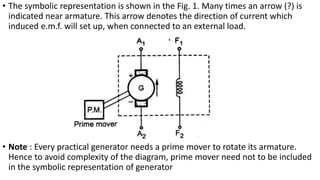
• The symbolic representation is shown in the Fig. 1. Many times an arrow (?) is
indicated near armature. This arrow denotes the direction of current which
induced e.m.f. will set up, when connected to an external load.
• Note : Every practical generator needs a prime mover to rotate its armature.
Hence to avoid complexity of the diagram, prime mover need not to be included
in the symbolic representation of generator
Methods of excitation
• The magnetic field required for the operation of a d.c. generator is produced by
an electromagnet. This electromagnet carries a field winding which produces
required magnetic flux when current is passed through it.
• The field winding is also called exciting winding and current carried by the field
winding is called an exciting current.
• Thus supplying current to the field winding is called excitation and the way of
supplying the exciting current is called method of excitation.
• There are two methods of excitation used for d.c. generators,
• 1. Separate excitation
• 2. Self excitation
• Depending on the method of excitation used, the d.c. generators are classified as,
• 1. Separately excited generators
• 2. Self excited generators
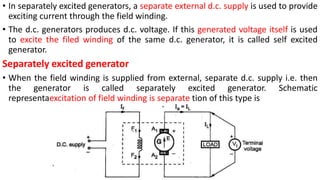
• In separately excited generators, a separate external d.c. supply is used to provide
exciting current through the field winding.
• The d.c. generators produces d.c. voltage. If this generated voltage itself is used
to excite the filed winding of the same d.c. generator, it is called self excited
generator.
Separately excited generator
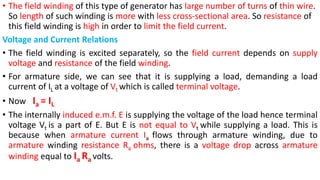
• When the field winding is supplied from external, separate d.c. supply i.e. then
the generator is called separately excited generator. Schematic
representaexcitation of field winding is separate tion of this type is
• The field winding of this type of generator has large number of turns of thin wire.
So length of such winding is more with less cross-sectional area. So resistance of
this field winding is high in order to limit the field current.
Voltage and Current Relations
• The field winding is excited separately, so the field current depends on supply
voltage and resistance of the field winding.
• For armature side, we can see that it is supplying a load, demanding a load
current of IL at a voltage of Vt which is called terminal voltage.
• Now Ia = IL
• The internally induced e.m.f. E is supplying the voltage of the load hence terminal
voltage Vt is a part of E. But E is not equal to Vt while supplying a load. This is
because when armature current Ia flows through armature winding, due to
armature winding resistance Ra ohms, there is a voltage drop across armature
winding equal to Ia Ra volts.
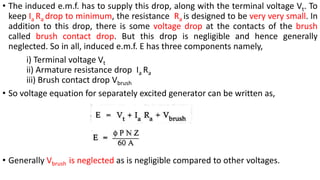
• The induced e.m.f. has to supply this drop, along with the terminal voltage Vt. To
keep Ia Ra drop to minimum, the resistance Ra is designed to be very very small. In
addition to this drop, there is some voltage drop at the contacts of the brush
called brush contact drop. But this drop is negligible and hence generally
neglected. So in all, induced e.m.f. E has three components namely,
i) Terminal voltage Vt
ii) Armature resistance drop Ia Ra
iii) Brush contact drop Vbrush
• So voltage equation for separately excited generator can be written as,
• Generally Vbrush is neglected as is negligible compared to other voltages.
Voltage Building in Self Excited Generator:
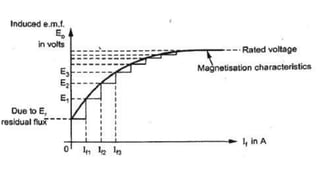
• Every generator which is used as a self excited generator there must exist some
residual magnetic flux.
• When armature rotates, conductor cut this small residual flux to produce the
e.m.f Er.
• This e.m.f drives small current through field winding.
• Thus If produce more flux which is greater than residual flux. Hence more e.m.f
induced.
• This further drives more current through field to produce more flux.
• This process cumulative and continuous till rated voltage gets build up.
self excited generator
• When the field winding is supplied from the armature of the generator itself
then it is said to be self excited generator. Now without generated emf field
cannot be excited in such generator and without excitation there cannot be
generated emf.
• How this type of generator works?
Residual magnetism possessed by the field poles, under normal condition.
• Though the generator is not working, without any current through field
winding, the field poles possess some magnetic flux called residual flux and
the property is called residual magnetism.
• When generator is started due to residual flux, it develops a small emf which
drives a small current through the field winding. This tends to increase the flux
produced and also increase the induced emf, field current and flux.
• This process is cumulative and continues till the generator develops rated voltage
across its armature. This is voltage building process in self excited generators.
• Based on connection of field winding to the armature to derive its excitation, this
type is further divided into three types, that are,
1. Shunt generator
2. Series generator
3. Compound generator
Shunt Generator:
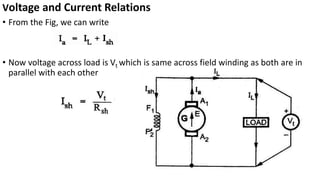
• When the field winding is connected in parallel with the armature and the
combination across the load then the generator is called shunt generator.
• The field winding has large number of turns of thin wire so it has high resistance.
Let Rsh be the resistance of the field winding.
Voltage and Current Relations
• From the Fig, we can write
• Now voltage across load is Vt which is same across field winding as both are in
parallel with each other
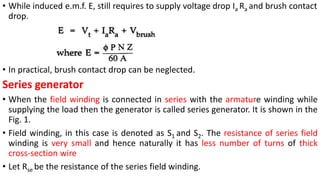
• While induced e.m.f. E, still requires to supply voltage drop Ia Ra and brush contact
drop.
• In practical, brush contact drop can be neglected.
Series generator
• When the field winding is connected in series with the armature winding while
supplying the load then the generator is called series generator. It is shown in the
Fig. 1.
• Field winding, in this case is denoted as S1 and S2. The resistance of series field
winding is very small and hence naturally it has less number of turns of thick
cross-section wire
• Let Rse be the resistance of the series field winding.
Voltage and current Relations
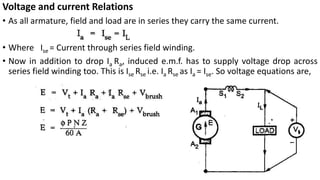
• As all armature, field and load are in series they carry the same current.
• Where Ise = Current through series field winding.
• Now in addition to drop Ia Ra, induced e.m.f. has to supply voltage drop across
series field winding too. This is Ise Rse i.e. Ia Rse as Ia = Ise. So voltage equations are,
Compound generator
• In this type, the part of the field winding is connected in parallel with armature
and part in series with the armature. Both series and shunt field windings are
mounted on the same poles. Depending upon the connection of shunt and series
field winding, compound generator is further classified as :
• Long shunt compound generator,
• Short shunt compound generator.
Long Shunt Compound Generator
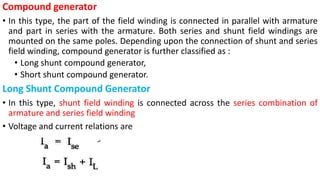
• In this type, shunt field winding is connected across the series combination of
armature and series field winding
• Voltage and current relations are
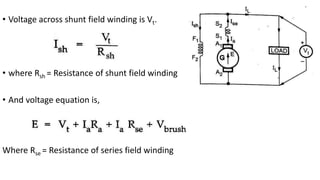
• Voltage across shunt field winding is Vt.
• where Rsh = Resistance of shunt field winding
• And voltage equation is,
Where Rse = Resistance of series field winding
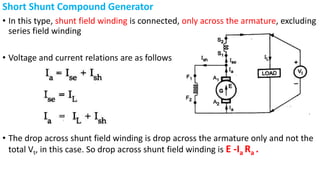
Short Shunt Compound Generator
• In this type, shunt field winding is connected, only across the armature, excluding
series field winding
• Voltage and current relations are as follows.
• The drop across shunt field winding is drop across the armature only and not the
total Vt, in this case. So drop across shunt field winding is E -Ia Ra .
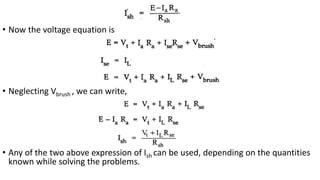
• Now the voltage equation is
• Neglecting Vbrush , we can write,
• Any of the two above expression of Ish can be used, depending on the quantities
known while solving the problems.
Cumulative and Differential Compound Generator
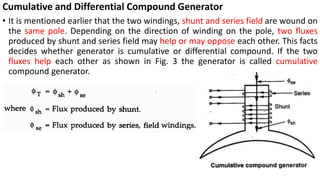
• It is mentioned earlier that the two windings, shunt and series field are wound on
the same pole. Depending on the direction of winding on the pole, two fluxes
produced by shunt and series field may help or may oppose each other. This facts
decides whether generator is cumulative or differential compound. If the two
fluxes help each other as shown in Fig. 3 the generator is called cumulative
compound generator.
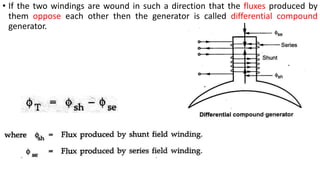
• If the two windings are wound in such a direction that the fluxes produced by
them oppose each other then the generator is called differential compound
generator.
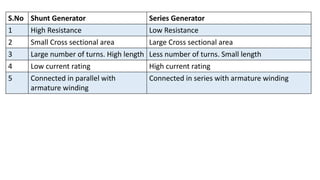
S.No Shunt Generator Series Generator
1 High Resistance Low Resistance
2 Small Cross sectional area Large Cross sectional area
3 Large number of turns. High length Less number of turns. Small length
4 Low current rating High current rating
5 Connected in parallel with
armature winding
Connected in series with armature winding
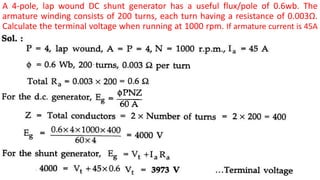
A 4-pole, lap wound DC shunt generator has a useful flux/pole of 0.6wb. The
armature winding consists of 200 turns, each turn having a resistance of 0.003Ω.
Calculate the terminal voltage when running at 1000 rpm. If armature current is 45A
A.
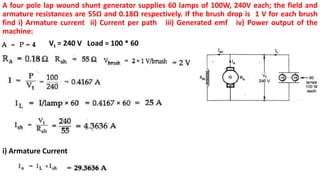
A four pole lap wound shunt generator supplies 60 lamps of 100W, 240V each; the field and
armature resistances are 55Ω and 0.18Ω respectively. If the brush drop is 1 V for each brush
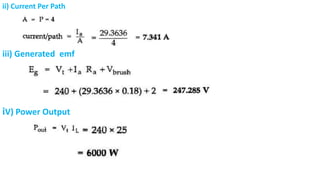
find i) Armature current ii) Current per path iii) Generated emf iv) Power output of the
machine:
Vt = 240 V Load = 100 * 60
i) Armature Current
ii) Current Per Path
iii) Generated emf
iV) Power Output
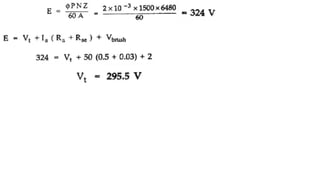
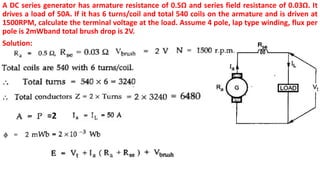
A DC series generator has armature resistance of 0.5Ω and series field resistance of 0.03Ω. It
drives a load of 50A. If it has 6 turns/coil and total 540 coils on the armature and is driven at
1500RPM, calculate the terminal voltage at the load. Assume 4 pole, lap type winding, flux per
pole is 2mWband total brush drop is 2V.
Solution:
=2
UNIT-2-DC GENERATOR.ppt

UNIT-2-DC GENERATOR.ppt

  • 1.
    Symbolic representation ofdc generators • The armature is denoted by a circle with two brushes. Mechanically it is connected to another device called prime mover. The two ends of armature are denoted as A1 – A2. The field winding is shown near armature and the two ends are denoted as . The field winding is shown near armature and the two ends are denoted as F1 – F2. The representation of field very little bit, depending on the type of generator.
  • 2.
    • The symbolicrepresentation is shown in the Fig. 1. Many times an arrow (?) is indicated near armature. This arrow denotes the direction of current which induced e.m.f. will set up, when connected to an external load. • Note : Every practical generator needs a prime mover to rotate its armature. Hence to avoid complexity of the diagram, prime mover need not to be included in the symbolic representation of generator
  • 3.
    Methods of excitation •The magnetic field required for the operation of a d.c. generator is produced by an electromagnet. This electromagnet carries a field winding which produces required magnetic flux when current is passed through it. • The field winding is also called exciting winding and current carried by the field winding is called an exciting current. • Thus supplying current to the field winding is called excitation and the way of supplying the exciting current is called method of excitation. • There are two methods of excitation used for d.c. generators, • 1. Separate excitation • 2. Self excitation • Depending on the method of excitation used, the d.c. generators are classified as, • 1. Separately excited generators • 2. Self excited generators
  • 4.
    • In separatelyexcited generators, a separate external d.c. supply is used to provide exciting current through the field winding. • The d.c. generators produces d.c. voltage. If this generated voltage itself is used to excite the filed winding of the same d.c. generator, it is called self excited generator. Separately excited generator • When the field winding is supplied from external, separate d.c. supply i.e. then the generator is called separately excited generator. Schematic representaexcitation of field winding is separate tion of this type is
  • 5.
    • The fieldwinding of this type of generator has large number of turns of thin wire. So length of such winding is more with less cross-sectional area. So resistance of this field winding is high in order to limit the field current. Voltage and Current Relations • The field winding is excited separately, so the field current depends on supply voltage and resistance of the field winding. • For armature side, we can see that it is supplying a load, demanding a load current of IL at a voltage of Vt which is called terminal voltage. • Now Ia = IL • The internally induced e.m.f. E is supplying the voltage of the load hence terminal voltage Vt is a part of E. But E is not equal to Vt while supplying a load. This is because when armature current Ia flows through armature winding, due to armature winding resistance Ra ohms, there is a voltage drop across armature winding equal to Ia Ra volts.
  • 6.
    • The inducede.m.f. has to supply this drop, along with the terminal voltage Vt. To keep Ia Ra drop to minimum, the resistance Ra is designed to be very very small. In addition to this drop, there is some voltage drop at the contacts of the brush called brush contact drop. But this drop is negligible and hence generally neglected. So in all, induced e.m.f. E has three components namely, i) Terminal voltage Vt ii) Armature resistance drop Ia Ra iii) Brush contact drop Vbrush • So voltage equation for separately excited generator can be written as, • Generally Vbrush is neglected as is negligible compared to other voltages.
  • 7.
    Voltage Building inSelf Excited Generator: • Every generator which is used as a self excited generator there must exist some residual magnetic flux. • When armature rotates, conductor cut this small residual flux to produce the e.m.f Er. • This e.m.f drives small current through field winding. • Thus If produce more flux which is greater than residual flux. Hence more e.m.f induced. • This further drives more current through field to produce more flux. • This process cumulative and continuous till rated voltage gets build up.
  • 9.
    self excited generator •When the field winding is supplied from the armature of the generator itself then it is said to be self excited generator. Now without generated emf field cannot be excited in such generator and without excitation there cannot be generated emf. • How this type of generator works? Residual magnetism possessed by the field poles, under normal condition. • Though the generator is not working, without any current through field winding, the field poles possess some magnetic flux called residual flux and the property is called residual magnetism. • When generator is started due to residual flux, it develops a small emf which drives a small current through the field winding. This tends to increase the flux produced and also increase the induced emf, field current and flux.
  • 10.
    • This processis cumulative and continues till the generator develops rated voltage across its armature. This is voltage building process in self excited generators. • Based on connection of field winding to the armature to derive its excitation, this type is further divided into three types, that are, 1. Shunt generator 2. Series generator 3. Compound generator Shunt Generator: • When the field winding is connected in parallel with the armature and the combination across the load then the generator is called shunt generator. • The field winding has large number of turns of thin wire so it has high resistance. Let Rsh be the resistance of the field winding.
  • 11.
    Voltage and CurrentRelations • From the Fig, we can write • Now voltage across load is Vt which is same across field winding as both are in parallel with each other
  • 12.
    • While inducede.m.f. E, still requires to supply voltage drop Ia Ra and brush contact drop. • In practical, brush contact drop can be neglected. Series generator • When the field winding is connected in series with the armature winding while supplying the load then the generator is called series generator. It is shown in the Fig. 1. • Field winding, in this case is denoted as S1 and S2. The resistance of series field winding is very small and hence naturally it has less number of turns of thick cross-section wire • Let Rse be the resistance of the series field winding.
  • 13.
    Voltage and currentRelations • As all armature, field and load are in series they carry the same current. • Where Ise = Current through series field winding. • Now in addition to drop Ia Ra, induced e.m.f. has to supply voltage drop across series field winding too. This is Ise Rse i.e. Ia Rse as Ia = Ise. So voltage equations are,
  • 14.
    Compound generator • Inthis type, the part of the field winding is connected in parallel with armature and part in series with the armature. Both series and shunt field windings are mounted on the same poles. Depending upon the connection of shunt and series field winding, compound generator is further classified as : • Long shunt compound generator, • Short shunt compound generator. Long Shunt Compound Generator • In this type, shunt field winding is connected across the series combination of armature and series field winding • Voltage and current relations are
  • 15.
    • Voltage acrossshunt field winding is Vt. • where Rsh = Resistance of shunt field winding • And voltage equation is, Where Rse = Resistance of series field winding
  • 16.
    Short Shunt CompoundGenerator • In this type, shunt field winding is connected, only across the armature, excluding series field winding • Voltage and current relations are as follows. • The drop across shunt field winding is drop across the armature only and not the total Vt, in this case. So drop across shunt field winding is E -Ia Ra .
  • 17.
    • Now thevoltage equation is • Neglecting Vbrush , we can write, • Any of the two above expression of Ish can be used, depending on the quantities known while solving the problems.
  • 18.
    Cumulative and DifferentialCompound Generator • It is mentioned earlier that the two windings, shunt and series field are wound on the same pole. Depending on the direction of winding on the pole, two fluxes produced by shunt and series field may help or may oppose each other. This facts decides whether generator is cumulative or differential compound. If the two fluxes help each other as shown in Fig. 3 the generator is called cumulative compound generator.
  • 19.
    • If thetwo windings are wound in such a direction that the fluxes produced by them oppose each other then the generator is called differential compound generator.
  • 20.
    S.No Shunt GeneratorSeries Generator 1 High Resistance Low Resistance 2 Small Cross sectional area Large Cross sectional area 3 Large number of turns. High length Less number of turns. Small length 4 Low current rating High current rating 5 Connected in parallel with armature winding Connected in series with armature winding
  • 21.
    A 4-pole, lapwound DC shunt generator has a useful flux/pole of 0.6wb. The armature winding consists of 200 turns, each turn having a resistance of 0.003Ω. Calculate the terminal voltage when running at 1000 rpm. If armature current is 45A A.
  • 22.
    A four polelap wound shunt generator supplies 60 lamps of 100W, 240V each; the field and armature resistances are 55Ω and 0.18Ω respectively. If the brush drop is 1 V for each brush find i) Armature current ii) Current per path iii) Generated emf iv) Power output of the machine: Vt = 240 V Load = 100 * 60 i) Armature Current
  • 23.
    ii) Current PerPath iii) Generated emf iV) Power Output
  • 24.
    A DC seriesgenerator has armature resistance of 0.5Ω and series field resistance of 0.03Ω. It drives a load of 50A. If it has 6 turns/coil and total 540 coils on the armature and is driven at 1500RPM, calculate the terminal voltage at the load. Assume 4 pole, lap type winding, flux per pole is 2mWband total brush drop is 2V. Solution: =2