UNIT I
FUNDAMENTALS OF ELECTRICITY
AND DC CIRCUITS
BASIC ELECTRICAL,
ELECTRONICS AND
MEASUREMENT ENGINEERING
Introduction
 Electricity is an apparent force in nature that exists
whenever there is a net electrical charge between any
two objects.
 Electrical charges are either negative (electrons) or
positive (protons)
 The unit of charge, q , is called the coloumb.
 When there are equal numbers of positive and negative
charges there is no electrical force as there is no net
charge. This is the case for a neutral atom.
 Electrical force is created when electrons are
transferred from one material to another (e.g. rubbing a
wool cloth with a plastic comb).
 Electrical charge is conserved; charge is neither
created nor destroyed
Voltage
 A force of attraction exists between positive and
negative charges.
 All charges possess a certain amount of potential
energy.
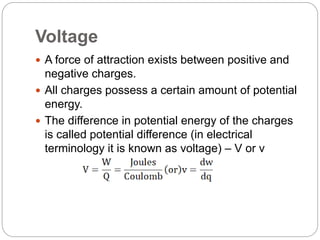
 The difference in potential energy of the charges
is called potential difference (in electrical
terminology it is known as voltage) – V or v
Principal Method of Producing
a Voltage
 Friction - Voltage is produced by rubbing two
materials together.
 Pressure (piezoelectricity) - Voltage is produced by
squeezing crystals of certain substances.
 Heat (thermo-electricity) - Voltage is produced by
heating the joint (junction) where two unlike metals
are joined.
 Light (photo-electricity) - Voltage is produced by light
striking photosensitive (light sensitive) substances.
 Chemical action - Voltage is produced by chemical
reaction in a battery cell.
 Magnetism - Voltage is produced in a conductor when
the conductor moves through a magnetic field or a
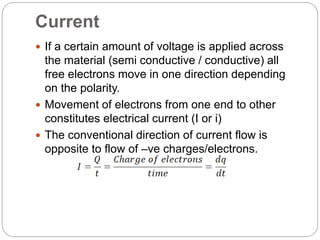
Current
 If a certain amount of voltage is applied across
the material (semi conductive / conductive) all
free electrons move in one direction depending
on the polarity.
 Movement of electrons from one end to other
constitutes electrical current (I or i)
 The conventional direction of current flow is
opposite to flow of –ve charges/electrons.
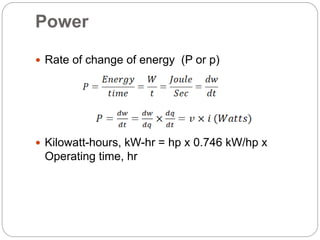
Power
 Rate of change of energy (P or p)
 Kilowatt-hours, kW-hr = hp x 0.746 kW/hp x
Operating time, hr
The Circuit
 The purpose of the circuit is to transfer energy
from sources to the load.
 A closed circuit:- a circuit in which current has a
complete path to flow.
 An open circuit:- the current path is broken , so
that current cannot flow.
Network Terminology
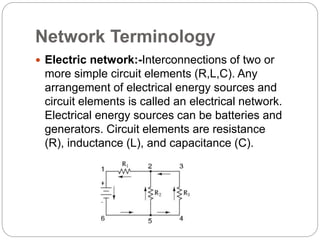
 Electric network:-Interconnections of two or
more simple circuit elements (R,L,C). Any
arrangement of electrical energy sources and
circuit elements is called an electrical network.
Electrical energy sources can be batteries and
generators. Circuit elements are resistance
(R), inductance (L), and capacitance (C).
 Electrical Circuit: It is a closed path followed by an
electric current. All electrical circuits are electrical
networks. Read about the differences between two
types of the electrical circuit: Series and Parallel
Circuit.
 Source: It is the device that supplies electrical
energy. Example: Battery, Generator.
 Load: It is the device that utilizes electrical
energy. Example: Lamp, Motor, Heater.
 Network elements: It is any circuit element with two
terminals that can be connected to other circuit
elements. Example: Resistors R1, R2, R3 in Figure
 Node: It is a junction where two or more circuit
elements are connected together. Example: Points
1,2,3,4,5,6 in Figure
 Minor node: Point at which only two elements
are connected together. Example: Point 1 in
Figure
 Major node: Point at which three or more
elements are connected
together. Example: Points 2,5 in Figure In circuit
analysis, the term node implies only the major
node
 Branch: It is the part of a circuit that lies between
two junction points. Example: 1-2, 2-5, 1-6 in
Figure
 Loop: It is any closed path of a
circuit. Example: 1-2-3-4-5-6, 1-2-5-6, 2-3-4-5 in
Figure
 Mesh: It is the most elementary form of a loop. A
Symbol and unit of quantities
 Ampere
 The ampere is the unit of electric current in the SI
 Coulomb
 The coulomb is the unit of electric charge in the
metre-kilogram—second-ampere system, the basis
of the SI system of physical units.
 Electron Volt
 A unit of energy commonly used in atomic and
nuclear physics, the electron volt is equal to the
energy gained by an electron
 Faraday
 The faraday (also called the faraday constant) is used in the
study of electrochemical reactions and equal to the amount of
electric charge that liberates one gram equivalent of any ion
from an electrolytic solution.
 Henry
 The henry is a unit of either self-inductance or mutual
inductance
 One henry is the value of self-inductance in a closed circuit or
coil in which one volt is produced by a variation of the inducing
current of one ampere per second.
 Ohm
 The unit of electrical resistance in the metre—kilogram-second
system is the ohm
 It is equal to the resistance of a circuit in which a potential
difference of one volt produces a current of one ampere
Thank You

Beeme UNIT I.ppt

  • 1.
    UNIT I FUNDAMENTALS OFELECTRICITY AND DC CIRCUITS BASIC ELECTRICAL, ELECTRONICS AND MEASUREMENT ENGINEERING
  • 2.
    Introduction  Electricity isan apparent force in nature that exists whenever there is a net electrical charge between any two objects.  Electrical charges are either negative (electrons) or positive (protons)  The unit of charge, q , is called the coloumb.  When there are equal numbers of positive and negative charges there is no electrical force as there is no net charge. This is the case for a neutral atom.  Electrical force is created when electrons are transferred from one material to another (e.g. rubbing a wool cloth with a plastic comb).  Electrical charge is conserved; charge is neither created nor destroyed
  • 3.
    Voltage  A forceof attraction exists between positive and negative charges.  All charges possess a certain amount of potential energy.  The difference in potential energy of the charges is called potential difference (in electrical terminology it is known as voltage) – V or v
  • 4.
    Principal Method ofProducing a Voltage  Friction - Voltage is produced by rubbing two materials together.  Pressure (piezoelectricity) - Voltage is produced by squeezing crystals of certain substances.  Heat (thermo-electricity) - Voltage is produced by heating the joint (junction) where two unlike metals are joined.  Light (photo-electricity) - Voltage is produced by light striking photosensitive (light sensitive) substances.  Chemical action - Voltage is produced by chemical reaction in a battery cell.  Magnetism - Voltage is produced in a conductor when the conductor moves through a magnetic field or a
  • 5.
    Current  If acertain amount of voltage is applied across the material (semi conductive / conductive) all free electrons move in one direction depending on the polarity.  Movement of electrons from one end to other constitutes electrical current (I or i)  The conventional direction of current flow is opposite to flow of –ve charges/electrons.
  • 6.
    Power  Rate ofchange of energy (P or p)  Kilowatt-hours, kW-hr = hp x 0.746 kW/hp x Operating time, hr
  • 7.
    The Circuit  Thepurpose of the circuit is to transfer energy from sources to the load.  A closed circuit:- a circuit in which current has a complete path to flow.  An open circuit:- the current path is broken , so that current cannot flow.
  • 8.
    Network Terminology  Electricnetwork:-Interconnections of two or more simple circuit elements (R,L,C). Any arrangement of electrical energy sources and circuit elements is called an electrical network. Electrical energy sources can be batteries and generators. Circuit elements are resistance (R), inductance (L), and capacitance (C).
  • 9.
     Electrical Circuit:It is a closed path followed by an electric current. All electrical circuits are electrical networks. Read about the differences between two types of the electrical circuit: Series and Parallel Circuit.  Source: It is the device that supplies electrical energy. Example: Battery, Generator.  Load: It is the device that utilizes electrical energy. Example: Lamp, Motor, Heater.  Network elements: It is any circuit element with two terminals that can be connected to other circuit elements. Example: Resistors R1, R2, R3 in Figure  Node: It is a junction where two or more circuit elements are connected together. Example: Points 1,2,3,4,5,6 in Figure
  • 10.
     Minor node:Point at which only two elements are connected together. Example: Point 1 in Figure  Major node: Point at which three or more elements are connected together. Example: Points 2,5 in Figure In circuit analysis, the term node implies only the major node  Branch: It is the part of a circuit that lies between two junction points. Example: 1-2, 2-5, 1-6 in Figure  Loop: It is any closed path of a circuit. Example: 1-2-3-4-5-6, 1-2-5-6, 2-3-4-5 in Figure  Mesh: It is the most elementary form of a loop. A
  • 11.
    Symbol and unitof quantities  Ampere  The ampere is the unit of electric current in the SI  Coulomb  The coulomb is the unit of electric charge in the metre-kilogram—second-ampere system, the basis of the SI system of physical units.  Electron Volt  A unit of energy commonly used in atomic and nuclear physics, the electron volt is equal to the energy gained by an electron
  • 12.
     Faraday  Thefaraday (also called the faraday constant) is used in the study of electrochemical reactions and equal to the amount of electric charge that liberates one gram equivalent of any ion from an electrolytic solution.  Henry  The henry is a unit of either self-inductance or mutual inductance  One henry is the value of self-inductance in a closed circuit or coil in which one volt is produced by a variation of the inducing current of one ampere per second.  Ohm  The unit of electrical resistance in the metre—kilogram-second system is the ohm  It is equal to the resistance of a circuit in which a potential difference of one volt produces a current of one ampere
  • 13.