Topic :
“Townsend ’s theory”
 Introduction
 Ionization by collision
 Townsend’s current growth equation
 Current Growth in the Presence of Secondary
Processes
 Townsend’s secondary ionization coefficient
 Townsend’s Criterion for Breakdown
 Breakdown in Electronegative Gases
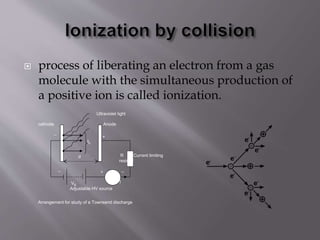
 process of liberating an electron from a gas
molecule with the simultaneous production of
a positive ion is called ionization.
Anodecathode
+
+ _
A
_
VB
Adjustable HV source
R Current limiting
resistor
Ultraviolet light
_
I
Arrangement for study of a Townsend discharge
I0
d
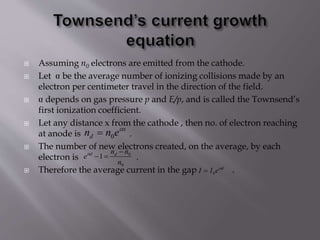
 Assuming n0 electrons are emitted from the cathode.
 Let be the average number of ionizing collisions made by an
electron per centimeter travel in the direction of the field.
 depends on gas pressure p and E/p, and is called the Townsend’s
first ionization coefficient.
 Let any distance x from the cathode , then no. of electron reaching
at anode is .
 The number of new electrons created, on the average, by each
electron is .
 Therefore the average current in the gap .
x
d enn 
0
0
0
1
n
nn
e dd 

d
eII 
0
 Single avalanche process .
 Secondary electrons.
 The other mechanisms are
i. The other mechanisms are
ii. The exited atoms or molecules in avalanches
iii. The metastable particles may diffuse back causing electron
emission.
 Total value of due to the three different processes is
and is function of gas pressure p and E/p.
 let number of secondary electrons produced due
to secondary processes
 Let total number of electrons leaving the cathode.
Then,
 The total number of electrons n reaching to the anode
becomes, and
 Eliminating , or

321  
'
0n

''
0n
'
00
''
0 nnn 
 d
enn ''
0
d
enn 
)( '
00  )]([ '
00
'
0 nnnn  
'
0n
)1(1
0

 d
d
e
en
n 

 )1(1
0

 d
d
e
eI
I 


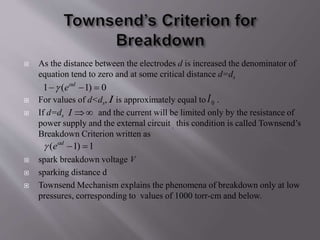
 As the distance between the electrodes d is increased the denominator of
equation tend to zero and at some critical distance d=ds
 For values of d<ds, is approximately equal to .
 If d=ds and the current will be limited only by the resistance of
power supply and the external circuit , this condition is called Townsend’s
Breakdown Criterion written as
 spark breakdown voltage V
 sparking distance d
 Townsend Mechanism explains the phenomena of breakdown only at low
pressures, corresponding to values of 1000 torr-cm and below.
0)1(1  d
e

I 0I
I
1)1( d
e

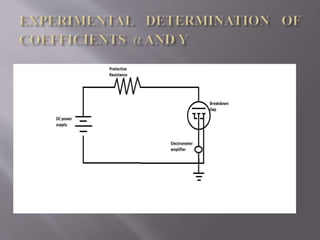
 The experimental arrangement is shown.The electrode system consists of
two uniform field electrodes. The high voltage electrode is connected to a
variable high voltage d.c. source (of 2 to 10 kV rating). The low voltage
electrode consists of a central electrode and a guard electrode. The
central electrode is connected to the ground through the high resistance
of an electrometer amplifier having an input resistance of 109 to 1013
ohms. The guard electrode is directly earthed. The electrometer amplifier
measures currents in the range 1(T14 to 10~8 A.
 The electrode system is placed in an ionization chamber which is either a
metal chamber made of chromium plated mild steel or stainless steel, or a
glass chamber. The electrodes are usually made of brass or stainless steel.
The chamber is evacuated to a very high vacuum of the order of 1(T4 to
ICT6 torr. Then it is filled with the desired gas and flushed several times
till all the residual gases and air are removed. The pressure inside the
chamber is adjusted to a few torr depending on the gap separation and
left for about half an hour for the gas to fill the chamber uniformly. The
cathode is irradiated using an ultra-violet (U.V.) lamp kept outside the
chamber. The U.V. radiation produces the initiatory electrons (/IQ) by
photo-electric emission.
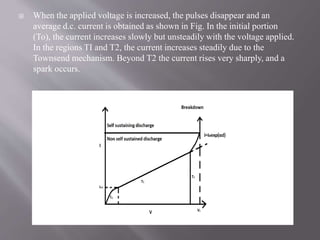
 When the applied voltage is increased, the pulses disappear and an
average d.c. current is obtained as shown in Fig. In the initial portion
(To), the current increases slowly but unsteadily with the voltage applied.
In the regions TI and T2, the current increases steadily due to the
Townsend mechanism. Beyond T2 the current rises very sharply, and a
spark occurs.
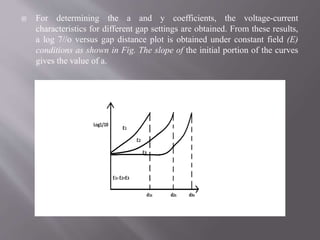
 For determining the a and y coefficients, the voltage-current
characteristics for different gap settings are obtained. From these results,
a log 7//o versus gap distance plot is obtained under constant field (E)
conditions as shown in Fig. The slope of the initial portion of the curves
gives the value of a.
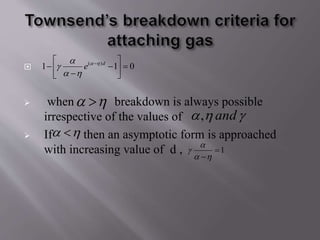
 High breakdown strength to a gas is the electron attachment.
 The gases in which attachment plays an active role are called
electronegative gases.
 Two types of attachment
 a) Direct attachment: An electron directly attaches to form a negative
ion.
 b) Dissociative attachment: The gas molecules split into their constituent
atoms and the electronegative atom forms a negative ion.
For example oxygen
Then Townsend’s equation is modified

 ABeAB 

 BAeAB 


























11 )(
)(
0
d
d
e
e
II










 when breakdown is always possible
irrespective of the values of
 If then an asymptotic form is approached
with increasing value of d ,
011 )(








  d
e 



 
 and,
 
1



 Time lag
 Townsend’s criteria required one electron present in
the gap between the electrodes if applied d.c. or
slowly varying .
 With rapidly varying voltages of short duration the
initiatory electron may not be present in the gap that
the breakdown can not occur
Townsend ’s theory

Townsend ’s theory

  • 1.
  • 2.
     Introduction  Ionizationby collision  Townsend’s current growth equation  Current Growth in the Presence of Secondary Processes  Townsend’s secondary ionization coefficient  Townsend’s Criterion for Breakdown  Breakdown in Electronegative Gases
  • 3.
     process ofliberating an electron from a gas molecule with the simultaneous production of a positive ion is called ionization. Anodecathode + + _ A _ VB Adjustable HV source R Current limiting resistor Ultraviolet light _ I Arrangement for study of a Townsend discharge I0 d
  • 4.
     Assuming n0electrons are emitted from the cathode.  Let be the average number of ionizing collisions made by an electron per centimeter travel in the direction of the field.  depends on gas pressure p and E/p, and is called the Townsend’s first ionization coefficient.  Let any distance x from the cathode , then no. of electron reaching at anode is .  The number of new electrons created, on the average, by each electron is .  Therefore the average current in the gap . x d enn  0 0 0 1 n nn e dd   d eII  0
  • 5.
     Single avalancheprocess .  Secondary electrons.  The other mechanisms are i. The other mechanisms are ii. The exited atoms or molecules in avalanches iii. The metastable particles may diffuse back causing electron emission.
  • 6.
     Total valueof due to the three different processes is and is function of gas pressure p and E/p.  let number of secondary electrons produced due to secondary processes  Let total number of electrons leaving the cathode. Then,  The total number of electrons n reaching to the anode becomes, and  Eliminating , or  321   ' 0n  '' 0n ' 00 '' 0 nnn   d enn '' 0 d enn  )( ' 00  )]([ ' 00 ' 0 nnnn   ' 0n )1(1 0   d d e en n    )1(1 0   d d e eI I   
  • 7.
     As thedistance between the electrodes d is increased the denominator of equation tend to zero and at some critical distance d=ds  For values of d<ds, is approximately equal to .  If d=ds and the current will be limited only by the resistance of power supply and the external circuit , this condition is called Townsend’s Breakdown Criterion written as  spark breakdown voltage V  sparking distance d  Townsend Mechanism explains the phenomena of breakdown only at low pressures, corresponding to values of 1000 torr-cm and below. 0)1(1  d e  I 0I I 1)1( d e 
  • 9.
     The experimentalarrangement is shown.The electrode system consists of two uniform field electrodes. The high voltage electrode is connected to a variable high voltage d.c. source (of 2 to 10 kV rating). The low voltage electrode consists of a central electrode and a guard electrode. The central electrode is connected to the ground through the high resistance of an electrometer amplifier having an input resistance of 109 to 1013 ohms. The guard electrode is directly earthed. The electrometer amplifier measures currents in the range 1(T14 to 10~8 A.  The electrode system is placed in an ionization chamber which is either a metal chamber made of chromium plated mild steel or stainless steel, or a glass chamber. The electrodes are usually made of brass or stainless steel. The chamber is evacuated to a very high vacuum of the order of 1(T4 to ICT6 torr. Then it is filled with the desired gas and flushed several times till all the residual gases and air are removed. The pressure inside the chamber is adjusted to a few torr depending on the gap separation and left for about half an hour for the gas to fill the chamber uniformly. The cathode is irradiated using an ultra-violet (U.V.) lamp kept outside the chamber. The U.V. radiation produces the initiatory electrons (/IQ) by photo-electric emission.
  • 10.
     When theapplied voltage is increased, the pulses disappear and an average d.c. current is obtained as shown in Fig. In the initial portion (To), the current increases slowly but unsteadily with the voltage applied. In the regions TI and T2, the current increases steadily due to the Townsend mechanism. Beyond T2 the current rises very sharply, and a spark occurs.
  • 11.
     For determiningthe a and y coefficients, the voltage-current characteristics for different gap settings are obtained. From these results, a log 7//o versus gap distance plot is obtained under constant field (E) conditions as shown in Fig. The slope of the initial portion of the curves gives the value of a.
  • 12.
     High breakdownstrength to a gas is the electron attachment.  The gases in which attachment plays an active role are called electronegative gases.  Two types of attachment  a) Direct attachment: An electron directly attaches to form a negative ion.  b) Dissociative attachment: The gas molecules split into their constituent atoms and the electronegative atom forms a negative ion. For example oxygen Then Townsend’s equation is modified   ABeAB    BAeAB                            11 )( )( 0 d d e e II         
  • 13.
      when breakdownis always possible irrespective of the values of  If then an asymptotic form is approached with increasing value of d , 011 )(           d e        and,   1   
  • 14.
     Time lag Townsend’s criteria required one electron present in the gap between the electrodes if applied d.c. or slowly varying .  With rapidly varying voltages of short duration the initiatory electron may not be present in the gap that the breakdown can not occur