UNIT I
POWER SEMICONDUCTOR DEVICES
POWER ELECTRONICS
 Power Electronics deals with the application of solid
state electronics for the control and conversion of
electric power
 Power deals with the static and rotating power
equipment for the generation, transmission and
distribution
 Electronics deals with the solid state devices and
circuits for signal processing to meet the desired
control objectives
 Control deals with the steady state and dynamic
characteristics of closed loop system
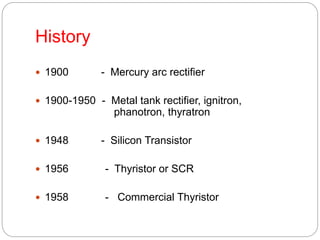
History
 1900 - Mercury arc rectifier
 1900-1950 - Metal tank rectifier, ignitron,
phanotron, thyratron
 1948 - Silicon Transistor
 1956 - Thyristor or SCR
 1958 - Commercial Thyristor
Applications
 UPS and stand by power supplies for critical load
such as computers, medical equipments
 Power conversion for HVAC and HVDC
transmission system
 Speed control of motors which are used in
traction drives, textile mills, rolling mills, cranes,
lifts, pumps
 Power supplies for communication systems,
telephone exchanges, satellite systems
Advantages of Power Electronic
Controllers
 Fast dynamic response due to static devices
 High efficiency of conversion due to low losses in
electronic devices
 Compact size and light weight of the controllers
 Increased operating life and reduced
maintenance
Disadvantages
 It generates Harmonics. These harmonics affect
the performance
 Power factor is low. Hence power factor
correction is necessary to reduce reactive power
 For very simple conversion requirements, power
electronic converters may be costly
Block Diagram
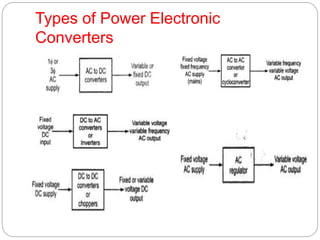
Types of Power Electronic
Converters
Classification
Power Diodes
Switching Characteristics
Types of Power Diodes
General Purpose Diodes
 General purpose diodes handle power at the mains
frequency or below 1 KHz
 Turn off switching time is more
 Reverse recovery time is large i.e. about 25 μs
 Rating 1A/50V to 5kA/10kV
 Used in rectifiers and converters
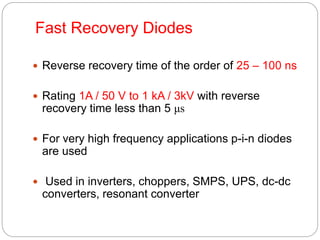
Fast Recovery Diodes
 Reverse recovery time of the order of 25 – 100 ns
 Rating 1A / 50 V to 1 kA / 3kV with reverse
recovery time less than 5 μs
 For very high frequency applications p-i-n diodes
are used
 Used in inverters, choppers, SMPS, UPS, dc-dc
converters, resonant converter
Schottky Diodes:
In Schottky Diodes, pn junction is eliminated. A thin film of
metal is placed directly on the semiconductor.
Normally aluminium is deposited on n-type semiconductor.
Cut in voltage - 0.2 V
Reverse breakdown voltage – 50 V
Applications
Silicon Controlled Rectifier (SCR)
Construction of SCR
Symbol
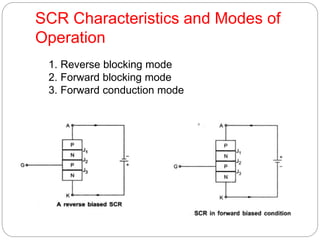
SCR Characteristics and Modes of
Operation
1. Reverse blocking mode
2. Forward blocking mode
3. Forward conduction mode
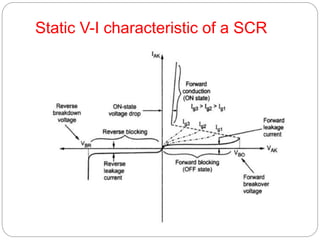
Static V-I characteristic of a SCR
Latching Current
Holding Current
BJT
Input and Output Characteristics
BJT Switching Performance
Safe operating Area
MOSFET
Output Characteristics
Switching Characteristics
IGBT
V-I and Transfer Characteristics
GTO

PE UNIT I.pptx

  • 1.
    UNIT I POWER SEMICONDUCTORDEVICES POWER ELECTRONICS
  • 2.
     Power Electronicsdeals with the application of solid state electronics for the control and conversion of electric power  Power deals with the static and rotating power equipment for the generation, transmission and distribution  Electronics deals with the solid state devices and circuits for signal processing to meet the desired control objectives  Control deals with the steady state and dynamic characteristics of closed loop system
  • 3.
    History  1900 -Mercury arc rectifier  1900-1950 - Metal tank rectifier, ignitron, phanotron, thyratron  1948 - Silicon Transistor  1956 - Thyristor or SCR  1958 - Commercial Thyristor
  • 4.
    Applications  UPS andstand by power supplies for critical load such as computers, medical equipments  Power conversion for HVAC and HVDC transmission system  Speed control of motors which are used in traction drives, textile mills, rolling mills, cranes, lifts, pumps  Power supplies for communication systems, telephone exchanges, satellite systems
  • 5.
    Advantages of PowerElectronic Controllers  Fast dynamic response due to static devices  High efficiency of conversion due to low losses in electronic devices  Compact size and light weight of the controllers  Increased operating life and reduced maintenance
  • 6.
    Disadvantages  It generatesHarmonics. These harmonics affect the performance  Power factor is low. Hence power factor correction is necessary to reduce reactive power  For very simple conversion requirements, power electronic converters may be costly
  • 7.
  • 8.
    Types of PowerElectronic Converters
  • 9.
  • 10.
  • 11.
  • 12.
    Types of PowerDiodes General Purpose Diodes  General purpose diodes handle power at the mains frequency or below 1 KHz  Turn off switching time is more  Reverse recovery time is large i.e. about 25 μs  Rating 1A/50V to 5kA/10kV  Used in rectifiers and converters
  • 13.
    Fast Recovery Diodes Reverse recovery time of the order of 25 – 100 ns  Rating 1A / 50 V to 1 kA / 3kV with reverse recovery time less than 5 μs  For very high frequency applications p-i-n diodes are used  Used in inverters, choppers, SMPS, UPS, dc-dc converters, resonant converter
  • 14.
    Schottky Diodes: In SchottkyDiodes, pn junction is eliminated. A thin film of metal is placed directly on the semiconductor. Normally aluminium is deposited on n-type semiconductor.
  • 15.
    Cut in voltage- 0.2 V Reverse breakdown voltage – 50 V
  • 17.
  • 18.
  • 19.
  • 21.
    SCR Characteristics andModes of Operation 1. Reverse blocking mode 2. Forward blocking mode 3. Forward conduction mode
  • 23.
  • 24.
  • 25.
  • 26.
  • 27.
    Input and OutputCharacteristics
  • 28.
  • 29.
  • 30.
  • 32.
  • 33.
  • 34.
  • 35.
    V-I and TransferCharacteristics
  • 37.