Ecology
WHAT IS ECOLOGY? Ecology-  the scientific study of interactions between  organisms and their environments,  focusing on energy transfer Ecology is a science of  relationships
WHAT DO YOU MEAN BY ENVIRONMENT? The environment is made up of two factors: Biotic factors - all living organisms inhabiting the Earth Abiotic factors - nonliving parts of the environment (i.e. temperature, soil, light, moisture, air currents)
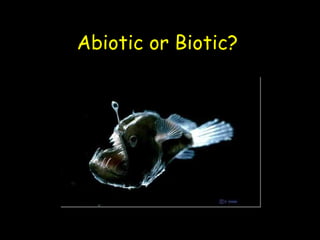
Abiotic or Biotic?
Abiotic or Biotic?
Abiotic or Biotic?
Abiotic or Biotic?
Organism Population Community Biosphere Ecosystem
Organism -  any unicellular or multicellular form exhibiting all of the characteristics of life, an individual. The lowest level of organization
POPULATION a group of organisms of  one species  living in the same place at the same time that  interbreed Produce  fertile  offspring Compete  with each other  for resources  (food, mates, shelter, etc.)
Community -   several interacting populations that inhabit a common environment and are interdependent.
Ecosystem -  populations in a community and the abiotic factors with which they interact (ex. marine, terrestrial)
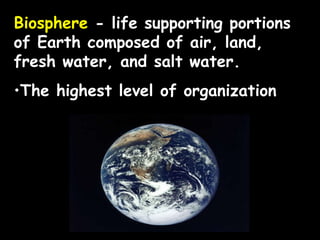
Biosphere  - life supporting portions of Earth composed of air, land, fresh water, and salt water. The highest level of organization
Habitat vs. Niche Niche  -   the role a species plays in a community; its total way of life Habitat - the place in which an organism lives out its life
Habitat vs. Niche A niche is determined by the tolerance limitations of an organism, or a limiting factor.  Limiting factor-  any biotic or abiotic factor that restricts the existence of organisms in a specific environment.
Examples of limiting factors - Amount of water Amount of food Temperature Amount of space Availability of mates Habitat vs. Niche
Feeding Relationships There are 3 main types of feeding relationships 1. Producer - Consumer 2. Predator - Prey 3. Parasite - Host
Feeding Relationships Producer-  all autotrophs (plants),   they trap energy from the sun Bottom of the food chain
Feeding Relationships Consumer -  all heterotrophs: they ingest food containing the sun’s energy Herbivores Carnivores Omnivores Decomposers
Feeding Relationships CONSUMERS  Primary consumers Eat plants Herbivores Secondary, tertiary … consumers Prey animals Carnivores
Feeding Relationships Consumer- Carnivores-eat meat Predators Hunt prey  animals for food.
Feeding Relationships Consumer-  Carnivores- eat meat Scavengers Feed on carrion,  dead animals
Feeding Relationships Consumer-  Omnivores  -eat both plants   and animals
Feeding Relationships Consumer-  Decomposers Breakdown the complex compounds of dead and decaying plants and animals into simpler molecules that can be absorbed
Symbiotic Relationships Symbiosis-  two species   living together 3 Types of symbiosis: 1. Commensalism 2. Parasitism 3. Mutualism
Symbiotic Relationships Commensalism-  one species benefits and the other is neither harmed nor helped Ex. orchids on a tree Epiphytes:  A plant, such as a tropical orchid or a bromeliad, that grows on another plant upon which it depends for mechanical support but not for nutrients. Also called  xerophyte ,  air plant .
Symbiotic Relationships Commensalism-  one species benefits and the other is neither harmed nor helped Ex. polar bears and cyanobacteria
Symbiotic Relationships Parasitism-  one species benefits (parasite) and the other is harmed (host) Parasite-Host relationship
Symbiotic Relationships Parasitism-  parasite-host Ex. lampreys,  leeches, fleas, ticks, tapeworm
Symbiotic Relationships Mutualism-  beneficial to both species Ex. cleaning birds and cleaner shrimp
Symbiotic Relationships Mutualism-  beneficial to both species Ex. lichen
 
= 1 species Type of relationship Species harmed Species benefits Species neutral Commensalism Parasitism Mutualism
Trophic Levels Each link in a food chain is known as a trophic level. Trophic levels represent a feeding step in the transfer of energy and matter in an ecosystem.
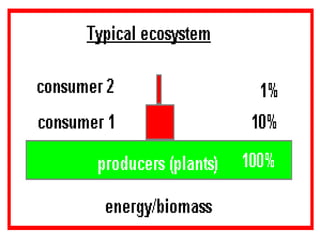
Trophic Levels Biomass-  the amount of organic matter comprising a group of organisms in a habitat. As you move up a food chain, both available energy and biomass decrease. Energy is transferred upwards but is diminished with each transfer.
Trophic Levels Producers- Autotrophs Primary consumers- Herbivores Secondary consumers-small carnivores Tertiary consumers- top carnivores E N E R G Y
 
 
Trophic Levels Food chain - simple model that shows how matter and energy move through an ecosystem
 
Trophic Levels Food web - shows all possible feeding relationships in a community at each trophic level Represents a network of interconnected food chains
Food chain Food web (just 1 path of energy)   (all possible energy paths)


Nutrient Cycles Cycling maintains homeostasis (balance) in the environment. 3 cycles to investigate: 1. Water cycle 2. Carbon cycle 3. Nitrogen cycle
Water cycle- Evaporation, transpiration, condensation, precipitation
Water cycle-
Carbon cycle- Photosynthesis and respiration cycle carbon and oxygen through the environment.
Carbon cycle-
Nitrogen cycle-   Atmospheric nitrogen (N 2 ) makes up nearly 78%-80% of air.  Organisms can not use it in that form. Lightning and bacteria convert nitrogen into usable forms.
Nitrogen cycle-  Only in certain bacteria and industrial technologies can fix nitrogen. Nitrogen fixation -convert atmospheric nitrogen (N 2 ) into ammonium (NH 4 + ) which can be used to make organic compounds like amino acids. N 2    NH 4 +
Nitrogen cycle- Nitrogen-fixing bacteria: Some live in a symbiotic relationship with plants of the legume family (e.g., soybeans, clover, peanuts).
Nitrogen cycle-   Some nitrogen-fixing bacteria live free in the soil.  Nitrogen-fixing cyanobacteria are essential to maintaining the fertility of semi-aquatic environments like rice paddies.
 
Atmospheric nitrogen Lightning Nitrogen fixing bacteria Ammonium Nitrification by bacteria Nitrites Nitrates Denitrification by bacteria Plants Animals Decomposers Nitrogen Cycle
Toxins in food chains-   While energy decreases as it moves up the food chain, toxins increase in potency.  This is called biological magnification Ex: DDT & Bald Eagles

Ecology good

  • 1.
  • 2.
    WHAT IS ECOLOGY?Ecology- the scientific study of interactions between organisms and their environments, focusing on energy transfer Ecology is a science of relationships
  • 3.
    WHAT DO YOUMEAN BY ENVIRONMENT? The environment is made up of two factors: Biotic factors - all living organisms inhabiting the Earth Abiotic factors - nonliving parts of the environment (i.e. temperature, soil, light, moisture, air currents)
  • 4.
  • 5.
  • 6.
  • 7.
  • 8.
    Organism Population CommunityBiosphere Ecosystem
  • 9.
    Organism - any unicellular or multicellular form exhibiting all of the characteristics of life, an individual. The lowest level of organization
  • 10.
    POPULATION a groupof organisms of one species living in the same place at the same time that interbreed Produce fertile offspring Compete with each other for resources (food, mates, shelter, etc.)
  • 11.
    Community - several interacting populations that inhabit a common environment and are interdependent.
  • 12.
    Ecosystem - populations in a community and the abiotic factors with which they interact (ex. marine, terrestrial)
  • 13.
    Biosphere -life supporting portions of Earth composed of air, land, fresh water, and salt water. The highest level of organization
  • 14.
    Habitat vs. NicheNiche - the role a species plays in a community; its total way of life Habitat - the place in which an organism lives out its life
  • 15.
    Habitat vs. NicheA niche is determined by the tolerance limitations of an organism, or a limiting factor. Limiting factor- any biotic or abiotic factor that restricts the existence of organisms in a specific environment.
  • 16.
    Examples of limitingfactors - Amount of water Amount of food Temperature Amount of space Availability of mates Habitat vs. Niche
  • 17.
    Feeding Relationships Thereare 3 main types of feeding relationships 1. Producer - Consumer 2. Predator - Prey 3. Parasite - Host
  • 18.
    Feeding Relationships Producer- all autotrophs (plants), they trap energy from the sun Bottom of the food chain
  • 19.
    Feeding Relationships Consumer- all heterotrophs: they ingest food containing the sun’s energy Herbivores Carnivores Omnivores Decomposers
  • 20.
    Feeding Relationships CONSUMERS Primary consumers Eat plants Herbivores Secondary, tertiary … consumers Prey animals Carnivores
  • 21.
    Feeding Relationships Consumer-Carnivores-eat meat Predators Hunt prey animals for food.
  • 22.
    Feeding Relationships Consumer- Carnivores- eat meat Scavengers Feed on carrion, dead animals
  • 23.
    Feeding Relationships Consumer- Omnivores -eat both plants and animals
  • 24.
    Feeding Relationships Consumer- Decomposers Breakdown the complex compounds of dead and decaying plants and animals into simpler molecules that can be absorbed
  • 25.
    Symbiotic Relationships Symbiosis- two species living together 3 Types of symbiosis: 1. Commensalism 2. Parasitism 3. Mutualism
  • 26.
    Symbiotic Relationships Commensalism- one species benefits and the other is neither harmed nor helped Ex. orchids on a tree Epiphytes: A plant, such as a tropical orchid or a bromeliad, that grows on another plant upon which it depends for mechanical support but not for nutrients. Also called xerophyte , air plant .
  • 27.
    Symbiotic Relationships Commensalism- one species benefits and the other is neither harmed nor helped Ex. polar bears and cyanobacteria
  • 28.
    Symbiotic Relationships Parasitism- one species benefits (parasite) and the other is harmed (host) Parasite-Host relationship
  • 29.
    Symbiotic Relationships Parasitism- parasite-host Ex. lampreys, leeches, fleas, ticks, tapeworm
  • 30.
    Symbiotic Relationships Mutualism- beneficial to both species Ex. cleaning birds and cleaner shrimp
  • 31.
    Symbiotic Relationships Mutualism- beneficial to both species Ex. lichen
  • 32.
  • 33.
    = 1 speciesType of relationship Species harmed Species benefits Species neutral Commensalism Parasitism Mutualism
  • 34.
    Trophic Levels Eachlink in a food chain is known as a trophic level. Trophic levels represent a feeding step in the transfer of energy and matter in an ecosystem.
  • 35.
    Trophic Levels Biomass- the amount of organic matter comprising a group of organisms in a habitat. As you move up a food chain, both available energy and biomass decrease. Energy is transferred upwards but is diminished with each transfer.
  • 36.
    Trophic Levels Producers-Autotrophs Primary consumers- Herbivores Secondary consumers-small carnivores Tertiary consumers- top carnivores E N E R G Y
  • 37.
  • 38.
  • 39.
    Trophic Levels Foodchain - simple model that shows how matter and energy move through an ecosystem
  • 40.
  • 41.
    Trophic Levels Foodweb - shows all possible feeding relationships in a community at each trophic level Represents a network of interconnected food chains
  • 42.
    Food chain Foodweb (just 1 path of energy) (all possible energy paths)
  • 43.
  • 44.
  • 45.
  • 46.
  • 47.
    Nutrient Cycles Cyclingmaintains homeostasis (balance) in the environment. 3 cycles to investigate: 1. Water cycle 2. Carbon cycle 3. Nitrogen cycle
  • 48.
    Water cycle- Evaporation,transpiration, condensation, precipitation
  • 49.
  • 50.
    Carbon cycle- Photosynthesisand respiration cycle carbon and oxygen through the environment.
  • 51.
  • 52.
    Nitrogen cycle- Atmospheric nitrogen (N 2 ) makes up nearly 78%-80% of air. Organisms can not use it in that form. Lightning and bacteria convert nitrogen into usable forms.
  • 53.
    Nitrogen cycle- Only in certain bacteria and industrial technologies can fix nitrogen. Nitrogen fixation -convert atmospheric nitrogen (N 2 ) into ammonium (NH 4 + ) which can be used to make organic compounds like amino acids. N 2 NH 4 +
  • 54.
    Nitrogen cycle- Nitrogen-fixingbacteria: Some live in a symbiotic relationship with plants of the legume family (e.g., soybeans, clover, peanuts).
  • 55.
    Nitrogen cycle- Some nitrogen-fixing bacteria live free in the soil. Nitrogen-fixing cyanobacteria are essential to maintaining the fertility of semi-aquatic environments like rice paddies.
  • 56.
  • 57.
    Atmospheric nitrogen LightningNitrogen fixing bacteria Ammonium Nitrification by bacteria Nitrites Nitrates Denitrification by bacteria Plants Animals Decomposers Nitrogen Cycle
  • 58.
    Toxins in foodchains- While energy decreases as it moves up the food chain, toxins increase in potency. This is called biological magnification Ex: DDT & Bald Eagles

Editor's Notes

  • #3 What do you think about when I say ecology? Recycling? Acid rain?
  • #4 When I say environment you think what—weather. Well Ok but it it much more than that
  • #9 Just like with classification, ecology is hierarchal. Each level builds on itself and they fit together like nesting boxes.
  • #10 The lowest level is the individual. The organism. Here we see a salmon and a bear as examples of organisms. REMINDER: organisms die, species go extinct
  • #11 The next level is a population. A population consists of a single species living together and breeding. Give me an example of a population. Ex. large mouth bass living in Lake Meade. Beetles living under the same log. Here we have salmon spwning and two bears fishing.
  • #12 Next level is a community which is several populations living together and depending on each other. What does interdependent mean? An example of a community is shown here with the bear and the salmon. They both live in a common environment and the bear needs the fish for food? How does the salmon need the bear?
  • #14 Lets review. Organisms make up populations, populations make up communities, communities and abiotic factors make up ecosystems, and all of the ecosystems make up the biosphere. From one to many and each depending on the other.
  • #15 Although several species may share a habitat they each have their own niche. A niche is a very narrow range where a species fits within a habitat.
  • #16 Although several species may share a habitat they each have their own niche. A niche is a very narrow range where a species fits within a habitat.
  • #17 Although several species may share a habitat they each have their own niche. A niche is a very narrow range where a species fits within a habitat.
  • #18 How do they trap the sun’s energy? Through what process? What is that process similar to in animal cells?
  • #19 How do they trap the sun’s energy? Through what process? What is that process similar to in animal cells?
  • #20 Energy moves up the food chain through the producer/consumer relationship.
  • #21 Herbivores are the 1 st step up the food chain, they eat the producers
  • #22 Scavengers are a type of carnivore that eat dead animals, or carrion. Vultures, hyenas, crabs, deep sea fish-talk about distance from the sun and must eat the dead things that sink to the bottom, bottom feeders
  • #23 Scavengers are a type of carnivore that eat dead animals, or carrion. Vultures, hyenas, crabs, deep sea fish-talk about distance from the sun and must eat the dead things that sink to the bottom, bottom feeders
  • #24 Humans and bears are omnivores but a large and important subset of omnivores are the decomposers. They breakdown dead producers and release the energy back into circulation.
  • #25 Humans and bears are omnivores but a large and important subset of omnivores are the decomposers. They breakdown dead producers and release the energy back into circulation.
  • #26 Cleaning shrimp
  • #28 You can see here that this polar bear is no longer white.
  • #31 The Egyptian plover takes insects from the backs of buffaloes, giraffes and rhinos. The plover has also been observed taking leeches from the open mouths of crocodiles! In this association the plover receives a supply of food and the other animal rids itself of unwelcome pests
  • #32 The Egyptian plover takes insects from the backs of buffaloes, giraffes and rhinos. The plover has also been observed taking leeches from the open mouths of crocodiles! In this association the plover receives a supply of food and the other animal rids itself of unwelcome pests