EMBEDDED & REAL TIME SYSTEMS
mr.C.KARTHIKEYAN
AP/ECE/RMKCET
UNIT II ARM
PROCESSOR
AND
PERIPHERALS
SYLLABUS
 ARM Architecture Versions
ARM Architecture
Instruction Set
Stacks and Subroutines
Features of the LPC 214X Family
 Peripherals
The Timer Unit
Pulse Width Modulation Unit
UART
Block Diagram of ARM9 and ARM Cortex M3 MCU
3
FUNDAMENTALS
COMPUTER TAXANOMY ARCHITECTURE (Arrangement of MEMORY)
DIFFERENCE BETWEEN COMPUTER & MOBILE PHONE SoC
REAL TIME APPLICATIONS
INTRODUCTION TO ARM PROCESSOR
DATAFLOW
ARM ARCHITECTURE
OPERATION
MODES
4
COMPUTER TAXANOMY ARCHITECTURE
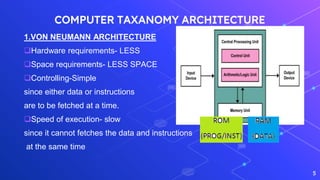
1.VON NEUMANN ARCHITECTURE
Hardware requirements- LESS
Space requirements- LESS SPACE
Controlling-Simple
since either data or instructions
are to be fetched at a time.
Speed of execution- slow
since it cannot fetches the data and instructions
at the same time
5
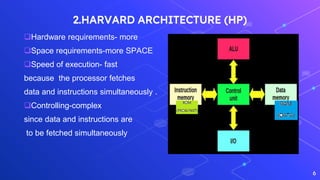
2.HARVARD ARCHITECTURE (HP)
Hardware requirements- more
Space requirements-more SPACE
Speed of execution- fast
because the processor fetches
data and instructions simultaneously .
Controlling-complex
since data and instructions are
to be fetched simultaneously
6
3.CISC
Flexibility
Performance
Command length varies
More no. of clock cycles even for small code
Emphasis on hardware
More RAM, Less Register
RTA: PC/ LAPTOPS FOR PROCESSING HEAVY GRAPHIC GAMING &
COMPUTING COMPLEX EQUATIONS
7
4.RISC
Rigidity
Performance
Command length equal
Less no. of clock cycles even for long code
Emphasis on software
Less RAM, More Register
RTA: MOBILE PHONES, ANDROIS, IOS, TABLETS FOR HIGHER
RESPONSE
8
APLLICATIONS
SMARTPHONES-Snapdragon Processors or Media Tek Processors
LAPTOP/ DESKTOP-Intel and AMD Processor
⬡ The Snapdragon central processing unit (CPU) uses the ARM RISC
instruction set, and a single SoC may include multiple CPU cores.
⬡ It comes with graphics processing unit (GPU), which provides high-quality
graphics and superior gaming experiences.
9
10
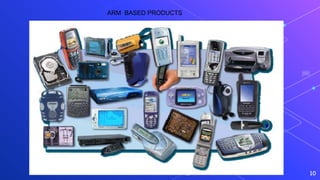
ARM BASED PRODUCTS
“ Introduction to ARM
Processor” - One of the
most licensed and thus
widespread processor cores
in the world
11
Advanced RISC
Machine
NOMENCLATURE
⬡ ARMxyzTDMIEJFS
⬡ – x: series
⬡ – y: MMU
⬡ – z: cache
⬡ – T: Thumb
⬡ – D: debugger
⬡ – M: Multiplier (MAC)
⬡ – I: Embedded ICE (built-in debugger hardware)
⬡ – E: Enhanced instruction
⬡ – J: Jazelle (JVM)
⬡ – F: Floating-point
⬡ – S: Synthesizible version (source code version for EDA Tools)
13
14
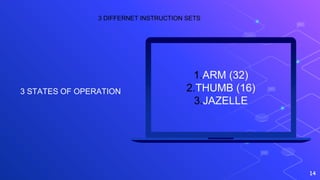
1.ARM (32)
2.THUMB (16)
3.JAZELLE
3 STATES OF OPERATION
3 DIFFERNET INSTRUCTION SETS
ARM
FEATURES
15
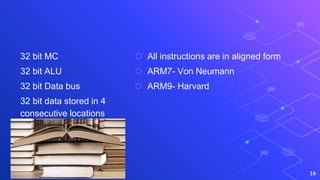
32 bit MC
32 bit ALU
32 bit Data bus
32 bit data stored in 4
consecutive locations
16
⬡ All instructions are in aligned form
⬡ ARM7- Von Neumann
⬡ ARM9- Harvard
Load/store model
8086(CISC)
ADD CL,BL
ADD CL,[2000]
⬡ ARM (RISC)
⬡ REGISTER BASED
⬡ LOAD THE DATA INTO THE REGISTR
⬡ PERFORM OPERATION
⬡ EXECUTE RESULT STORE IN REGISTER
⬡ RIGID, HP
17
18
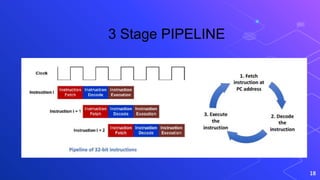
3 Stage PIPELINE
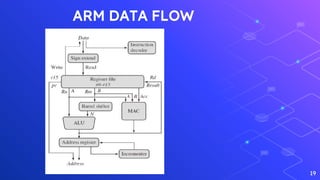
ARM DATA FLOW
19
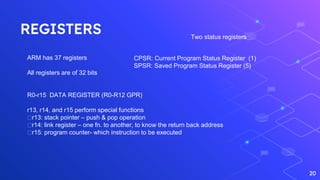
REGISTERS
20
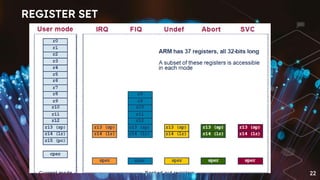
ARM has 37 registers
All registers are of 32 bits
R0-r15 DATA REGISTER (R0-R12 GPR)
r13, r14, and r15 perform special functions
r13: stack pointer – push & pop operation
r14: link register – one fn. to another, to know the return back address
r15: program counter- which instruction to be executed
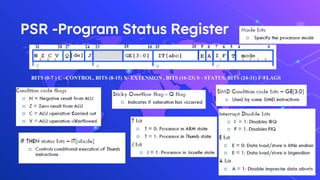
Two status registers
CPSR: Current Program Status Register (1)
SPSR: Saved Program Status Register (5)
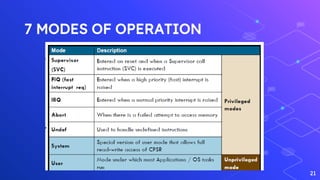
7 MODES OF OPERATION
21
REGISTER SET
22
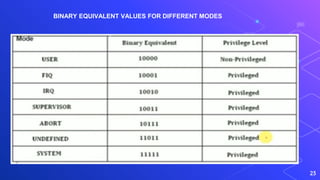
BINARY EQUIVALENT VALUES FOR DIFFERENT MODES
23
PSR -Program Status Register
24
BITS (0-7 ) C –CONTROL, BITS (8-15) X- EXTENSION , BITS (16-23) S - STATUS, BITS (24-31) F-FLAGS
25
Thanks!
Any questions?

Unit2 arm

  • 1.
    EMBEDDED & REALTIME SYSTEMS mr.C.KARTHIKEYAN AP/ECE/RMKCET
  • 2.
  • 3.
    SYLLABUS  ARM ArchitectureVersions ARM Architecture Instruction Set Stacks and Subroutines Features of the LPC 214X Family  Peripherals The Timer Unit Pulse Width Modulation Unit UART Block Diagram of ARM9 and ARM Cortex M3 MCU 3
  • 4.
    FUNDAMENTALS COMPUTER TAXANOMY ARCHITECTURE(Arrangement of MEMORY) DIFFERENCE BETWEEN COMPUTER & MOBILE PHONE SoC REAL TIME APPLICATIONS INTRODUCTION TO ARM PROCESSOR DATAFLOW ARM ARCHITECTURE OPERATION MODES 4
  • 5.
    COMPUTER TAXANOMY ARCHITECTURE 1.VONNEUMANN ARCHITECTURE Hardware requirements- LESS Space requirements- LESS SPACE Controlling-Simple since either data or instructions are to be fetched at a time. Speed of execution- slow since it cannot fetches the data and instructions at the same time 5
  • 6.
    2.HARVARD ARCHITECTURE (HP) Hardwarerequirements- more Space requirements-more SPACE Speed of execution- fast because the processor fetches data and instructions simultaneously . Controlling-complex since data and instructions are to be fetched simultaneously 6
  • 7.
    3.CISC Flexibility Performance Command length varies Moreno. of clock cycles even for small code Emphasis on hardware More RAM, Less Register RTA: PC/ LAPTOPS FOR PROCESSING HEAVY GRAPHIC GAMING & COMPUTING COMPLEX EQUATIONS 7
  • 8.
    4.RISC Rigidity Performance Command length equal Lessno. of clock cycles even for long code Emphasis on software Less RAM, More Register RTA: MOBILE PHONES, ANDROIS, IOS, TABLETS FOR HIGHER RESPONSE 8
  • 9.
    APLLICATIONS SMARTPHONES-Snapdragon Processors orMedia Tek Processors LAPTOP/ DESKTOP-Intel and AMD Processor ⬡ The Snapdragon central processing unit (CPU) uses the ARM RISC instruction set, and a single SoC may include multiple CPU cores. ⬡ It comes with graphics processing unit (GPU), which provides high-quality graphics and superior gaming experiences. 9
  • 10.
  • 11.
    “ Introduction toARM Processor” - One of the most licensed and thus widespread processor cores in the world 11
  • 12.
  • 13.
    NOMENCLATURE ⬡ ARMxyzTDMIEJFS ⬡ –x: series ⬡ – y: MMU ⬡ – z: cache ⬡ – T: Thumb ⬡ – D: debugger ⬡ – M: Multiplier (MAC) ⬡ – I: Embedded ICE (built-in debugger hardware) ⬡ – E: Enhanced instruction ⬡ – J: Jazelle (JVM) ⬡ – F: Floating-point ⬡ – S: Synthesizible version (source code version for EDA Tools) 13
  • 14.
    14 1.ARM (32) 2.THUMB (16) 3.JAZELLE 3STATES OF OPERATION 3 DIFFERNET INSTRUCTION SETS
  • 15.
  • 16.
    32 bit MC 32bit ALU 32 bit Data bus 32 bit data stored in 4 consecutive locations 16 ⬡ All instructions are in aligned form ⬡ ARM7- Von Neumann ⬡ ARM9- Harvard
  • 17.
    Load/store model 8086(CISC) ADD CL,BL ADDCL,[2000] ⬡ ARM (RISC) ⬡ REGISTER BASED ⬡ LOAD THE DATA INTO THE REGISTR ⬡ PERFORM OPERATION ⬡ EXECUTE RESULT STORE IN REGISTER ⬡ RIGID, HP 17
  • 18.
  • 19.
  • 20.
    REGISTERS 20 ARM has 37registers All registers are of 32 bits R0-r15 DATA REGISTER (R0-R12 GPR) r13, r14, and r15 perform special functions r13: stack pointer – push & pop operation r14: link register – one fn. to another, to know the return back address r15: program counter- which instruction to be executed Two status registers CPSR: Current Program Status Register (1) SPSR: Saved Program Status Register (5)
  • 21.
    7 MODES OFOPERATION 21
  • 22.
  • 23.
    BINARY EQUIVALENT VALUESFOR DIFFERENT MODES 23
  • 24.
    PSR -Program StatusRegister 24 BITS (0-7 ) C –CONTROL, BITS (8-15) X- EXTENSION , BITS (16-23) S - STATUS, BITS (24-31) F-FLAGS
  • 25.