RMK COLLEGE OF ENGINEERING AND
TECHNOLOGY
DEPARTMENT OF ELECTRONICS AND
COMMUNICATION ENGINEERING
EC8791
EMBEDDED AND REAL TIME SYSTEMS
S. Rajalakshmi
AP/ECE
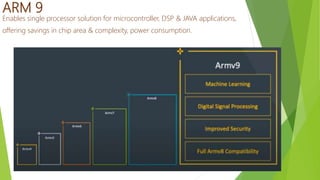
ARM 9
Enables single processor solution for microcontroller, DSP & JAVA applications,
offering savings in chip area & complexity, power consumption.
FEATURES OF ARM9
 Pipeline Depth: 5 stage (Fetch, Decode, Execute,
Decode, Write)
 Operating frequency: 150 MHz
 Power Consumption: 0.19 mW/MHz
 Architecture used: Harvard
 MMU/MPU: Present
 Cache Memory: Present (separate 16k/8k)
 ARM/ Thumb Instruction: Support both
 ISA (Instruction Set Architecture):
V5T(ARM926EJ-S)
ARM9 family
ARM9TDMI
ARM940T
ARM9E-S
ARM966E-S
ARM920T
ARM922T
ARM946E-S
ARM9EJ-S
ARM926EJ-S
ARM968E-S
ARM996HS
 Flexible Core Design
 DSP Enhancements: (very important)
 Single cycle 32x16 multiplier Implementation
 Speed up all the multiply instructions
 New 32x16 & 16x16 multiply instructions
 Allows independent access to 16 bit halves of
registers
 ARM ISA supports 32x32 multiply instruction
 Saturating Arithmetic (QADD, QSUB)
 Count leading zero for factor Division
 31 (32-Bit size) Registers
 32-bit ALU & Barrel Shifter
 Enhanced 32- bit MAC block
 Memory Controller
 Memory operations are controlled by MMU or
MPU
 MMU
 Provides Virtual Memory Support
 Fast Context Switching Extensions
 MPU
 Enables memory protection & bounding Sand –
boxing of applications
 Flexible Cache Design (sizes can be 4KB to
128KB)
 Consumer type: Smart phones, PDA, Set-Top box, Electronics Toys, Digital
Cameras, etc.
 Networking type: Wireless LAN, 802.11, Bluetooth, etc.
 Automatic: Power Train, ABS, Navigation, etc.
 Embedded USB controllers, Bluetooth controllers, Medical scanners, etc.
 Storage: HDD controllers, solid state drivers etc.
Applications of ARM9
ARM920T PROCESSOR
The ARM920T processor is a member of the ARM9TDMI family of general-purpose
microprocessors, which includes:
 ARM9TDMI (core)
 ARM940T (core plus cache and protection unit)
 ARM920T (core plus cache and MMU).
1. ARM9TDMI (CORE)
 Harvard architecture.
 Five Stage pipeline consisting of Fetch, Decode, Execute, Memory, and Write stages.
 It can be provided as a standalone core that can be embedded into more complex devices.
 The standalone core has a simple bus interface that allows you to design your own caches
and memory systems around it.
 Supports both the 32-bit ARM and 16-bit Thumb instruction sets
ARM920T (CORE PLUS CACHE AND MMU).
 Harvard cache architecture processor
 Multi programmer applications where full memory management, high performance, and low
 Cache is 16KB size
 8-word line length
 Implements an enhanced ARM architecture v4 MMU
 Supports the ARM debug architecture and includes logic to assist in both hardware and software
debug.
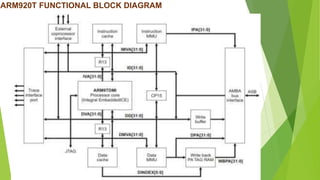
 Support for coprocessors, exporting the instruction and data buses along with simple handshaking
signals.
 Advanced Microcontroller Bus Architecture (AMBA), Advanced System Bus (ASB) or Advanced High-
performance Bus (AHB) bus scheme either as a fully-compliant AMBA bus master, or as a slave.
 Has tracking ICE mode which allows an approach similar to a conventional ICE mode of operation
 Embedded Trace Macrocell (ETM) for real-time tracing of instructions and data.
ARM920T FUNCTIONAL BLOCK DIAGRAM
PROGRAMMING MODEL
1. ARM9TDMI PROGRAMMER'S MODEL
The ARM9TDMI processor core implements ARM architecture v4T
Executes the ARM 32-bit instruction set and the compressed Thumb 16-bit
instruction set.
2. ARM920T PROGRAMMERS MODEL
Incorporates the ARM9TDMI integer core
It executes the ARM and Thumb instruction sets, and includes Embedded ICE
and JTAG software debug features.
The programmer's model of the ARM920T processor consists of the
programmer's model of the ARM9TDMI core with the following
additions and modifications:
The ARM920T processor incorporates two coprocessors
 CP14, which allows software access to the debug communications channel
CP15- system control coprocessor, which provides additional registers that are
used to configure and control the caches, MMU, protection system, the
clocking mode, and other system options of the ARM920T, such as big or little-
endian operation.
 Also features an external coprocessor interface.
 Registers and operations provided by any coprocessors attached to the
external coprocessor interface can be accessed using appropriate coprocessor
instructions.
 The ARM920T has a Trace Interface Port that allows the use of Trace
hardware and tools for real-time tracing of instructions and data.
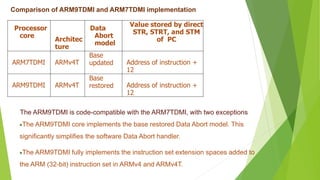
Processor
core
Architec
ture
Data
Abort
model
Value stored by direct
STR, STRT, and STM
of PC
ARM7TDMI ARMv4T
Base
updated Address of instruction +
12
ARM9TDMI ARMv4T
Base
restored Address of instruction +
12
Comparison of ARM9TDMI and ARM7TDMI implementation
The ARM9TDMI is code-compatible with the ARM7TDMI, with two exceptions
The ARM9TDMI core implements the base restored Data Abort model. This
significantly simplifies the software Data Abort handler.
The ARM9TDMI fully implements the instruction set extension spaces added to
the ARM (32-bit) instruction set in ARMv4 and ARMv4T.
Data Abort model
 The difference in the Data Abort models affects only a very small section of
operating system code, the Data Abort handler.
 It does not affect user code.
 When a Data Abort exception (response by a memory system to an invalid
data access) occurs during the execution of a memory access instruction, the
base register is always restored by the processor hardware to the value the
register contained before the instruction
INSTRUCTION SET EXTENSION
SPACES.
Arithmetic instruction extension space
Control instruction extension space
Coprocessor instruction extension space
Ec8791 arm 9 processor

Ec8791 arm 9 processor

  • 1.
    RMK COLLEGE OFENGINEERING AND TECHNOLOGY DEPARTMENT OF ELECTRONICS AND COMMUNICATION ENGINEERING EC8791 EMBEDDED AND REAL TIME SYSTEMS S. Rajalakshmi AP/ECE
  • 2.
    ARM 9 Enables singleprocessor solution for microcontroller, DSP & JAVA applications, offering savings in chip area & complexity, power consumption.
  • 3.
    FEATURES OF ARM9 Pipeline Depth: 5 stage (Fetch, Decode, Execute, Decode, Write)  Operating frequency: 150 MHz  Power Consumption: 0.19 mW/MHz  Architecture used: Harvard  MMU/MPU: Present  Cache Memory: Present (separate 16k/8k)  ARM/ Thumb Instruction: Support both  ISA (Instruction Set Architecture): V5T(ARM926EJ-S) ARM9 family ARM9TDMI ARM940T ARM9E-S ARM966E-S ARM920T ARM922T ARM946E-S ARM9EJ-S ARM926EJ-S ARM968E-S ARM996HS
  • 4.
     Flexible CoreDesign  DSP Enhancements: (very important)  Single cycle 32x16 multiplier Implementation  Speed up all the multiply instructions  New 32x16 & 16x16 multiply instructions  Allows independent access to 16 bit halves of registers  ARM ISA supports 32x32 multiply instruction  Saturating Arithmetic (QADD, QSUB)  Count leading zero for factor Division  31 (32-Bit size) Registers  32-bit ALU & Barrel Shifter  Enhanced 32- bit MAC block  Memory Controller  Memory operations are controlled by MMU or MPU  MMU  Provides Virtual Memory Support  Fast Context Switching Extensions  MPU  Enables memory protection & bounding Sand – boxing of applications  Flexible Cache Design (sizes can be 4KB to 128KB)
  • 5.
     Consumer type:Smart phones, PDA, Set-Top box, Electronics Toys, Digital Cameras, etc.  Networking type: Wireless LAN, 802.11, Bluetooth, etc.  Automatic: Power Train, ABS, Navigation, etc.  Embedded USB controllers, Bluetooth controllers, Medical scanners, etc.  Storage: HDD controllers, solid state drivers etc. Applications of ARM9
  • 6.
    ARM920T PROCESSOR The ARM920Tprocessor is a member of the ARM9TDMI family of general-purpose microprocessors, which includes:  ARM9TDMI (core)  ARM940T (core plus cache and protection unit)  ARM920T (core plus cache and MMU). 1. ARM9TDMI (CORE)  Harvard architecture.  Five Stage pipeline consisting of Fetch, Decode, Execute, Memory, and Write stages.  It can be provided as a standalone core that can be embedded into more complex devices.  The standalone core has a simple bus interface that allows you to design your own caches and memory systems around it.  Supports both the 32-bit ARM and 16-bit Thumb instruction sets
  • 7.
    ARM920T (CORE PLUSCACHE AND MMU).  Harvard cache architecture processor  Multi programmer applications where full memory management, high performance, and low  Cache is 16KB size  8-word line length  Implements an enhanced ARM architecture v4 MMU  Supports the ARM debug architecture and includes logic to assist in both hardware and software debug.  Support for coprocessors, exporting the instruction and data buses along with simple handshaking signals.  Advanced Microcontroller Bus Architecture (AMBA), Advanced System Bus (ASB) or Advanced High- performance Bus (AHB) bus scheme either as a fully-compliant AMBA bus master, or as a slave.  Has tracking ICE mode which allows an approach similar to a conventional ICE mode of operation  Embedded Trace Macrocell (ETM) for real-time tracing of instructions and data.
  • 8.
  • 9.
    PROGRAMMING MODEL 1. ARM9TDMIPROGRAMMER'S MODEL The ARM9TDMI processor core implements ARM architecture v4T Executes the ARM 32-bit instruction set and the compressed Thumb 16-bit instruction set. 2. ARM920T PROGRAMMERS MODEL Incorporates the ARM9TDMI integer core It executes the ARM and Thumb instruction sets, and includes Embedded ICE and JTAG software debug features.
  • 10.
    The programmer's modelof the ARM920T processor consists of the programmer's model of the ARM9TDMI core with the following additions and modifications: The ARM920T processor incorporates two coprocessors  CP14, which allows software access to the debug communications channel CP15- system control coprocessor, which provides additional registers that are used to configure and control the caches, MMU, protection system, the clocking mode, and other system options of the ARM920T, such as big or little- endian operation.  Also features an external coprocessor interface.  Registers and operations provided by any coprocessors attached to the external coprocessor interface can be accessed using appropriate coprocessor instructions.  The ARM920T has a Trace Interface Port that allows the use of Trace hardware and tools for real-time tracing of instructions and data.
  • 11.
    Processor core Architec ture Data Abort model Value stored bydirect STR, STRT, and STM of PC ARM7TDMI ARMv4T Base updated Address of instruction + 12 ARM9TDMI ARMv4T Base restored Address of instruction + 12 Comparison of ARM9TDMI and ARM7TDMI implementation The ARM9TDMI is code-compatible with the ARM7TDMI, with two exceptions The ARM9TDMI core implements the base restored Data Abort model. This significantly simplifies the software Data Abort handler. The ARM9TDMI fully implements the instruction set extension spaces added to the ARM (32-bit) instruction set in ARMv4 and ARMv4T.
  • 12.
    Data Abort model The difference in the Data Abort models affects only a very small section of operating system code, the Data Abort handler.  It does not affect user code.  When a Data Abort exception (response by a memory system to an invalid data access) occurs during the execution of a memory access instruction, the base register is always restored by the processor hardware to the value the register contained before the instruction INSTRUCTION SET EXTENSION SPACES. Arithmetic instruction extension space Control instruction extension space Coprocessor instruction extension space